
Reading Piano Key Signatures: Finding the Key and Tracking Accidentals
A piano key signature tells you which letter names are normally sharp or flat throughout the music. An accidental beside a note changes that particular pitch locally. To read accurately, start with the signature, notice any alteration in the current bar, and return to the signature at the next barline. A tied note keeps its pitch across the barline.
The signature also suggests a major key and its relative minor. The music tells you which note feels like home. One sharp, for example, belongs to both G major and E minor; it tells you to play F-sharps, but it does not settle the tonal question by itself.
I like to connect these two kinds of reading early. When a student misses a natural sign, we can identify the correct key on the piano, then listen to what changed in the phrase. In Chopin's E-minor Prelude, the accidentals make the repeated accompaniment move. They are part of what gives the passage its direction.
- Read the signature in both clefs and name the altered letters.
- Track local accidentals by pitch, octave and bar.
- Notice ties and any new key signature before applying a reset.
- Check the likely major or minor key against the harmony and phrase endings.
What the key signature changes
Look just after the clef at the beginning of a staff. The group of sharps or flats there is the key signature. In a conventional piano score, you will usually see the same signature on the treble and bass staves, placed at the appropriate heights for each clef. Read the letter names from the clef rather than transferring the visual positions from one staff to the other.
A signature containing F-sharp changes every F in every octave on that staff. An F near middle C, an F above the treble staff and an F in the bass all follow the signature when it appears on their respective staves. The sign's printed position identifies a letter name; it does not restrict the change to that one register.
The signature continues through barlines and is normally printed again at the beginning of each new system, or line of music. Repeating the same signature at a line break simply keeps the information in view. When a different signature appears, use the new collection of sharps or flats from that point. A key change may be printed in the middle of a line, so the opening of the piece is only the first place to look.
At the keyboard, connect each altered letter to its actual key. F-sharp is a black key, but a sharp does not always mean black: E-sharp is played on the same key as F-natural, and B-sharp on the same key as C-natural. Likewise, C-flat uses the key called B-natural. The spelling records the note's place in the music as well as its keyboard location.
Sharps, flats and major/minor pairs
Conventional major and minor key signatures add sharps in this order: F, C, G, D, A, E, B. Flats use the reverse order: B, E, A, D, G, C, F. A three-sharp signature therefore means F-sharp, C-sharp and G-sharp. Three flats mean B-flat, E-flat and A-flat.
For a sharp signature, the major tonic is a half step above the last sharp. If G-sharp is last, the major key is A major. With flats, the next-to-last flat names the major key: B-flat and E-flat give B-flat major. Remember the two starting cases separately: no signs for C major, and one flat, B-flat, for F major.
Each of those major keys shares its signature with a relative minor. Find the minor tonic a minor third, or three half steps, below the major tonic: G major pairs with E minor, and B-flat major with G minor. Keep the spelling that belongs to the signature. D-flat major pairs with B-flat minor, for example, rather than A-sharp minor.
One signature, two related keys
Find the pair here, then listen for the tonic in your piece.
| Signature | Major | Minor |
|---|---|---|
| None | C major | A minor |
| 1 sharp | G major | E minor |
| 2 sharps | D major | B minor |
| 3 sharps | A major | F♯ minor |
| 4 sharps | E major | C♯ minor |
| 1 flat | F major | D minor |
| 2 flats | B♭ major | G minor |
| 3 flats | E♭ major | C minor |
| 4 flats | A♭ major | F minor |
Five to seven sharps or flats
The letters continue in the same order: F–C–G–D–A–E–B for sharps, B–E–A–D–G–C–F for flats.
| Signature | Major | Minor |
|---|---|---|
| 5 sharps | B major | G♯ minor |
| 6 sharps | F♯ major | D♯ minor |
| 7 sharps | C♯ major | A♯ minor |
| 5 flats | D♭ major | B♭ minor |
| 6 flats | G♭ major | E♭ minor |
| 7 flats | C♭ major | A♭ minor |
The table is a reference for the usual major/minor possibilities. To use it at the piano, name the altered letters before playing a short phrase. A student who remembers “three flats” but has not connected those signs to B, E and A still has a fresh decoding task at every note.
You can also play a scale slowly enough to hear where its half steps fall, then find that same collection in your piece. The guide to scales that support repertoire practice develops this connection through phrases and keyboard patterns.


One-to-one classical piano
Online, worldwide. US$40 / 60 min · US$60 / 90 min.

Enea
Concert pianist from Vienna
Free 55-minute trial, online or in person · Ikebukuro & Shinjuku studios from October 2026
How long an accidental lasts
In ordinary modern piano notation, an accidental applies to its note and later notes at the same pitch and octave on that staff for the rest of the bar, unless another accidental changes it. It also applies when other notes intervene. A rest does not cancel it.
A natural sign restores the unaltered letter name. With F-sharp in the signature, F-natural means the white F key. Later Fs at that same octave in the bar remain natural. At the next barline, an untied F returns to F-sharp under the signature. The barline restores the signature, not a general set of white notes.
The octave matters for local accidentals. An F-natural in one octave does not automatically cancel the signature's F-sharp an octave higher. Nor should a local sign on the treble staff be copied across to the bass staff. Keep track of the written pitch and staff; changing hands to play a note does not change the notation rule.
Here is a short reading example with one sharp in the signature. All the notes are on one staff, and none are tied. In the pitch labels, C4 means middle C and F5 is an octave above F4.
Follow one natural sign
Key signature: F♯. One staff; no ties or other accidentals in this example.
First F4, no local sign
F♯4
The signature supplies the sharp.
F♮4 appears
F4
The natural cancels F♯ in this octave.
Later F4 in the same bar
F4
The natural is still in effect.
F5 in that bar, no local sign
F♯5
The other octave follows the signature.
Untied F4 in the next bar
F♯4
The new bar returns to the signature.
C4 is middle C. F4 and F5 are an octave apart.
Read the sign as an instruction for the named note, rather than as another adjustment to whatever was sharp before. A sharp beside an F already sharpened by the signature still means F-sharp. F-double-sharp, written with a double-sharp sign, is two half steps above F-natural and uses the same piano key as G-natural. A double-flat lowers the natural note by two half steps. These spellings preserve the letter's role in a scale or chord.
Ties and courtesy signs
A tie carries the same sounding note into the next written duration. If an altered note is tied across a barline, keep that pitch for the tied continuation. The signature does not change the sound halfway through the tie, and the second notehead is not a fresh attack. The guide to counting ties and rests explains how that sustained sound fits the pulse.
Take care to distinguish a tie from a phrase slur. A tie joins two notes at the same pitch. A slur can span a whole melody containing different pitches; it does not prolong an accidental across each bar it covers. This distinction is especially useful in Romantic piano music, where a long curved line may sit above several changing harmonies.
You may also see a courtesy, or cautionary, accidental reminding you of a pitch that the ordinary rules already supply. It is sometimes placed in parentheses. For example, a publisher may repeat a natural at the beginning of a bar after that letter was sharpened in the previous one. Read the reminder as information about the pitch, not as evidence of a new key signature.
For a confusing passage, identify the exact note, octave, barline and tie before deciding that a sign is redundant or missing. Earlier editions and unusual notation can require closer reading. Compare a reliable edition of that passage with your teacher rather than pencilling in a change from a general rule alone.
Chopin's E-minor Prelude
The opening of Chopin's Prelude in E minor, Op. 28 No. 4, has one sharp in each staff's signature: F-sharp. The upbeat leads into the first full bar, whose left-hand chord contains G, B and E. Listen to that E-minor harmony before following the alterations in the accompaniment.
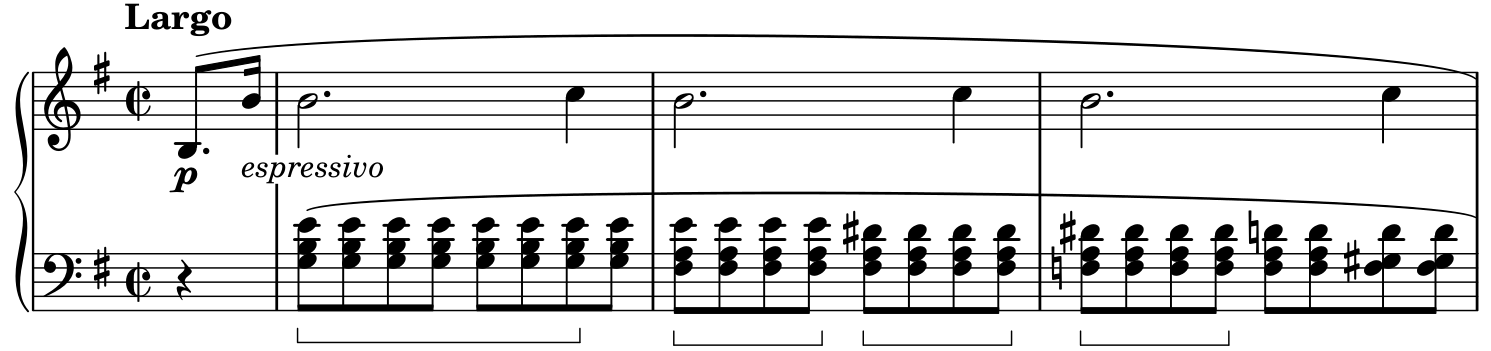
In bar 2, the left hand begins with F-sharp3, A3 and E4. The F needs no extra sharp because the signature supplies it. Halfway through the bar, E4 moves to D-sharp4. That printed sharp applies to the repeated D at the same octave for the remaining chords in the bar.
Bar 3 makes the two kinds of information particularly clear. The bass F3 now has a natural sign, cancelling the signature's F-sharp for that octave in this bar. The upper D-sharp4 has its sharp printed again: the previous bar's accidental has expired. Both signs are needed at the new bar's opening.
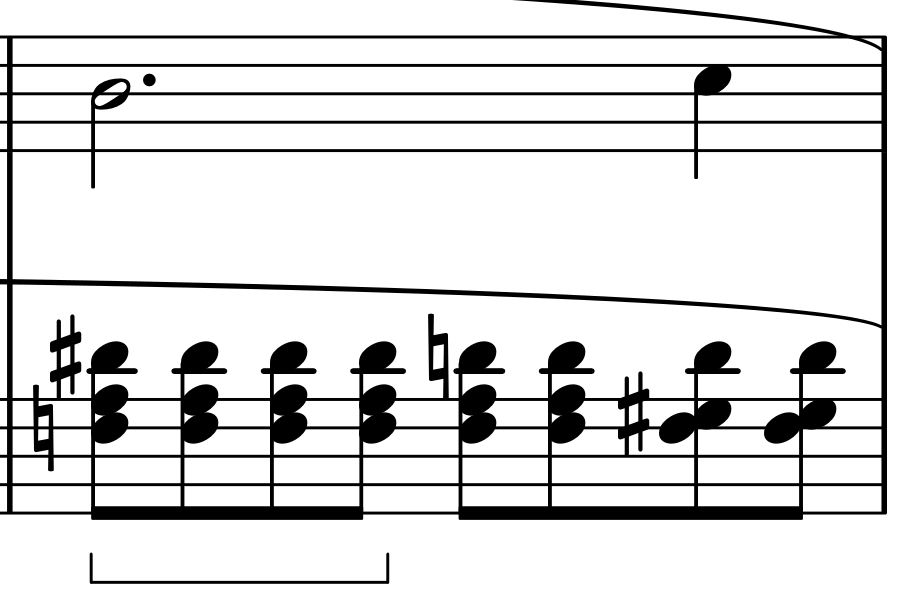
Follow the eight left-hand chords in that close-up. The first four contain F-natural3, A3 and D-sharp4. In the fifth chord, the natural sign beside D changes the upper note to D-natural4; the sixth chord repeats it. In the last two chords, A3 moves to G-sharp3, while F-natural3 and D-natural4 remain. The F-natural sign at the start governs all eight chords, even though it is printed only once.
I would first play those changing inner notes slowly while keeping the other notes quiet. The small descent from D-sharp to D-natural, then from A to G-sharp, becomes audible within the repeated texture. After finding the correct keys, restore the melody and listen to how its repeated notes sit above the moving harmony. The separate Chopin Prelude guide explores that balance and the pedal.
Finding the key in the music
One sharp gives us G major and E minor as the ordinary major/minor candidates. Chopin's opening harmony supplies E, G and B, and the complete Prelude ultimately closes in E minor. The first melody note is B, which shows why naming the first note is an unreliable shortcut to naming the key.
Look for a tonic: the note and chord that give the phrase a sense of arrival. Examine the bass and harmony at clear endings, then listen to how earlier notes lead towards them. In G major, G, B and D form the tonic chord. In E minor, E, G and B do. The signature is identical, but the relationships among those notes are different.
Minor-key music often raises its seventh scale degree. In E minor, D-sharp can act as a leading note towards E, although the signature still contains only F-sharp. The raised seventh is written as a local accidental. This is one reason that counting all the sharps visible in a bar will not tell you how many belong in the key signature.
Read such notes in their phrase and harmony. An isolated D-sharp could have several functions, and a piece can move towards another tonal centre while keeping its original printed signature. A later change of signature is useful evidence when it occurs; the sound and harmonic progression also matter. For learning a new piece, begin with its main tonal home and notice where the music departs from it.
Practising the reading in a phrase
Before playing, choose a short passage and say the altered letters in its signature. Then find those letters in the actual notes of both hands. For a three-flat passage, locate the Bs, Es and As across the registers you are about to play. This prepares the relevant keys without turning the whole page into written-in note names.
Next, look at the local signs and the barlines around them. If a natural has caught you out, name the next occurrence of that pitch and decide whether it is in the same bar. Play far enough to include the reset. Repeating only the note with the sign can leave the following unmarked note just as uncertain as before.
For a quick check, imagine B-flat and E-flat in the signature. A B-natural3 appears, then another unmarked B3 in the same bar, followed by an unmarked B4. The two B3s are natural; B4 follows the signature and is flat. An untied, unmarked B3 at the start of the next bar is flat again. Try finding those pitches on the keyboard while keeping the two octaves distinct.
Once the pitches are secure, put the passage back into its rhythm and listen to the line. A corrected note can still be late or over-accented because you are watching it so closely. Hear what happens before and after it, then play the phrase again with its intended balance. A short sight-reading routine gives this kind of preparation a regular place in practice.
Reading your piece in a lesson
Bring the score and the place where the notes keep becoming uncertain. In a lesson, I would separate the signature from the local alterations, hear the passage in context, and work on the keyboard pattern it creates. We can also look at why the harmony moves as it does, so the correct notes become part of the phrase you recognise.
Vienna Piano School offers online classical piano lessons for junior-high-school age learners and adults, and in-person lessons at piano studios in Ikebukuro and Shinjuku, Tokyo, from October 2026. Online lessons are US$40 for 60 minutes or US$60 for 90 minutes; regular in-person lessons are US$40 for 55 minutes, including studio use. The first trial is free and lasts 55 minutes.
Use the trial application to tell me which piece you are reading and what is causing difficulty. For learners under 18, a parent or guardian should contact us.