
Piano Scales That Help Your Repertoire: From Pattern to Phrase
Piano scales help your repertoire when you practise the feature that the music actually uses: its notes, direction, hand movement, rhythm or sound. Start with a troublesome passage, choose a small scale exercise that addresses what you hear, then play the passage again. The result to listen for belongs in the piece.
I enjoy working on scales when there is a musical question behind them. A thumb note that keeps jumping out of a Mozart run gives us something to investigate. So does a descent that accelerates, or a left hand that becomes heavy whenever the right hand moves quickly. Playing every scale faster would leave those questions unanswered.
- Find the passage’s actual notes, including accidentals, and its turning point.
- Keep the fingering and direction that you intend to use in the piece.
- Choose one listening task, such as an even crossing or a clear arrival.
- Return to the original rhythm and both hands before judging the result.
What scales contribute to a piece
A familiar scale gives you a map of neighbouring notes. In C major, you expect the white-note sequence; in G major, F-sharp belongs to that map. Recognising the pattern can free some attention for the phrase, the accompanying hand and the next change of direction. It also gives you a way to hear a wrong note as a break in a known sequence, rather than an isolated mistake.
There is a physical side too. A scale asks the hand to travel beyond one position while the fingers take turns sounding notes. The important event may be the transfer around the thumb, the approach to a black key, or the change from rising to falling. In a piece, that event happens at a particular speed and dynamic, with other music around it.
That is why I listen beyond whether a scale contains the right notes. Does one note arrive late? Does the thumb produce an accent? Does the sound suddenly become louder when the hand turns? A scale can reveal these habits in a simple setting. The repertoire tells us which of them matters today.
General scale study still has a place. Learning unfamiliar keys, reading key signatures and developing different touches build a wider musical vocabulary. Alongside that work, choose a scale task from the piece on your music desk. One serves your broader education; the other has an immediate sound to improve.
The passage’s notes and direction
Begin with the score, including the bass. The key printed at the start of a piece gives a useful starting point, but the passage may move elsewhere or alter a note for its harmony. A run in a piece with no sharps or flats in the key signature can still contain a C-sharp. Practising only white notes would miss the very note that redirects the hand and the ear.
Mark the lowest and highest notes of the short run. Then notice where it starts. Music often begins a scale-like figure partway through the collection of notes, turns before completing an octave, repeats a pitch, or continues beyond the point where a technical exercise normally stops. Those details determine the movement you need to learn.
Mozart’s C-major Sonata K.545 offers a particularly useful example. In bar 5 of the first movement, the right hand starts on A above middle C, rises to the next A, and falls back to its starting note. It uses the white notes available in C major, but it does not begin on C. Simply moving your usual C-to-C scale exercise faster would leave its entrance and turn unexplored.
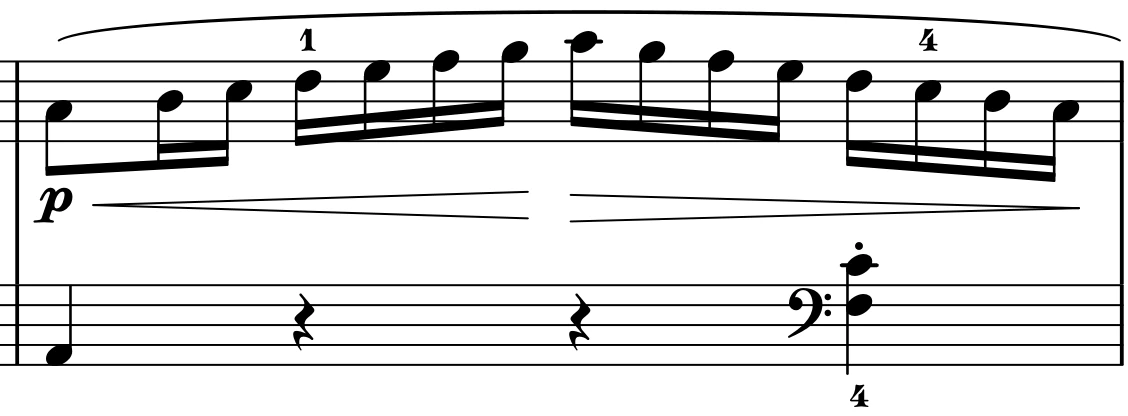
Follow the note names slowly: A–B–C–D–E–F–G–A, then G–F–E–D–C–B–A. The top A sounds once before the descent. Playing it twice, as you might in some separate up-and-down exercises, would add a note to Mozart’s bar.
For a piece you are already learning, find an equally small passage. A few notes around a crossing can be more revealing than four octaves. Choose the boundaries by the musical difficulty, and include the note you are trying to reach.


One-to-one classical piano
Online, worldwide. US$40 / 60 min · US$60 / 90 min.

Enea
Concert pianist from Vienna
Free 55-minute trial, online or in person · Ikebukuro & Shinjuku studios from October 2026
Mozart’s rhythm and turning point
The opening A in bar 5 is an eighth note. The remaining notes are sixteenths. That longer first note gives the figure its entrance: it must keep its full duration even when the hand is eager to start running. On the third quarter-note beat, the line reaches its high A and changes direction.
The beat map below shows why “four notes per beat” is an incomplete instruction here. Beat one has three attacks, because its first note occupies two sixteenth-note divisions. The other beats have four attacks each. The map follows the right hand; the score above also shows the left hand and its rests.
One run, four beats
Mozart K.545, first movement, bar 5. Each box spans one quarter-note beat. A4 is the A above middle C; A5 is one octave higher.
Beat 1: Begin the rise
The first A lasts an eighth note: two divisions.
Beat 2: Continue upward
Four sixteenths lead towards the high A.
Beat 3: Turn and descend
Play the high A once, then move down.
Beat 4: Finish the descent
The left-hand chord joins the first note, D5.
Listen through the turning point
Play D5–E5–F5–G5–A5, then include the descending G5. Hear the upper A as the beginning of beat three, with no extra pause or repeated attack.
Return to the whole bar. Keep the longer opening A4, and place the left-hand chord with D5 at the beginning of beat four.
First play the right hand in the written rhythm at a tempo where you can hear those four beats. Listen especially to the high A. A small hesitation there stretches the third beat; a hard landing makes the turn sound like an interruption. Aim to hear one continuous rise and fall, with the high point belonging inside it.
You can briefly play the same pitches in equal note values to examine a crossing. Then restore Mozart’s longer opening note immediately. The simplified version is useful only while it reveals something you can carry back into the written figure. Keep the original bar close enough that your ear remembers its shape.
Next, enter from the end of bar 4. There is a right-hand rest before the run, and the new figure begins quietly in this edition. Count through that space and hear the first A before playing it. A run that works from a standing start may still feel hurried when it follows the preceding phrase.
Fingering through the crossing
The fingering printed in the illustrated edition places the right thumb on D during the ascent of bar 5 and finger 4 on C during the descent. These are useful landmarks to try. They also show why starting from a familiar tonic with a memorised scale formula is not the whole task: the passage begins on another note and must fit its own shape.
Work with a short overlap around the place that sounds uneven. For the ascent, that might be B–C–D–E; for the descent, D–C–B–A. Include notes on both sides of the crossing. If you practise only up to the thumb and stop there, you rehearse an arrival without learning how the hand continues.
I would listen for two different problems. A gap before D suggests that the movement is arriving late. An unexpectedly loud D suggests that the transfer is disturbing the sound. They can occur together, but speeding up the whole run does not tell you which one is happening. Play the short group quietly enough to hear the relationship between neighbouring notes.
Let the hand travel with the line instead of holding it over the starting notes while the fingers reach farther away. The precise movement depends on your hand, the keys and the tempo. At a lesson, I want to see the crossing from the side as well as hear it; the same audible bump can come from different movements.
Once a fingering works, use it in the exercise and in the passage. Testing a different option means testing its approach and exit too. The guide to choosing piano fingering looks more closely at that process. Here, the immediate question is whether the chosen route lets the scale retain its pulse and sound.
Grouping, articulation and sound
Grouping helps you hear more than a stream of separate notes. In Mozart’s bar, the quarter-note beats give useful points of reference: A, D, the upper A, then D. You can hear those landmarks inwardly while keeping the intervening sixteenths light. A landmark does not need a physical accent every time it arrives.
Practise a small group into its next beat, then stop and listen. For example, D–E–F–G leading to the upper A tests the approach to the turn. Include the first descending G on another attempt, so that reaching the top does not become an automatic stopping habit. Finally play the whole bar without the practice stops.
Long-short and short-long rhythms can sometimes expose an uneven pair of notes. Use a modest contrast on a short group, then return to equal sixteenths and compare. If the altered rhythm makes you strike or grip the quick note, choose a simpler version. The useful result is a steadier written rhythm, not an impressive collection of practice patterns.
Sound needs its own attention. Try the rising and falling line at a comfortable quiet dynamic, then at a fuller one. Listen for a smooth change across several notes, rather than a sudden increase on the thumb or at the top. The illustrated edition gives the passage a rising and falling dynamic shape; hear that contour across the run.
In other repertoire, a scale may be detached, slurred in small groups, or interrupted by a rest. Keep those articulations in the exercise once the notes are secure. A beautifully connected legato scale does not by itself teach the release at the end of a two-note slur. The end of a note is part of the technique too.
The left hand and the next bar
In bar 5, the left hand sounds on beats one and four, with quarter rests on beats two and three. Learn those entries against the right-hand beat landmarks. The beat-four chord belongs with the right-hand D, not with the last note of the descending run. Waiting for the run to finish would move the accompaniment late.
Play the left hand alone while counting all four beats. Then add only the right-hand note at each beat’s beginning. This temporary reduction lets you hear the alignment before restoring the intervening sixteenths. When the full right hand returns, keep listening to the left hand’s timing and release.
Balance changes the impression of speed. If the beat-four chord is too heavy, the scale can seem to stumble even when its notes are evenly timed. I like to listen to the run once as the main line, then listen again mainly to the accompaniment. The second hearing often reveals a chord that is dominating the phrase.
Bar 6 begins the next rise on G. It reaches the G an octave above and comes down again, with the same longer opening note followed by sixteenths. The printed ascending thumb now falls on C. The shape is familiar, but the starting note and the route through the keys have moved.
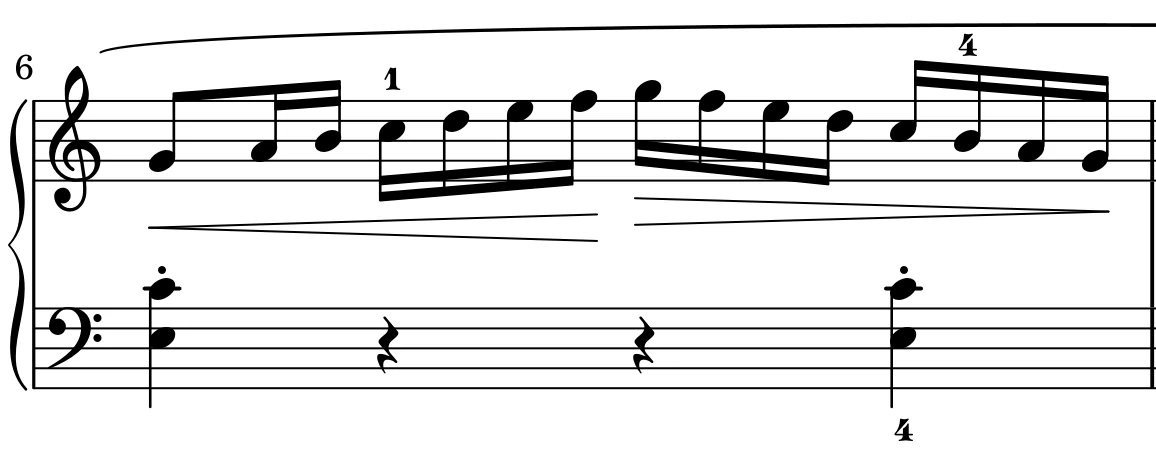
Try the end of bar 5 into the beginning of bar 6. Hear the last A lead down to the new G without a gap or a rush. This join is easy to overlook when each bar has become a separate exercise. It is also where the benefit of scale work becomes audible: the hand recognises the stepwise continuation while the ear follows a larger phrase.
Tempo and signs of progress
Choose a practice tempo by what you can control in the passage. You should be able to preserve the opening eighth note, hear the turn, place the left-hand chord and continue into the next bar. If one of those disappears as the speed rises, you have found the next thing to work on.
A metronome can help you compare the lengths of the quarter-note beats. Set it to a pulse you can follow while still hearing the music. If you need a separate click for every sixteenth at first, use that briefly to establish the spacing, then hear several notes within a slower click. The aim is a phrase with a dependable pulse.
Increasing the number on the metronome is only one sign of progress. A passage may improve at the same tempo because the thumb no longer stands out, the high note turns smoothly, or the accompaniment has become lighter. Listen to a short recording before and after a focused exercise. Keep the starting point and tempo the same so that you can compare the feature you worked on.
Repetitions need a purpose. After a few attempts, ask what changed in the sound. If the same bump remains, shorten the group or revisit the fingering instead of adding another long run. If the line is already clear, move back to the phrase. Spending more time on the exercise than the piece can hide whether the work has transferred.
Choosing your next scale task
For your next practice session, take one passage you care about and name the musical difficulty in a sentence. “The descending notes accelerate” suggests a different task from “I lose the first note after the rest” or “The left hand covers the melody.” A useful scale exercise should answer that sentence.
Sometimes the answer is to practise the relevant key. Sometimes it is to start the scale from the passage’s actual note, repeat only a turn, or keep the pitches while testing a quieter sound. And sometimes the obstacle is a jump, a chord change or uncertain reading, so a scale is only a small part of the work. Let the score determine the exercise.
At a lesson, bring the passage together with the scale you have been practising. I want to hear both, because their connection may be the most useful part of the discussion. We can choose a fingering, shape the movement and listen for the result in the phrase. The article on a focused piano practice loop explains how to carry one such question through a practice session.
Vienna Piano School offers online classical piano lessons and in-person lessons at piano studios in Ikebukuro and Shinjuku, Tokyo, from October 2026, for learners of junior-high-school age and adults. Online lessons are US$40 for 60 minutes or US$60 for 90 minutes; in-person lessons are US$40 for 55 minutes, including studio use. The first trial lesson is free and lasts 55 minutes, online or in person. In your trial lesson application, tell me which piece you are learning and where the scale passage becomes difficult. For learners under 18, a parent or guardian should contact us and consent to lessons.