
How to Count Ties and Rests Without Losing the Pulse
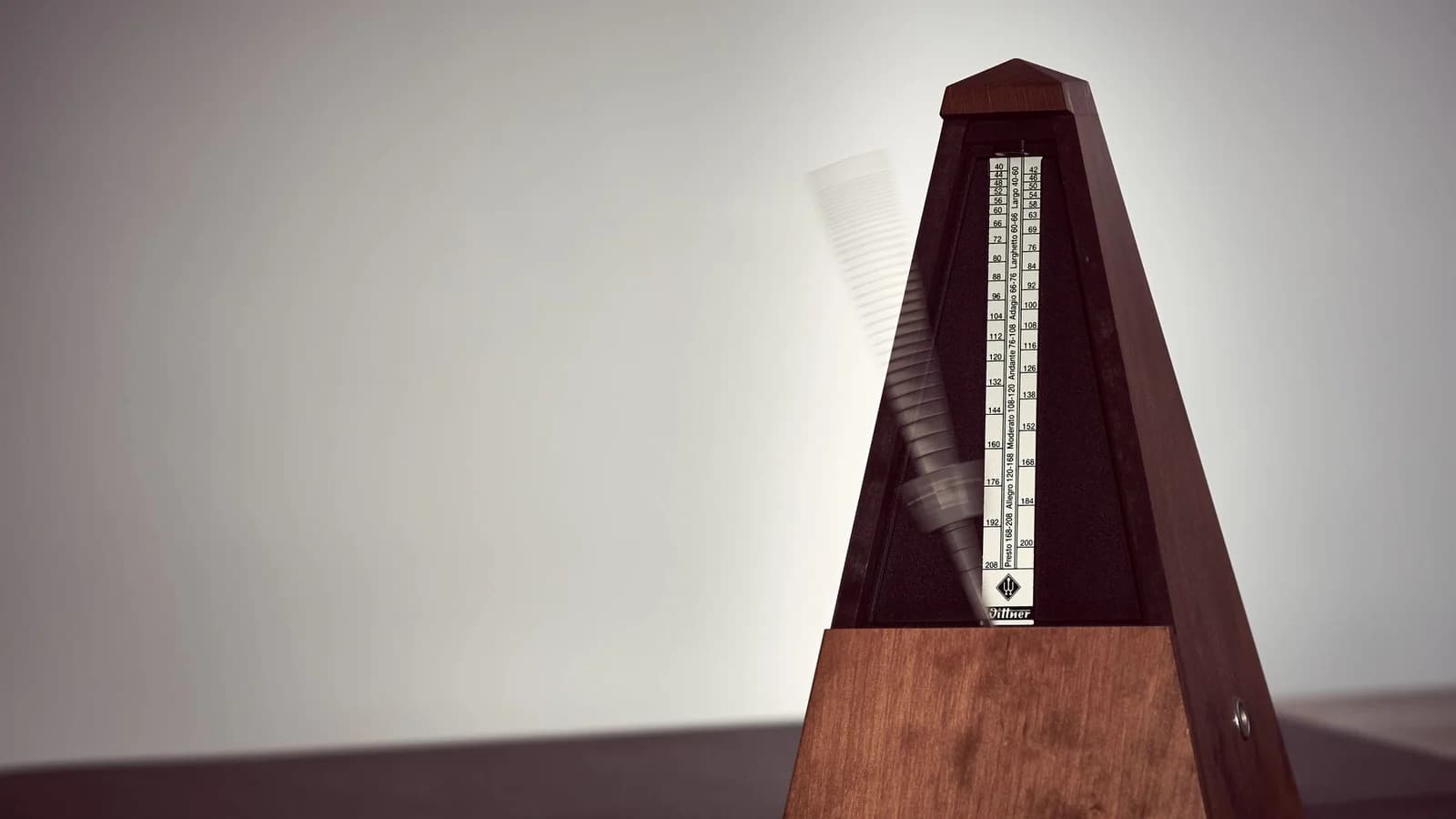
You reach a tied note, wait for it, and then discover that the next bar has arrived too soon. Or a rest interrupts an otherwise fluent passage: the hand lifts, the count stops, and the next note begins whenever the fingers feel ready. In both cases, the missing skill is keeping track of time while there is no new sound to mark it.
A tie continues a note that has already begun. A rest gives a voice a measured span of silence. The beat carries on through both. At the piano, this can happen in one finger while another finger, or the other hand, plays something new.
I listen closely to these quiet moments in a lesson. A pianist may have learned all the attacks correctly but still shorten the last part of a long note or hurry across an empty beat. Working on that space often changes the character of the whole phrase: the music has somewhere to breathe, and the next entry belongs to a pulse we can still feel.
- Count the spaces between attacks, including the final part of a held note.
- At a tie, keep the same note sounding through the written durations.
- At a rest, keep counting while that voice is silent.
- When hands or voices differ, identify exactly which note continues and which begins.
A pulse you can follow
Start with a small passage in 2/4, 3/4 or 4/4, taking the quarter note as the beat. In British terminology, a quarter note is a crotchet and an eighth note is a quaver. Two eighth notes divide one quarter-note beat into equal halves. Saying “one and two and” gives you four evenly spaced positions in a bar of 2/4.
The numbers and the “ands” need equal spacing. A common mistake is to say the number firmly, rush the “and,” then wait for the next number. Try speaking the count before touching the keys. You should be able to place an attack on either half of the beat without changing the distance between the syllables.
Keep the beat small and comfortable: a quiet tap with the free hand can help. If tapping and playing together create another coordination problem, speak the count instead. The useful test is whether you know where the next beat will fall while the piano sound is fading.
Choose a tempo at which you can hear this clearly. The metronome can mark the quarter-note beats while your voice supplies the halves. A click confirms a position in time; it cannot tell you whether you have released a note too early or struck a tied note again. Those details still need your ears and the score.
Ties and fresh attacks
A tie joins notes of the same pitch into one duration. Play the first note, continue holding it through the tied note, and release at the end of the combined value. A quarter note tied to an eighth note lasts three eighth-note divisions. There is one attack, even though the score contains two noteheads.
For a small keyboard example, play C on beat one of a 2/4 bar. Keep it down through “one and two,” then release on the final “and.” You have held the sound for a quarter note plus an eighth note, followed by an eighth rest. Count the final rest before starting the next bar.
Now compare that with playing C on “one” and striking C again on “two,” still releasing on the final “and.” The occupied time is the same, but the second version has an extra attack. You can hear the difference without playing faster or changing the pitch. This is the distinction a tie asks you to preserve.
What happens on beat two?
Open a pattern. Every column lasts one eighth note; each bar has two quarter-note beats. Say all four counts evenly.
A tied note: one attack
The quarter-note C on one is tied to an eighth-note C on two. Keep it down for three divisions, then release on two-and.
A repeated note: two attacks
Without a tie, the C on two begins again. Release on two-and. The second attack changes the rhythm you hear.
A rest before the next note
Release C on two. Keep that half-beat silent, then play D on two-and and release at the barline.
A dotted quarter note also lasts three eighth notes. A tie can show how that length passes across a beat or a barline, where combining the values into one dotted note may hide the division the notation needs to show. Follow the written grouping as you count.
Curved lines also appear as slurs. A slur groups notes into an articulation or phrase; each written note still has its own attack unless a tie also connects it to the preceding note. Look at the endpoints and the pitches, especially in chords. The presence of a curved line alone does not tell the whole hand to stay down.

One-to-one classical piano
Beginner to advanced. Online, worldwide.
Enea
Concert pianist from Vienna
30 minutes · Ikebukuro & Shinjuku studios from October 2026
Rests still occupy time
An eighth rest lasts as long as an eighth note. In the same 2/4 bar, play C for beat one, release it on “two,” then play D on the final “and.” The silent half-beat is between the release and the new attack. If D arrives on “two,” the rest has disappeared, even if you briefly lifted the hand.
I often ask a student to say the count straight through and speak the word “play” only where the next sound belongs. The voice keeps the timeline moving while the fingers learn to wait. A rest can then feel like an approach to the next note, rather than an interruption in the music.
Also listen to when the previous note ends. If it continues across a written rest, the rhythm can become blurred even when the next attack is on time. Work without the sustain pedal while checking these releases. Pedal decisions can be added when the note lengths and the musical effect are clear.
In piano music, silence may belong to only one voice. The right hand can rest while the left hand continues, or one note in a chord can end while another remains. Read the rest in relation to its own line. Lifting both hands at every rest would erase music that is still meant to sound.
Schumann’s opening: count the silence
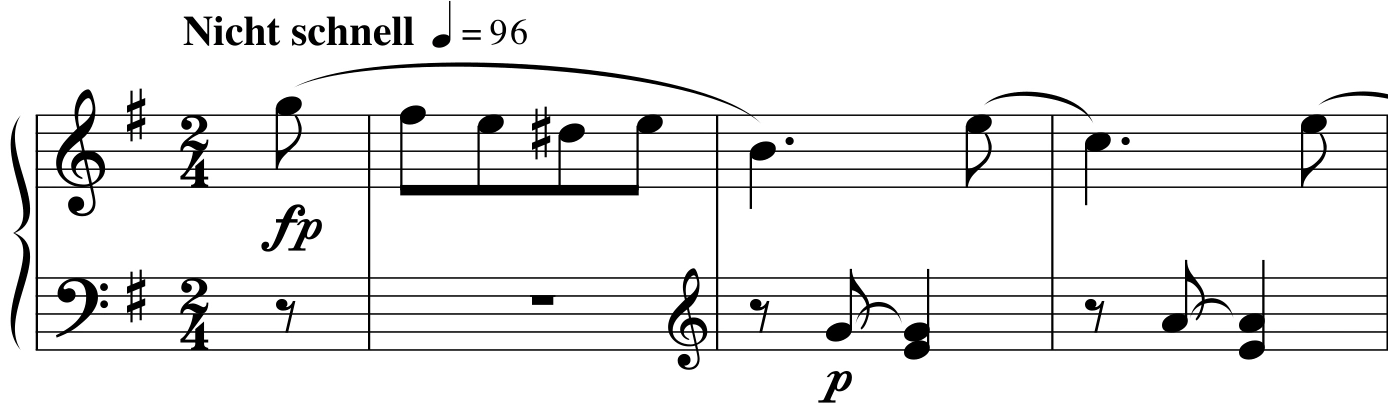
Schumann’s First Loss, Op. 68 No. 16, begins with an eighth-note pickup in the right hand and an eighth rest in the left. The time signature is 2/4. Give yourself the pulse before starting: say “one and two,” then play the pickup on the final “and.” The following note begins the first complete bar.
Enlarge the opening score excerpt.
The left hand is silent throughout that first complete bar. Its whole-bar rest fills the bar’s two quarter-note beats; it does not add four beats to this 2/4 music. Continue “one and two and” under the four moving right-hand eighth notes. Count the opening pickup separately from the complete bar that follows.
The next bar starts with another left-hand eighth rest. Its first note comes on the “and” after one. That delay matters: if the left hand enters with the right hand on beat one, the accompaniment changes its relationship to the melody. The entry should sound as though it grows into the phrase after the melody has begun.
Try the right hand alone while speaking the left-hand entry: “one, play, two, and.” Then play the left hand alone with the same count. Keep the silence at the beginning of the bar in both attempts. Starting directly on the first left-hand note skips the part you are trying to learn.
A tie within one hand
Look more closely at bar two, counting the first complete bar as bar one. The left-hand staff has changed to treble clef. After its eighth rest, the left hand plays G above middle C on “one-and.” That G is tied to the G in the following quarter-note chord. On beat two, E above middle C joins it underneath.
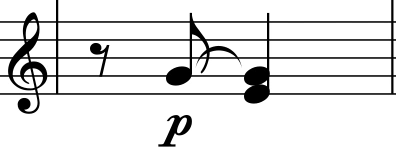
There are three events to hear: silence on one, G beginning on one-and, and E beginning on two while G continues. The G lasts for three eighth-note divisions, from one-and to the next barline. The E lasts for two divisions, from two to the barline. Release both for the eighth rest at the start of the next bar.
This is where “hold the tie” can be misunderstood. The hand has another job during the held G: it must play E on beat two. If you replay the whole E–G chord, G receives an extra attack. If you freeze the whole hand, E never arrives. Practise the two fingers slowly enough to hear the new E against the continuing G.
The right hand adds a different pattern. Its B lasts a dotted quarter, through “one and two”; E begins on the final “and.” First keep the left-hand pattern steady by itself. Then add the right hand and listen for the alternating entries: right hand on one, left-hand G on one-and, left-hand E on two, right-hand E on two-and.
The score therefore gives you a continuous sequence of eighth-note positions without asking either hand to strike on every one. This is a valuable piano skill: the pulse belongs to the whole texture, while individual notes have their own beginnings and endings.
Across a barline
A barline changes the count, not the fact that a note is already sounding. In 4/4, imagine a C played as a quarter note on beat four, tied to a half note in the next bar. Count “four and | one and two and,” releasing on beat three. The C lasts three quarter-note beats in total, with no new attack on the next bar’s one.
Practise that while the other hand quietly taps the downbeat. You should be able to acknowledge the new bar without making the tied finger join in. This separates the feeling of a strong beat from the action of striking a key. Later, another voice may supply a real new note on that downbeat.
Begin your practice before the tie, so you can hear its original attack and its continuation. Restarting on the second written note changes its role: you have to strike it to begin practising there, but that is not what happens when you play through from the preceding bar. Once the pitch is secure, return to the earlier starting point.
The counting unit also depends on the metre. In 6/8, a common way to feel the bar is two dotted-quarter beats, each divided into three eighth notes. A tie’s written values still add together, but the “one and two and” grid used here belongs to a two-part subdivision. Match your spoken count to the passage rather than applying one set of syllables to every time signature.
Back to the keyboard
Take two bars that keep changing rhythm in practice. Find the beat unit and the smallest division needed for the problem. Mark only the places where a fresh sound begins. Leave tied continuations unmarked, and include the divisions occupied by rests in your count.
Play the rhythm on one comfortable key while speaking the subdivisions. Hold through the ties and release for the rests. When that is steady, restore the written pitches at the same tempo. If the rhythm changes as soon as the pitches return, locate the movement that is stealing time: perhaps a left-hand leap, a chord shape or a finger change.
Work on that movement separately, then return to a starting point before it. The goal is to prepare the next position during time already present in the score. Taking an extra pause before a jump, or shortening the preceding note to escape it, changes the musical sentence. A slower tempo gives you room to coordinate the movement with the written duration.
In a two-hand passage, decide which line you will listen to first. You might follow the held melody while the accompaniment moves, then listen to the accompaniment while checking that the melody has not been struck again. For a broader difficulty bringing the hands together, use the piano coordination practice guide alongside this rhythm work.
From counting to phrasing
Once the durations are secure, reduce the spoken count. Keep it through the troublesome bar, then try the whole phrase silently. Listen for the next arrival: can you still hear where it belongs while a tied sound fades or a rest passes? A short recording can reveal whether the pause has grown or shrunk when your attention moved to expression.
Accurate counting should serve the phrase. In Schumann’s opening, the delayed left-hand entry and its continuing G make a gentler texture than a succession of newly struck chords. Holding the written notes is only the beginning; you can then shape the melody and balance the accompaniment while preserving that relationship.
When I hear a rhythm repeatedly change in a lesson, I want to see the precise place where the player’s sense of the beat disappears. Sometimes the answer is a misunderstood tie. Sometimes the notation is understood, but the next movement has not been prepared. Bring the passage and play it from a little before the difficulty so we can hear both the cause and the result.
Vienna Piano School teaches students from junior-high-school age through adulthood. Online lessons are available now, and in-person lessons at piano studios in Ikebukuro and Shinjuku, Tokyo, begin in October 2026. Regular 55-minute lessons are US$35 online or US$40 in person, following a free 30-minute trial.
To work on a rhythm that keeps changing in your playing, request a trial lesson with the piece and the bars you want to understand. Students under 18 should apply with a parent or guardian’s approval and contact details.