
Chopin’s Nocturne Op. 9 No. 2: Melody, Ornaments and Rubato
Chopin’s Nocturne in E-flat major, Op. 9 No. 2, is easy to recognise and surprisingly difficult to keep alive. A melody that sounded graceful alone can become hesitant over the left-hand leaps. An ornament can steal the time needed by the next note. Repeated phrases can sound like repeated attempts at the same four bars.
The useful starting point is a singing melody over four broad beats, with each return slightly changed. Learn that relationship before polishing the small notes. Then the ornaments belong to the phrase, the accompaniment supports its movement, and the final cadenza has somewhere to lead.
The examples below use Carl Mikuli’s historical edition. Bar numbers begin with the first complete bar after the opening upbeat. Keep your own edition beside it: Chopin’s ornament variants are part of this piece’s history, and two reliable scores can contain different details.
A map of the returning melody
This nocturne has 34 complete bars, but its musical interest comes from how familiar material returns. The opening idea occupies bars 1–4 and immediately returns with decoration in bars 5–8. A contrasting idea follows in bars 9–12. Thereafter, the two ideas alternate before the closing passage expands into the cadenza.
Follow the returns
Count bar 1 after the upbeat. The final cadenza is in bar 32; Tempo I returns in bar 33.
- Bars 1–4Opening idea
- Establish the melodic outline.
- Bars 5–8First return
- Hear the same idea with added decoration.
- Bars 9–12Contrasting idea
- Follow its cadence and the recovery of tempo.
- Bars 13–16Opening idea returns
- Compare the new detail with bars 1–4.
- Bars 17–20Contrasting idea returns
- Recognise the phrase beneath its changes.
- Bars 21–24Further decorated return
- Keep the longer figures moving to their arrivals.
- Bars 25–34Closing passage
- Follow the expansion, cadenza and quiet release.
Use this map to practise related passages beside each other. Play bars 1–4, then 5–8, then 13–16. Ask what remains recognisable and what changes: an extra turn, a longer run, a different arrival. Learning each return as an entirely separate passage makes the piece harder to remember; treating them as identical loses what Chopin wrote.
I like to hear the first version plainly enough that the later decoration has something to transform. That does not mean playing the opening without expression. It means leaving room for the same thought to become more elaborate as the piece unfolds.
Four beats beneath the melody
The time signature is 12/8: four dotted-quarter beats, each containing three eighth notes. The left hand makes those groups visible. At the opening, each group begins with a bass note followed by two chords. Hear the four larger beats through those twelve movements.
Upbeat and bars 1–2: four broad beats
Scroll sideways to read the score.
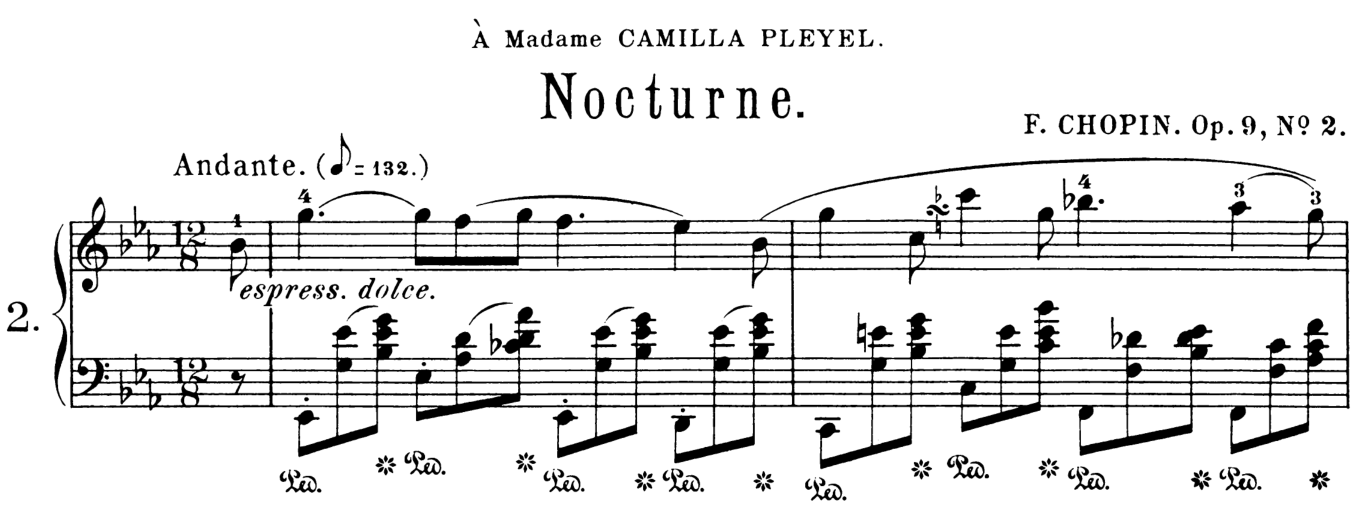
The first right-hand B-flat is an upbeat. It leads into the G above it on the first full bar. Give that small beginning a direction towards the arrival; an exaggerated pause before the G separates two notes that belong to one gesture.
In bar 1, the G is tied across into the second beat. Follow the tie while the left hand continues underneath. A common disturbance is to give the melody a fresh impulse simply because the accompaniment has reached another bass note. The held note needs to remain part of one line.
Practise the melody with only the first bass note of each three-note group. This reduction exposes the four-beat frame without all the chord movements. Then restore the two chords inside each group at a quieter level. Listen for the melody to retain its longer shape when the texture fills out.
Count subdivisions when you need to locate a note precisely. Once the relationship is clear, hear the broader beats again. Twelve equally stressed counts can make an Andante phrase sound as though it is advancing in tiny separate steps.
Left-hand leaps and balance
The left hand repeatedly travels from the bass into the middle register. The problem is often the landing: a chord struck too heavily after a leap makes the accompaniment lurch forward. Simply asking the right hand to play louder adds volume without correcting that disturbance.
Take one bass-and-chords group. Play the bass, release the hand from that position, and move to the chord shape. Pause there during practice to check where the fingers have arrived. Then remove the pause while keeping the same clear destination. This is a way to learn the distance, not a new rhythm for the performance.
Join two groups next. Include the return from the second chord to the following bass, because that journey is part of the pattern too. Choose a pace at which the bass arrives without a last-moment rush. A missed bass followed by two hurried chords often sounds more disruptive than a uniformly slower passage.
Listen separately to the lower notes and the chord layer. The bass can give harmonic direction while the upper chords remain light. Avoid making every bass equally emphatic: some continue an existing harmony, while others change the direction of the phrase. The melody should remain audible through both.
If the printed fingering makes a particular landing awkward, test another choice through the preceding and following group. The guide to choosing piano fingering explains how to compare options in their musical context.
Ornaments that keep their destination
At the first return, bar 5 decorates the opening melody. Compare it with bar 1 before practising the faster notes. Which pitches carry the outline? Which notes circle around them? Where must the figure arrive for the phrase to continue?
Bars 3–5: the first decorated return
Scroll sideways to read the score.
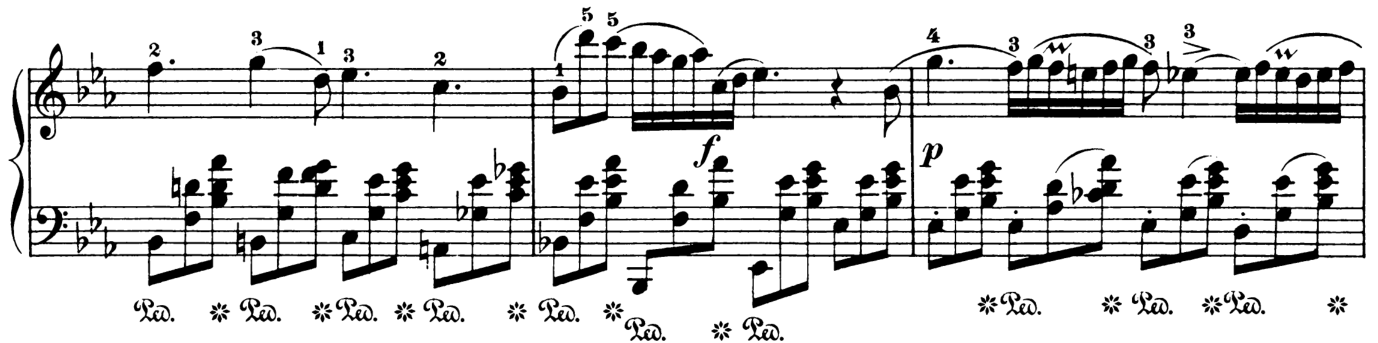
The excerpt shows bars 3–5, so the return is heard after its preceding cadence. In this edition, bar 5 contains both written small rhythmic values and ornament signs. Read them as different kinds of notation. A written group has an indicated rhythmic place; a turn sign needs a realisation appropriate to the note, its accidentals and its position in the phrase.
Begin with the ornament’s main note and its destination. Add the intervening notes slowly, keeping that route audible. Then join the figure to the next substantial melody note. Repeating only the quick notes can produce an impressive little flourish that still arrives late every time.
For a long written run, find a fingering that reaches the final note without a change of plan halfway through. Practise from the last few notes into the arrival, then add the preceding portion. Keep the left-hand event at the destination in the exercise. That arrival is where the two hands must meet again.
The National Edition’s commentary documents variants that Chopin introduced while performing and teaching this nocturne, including additions in pupils’ copies. Its editors present more than one version. That evidence matters when a recording contains an ornament absent from your score: the difference may be textual, rather than a pianist misreading the notes.
Learn one coherent version first. When comparing an alternative, identify the precise bar and source, then decide how it changes the phrase. The guide to Urtext and edited scores offers a fuller explanation of what an edition’s commentary can tell you.
Rubato with a return to tempo
Flexibility is most convincing when a listener can still feel where the phrase is going. In this score, a little slowing around a cadence is followed by a return to the opening tempo. Practise the return as carefully as the slowing. Otherwise, each expressive pause leaves the next phrase slower than the last.
Choose a short span containing both events, such as bars 9–13 in the Mikuli score. First play it with a clear, mostly even pulse. Then allow more time at the cadence and recover the movement at the marked Tempo I. Listen to the relationship between the two phrases, rather than evaluating the pause on its own.
The accompaniment should give the melody a dependable frame, but it is also part of the same musical sentence. Keeping the left hand rigid while the right hand stretches arbitrarily can sound disconnected. At some places the melody has local freedom within the beat; at a larger arrival, both hands may shape the time together.
I would rather hear a modest, well-directed change of pace than an expressive delay on every important-looking note. Choose where the phrase most needs time and let the surrounding music move. The contrast gives the arrival its weight.
For a listening reference, use Arthur Rubinstein’s recording on Sony Classical’s official channel. Follow the first statement and its return in your score. Ask whether you can still feel the four-beat movement under the ornamentation, and notice where the next phrase resumes after a cadence. Those are useful listening questions even when the recording’s text differs from your edition. More general timing work is covered in rubato and phrase direction.
Pedal and harmonic changes
The left hand’s repeated shape can tempt the foot into a repeated routine. Read the changing notes inside that shape. In the opening excerpt, the bass and chord contents change within the bar; one pedal held for the entire bar would carry earlier harmonies into later ones.
Try one bar without pedal to hear the individual changes. Then add pedal while listening to the moment when the new bass replaces the old one. The pedal should connect the resonance without allowing the previous harmony to dominate the next chord. Its depth and release will depend on the instrument and room.
Keep listening to the melodic detail too. A clear bass change does not guarantee that a decorated upper line remains clear. In a passage with chromatic ornamentation, compare a shallower pedal or a more complete release at the relevant change. Judge the notes that remain in the sound, rather than the appearance of the foot movement.
The historical pedal marks are a useful starting point for comparison. Test their result on your piano, especially where the bass register is strong. The sustain-pedal guide explains the coordination of a new attack and pedal renewal in more detail.
The cadenza and quiet ending
The final passage changes the scale of the piece. In the Mikuli score, the cadenza begins at bar 32 with ff and senza tempo. The left hand reaches a held harmony, and the right hand continues through a repeated figure before descending towards the return marked Tempo I.
Bars 32–34: cadenza and quiet close
Scroll sideways to read the score.
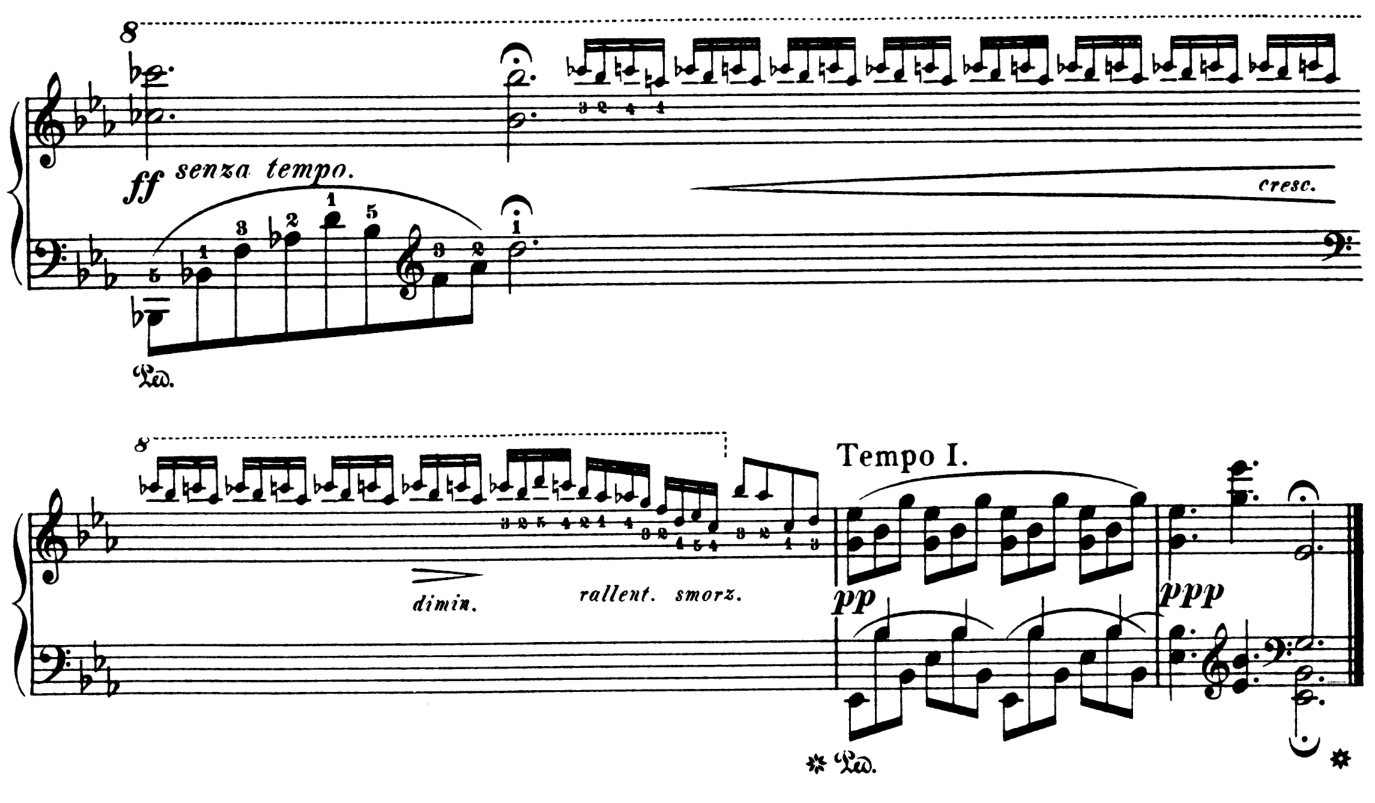
Read the entire route before trying to make the repeated figure fast. Check the accidentals, the octave sign and the point where the pattern begins to change. A fingering that works for repeated cycles also has to carry the exit into the descending notes.
Practise the pattern in short groups with a clear destination, then join them without an accent at each practice boundary. The printed crescendo and subsequent diminishing and slowing give the passage an arc. The held left-hand harmony provides a different setting from the earlier continuous accompaniment; there is no need to squeeze this passage into the same four regular beats used to learn the opening.
The most useful last step is to practise from the end of the cadenza into the quiet Tempo I. Let the accompanying motion resume with a recognisable pace. Continue through the final chord and its release. Stopping as soon as the difficult run is over leaves the actual ending unprepared.
On a complete run, listen for three things: a melody that survives the left-hand movement, returns that sound familiar but changed, and an ending that grows naturally from the final expansion. Those relationships give this short nocturne its continuity. The ornaments then sound like part of a voice, with something to say and somewhere to arrive.