
Rubato in Romantic Piano Music: Timing a Phrase Without Losing Its Direction
Rubato is expressive flexibility in musical time. At the piano, that can mean a melody lingering against an accompaniment that keeps moving, or a whole phrase taking a little more time as its voices arrive together. The useful question is what the listener hears through that change: an anticipation, a resistance, a release, a breath.
A hesitation before a difficult chord also takes time. So does a pause while the left hand finds its next bass note. The difference becomes audible in what comes before and after. Expressive timing belongs to the phrase; an accidental hesitation usually interrupts it.
I listen for the destination first. When someone gives every beautiful note its own pause, the individual sounds may be lovely, but the sentence loses its shape. Two passages show how to keep that larger movement alive: the opening of Chopin's Nocturne Op.9 No.2 and the first eight bars of Schumann's Träumerei.
Two ways of moving the time
In one kind of rubato, the accompaniment supplies a recognisable pulse while the melody arrives a little early or late within it. The hands have some independence. You can hear the accompaniment continuing beneath a moment of melodic freedom.
In another, the pace of the whole texture changes. A cadence broadens, several voices lean into a harmony, or the next phrase gathers momentum. Both hands participate. Keeping the left hand rigid through such a moment would pull the texture apart.
What moves, and what continues?
A melodic inflection
One melodic arrival is slightly delayed against a continuing accompaniment. The following events reconnect.
A shared broadening
The time between events grows. Melody and accompaniment feel that change together.
Dots show attacks over time. These sketches illustrate the relationship between parts, rather than prescribe an amount of delay.
These are useful listening distinctions, and a performance can move between them. The score tells you where notes belong rhythmically; harmony, melodic contour and the relationship between voices help you judge how much flexibility a particular moment can carry.
Start by playing the passage with a clear pulse. Listen to its written long and short notes before adding anything. A tied note over moving harmony already creates a kind of resistance. A rest already makes space. Expressive timing grows more convincing when you hear those details, because you can choose where an additional inflection matters.
Chopin: a melody over four broad beats
The Nocturne Op.9 No.2 begins in 12/8. Each complete bar contains four dotted-quarter beats, with three eighth notes inside each beat. In the left hand, a bass note is followed by two chords. Hear those three events as one broad gesture, then let the next bass note carry you onward.
E-flat major, 12/8. Four dotted-quarter beats per bar; the left hand places three eighth notes inside each beat.
Scroll sideways to follow the score.
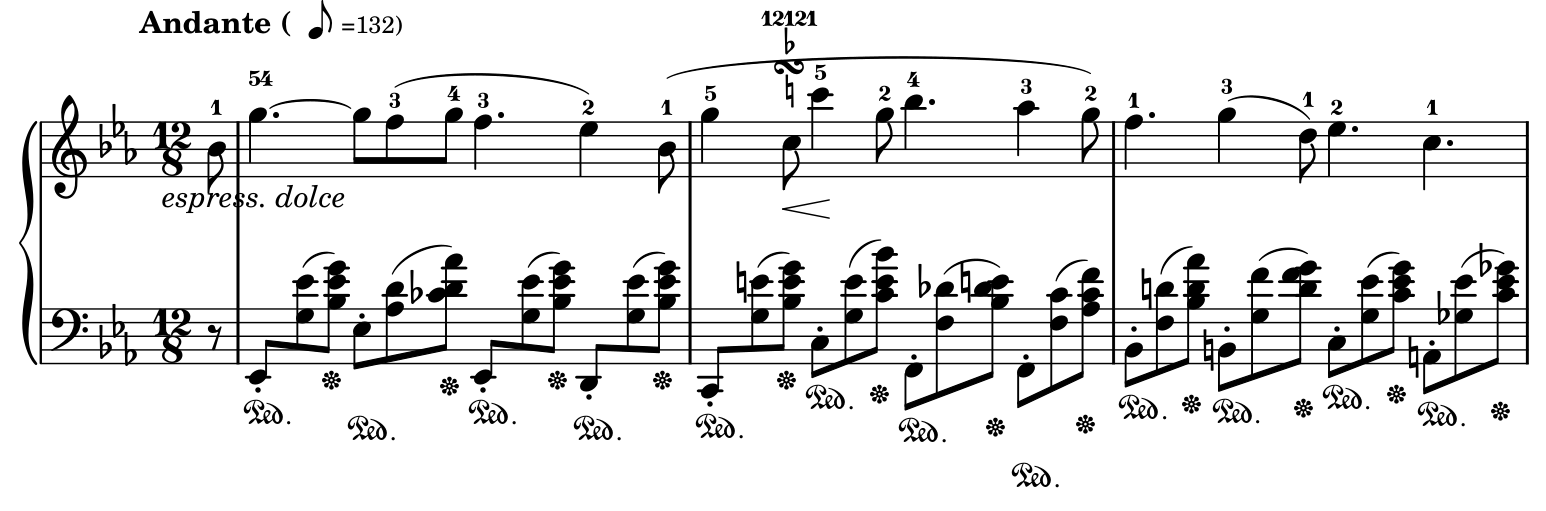
The right-hand B-flat upbeat leads to G at the start of bar 1. That G is tied into the next beat. The left hand has already begun its second group while the melody is still holding the first long note. This overlap is part of Chopin's rhythm, before you introduce any rubato.
Play the left hand and sing the melody, including the tie. If the accompaniment waits for the singer to change notes, the four-beat span starts to dissolve. Keep hearing its successive bass notes under the sustained G. At the piano, that means maintaining a quiet, travelling accompaniment while allowing the upper sound to last.
This is also a balance problem. A heavy bass followed by two equally heavy chords turns each beat into three interruptions. Try the accompaniment alone with a clear bass and lighter upper chords, listening across the whole bar. Then add the melody at a level where its long notes remain present between the left-hand attacks.
A small delay at the melodic peak
In bar 2, the melody rises to the high C on the second broad beat. It is a useful place to compare two interpretations. First, play the C exactly with the bass that begins that beat. Next, let the bass arrive and allow the melodic C to follow very slightly later. Keep the intervening accompaniment flowing, and let the melody rejoin its written relationship to the accompaniment as the phrase continues.
The second version gives the arrival a different inflection. Its success depends on the approach from the previous notes, the amount of separation and the sound of the C itself. An obvious gap can turn a singing arrival into an affected gesture. A forceful attack can make even a tiny delay sound like an accent.
For this comparison, change only that arrival. If the accompaniment also slows, you are exploring a broader tempo change, which is another musical choice. Hear the difference between the two. I often return to the aligned version after trying a delay; sometimes the line already says enough through its rise and change of harmony.
A delayed melody note still belongs to the same phrase. If you rush the following notes to repair a large gap, the listener hears the repair. Try a smaller displacement, or give the whole gesture a little more space instead. The point is a natural continuation into the next part of the melody.
Chopin: the harmony carries the sentence
The opening's four bars travel farther than their familiar melody might suggest. In bar 2, the C bass and E-natural in the accompaniment introduce a colour that leads toward F minor. In bar 3, the bass moves through B-flat, B-natural, C and A. Those changes keep the phrase searching even as the melody descends.
Play just the bass notes with the melody. You will hear why the descending line cannot simply relax after its high point. The harmony is still moving. Then restore the chords, keeping that sense of travel under the more detailed surface.
One phrase, beyond the high note
Bar 1
Establish the span
The melody holds across a changing accompaniment. Keep hearing the four broad beats.
Bar 2
Rise and colour
The high C is a possible local inflection. The harmony continues toward F-minor colour.
Bar 3
Keep travelling
The descending melody sits above a searching bass: B-flat, B-natural, C, A.
Bar 4
Arrive, then breathe
Melody and bass reach E-flat on beat three. The left hand continues through the melodic rest.
In bar 4, the melody leaps upward, falls through a quick group and reaches E-flat on the third broad beat. The bass arrives on E-flat there too. That shared arrival is a stronger point of repose than every preceding melodic turn. The remaining accompaniment and the next B-flat upbeat keep the music connected to what follows.
The melody and bass reach E-flat on the third broad beat. The accompaniment continues through the melody's quarter rest.
Scroll sideways to follow the score.
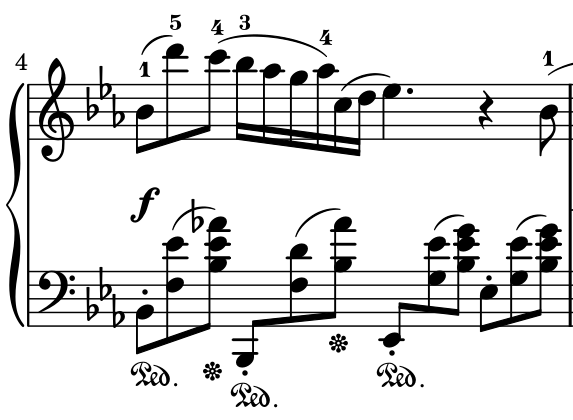
Try the passage from the start of bar 3 through the next upbeat. In one version, slow noticeably on every changing bass note. In another, keep the succession moving and allow more space around the E-flat arrival in bar 4. Listen for whether you can still hear one approach to a destination.
There is room to shape the quick descent before the E-flat, but its smaller notes have a place within the beat. Practise their written rhythm first. Then hear them as a single gesture toward the arrival. Stretching each one separately makes the descent feel laboured; hurrying them all leaves a hole before the long note.
The right-hand quarter rest in the last beat deserves attention too. The accompaniment continues through it. Release the melodic line, listen to the remaining sound, and hear the next upbeat before you play it. A melodic breath can happen while the music underneath remains alive.
Schumann: several voices breathing together
The opening of Träumerei, Op.15 No.7, offers a different texture. There is no repeating bass-and-two-chords pattern to carry every beat. Long notes, moving inner parts and overlapping phrases share the space.
F major, 4/4. In bar 1, the inner notes enter on beat two while the melody and low bass remain held.
Scroll sideways to follow the score.
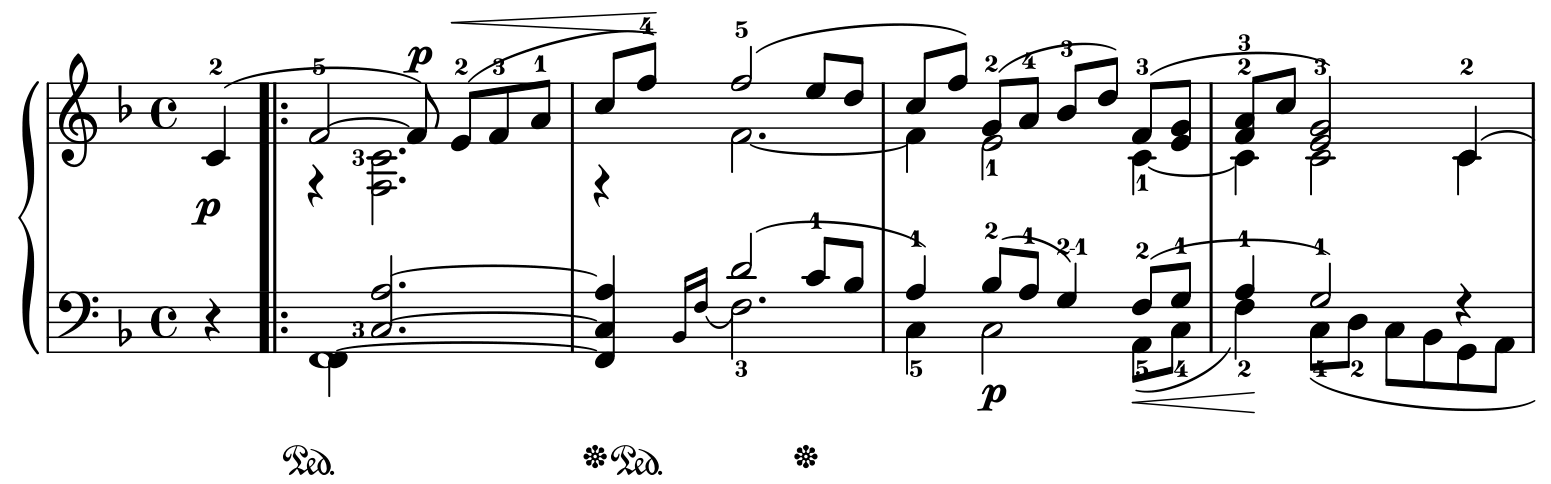
The C upbeat rises to F in bar 1. The melody holds that F while the inner notes enter on beat two. Underneath, the low F continues. If you treat the melody's first long note as a licence to suspend everything, the inner entry loses its place. The line is sustained, but the harmony is becoming fuller inside it.
Play the melody and bass first, then add only the inner entry on beat two. Hear the added colour without making it a new melodic accent. Finally, continue through the small notes at the end of the bar toward the higher F in bar 2. The phrase has already begun to rise while the first note is fading.
A little flexibility around that rise can involve the whole sound. Let the moving notes approach their arrival together, listening to the lower parts as well as the top. This passage gains its intimacy from the way the voices meet. Habitually putting the right hand behind the left can make those meetings sound loose.
The lower voices become more active as the melody comes away from its high F. Listen through bars 3 and 4 with the top line quieter than usual, just for a comparison. You will hear movement that a melody-only reading can overlook. When you restore the normal balance, keep that movement in your ear; it helps the long upper notes retain direction.
The second phrase reaches farther
Bars 5–8 begin by recalling the opening, then extend its reach. In bar 6, the melody rises to A, above the F reached in bar 2. The continuation also becomes more unsettled, with changing inner notes and the E-flat near the end of bar 7. This second phrase has a different intensity even though its beginning sounds familiar.
The melody reaches A in bar 6. This edition marks ritard. in bar 8; the next phrase starts with the final C upbeat.
Scroll sideways to follow the score.
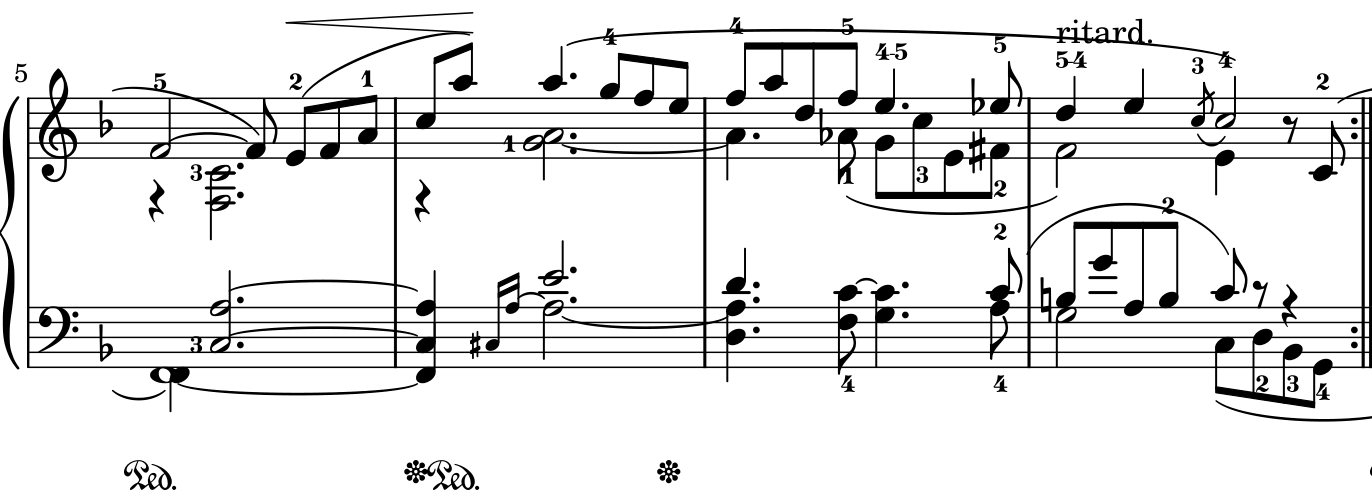
Play bars 1–8 as one span and compare the two high points. If you give the first F the largest possible expansion, there is little expressive room left for the later A. Try a more flowing first phrase, then allow the second to open out where its higher register and harmony ask for it. The contrast can be small and still be audible.
The reproduced edition prints ritard. in bar 8 and an a tempo at the next return. Read the slowing across the moving voices. The melody has D, E and an ornamented C, while the lower parts continue their own motions. They need a shared sense of the changing beat. A right hand that slows alone against an unyielding lower part will obscure that connection.
First play bar 8 without broadening, so you know where the parts meet. Then begin earlier, in bar 7, and let the pace ease through the approach and arrival. Keep the lower notes connected to the same broadening. Listen to the rest and the C upbeat at the end: the next phrase begins there, before its first full bar.
The return of tempo needs to be felt in that upbeat. If you wait until the following downbeat to restart the pulse, the pickup becomes an isolated note. Sing the upbeat and the first long F as one gesture, then let your hands follow that breath.
Rubato, hesitation and sound
A flexible phrase should still be recognisable when you play it at a simpler, steadier pace. Try that version when a passage sounds uncertain. If the same gap appears before a leap, chord or fingering change, investigate the movement at the keyboard. Give the hand time to find its destination during practice, then put the passage back into the phrase.
I find it useful to ask what changes when the difficult movement becomes comfortable. Sometimes a supposedly expressive pause disappears by itself. Sometimes the pause remains because the harmony really does benefit from space. Playing both versions lets the ear make that decision.
Sound also changes our perception of time. A louder note attracts attention; a very soft note can feel withdrawn. Before adding another delay, compare the same timing with a warmer melodic sound or a lighter accompaniment. You may find the phrase's emphasis through balance alone. The guide to bringing out a melody inside chords develops that side of the work.
Pedal affects the result too. If you broaden into a new harmony while keeping the previous one blurred underneath, the intended arrival may be hard to hear. Listen to the bass change and refresh the pedal according to the sound. Our sustain-pedal guide looks more closely at clarity through harmonic changes.
Listening across the whole phrase
Record enough music to include the approach, the expressive moment and the continuation. For these examples, that means Chopin's opening through the next upbeat, or Schumann's first eight bars into the returning F. A recording of only the delayed note tells you little about the phrase it belongs to.
Listen once without the score. Notice where your attention goes and whether the next event feels expected. Then listen while following the bass and inner parts. A melody can sound persuasive by itself while the accompaniment repeatedly loses its flow underneath.
These three questions are useful when comparing versions:
- Destination: Where does the phrase arrive, and can I hear the approach to it?
- Togetherness: Which voices move freely, and which arrivals still belong together?
- Continuation: Does the music recover its natural movement after the space I have taken?
Rubato is sometimes described as borrowing time and paying it back. That image can help you hear a local inflection against a continuing pulse. Across a whole phrase, the relationship is more musical than arithmetic. A cadence may genuinely broaden. What matters is that the listener can follow the proportion of the phrase and feel the next beginning.
Once you have found a version you like, play it again with slightly less intervention. Keep the important arrival and let some smaller inflections go. I often prefer this second version: the line keeps its freedom, and the listener has more room to hear the harmony. For the underlying ideas of phrase beginnings, destinations and endings, see how to shape a classical piano phrase.