
Starting Piano as an Adult: Your First Pieces, Reading and Lessons
To start piano as an adult, begin with a few connected skills: finding notes on the keyboard, keeping a pulse, reading a short pattern and listening to the sound you make. A first piece brings those skills together. You can start learning the music while you learn its notation; reading every note fluently comes through continued practice.
The first lessons are often most rewarding when the musical idea is small enough to hear clearly. Two neighbouring notes can teach you about timing and the end of a sound. A short tune can show how a melody rises, comes to rest and begins again. Those experiences give the symbols on the page a purpose.
I like to hear a beginner try a small phrase before adding several instructions. Perhaps the last note disappears too quickly, or the hand leaves the keyboard between every sound. One change, followed by another attempt, can make the phrase feel and sound quite different.
Here is what to look for as you begin:
- A short musical task whose sound you understand.
- A way to find the notes again without copying the teacher's hand every time.
- Regular access to a keyboard and a clear idea of what to practise next.
The keyboard and your first sound
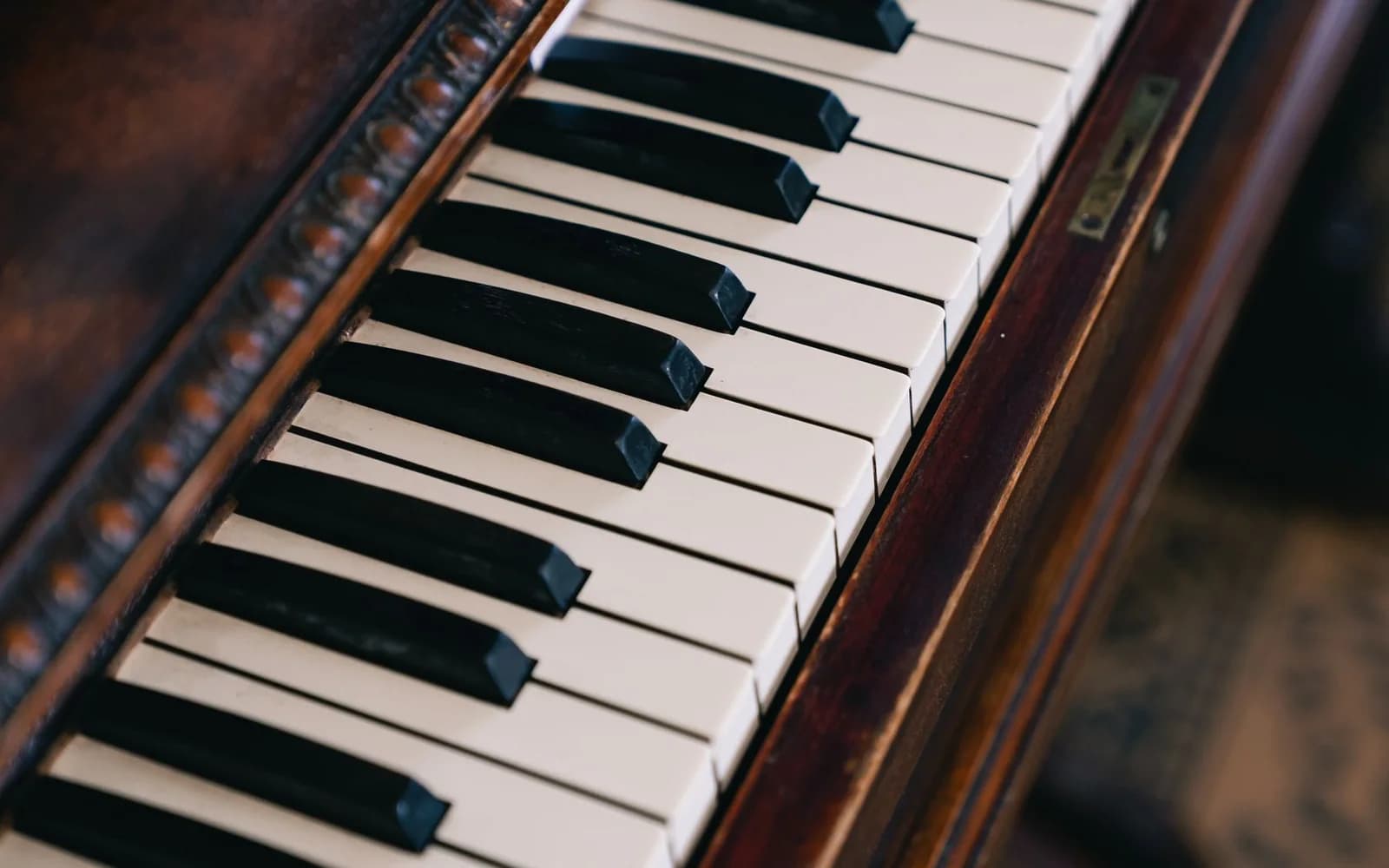
Look at the black keys before trying to name every white key. They form repeating groups of two and three. C is the white key immediately to the left of a group of two black keys; D is the white key between them. Find several pairs of C and D across the keyboard and listen to how the same relationship sounds higher or lower.
The pattern repeats across the keyboard. For the score below, use C5, one octave above middle C, and the D beside it.
Sit where your arms can move towards the keys without reaching from the shoulders. A stable seat and supported feet give you a more settled starting point than balancing on the front of an unsuitable chair. Your teacher can help adjust the position while watching how you play, including in an online lesson.
Place your right thumb on a C and your index finger on the next white key, D. Play C, then D, slowly. Listen for the point at which one sound ends and the next begins. If the hand jumps away after C, there may be a gap. If both keys remain down, the sounds overlap. Exploring that difference is an early lesson in articulation: how notes connect or separate.
Now try the same two notes a little more quietly. The aim is to hear a change in sound while both notes still speak. At this stage, listening and movement belong together. A hand position that looks tidy in a photograph says less than how easily you can make the next note and hear the result.
Reading a small musical pattern
The five lines of a musical staff show pitch, while the shapes of the notes show duration. A note moving from a space to the neighbouring line moves one written step. Starting from a known note, you can follow that direction instead of naming every symbol from the beginning of the staff.
This short exercise from Ferdinand Beyer's Op.101 uses only C and D. In the score they are C5 and D5: middle C is the C near the centre of a standard piano, and C5 is the next C to its right, one octave higher. That places the notes comfortably inside the treble staff. The finger numbers are 1 for the thumb and 2 for the index finger.
Beyer, Op.101: preliminary right-hand exercise 1.
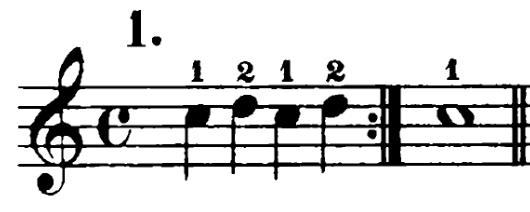
Select the score to enlarge it. The C-shaped time signature means 4/4: four quarter-note beats per bar.
Read the pattern
C–D–C–D. Start on C, then move up, down and up by one white key.
Repeat the first bar
Play one note on each of four even beats. The two dots tell you to play that bar again.
Keep the ending alive
Hold the final C through four beats, then release. Keep listening while the hand is still.
Find the first note, then look at the shape of the four-note pattern: up, down, up. Each filled note with a stem lasts one quarter-note beat here. Count four even beats while playing C, D, C, D. The two dots beside the bar line tell you to repeat that bar. Then play the final C, shown as an open note without a stem, and hold it for four beats.
The last note deserves attention. When the fingers stop moving, it is tempting to stop counting too. Keep hearing the four beats inside the held sound, then release. You have now practised both starting notes and giving an ending its full length.
Finger numbers and note names do different jobs. In this exercise the thumb plays C, but the thumb is not permanently assigned to that key. Later, another piece will place the hand elsewhere. Learn the location of C from the keyboard and the staff, and use the number to organise this particular movement.
From here, a teacher can introduce a third note, a different duration or a rest. Each addition changes what you listen for. A rest asks you to continue feeling time while the key is released; a longer note asks you to keep the phrase moving internally while the sound decays. Reading becomes musical when you hear what the symbol asks you to do.

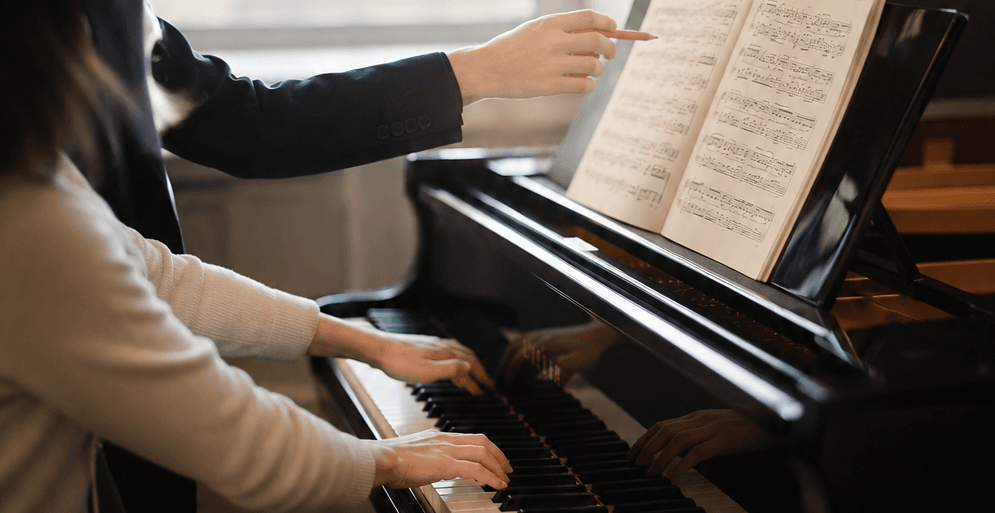
One-to-one classical piano
In person in Ikebukuro or Shinjuku, Tokyo. Online worldwide.
Enea
Concert pianist from Vienna
Pre-launch · Applications open
Adding the other hand
Your early reading work will include bass clef as well as treble, so you can recognise notes across the piano’s range. Playing with both hands introduces more than a second set of notes. The hands may begin together but finish at different times. One may repeat while the other holds. Early coordination grows through hearing those relationships in a small amount of music.
After the right-hand C–D pattern feels familiar, try a simple addition: play a lower C with the left hand as the right hand begins, and hold it while the right hand plays its four notes. Release the left hand after the fourth beat. The left hand has one event to manage, while the right hand has four.
First listen for the two Cs starting together. Then keep the lower sound in mind while the right hand moves. If the left hand lifts whenever the right index finger plays, slow down enough to notice that connection. You can also hold the left-hand note and speak the right-hand note names before playing them.
This small experience prepares you for a melody over an accompaniment. Later, the left hand can repeat a note or change between two notes; eventually it will have a phrase of its own. Progress comes from understanding the relationship at each stage. The guide to building piano hand coordination explains how to work when each hand seems secure alone but the combination falls apart.
Choosing your first pieces
A good first piece gives you something worth hearing while keeping the reading and movement manageable. Look for a short melody, recognisable rhythmic patterns and a hand position you can find reliably. When both hands play, the accompaniment should leave room in your attention for the melody.
That might be a short piece in an adult beginner method, a familiar tune with a simple accompaniment, or a teacher-selected miniature. Familiar music helps because you have an idea of its sound, but check the arrangement: the same tune can appear as a single melody or as a much harder texture of chords, jumps and ornaments.
You can also keep a longer-term piece in mind. If you love Beethoven's “Moonlight” Sonata, your early lessons can develop a quiet pulse and different sound levels between the hands. The original first movement brings considerably greater demands in voicing and pedal, so its mood can guide your interests before the complete work becomes your current assignment.
I would rather hear a beginner shape a short phrase with attention than struggle through a famous page while losing every musical detail. That does not make the first piece trivial. A repeated phrase can return more quietly; the end can settle without collapsing; a longer note can lead towards the next one. These are musical decisions from the beginning.
When you can read the opening, inspect the rest of the piece too. A later hand shift, extra voice or change of rhythm may require a new skill. The guide to choosing a classical piece at the right level shows how to look beyond an inviting first line.
Practice between lessons
Begin a practice session by recalling the sound or movement you worked on. With the Beyer example, that could be an even C–D alternation followed by a full four-beat ending. Play it once, listen, then choose the part that needs attention. If the ending is rushed, practise the approach and held note together rather than repeating the opening endlessly.
A short session can contain several kinds of attention. Spend a little time finding the notes and reading the rhythm, some time playing the phrase, then a final attempt in which you listen to its overall flow. The exact minutes matter less than finishing with a musical question answered: did the long note last, did the hands begin together, did the quiet version still speak?
Put a brief reminder beside the relevant bar. “Hold the final C for four beats” will be more useful tomorrow than “practise carefully”. If you forget the fingering or rhythm between lessons, bring that uncertainty back to the teacher. It may call for a clearer explanation, a smaller passage or another way to recognise the pattern.
Regular contact with the keyboard lets you revisit the same idea while it is still familiar. On a busy day, choose one short phrase and listen to it closely. When you have more time, add some reading or a different piece rather than filling the whole session with increasingly impatient repetitions.
A piano you can use regularly
You need access to an instrument between lessons. It can be your own piano, a borrowed instrument or a practice-room arrangement that fits your week. The key question is when you will actually sit down and play. A lesson followed by several weeks without a keyboard leaves little opportunity to develop the new movements.
For a digital instrument intended for continued classical study, discuss full-size, touch-sensitive keys and a weighted action with your teacher. Touch sensitivity lets the sound respond to how you play, while the action affects the resistance you feel. An 88-key digital piano provides the usual piano range for developing repertoire. A small keyboard can introduce notes and simple patterns, but check its limitations before planning a long course of study around it.
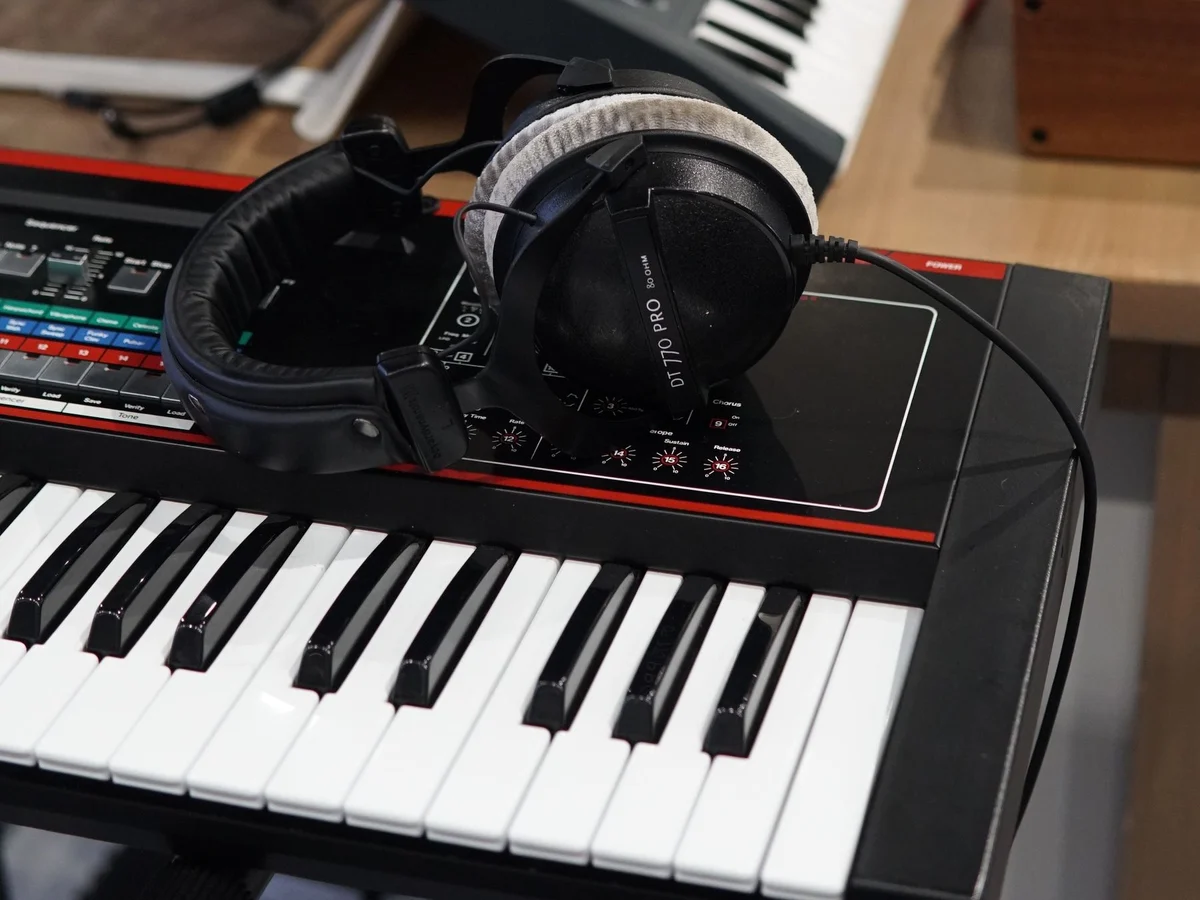
Headphones can make a digital instrument practical at home. They do not remove the physical sound of the keys, and a comfortable setup still needs a stable stand, seat and pedal position. These everyday details influence whether practice becomes a natural part of your week.
If you are arranging access before buying, the guide to starting lessons without a piano at home covers shared instruments and practice options. Bring your actual situation to the first conversation so the lesson and practice plan fit the instrument you will use.
What a first lesson reveals
A first lesson can begin at the keyboard even if you have never read music. You might find a group of black keys, copy a short rhythm, explore a few notes and then recognise the same pattern on the page. The teacher listens to how you respond, and chooses the next task from that response.
If you hear the rhythm clearly but lose your place on the keyboard, the next explanation may use the black-key groups. If you find the notes quickly but hurry the ending, we can sing or count through the long note. If the hand becomes fixed in one shape, we can make the movement smaller and try the phrase again. The lesson should give you a connection between an instruction and a sound you recognise.
Tell the teacher about the music that brought you to the piano, the instrument you can use and the time available for practice. Mention whether you enjoy learning by ear, reading explanations or watching a demonstration. A lesson can use all of those approaches while gradually developing the skills that are new to you.
Lessons online or in Tokyo
Adult beginners can start through individual online lessons or in person. Online, the teacher needs to hear the instrument and see your hands and the way you sit at the keyboard. A first meeting can establish a usable view and begin the musical work; the separate online lesson setup guide explains the practical details.
Vienna Piano School is accepting applications for lessons in English, online worldwide and in person at piano studios in Ikebukuro and Shinjuku, Tokyo. The school is preparing to open; start dates and trial arrangements are confirmed by email. The first trial is 55 minutes and free. Regular online lessons are US$40 for 60 minutes or US$60 for 90 minutes. In-person lessons are 55 minutes, ¥4,800 plus an ¥800 room fee, totalling ¥5,600.
To apply for a free trial lesson, tell me that you are starting as an adult, what you would love to play and what instrument access you have. We can begin with a small musical idea and build from what you hear.