
Why Your Hands Fall Apart at the Piano: How to Rebuild Coordination
When a piano passage works with each hand separately but falls apart when the hands meet, treat the combined passage as a new coordination task. First identify whether reading, fingering, rhythm, tempo, or too many unresolved decisions are causing the break. Then reduce the music until the shared timing is clear, join a very short unit, and reconnect it to the phrase.
This is more useful than repeating the whole passage and hoping the hands eventually agree. It also avoids a misleading idea about “hand independence.” The hands do not need to ignore one another. They need to perform different roles on the same musical timeline.
This article concerns a passage-specific practice problem. It does not address a sudden or unexplained change in hand control, pain, or symptoms that also occur away from the piano.
Hands together is a separate task
Hands-separate practice can settle notes, fingering, rhythm, and movement in each part. It is often the right first step. What it cannot establish by itself is the exact sequence created when the parts are combined: which notes begin together, which hand enters alone, which sound must be held, and where one hand moves while the other remains still.
That distinction has some experimental support, although the evidence should not be stretched into a rule about piano teaching. In a four-day laboratory study of short finger sequences, sequence-specific learning transferred little or not at all between one-hand and two-hand versions of the task. The experiment used discrete key presses rather than repertoire, so it does not show that hands-separate practice is useless. It supports a narrower point: the joined sequence deserves practice of its own.
Before joining, make each hand predictable over the exact troublesome span. Use the intended fingering, observe every rest and held note, and begin from more than one point. Then alternate between right hand, left hand, and both hands without turning the separate versions into long performances. The purpose is to prepare the parts and test the combination, not to postpone the combination indefinitely.
Find the first layer that fails
Stop at the first place where the passage breaks. Do not diagnose the entire page. Use these tests on one or two beats around that point.
- Reading: Pause before the difficult beat and name or point to the next event in both staves. Is it both hands together, the right hand alone, the left hand alone, or a held note in one part? If that is unclear without tempo, solve the vertical reading first.
- Fingering: Play each hand alone twice from the same starting point. If the fingering changes between attempts, or one choice leaves the hand poorly placed for the next event, decide on a workable fingering and mark only the necessary numbers.
- Rhythm: Tap the two parts on a closed keyboard or play each rhythm on one repeated key. Count the smallest useful subdivision. If an entry, hold, or rest is still uncertain, the pitches are hiding a rhythm problem.
- Tempo: Find a speed at which the correct order of events remains clear. If guesses and late movements appear only above that point, the pattern is not yet available at the faster tempo. There is no universal starting speed or required number on the metronome.
- Too many unresolved tasks: Remove pedal, dynamics, and detailed articulation temporarily. If the notes and rhythm then work, coordination may not be the only issue. Several undecided musical tasks were being attempted at once.
A study of child and adult pianists learning a novel piece found a high incidence of simultaneous pitch and timing errors, alongside changes in timing, planning, and accuracy across practice and skill levels. It did not test this checklist. Its useful lesson here is modest: knowing the notes does not automatically settle when those notes must happen.
If all five tests are secure separately and the exact combination still fails, the problem is now well defined. It is a genuine join problem, not a vague lack of coordination.

One-to-one classical piano
Beginner to advanced. Online, worldwide.
Enea
Concert pianist from Vienna
30 minutes · Tokyo studio from October 2026
Make a shared rhythm skeleton
Write or speak an attack map for the short unit. On each beat or subdivision, label what happens: both, right, left, or hold. A rest should remain a rest, not become an unplanned release or an extra note.
Next, tap the two rhythms while counting. Then play the same attack pattern on one repeated key in each hand. This removes note finding and most hand travel while preserving the relationship between the parts. It is a teaching reduction, not a scientifically validated formula, and it only helps if the full passage returns soon afterward.
Rebuild the passage in five layers
HAND COORDINATION
Work with two difficult bars. Remove notes until each hand can keep its rhythm, then rebuild the passage without losing the pulse.
Keep the pulse
Count 1 & 2 & 3 & 4 & before either hand plays.
Right hand only
Use one pitch and keep only the rhythm.
Left hand only
Notice its attacks, holds, and rests.
Join one beat
Add the next beat only after the first stays steady.
Restore the music
Return pitches, fingering, and dynamics one layer at a time.
A two-bar rhythm skeleton
4/4, one fixed pitch in each hand
Count the eighth-note grid aloud. A dot is an attack, a line is a held sound, and “rest” is silent.
Bar 1
RH
LH
Bar 2
RH
LH
This is a coordination drill, not a finished piece. Once the rhythm is secure, apply the same process to the exact notes and phrasing in the passage being studied.
In the two-bar example, the hands sometimes attack together and sometimes take different roles. The important information is not the pitch. It is whether a hand enters, holds, or rests at the correct point in the count. Once that pattern is clear, replace the repeated keys with the written notes and keep the same timing.
Rebuild the passage in a unit that can succeed
Choose the smallest unit that still contains the conflict. One chord is too small if the failure happens while moving into the next chord. An entire phrase is too large if the same two-note exchange keeps breaking. The useful unit might be one beat, an upbeat plus a downbeat, or the final note of one bar and the first note of the next.
Start with the rhythm skeleton. Add the real notes, then the chosen fingering. Play into the unit from one event before it and finish one event after it. Listen for three things: the attacks remain in the correct order, held notes last their full value, and the pulse does not pause while one hand searches.
Do not use a fixed quota of correct repetitions. Instead, make comparable attempts. If the first works only by luck and the next immediately collapses, the unit is not ready to expand. If the timing remains clear and the same fingering returns without a last-second correction, add the neighboring beat. When it fails, reduce only the layer that failed rather than stripping everything away again.
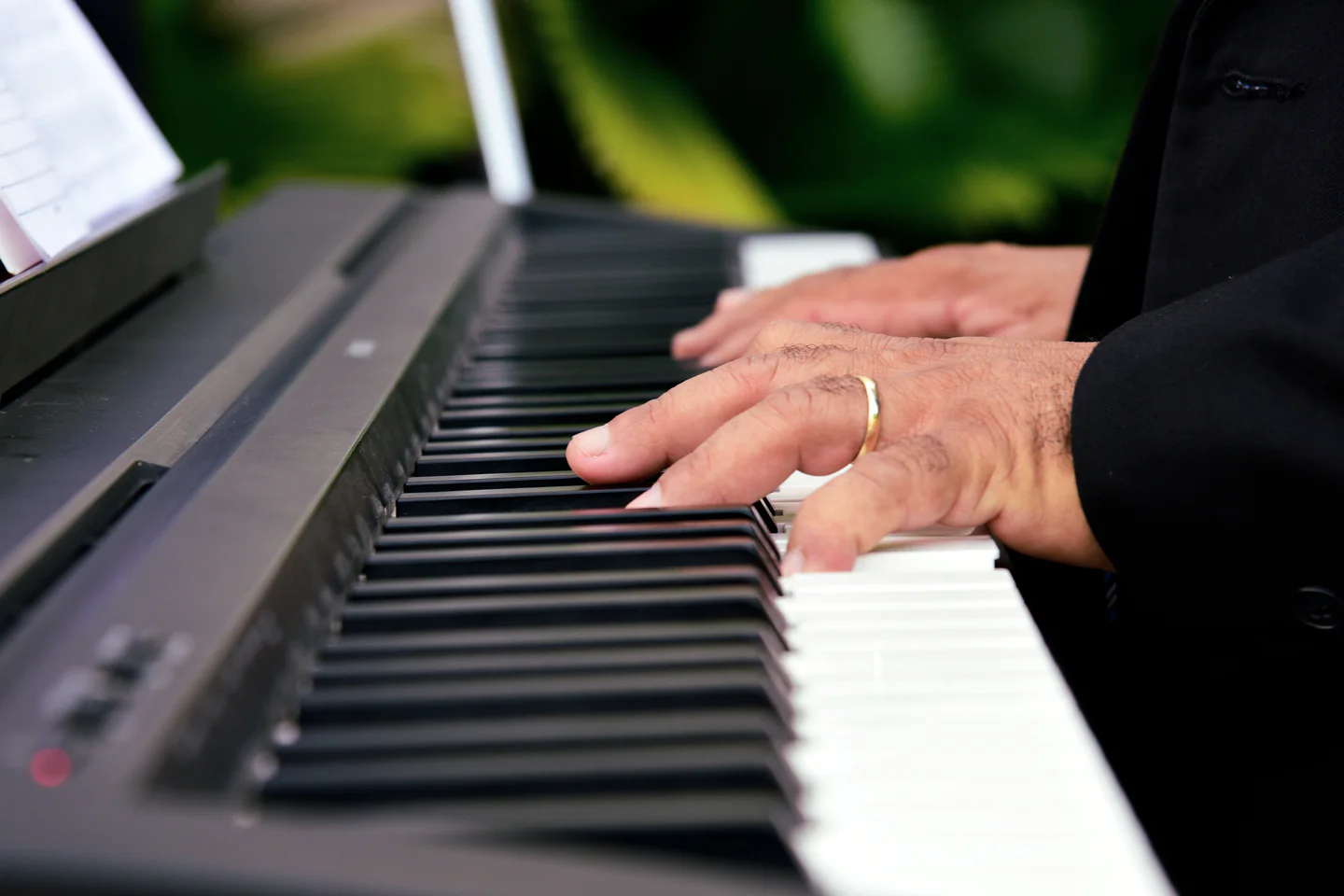
Both hands at a digital piano. Photo: Joel Uribe / Pexels. Stock photograph.
Practise the join, not only the pieces
Passages often fail at the boundary between two units that already work. The end of one pattern and the beginning of the next may each be secure, while the movement across the bar line is not. Starting directly on the second unit misses the transition that needs practice.
A 2026 study of expert conservatory pianists playing memorized experimental sequences found greater disruption when auditory perturbations occurred at chunk junctions than within chunks. Both training groups reduced performance errors, while junction-focused training produced a clearer improvement in force control around the transitions. The study used artificial material, expert players, and a controlled laboratory task. Applying it to ordinary repertoire is a teaching inference, not a guaranteed effect.
The practical test is simple: begin one beat before the break and finish one beat after it. Then move the starting point. A passage that works only from its first note is not yet easy to retrieve in context. Several starting points also reveal whether the fingering and rhythm are genuinely settled or merely attached to one run-up.
Return coordination to the music
Correct attacks are the framework, not the final result. Restore articulation, balance, phrasing, and pedal one layer at a time. If adding pedal hides an uncertain release, remove it and listen again. If bringing back dynamics makes the accompaniment rush, keep the intended balance at the last tempo that preserves the pulse.
A metronome can test whether the underlying beat remains steady, but it should not force a speed at which the movement becomes a series of guesses. Increase tempo only while the real fingering, direction, and sound remain recognizable. Very slow practice can also become unhelpful if it changes the movement or breaks the phrase into unrelated notes. Choose a workable tempo, not the slowest possible one.
Finally, play the repaired unit inside the phrase. Begin from a musically sensible point and continue beyond the old stopping place. Listen to melody, bass, harmony, and arrival rather than watching every finger. Coordination has returned to the music when the distinct roles of the hands remain audible without the pulse being reorganized around the difficult spot.
This repair can fit inside the focused passage block in a 30-minute piano practice plan. It does not need to consume every piece in the session.
A ten-minute coordination reset
When time is limited, use ten minutes on one break point:
- Two minutes: locate the first failed event and test reading, fingering, and rhythm without tempo.
- Two minutes: tap or play the shared rhythm on repeated keys.
- Three minutes: restore the notes and fingering in the smallest joined unit.
- Two minutes: add the beat before and after, then start from a second point.
- One minute: play the phrase and note which layer needs attention next time.
These times are boundaries for the task, not a promise that the passage will be fixed in one session. If a test exposes an insecure rhythm or fingering, that diagnosis is useful progress. Leave a precise note such as “bar 24, left-hand release on beat 3” rather than “hands together needs work.”
If a passage is secure one hand at a time but still breaks when the hands are joined, we can test the reading, rhythm, fingering, and tempo one layer at a time. Online lessons are available worldwide now. Request a free 30-minute trial lesson.
Sources and further reading
- Atsushi Yokoi, Wenjun Bai, and Jörn Diedrichsen, “Restricted Transfer of Learning Between Unimanual and Bimanual Finger Sequences”, Journal of Neurophysiology, 2017, DOI: 10.1152/jn.00387.2016.
- Carolyn Drake and Caroline Palmer, “Skill Acquisition in Music Performance: Relations Between Planning and Temporal Control”, Cognition, 2000, DOI: 10.1016/S0010-0277(99)00061-X.
- Pei-Cheng Shih, Masato Hirano, and Shinichi Furuya, “Bridging Chunks During Complex Movement Sequence Execution”, iScience, 2026, DOI: 10.1016/j.isci.2025.114562.