
Sonata Form for Pianists: Practising the Changed Return
A returning theme can feel reassuring under the fingers until it takes a different turn. The melody is familiar, the next phrase seems obvious, and suddenly you are playing the exposition again when the score says otherwise. Sonata form gives that moment a musical explanation: the theme has returned, but its job in the movement has changed.
For piano practice, the useful question is what stays recognisable, and what changes underneath it? Compare the bass, the key and the approach to the next theme. Those differences tell you where to concentrate, and they give the returning music a character beyond “the beginning again”. Beethoven’s Sonata in F minor, Op.2 No.1, first movement, offers a particularly clear example.
Sonata form and a piano sonata
A piano sonata is a work that may contain several movements. Sonata form describes the organisation of an individual movement. Its main sections are the exposition, development and recapitulation, sometimes framed by an introduction or a coda. Other movements of the same sonata can use other forms.
In the exposition, the music establishes its opening key and introduces material in a contrasting key area. The development reworks ideas through changes of harmony, register, texture or phrase length. In the recapitulation, familiar material returns, with the contrasting group normally brought into the home-key area. The relationship between the themes and their tonal setting matters more than fitting the page into three equal boxes.
At the piano, begin with three comparisons:
- Find the opening theme and its return. Compare dynamics, accompaniment and the preceding phrase.
- Find the contrasting theme in each section. Check its bass and the notes that have changed.
- Follow the passage that leads into the return. Hear what makes the arrival feel prepared.
The following map applies to this Beethoven movement. Count the first complete bar as bar 1; the opening upbeat comes before it. A performed repeat does not create new bar numbers.
Beethoven Op.2 No.1: the first movement
Open a section for the landmarks to follow in the score and sound.
Exposition bars 1–48F minor → A-flat major
The opening establishes F minor. The second group enters in bar 20, with E-flat in the accompaniment; the exposition closes in A-flat major. Its repeat goes back to the opening pickup.
Development bars 49–100Fragments and changing keys
The opening idea reappears in a new setting; the descending idea follows. Later, the persistent C in the bass prepares F minor. Follow the bass beneath the moving right hand.
Recapitulation bars 101–147The themes return in F minor
The opening returns forte at 101. The transition changes, and the second group enters at 119 in F minor. Recognising the tune is only the start: compare its bass and altered notes.
Coda bars 148–152The final close in F minor
A short final extension follows the returning closing material. Hear these bars as the end of the whole movement, while keeping Beethoven’s written rhythm and articulation.
Beethoven’s opening and its return
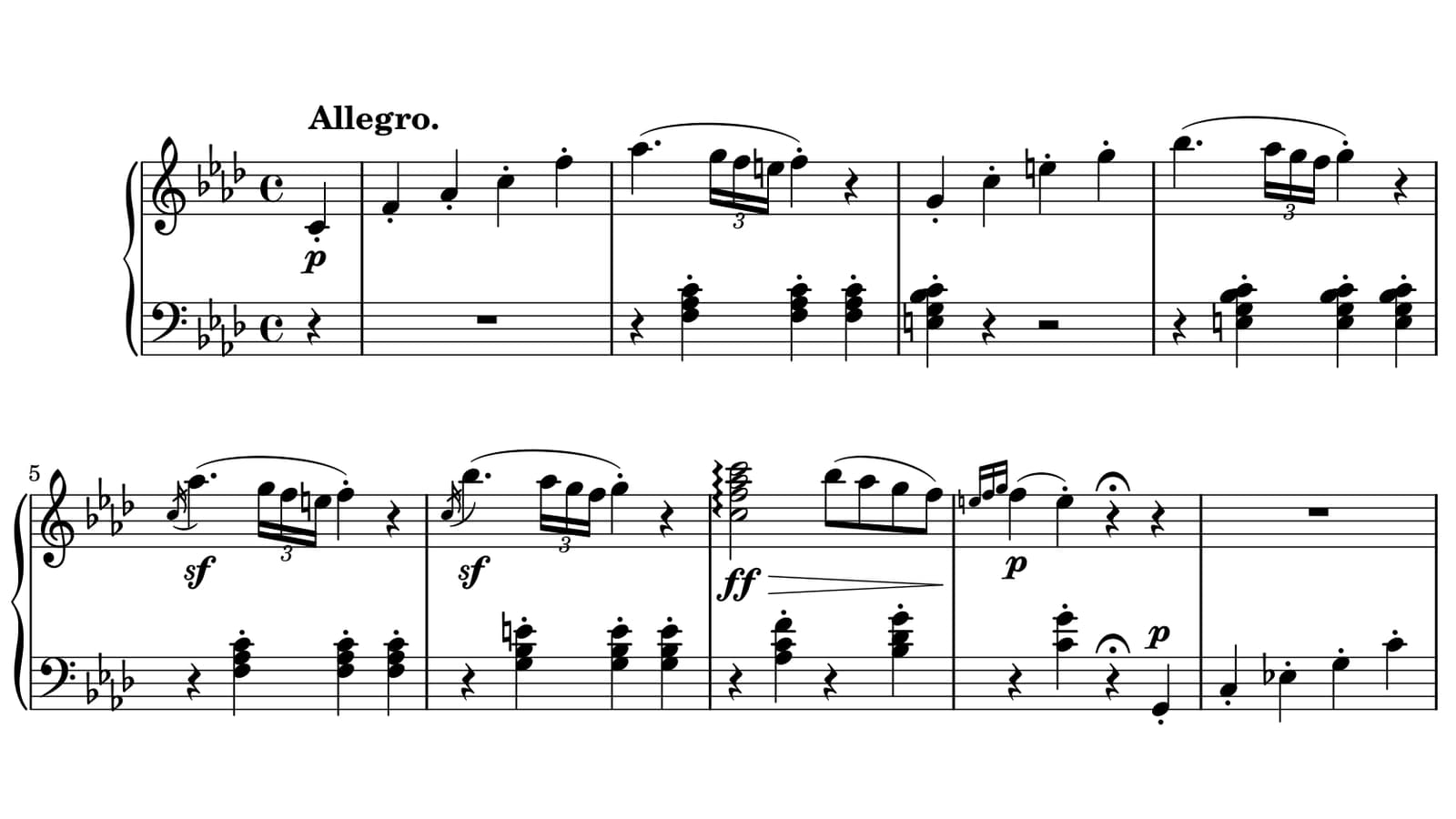
The first sound is a quiet C upbeat. The melody then climbs through F, A-flat, C and F, outlining the home chord. The left hand rests through that first full bar, so the rising line has an exposed, almost questioning quality. Its staccato notes and the short slurred answer already provide plenty of character without a large sound.
When the upward figure returns at bar 101, Beethoven marks it forte and supports the arrival with a left-hand F-minor chord. The familiar shape now comes out of a crescendo in the preceding bars. The phrase has a history behind it: we hear the opening after the development’s changing harmonies and its preparation of the home key.
Scroll sideways to read the score.
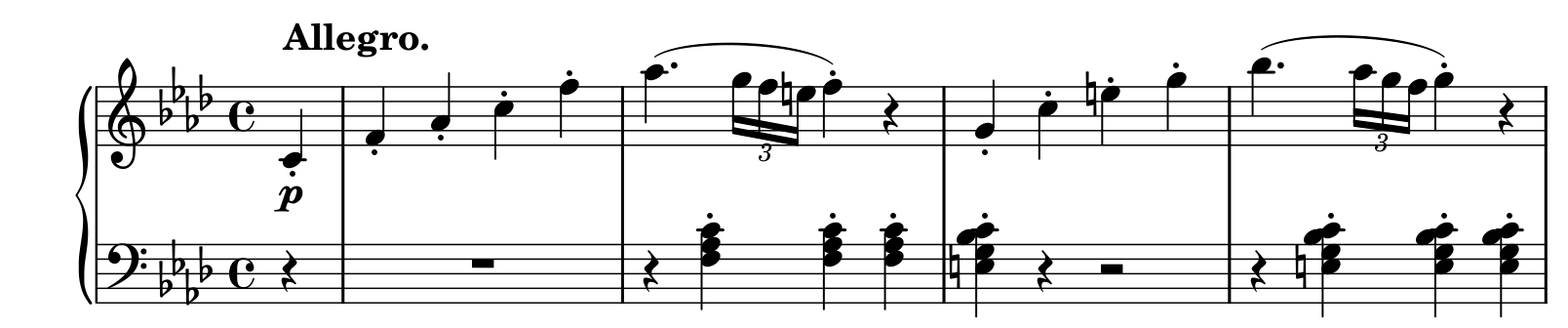
The first full bar begins with F. The upward gesture starts quietly, without a bass chord beneath that F.
Scroll sideways to read the score.
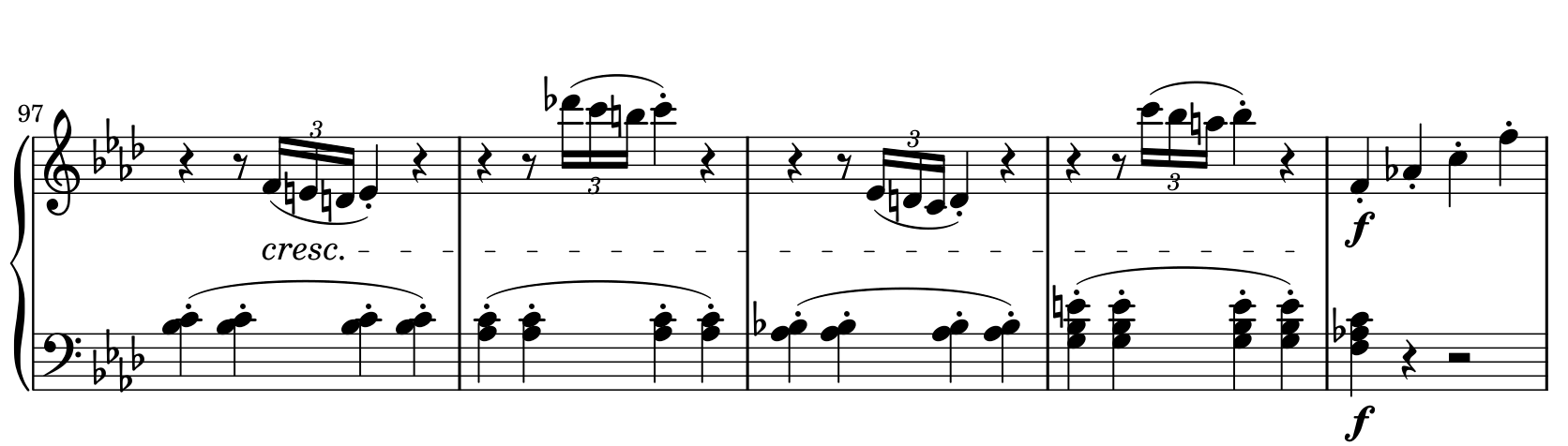
At 101 the familiar arpeggio arrives forte, with the bass supporting it. Hear the four preceding bars as its approach.
Play the opening and the return close together, then play into bar 101 from bar 97. The comparison should change what you listen for. A forte chord needs a clear bass foundation, while the upward notes still need their articulation and lift. If the chord makes the wrist rigid and every following note becomes heavy, the larger arrival has swallowed the gesture that identifies the theme.
I like this comparison because it gives a dynamic instruction a reason. “Louder here” is a limited idea; “this is the theme arriving after the preceding tension” connects the sound to the whole movement. The score supplies the evidence, and the pianist decides how to make that evidence audible on the instrument in front of them.
The second group changes its destination
The more revealing comparison comes later. In the exposition, a descending idea enters near the end of bar 20 above repeated E-flats in the accompaniment. This is the second group, in the A-flat-major area. The F-flat in its melody colours that major setting with a darker note; the key signature alone does not describe everything we hear.
At bar 119, the corresponding idea returns in F minor. The accompaniment now repeats C, and the descending line in bar 120 includes E-natural, which pulls towards F. The contour and rhythm remain recognisable, but the tonal destination has changed. Calling this simply “the same theme lower down” misses the change from the relative major to the home minor.
Scroll sideways to read the score.
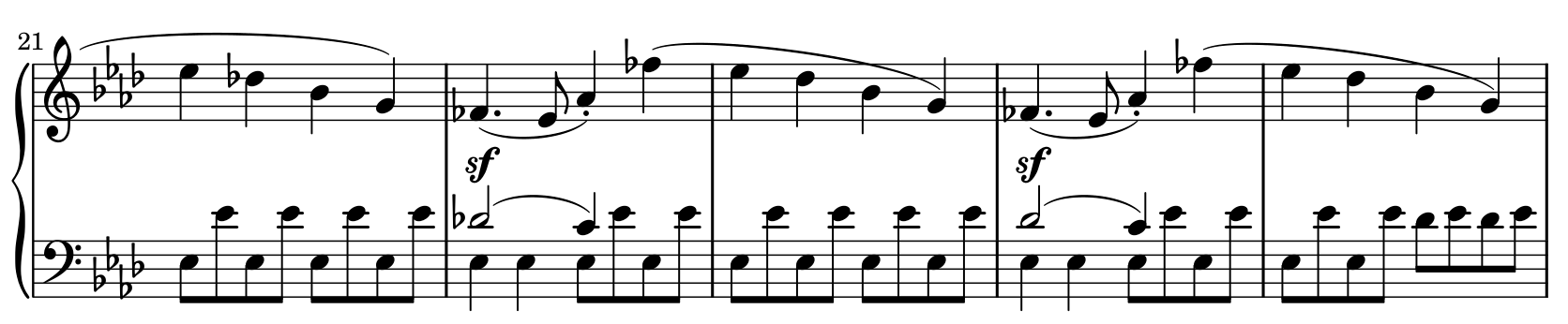
The entry begins late in bar 20, just before this crop. Here the repeated bass is E-flat; the phrase belongs to the A-flat-major area.
Scroll sideways to read the score.
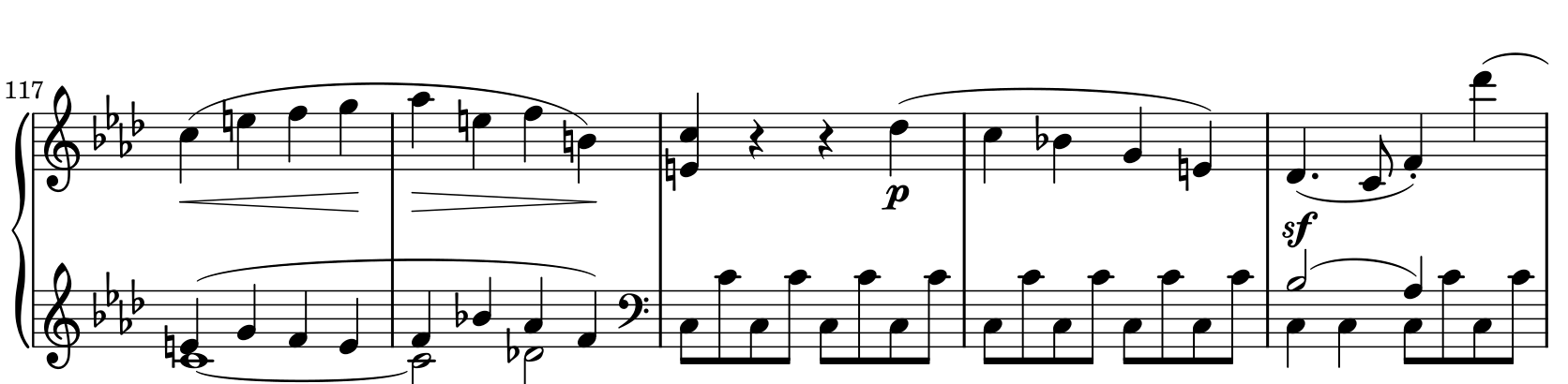
The third bar shown is 119. The accompaniment now repeats C, and bar 120 includes E-natural. Compare the destination as well as the contour.
Try just the repeated bass note and the melody in each version. Listen to the E-flat supporting the exposition’s line, then to the C supporting its return. Afterwards, restore the complete accompaniment. The reduction lets the ear identify the relationship before the hands take over with a familiar movement pattern.
The altered notes also affect fingering. A passage that moves from a white key to a black key in one version may have a different arrangement in the other. Keep the same fingering where it remains comfortable and serves the phrase; choose a different one where the hand needs a different route. The guide to choosing piano fingering explains how to judge that choice through the sound and movement of the complete phrase.
Mark the two entries together in the score. A useful annotation might be “E-flat bass, towards A-flat” at the first, and “C bass, towards F minor” at the second. Those are musical directions you can hear. A large letter A or B by itself says less about what the fingers must do next.
The changed transition
Between the first and second groups, the transition carries the harmony towards its next destination. In the exposition, that destination is the relative major; in the recapitulation, Beethoven alters the corresponding passage so that the second group can return in F minor. The changed writing around bars 115–119 deserves attention before the second theme feels secure.
A common practice habit is to begin directly on the troublesome entry. That can produce an excellent bar 119 and still leave the approach unreliable. Start earlier, around bar 115, and continue through the first phrase of the returning second group. The ear must recognise the preparation, and the hand must arrive with the right position already available.
Then compare the corresponding approach in the exposition, around bars 15–21. Play one, pause, hear the other destination internally, and play the other. If the wrong continuation appears, locate the first changed bass note or accidental that went unnoticed. Practise across that point, including the few notes before it. Repeating the entire movement would give the actual decision very little attention.
This is one of the strongest uses of analysis in a lesson. It tells us exactly where a familiar passage stops being familiar. The practice unit follows the musical change, which may fall halfway through a system or several bars after a page turn.
Development and the approach home
The development begins at bar 49. Familiar ideas appear in new harmonic surroundings, and the descending material moves through different settings. Later, a persistent C in the bass prepares the return to F minor. This dominant preparation is often called the retransition: the part of the development that leads back towards the opening material.
Follow the bass through this stretch before trying to give every right-hand figure a separate expressive story. Where does the harmony move? Where does it remain over C while the upper parts change? Holding one bass foundation can create expectation even while the surface remains busy. The return at bar 101 then answers something the listener has been waiting for.
For practice, play a reduced version with the bass and the principal melodic notes, keeping the pulse and the phrase lengths. Add the intervening notes once the harmonic direction is audible. This reduction has a specific purpose: it reveals the support beneath the figuration. It should not turn into a new arrangement that replaces learning the written texture.
The cadence guide looks more closely at local arrivals and unfinished endings. Here, those smaller events belong to a longer span. A cadence halfway through the development can articulate a phrase without feeling like the end of the movement’s argument.
Repeats, memory and proportion
The exposition repeat and the recapitulation are different events. Following the repeat sign at bar 48 takes you back to the original opening and its original tonal journey. Reaching bar 101 continues the movement after the development, with a changed opening sonority and a rewritten route for the second group. Both involve recognition, but only one involves turning back in the written score.
Practise the repeat junction itself. Hear the C upbeat before playing it, and recover the quiet opening character after the exposition’s closing material. Then practise the approach to bar 101 separately. If both events have been learnt only as “go back to the tune”, they can become confused in memory even when each page is technically comfortable.
A movement also needs proportion. The return at 101 is important, but it is not the final climax or the end of the piece. The second group and closing material still have work to do. Keep enough forward movement through the arrival for the rest of the recapitulation to speak, and reserve the finality of the ending for the closing bars and short coda.
Listening with Kempff
Use Wilhelm Kempff’s recording below with the score open. First follow the rising figure at the beginning and at bar 101. Then track the second group: E-flat in the exposition’s accompaniment, C in the recapitulation’s. These are audible landmarks even before you can name every harmony in between.
Wilhelm Kempff: Op.2 No.1, first movement
Deutsche Grammophon / Universal Music Group. Listen on YouTube.
On another hearing, attend to the bars before each return. Ask how much of the arrival you can anticipate from the bass, the crescendo and the length of the preceding phrase. The purpose is to hear a continuous movement rather than wait for four labelled sections to announce themselves. Keep the recording’s sound and tempo as things to consider, while using the written notes and your own instrument to form your interpretation.
Applying the map to your own sonata
Open the movement you are learning and find one returning passage. Put its two appearances side by side and compare the melody, bass, dynamics and continuation. The first useful discovery might be a changed accidental, a longer transition or a return in an unexpected key. Follow that discovery into the sound before filling the entire score with labels.
Composers vary this plan. In Mozart’s K.545, for example, the first movement’s recapitulation begins in F major rather than the opening C major. The K.545 practice guide considers that work in detail. A form map earns its place by describing the piece accurately; an unexpected return is a musical event worth hearing.