
Piano Cadences: Hearing Where a Phrase Arrives
A cadence is the way a musical phrase comes to an arrival. The last chord matters, but so do the bass, the melody, the key you have been hearing and the rhythm that brings them together. Two passages can finish on the same note and leave quite different expectations: one feels settled, while the other seems to be waiting for an answer.
For a pianist, that difference changes the direction of a phrase. It affects which notes need space, where the bass should remain audible and whether the next idea continues an unfinished thought. Learning cadence names becomes useful when the names help you hear these relationships in a piece you already play.
The three things to hear
Start with the local key, the bass and the melody. In C major, C is the tonic: the note around which the key is organised. A C-major chord contains C, E and G. The dominant chord, built on the fifth scale degree, contains G, B and D; adding F makes it G7. The movement from dominant to tonic is one familiar source of arrival.
The bass is the lowest sounding note, not automatically the name of the chord. C–E–G remains a C-major chord when E is underneath it. That position is called first inversion, written C/E in chord symbols. The change of bass can make an arrival feel less firmly rooted even though its harmony is already tonic.
The top voice matters too. A melody that reaches C above a C-major chord offers a different kind of rest from one that settles on E. Both notes belong to the chord. Listening for the relationship is more useful than treating every consonant chord as the end of the sentence.
One approach, three endings
Try the short progression below at the piano. Play the bass with the left hand and the three upper notes together with the right. Keep an even pulse, with one chord per beat. C4 means middle C. Begin with C major, F major and G major; then choose an ending.
The same beginning: C → F → G
Left hand: one bass note. Right hand: three notes together. Numbers show the octave.
1. C · I
Left: C3
Right: E4 · G4 · C5
2. F · IV
Left: F2
Right: F4 · A4 · C5
3. G · V
Left: G2
Right: D4 · G4 · B4
Open an ending and try it
Return to C: V–I
Left: C3 · Right: E4 · G4 · C5
Play a fourth chord. The bass and melody both reach C.
Stop on G: …–V
Left: G2 · Right: D4 · G4 · B4
Omit the fourth chord and hold the G harmony. Listen for the expectation it leaves.
Turn to A minor: V–vi
Left: A2 · Right: E4 · A4 · C5
Play A minor as the fourth chord. The melody reaches C, but the bass moves to A.
First play the version returning to C major. Then stop on the G chord instead. Finally, replace the expected C-major arrival with A minor. Keep the same touch and tempo so that the harmony does the work. An exaggerated pause or accent would answer the question before your ear has heard the chords.
Notice the last version particularly. Its top note is C, just as in the C-major ending, but the bass is A. A familiar melodic arrival now belongs to a different harmony. This is one reason a pianist can play the melody beautifully and still leave the phrase's direction unclear: the listener also needs its harmonic support.
These little progressions isolate the sound. In repertoire, a cadence belongs to a phrase boundary, with a rhythm and melodic shape leading towards it. A G-to-C change in the middle of an accompaniment does not, by itself, divide the music into two phrases.
The useful cadence names
An authentic cadence closes a phrase with dominant-to-tonic harmony, V–I in a major key. For a perfect authentic cadence, both chords are in root position and the melody arrives on the tonic. In C major that means G in the bass before C, with C at the top of the final harmony. The first ending in the exercise gives that basic sound.
An imperfect authentic cadence also arrives on tonic but lacks one of those conditions. A different melodic arrival, or an inverted chord, gives the ending another character. The word “imperfect” describes its construction, not the quality of the playing. A phrase can be beautifully finished without the most emphatic harmonic close.
A half cadence finishes on the dominant. In C major, that is a G-major harmony. It provides a place to breathe while leaving harmonic expectation open. A deceptive cadence changes the expected destination after the dominant, often to vi: A minor in our C-major example. It can sound like a diversion that calls for more music.
You will also encounter the plagal progression IV–I, such as F major to C major. Its approach has a different colour because it reaches tonic without the dominant immediately before it. Learn the sound at the keyboard, then look for its place in the actual phrase. Labels organise listening; the phrase supplies the context.
Schumann: an arrival in stages
Schumann's Melody, Op.68 No.1, is a useful piece for this work because the accompaniment keeps moving while the melody slows into its ending. Here are the final four written bars, 17–20. Count the opening repeat only once when locating them in the score.
Scroll sideways to read the score.
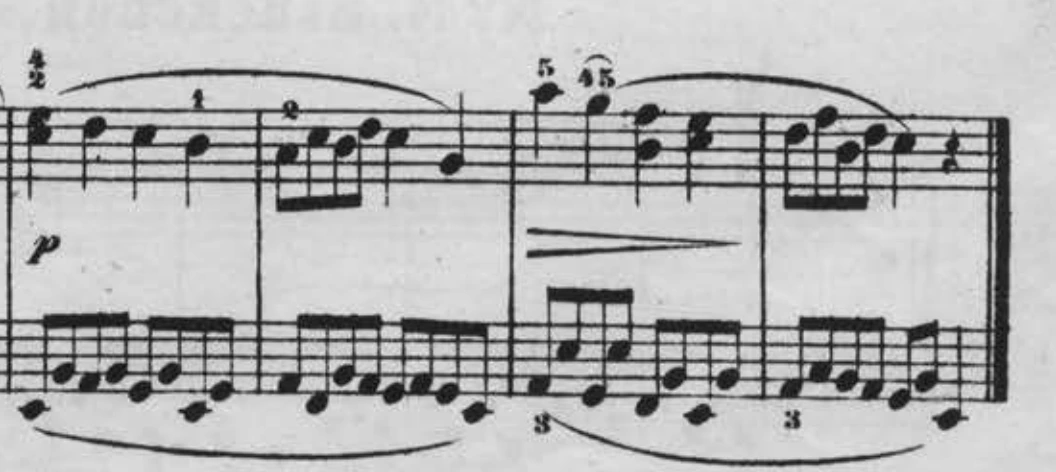
The arrival in bar 20
Beat 2
G7
G–F below B–D
Beat 3
C/E
C arrives over E–G
Beat 4
C
Low C completes the close
In the last bar, the second beat contains the notes of G7: G, B, D and F, distributed between the hands. On beat three, the melody reaches C while the left hand plays E and G. The harmony has become C major, with E at the bottom. The low C follows on beat four, after the melody has reached its rest.
That sequence is more interesting than a single “last chord.” The melody arrives first over an inverted tonic, and the bass completes the settling motion afterwards. If the left hand drops out as soon as the right hand stops, the close loses part of its shape. If the final bass C is struck heavily, the last accompaniment note can sound like an extra event rather than the completion of the phrase.
I would first ask for the melody and the lowest note on each beat, played slowly enough to hear their relationship. Then I would restore the inner notes. The aim is to preserve the same arrival when the accompaniment becomes fluid again. This is also a good passage for checking whether a diminuendo still leaves the important bass notes audible.
The first ending goes somewhere else
The first four bars offer a useful comparison. Although the piece begins in C major, its opening section settles on G. Listen for the F-sharp in the fourth bar: it helps point towards G as a temporary local centre.
Scroll sideways to read the score.
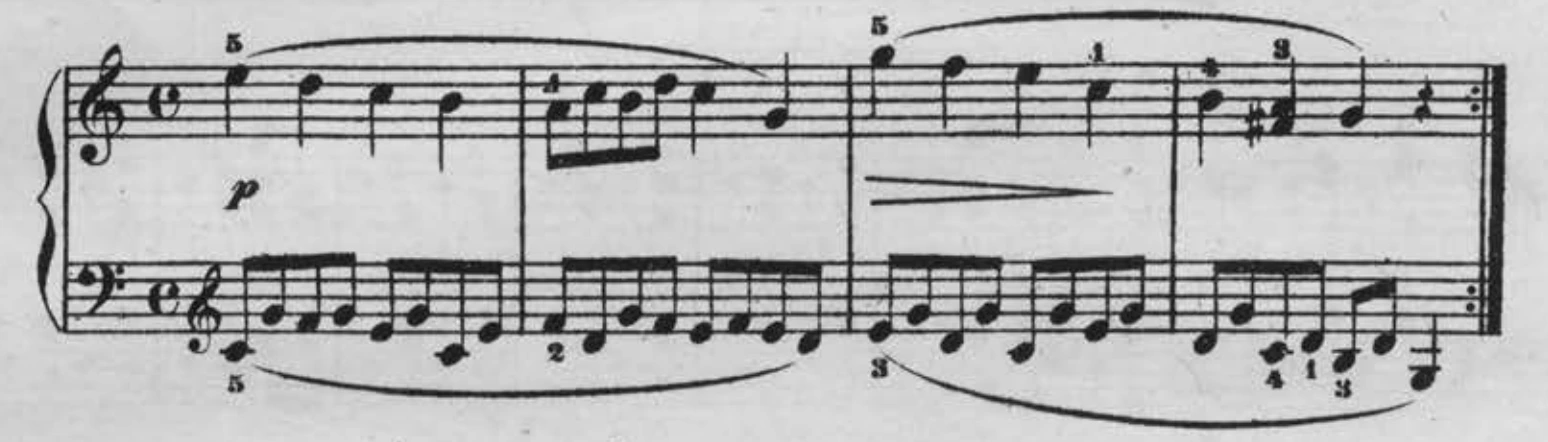
The arrival in bar 4
Beat 2
D7
C–D below F♯–A
Beat 3
G/B
G arrives over B–D
Beat 4
G
Low G completes the close
At the second beat of bar four, F-sharp and A in the right hand combine with C and D in the left to form D7, the dominant of G. On beat three, the notes B, D and G give a G-major chord over B. The low G follows on the last beat. The approach and the delayed bass arrival resemble the final bar, but their destination is different.
This is why naming a cadence from the final bass note alone can mislead. G is the dominant of the main key, C major, but here it is also being approached as a local tonic. The F-sharp is part of the evidence. Ask what the surrounding music has made G sound like, rather than automatically calling every phrase ending on G a half cadence.
The repeat then takes us back to the opening C-major material. Hold both experiences in mind: the small arrival on G, and the return to the piece's main home. That is a musical reason to distinguish this close from the final return to C.
Listen through the whole piece
Jörg Demus's recording gives a complete performance to follow with the score. Listen first for the close of the opening four-bar section, then for the ending of the whole piece. On a second hearing, follow the bass during the final bar and notice how its movement relates to the melody's arrival. Use the written bars as landmarks rather than trying to copy a recording's timing.
Jörg Demus: Melody, Op.68 No.1
Nuova Era. Listen on YouTube.
You can make the same comparison in your own recording. Does the opening close leave room for the repeat to begin naturally? At the very end, can you hear the bass finish its thought after the melody? Those questions concern the shape of the music, rather than the amount of slowing down added to it.
Timing, balance and pedal
A cadence does not require an automatic ritardando. Its harmonic change may already be clear at the prevailing tempo. First play the phrase with an even pulse; then try a small amount of space at the arrival. Listen to whether the next phrase still belongs to the same movement.
The point receiving space is not always the last note printed on the line. In Schumann's final bar, the melodic C on beat three and the bass C on beat four have different jobs. Delaying every event equally can make the ending heavy. Hear the melody's arrival, then let the bass complete it.

Pedal can either support that movement or blur it. If G7 remains under the C-major arrival, the earlier B and F continue colouring the new harmony. Try the ending without pedal to hear its voice-leading, then add pedal according to the instrument and the written durations. Our guide to clear sustain-pedal changes develops that listening work.
An arrival can also be lost because the accompaniment competes with the melody. Keep the rhythm of its small notes alive, but listen beyond each one towards the larger harmonic change. The article on shaping a classical piano phrase looks more closely at balance, melodic direction and the space between phrases.
Bring the cadence back into the phrase
Choose one ending in a piece you are learning. Begin far enough before it to establish the key and the musical thought. Play the outer voices, then add the inner parts. Compare the sound of stopping at the arrival with the sound of continuing into the next phrase. The boundary should remain audible even when you play straight through.
Write a small harmonic label only where it answers a musical question. “G7 to C/E, then low C” tells you something precise about Schumann's ending. Covering every accompaniment note with a chord symbol can hide the phrase you were trying to understand.