
Mozart's Sonata K.545: Difficulty, Practice and the Music Beyond the Notes
Mozart's Sonata in C major, K.545, has an inviting opening: a clear melody above a repeating left-hand pattern. A few bars later, the right hand is running through scales. The Andante asks for a long singing line, and the finale brings quick exchanges, paired notes and changes of character. Learning the complete sonata means learning all of these ways of playing.
I generally approach K.545 as an intermediate project. A player who reads comfortably, has some experience with scales and can keep an accompaniment beneath a melody has useful foundations. The title Sonata facile, or “easy sonata”, says little about how much work an individual pianist will need on its sound and timing.
This guide follows all three movements, with score examples for balance, scale passages, sustained melody and articulation. If you already know the notes, these are also places to return to when the piece feels stuck.
Three movements, three kinds of listening
I · Allegro
C major · 4/4
Clear melody, quiet accompaniment and flowing scales.
The pulse continues through rests and changes of texture.
II · Andante
G major · 3/4
A sustained melody above a moving left hand.
Long notes remain audible as the harmony changes.
III · Rondo
C major · 2/4
Paired notes, light articulation and exchanges between the hands.
Each hand keeps its own releases and entrances.
K.545 difficulty and readiness
Before committing to the whole sonata, try a little of each movement. In the first movement, read the opening and a scale passage at a manageable speed. In the second, listen for the melody above the moving accompaniment. In the finale, see whether the paired notes arrive together and whether each hand keeps its rests.
These samples reveal different starting points. Perhaps the scale lies comfortably under your fingers but the Andante's accompaniment is too loud. Perhaps the melody sings naturally, while every change of hand position interrupts the pulse. That difference matters more for planning your work than a single difficulty label.
Experience with a complete Clementi or Kuhlau sonatina can help, especially if you have worked on contrasting movements, phrase endings and a light accompaniment. Simply having reached a particular book is less informative. Listen to what you can control in the music you already play: the line, the pulse, the ends of notes and the change from one texture to another.
For a returning pianist, I would also compare the opening tempo with the scale tempo. If the familiar tune comes back quickly but the passagework still needs attention, bring the opening down to a speed the following music can sustain. Otherwise the first four bars become a promise the rest of the movement cannot keep.
First movement: melody and Alberti bass
The first right-hand notes are C, E and G. The opening C lasts two beats; underneath it, the left hand plays C–G–E–G in eighth notes. This broken-chord arrangement, moving through the low, high, middle and high notes, is called an Alberti bass.
Movement I, bars 1–3. Both staves begin in treble clef.
Scroll sideways to read the score.
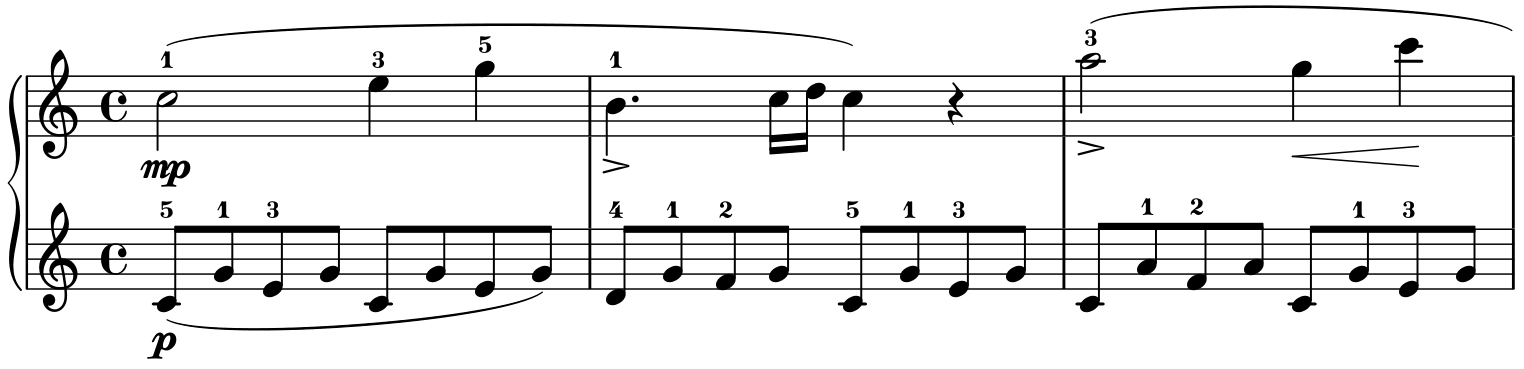
Follow the opening C for two beats. At the end of bar 2, release the melody while the left-hand eighth notes continue.
Play the right hand alone and hear the C moving towards E and G. Then add only the left-hand C at the start of the bar. The melody should retain its place in your ear when that lower note joins it. Finally restore the complete accompaniment and listen for what changes.
A common difficulty is the repeated left-hand G. It falls under the thumb in this edition and can stand out each time it returns. The result is a second, insistent line competing with the melody. Play the left hand alone at a quiet level and listen across all eight notes of the bar. The G belongs inside the pattern; it should not interrupt it.
The harmony changes in bar 2: D–G–F–G is followed by C–G–E–G. First play those two groups as quiet chords to hear the change, then restore the written pattern. This gives the accompaniment a harmonic purpose and makes the movement of the hand less arbitrary.
At the end of bar 2, the right hand has a quarter rest while the left hand continues. Release the melody and keep listening to the accompaniment. That small space is part of the phrase. Filling it with a held right-hand note, or stopping both hands together, changes the shape of the opening.
I listen closely to that rest in a lesson. It tells me whether the pianist is following the two parts independently, even when attention is drawn to the tune. The same kind of listening will be needed in the finale, where the exchanges are quicker.

One-to-one classical piano
In person in Ikebukuro or Shinjuku, Tokyo. Online worldwide.
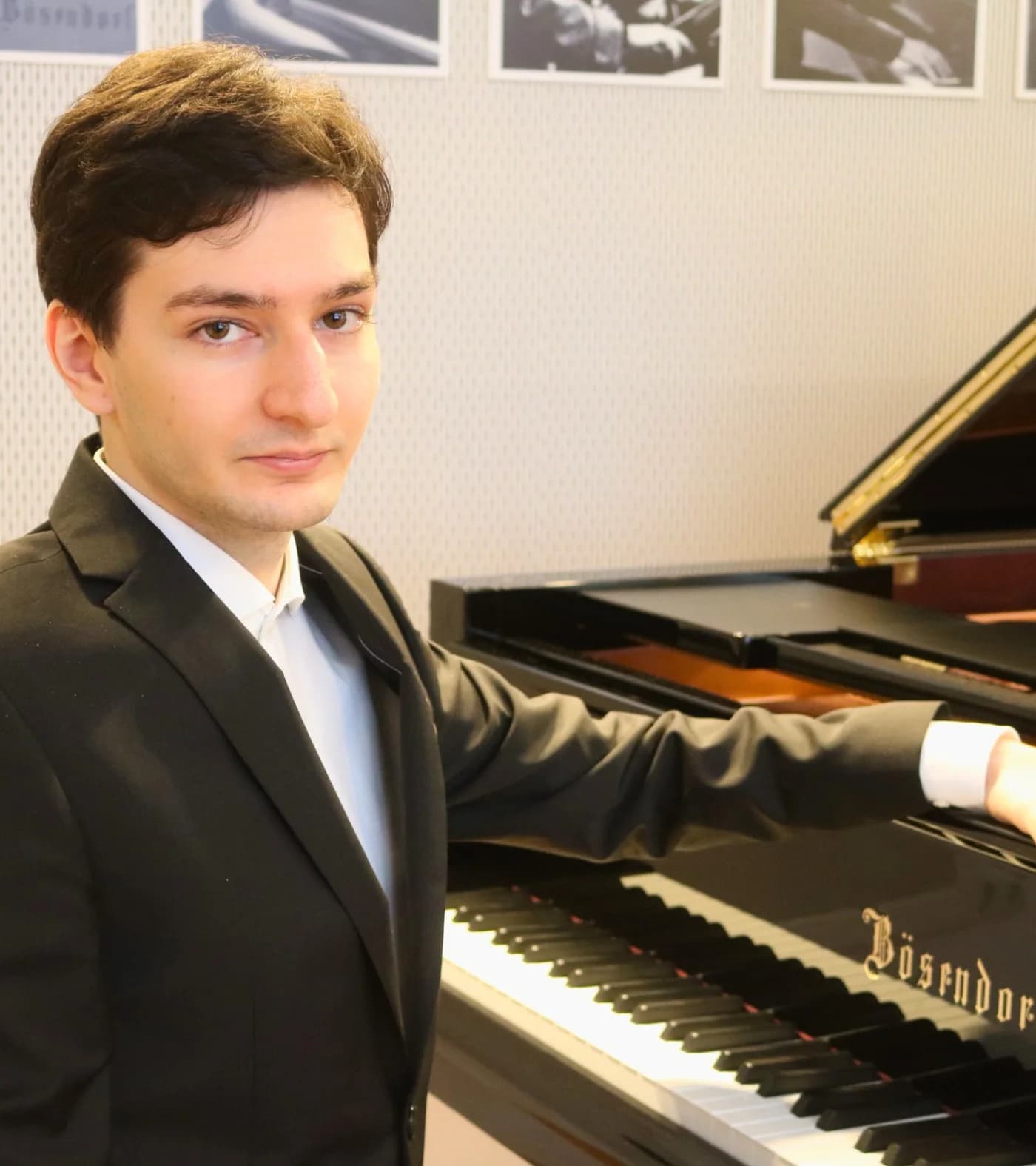
Enea
Concert pianist from Vienna
Pre-launch · Applications open
First movement: the scale in bar 5
The right-hand run in bar 5 begins on A, rises to the next A and comes back down. Look carefully at its rhythm: the first A is an eighth note, followed by sixteenths. Starting with evenly spaced sixteenths from the first note compresses the beginning of the bar.
Movement I, bars 4–5. The run begins in the second bar shown.
Scroll sideways to read the score.
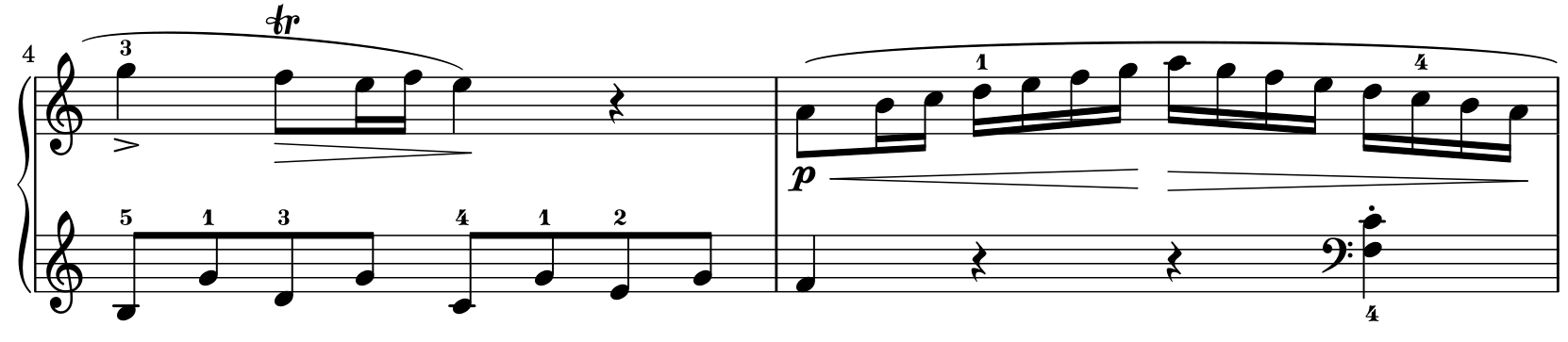
The first A is an eighth note. The beat notes are A–D–A–D; keep those arrivals in place as you fill in the run.
The notes on the four quarter-note beats are A, D, A and D. Play those four notes alone in a steady pulse. Then fill in the notes between them, keeping the same beat positions. The upper A arrives on beat 3; the descending D begins beat 4. This gives the run a shape in time as well as a shape on the keyboard.
Next hear the ascent and descent as one gesture. If the upper A becomes a stopping point, practise a small group that crosses it: the notes immediately before the turn, the A itself and the first few notes after it. Keep the change of direction inside the pulse. Repeating only the ascent leaves the turn unpractised.
The left hand also changes character here. Its continuous eighth notes give way to an F, two quarter rests and a lower F–C pair on beat 4. Practise the right hand with those two left-hand arrivals. The final chord needs preparation while the scale is still moving; reaching for it at the last moment can pull the right hand off course.
Once bar 5 works, begin in bar 4. The right-hand rest at the end of that bar must retain its place before the run starts. Then continue into bar 6, where the scale begins a step lower. A successful isolated run is useful; a successful entrance and exit make it part of the piece.
For more work on grouping and transferring scale practice into repertoire, see piano scales that help your repertoire. Here, keep the larger question in view: how does this flowing passage grow out of the opening phrase?
First movement: the return of the theme
As the movement develops, the opening material changes key and position. One particularly revealing moment is the return of the main theme in F major. It sounds familiar, but the hands are in a different place and B-flat belongs to the new key.
Find that return in your score and compare it with the opening. Sing the two versions, then play their melodies. The identity of the phrase survives the transposition. Its new position still needs its own fingering and balance, rather than an automatic replay of the opening's movements.
Learning to start at the contrasting theme, the development and the return also helps you hear the movement's form. Give each starting place a musical reason: a new key, a change of texture, the reappearance of a familiar idea. These are stronger landmarks than “the top of page three”.
Andante: a long note above moving notes
The second movement is in G major and 3/4. Its first melody note, B, lasts two beats. Beneath it, the left hand plays sixteenths. The melody then moves through D–C–B–C on the third beat. There is already plenty to hear before the second bar begins.
Movement II, bars 1–2. G major, 3/4.
Scroll sideways to read the score.
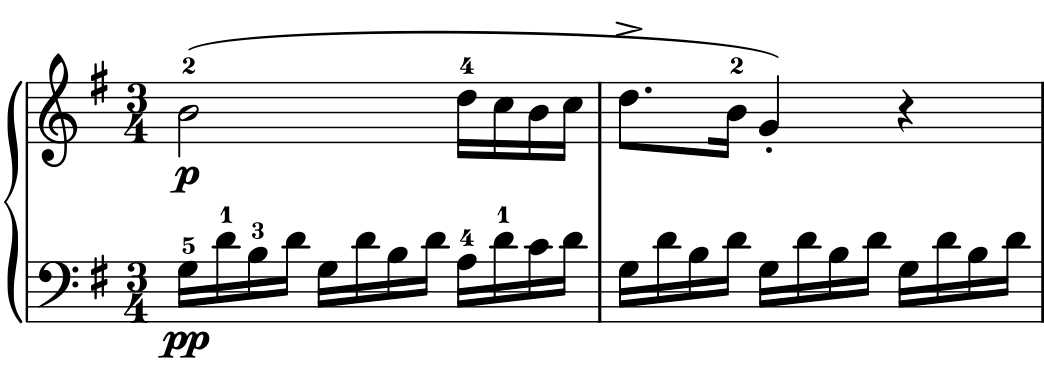
Keep hearing the long B while the accompaniment moves. On beat 3, both the melody and the left-hand harmony change.
Play the melody alone and sing through the long B towards the four notes that follow. The B should remain part of the phrase while it sounds. At the piano its volume naturally decays; pressing harder after the attack will not make the held note grow. The moving left hand has to leave room for that fading sound.
Practise the accompaniment at a level where all its notes speak evenly. Listen especially to the repeated upper D. Then add the melody and follow the B with your ear through the first two beats. If it disappears behind the accompaniment, reduce the left-hand sound before making the melody increasingly forceful.
The accompaniment changes on beat 3: G–D–B–D becomes A–D–C–D. Play those groups as chords and listen to the change underneath the melody's D–C–B–C. Restoring the broken pattern should keep that harmonic movement audible. The left hand is carrying the phrase forward even when its surface pattern looks repetitive.
Bar 2 ends with another right-hand rest while the left hand continues. Hear the melody's G release, then listen through the remaining beat. A slow movement still has motion during its rests. Holding the G through everything makes the phrase less articulate; cutting off the accompaniment makes it lose its breath.
Later, the G-minor passage brings a different colour. Notice how the changed notes affect the melody and harmony before deciding how much to alter the sound. The continuing accompaniment can support that darker character without becoming heavier at every note.
Andante: pedal and a singing tempo
Begin a short passage without pedal so you can hear the finger legato, the melody's release and the accompaniment separately. Then add enough pedal to enrich the sound while preserving those relationships. Listen at a harmonic change: does the old harmony obscure the new one, or does the change remain clear?
The opening's change on beat 3 is a useful place to test this. A pedal held through the whole bar carries notes from the first harmony into the next. Compare that sound with a change of pedal, and listen on your own instrument. The answer depends on the resonance you actually hear, including what the fingers are already holding.
Choose a tempo in which the melody can travel through a phrase. Very slow practice can expose uneven sixteenths, but an excessively slow performance may leave every long note stranded. After detailed work, play a longer span and sing along. Listen for the connection from one melodic arrival to the next.
Rondo: paired notes and conversation
The finale is in 2/4. It begins with two right-hand pairs of E and G as a pickup. The left hand enters in the first full bar, and the parts alternate between short paired notes, rests and running figures. That changing relationship gives the music its conversational character.
Movement III, pickup and bars 1–4. C major, 2/4.
Scroll sideways to read the score.
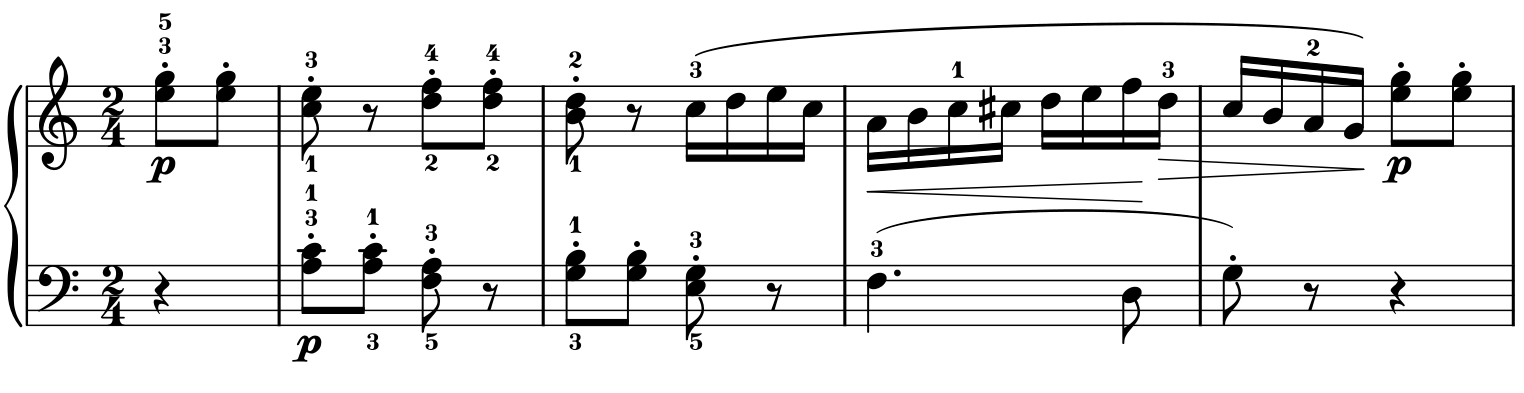
In the first full bar, the right hand rests on the second eighth note and the left hand on the fourth. Hear both exchanges within the same pulse.
Start by playing the upper note of each right-hand pair as a single line. Then restore the lower notes while keeping the upper line audible. Both notes of a pair should arrive together. If they split, try the pair slowly at a comfortable volume and observe how the two fingers contact the keys; increasing force rarely clarifies the timing.
Now compare the hands' rests. In the first full bar the right hand rests on the second eighth note, while the left hand plays. On the fourth eighth note, the left hand rests while the right hand plays. Practise that bar slowly enough to hear the changes of activity. Each hand needs to stop and start at its own moment.
Short notes can still have a rounded sound. Try a brief, gentle pair and then a sharper pair at the same tempo. Choose the character you want to hear, and let the release serve it. A large lift after every pair can make the next entrance late and turn a light exchange into a series of separate gestures.
The running figure that follows asks for a different connection between notes. Practise from the last paired notes into that run, then through its return to the opening figure. The contrast should be audible within one continuing pulse. Keeping one touch for every texture makes the finale much less lively.
Editions, dynamics and tempo
K.545 appears in editions with quite different performance markings. The New Mozart Edition's preface explains that the early printed sources it used contain no dynamics; later editions supplied them. The dynamics and fingerings in the excerpts here therefore belong to the performing edition. Use them as musical proposals to hear and test, alongside the phrase and harmony.
For example, the rising scale may gain intensity without every successive note becoming louder. Its upper turning point can be bright, while the descending line eases towards the next entry. In the opening, the arrival on G can carry more direction than a mechanically identical C, E and G. Shaping a Classical phrase explores these choices in more detail.
A workable tempo allows the most demanding texture to retain its character. Try the scale passage, a left-hand passage and a phrase with rests before settling on the first movement's speed. In the finale, the paired notes must remain coordinated as well as quick. A recording's tempo is one performer's choice, not a deadline for your hands.
Learning the complete sonata
Give the three movements separate places in your practice while keeping their relationship in your ear. The first movement brings clarity and motion; the Andante makes room for a sustained line; the Rondo brings a lighter exchange. Listen to the full work as well as individual passages so the familiar opening does not become the whole story.
After working on a detail, return to a phrase long enough to test it. A quieter Alberti bass should still work when the harmony changes. An even scale should keep its rhythm when it follows a rest. A well-balanced Andante opening should lead naturally into the next melodic gesture.
These are the kinds of changes I work on with a pianist who already knows K.545 but wants more from it. We can also use a few passages to judge whether the sonata suits the next stage of study, and which foundations deserve attention first.
Vienna Piano School is accepting applications for English-language lessons online worldwide and in person at piano studios in Ikebukuro and Shinjuku, Tokyo. The school is preparing to launch; start dates and trial arrangements are confirmed by email. You can apply for a free 55-minute trial lesson and bring the movement or passage you would like to explore.