
Schubert Impromptu Op.90 No.3: A Singing Line Over Flowing Accompaniment
Schubert’s Impromptu in G-flat major, Op.90 No.3, asks you to sustain a singing melody while another part of the hand keeps moving underneath it. The notes can feel manageable long before the music sounds settled. A heavy inner note, an impatient bass entry or a pedal change that erases the melody can interrupt the line without producing an obvious wrong note.
Begin by hearing three layers: melody, flowing accompaniment and bass. Then follow how their relationship changes across the piece. The more forceful middle passages, the accompaniment moving into the left hand and the unsettled closing pages all need their own attention. A beautiful opening is the beginning of the work.
Beyond the first page
- Bars 1–24Opening and expansion
- Hear the melody, moving inner voice and bass as three layers.
- Bars 25–54Contrast and changing texture
- Stronger bass activity, quieter responses and accompaniment in the left hand.
- Bars 55–74The opening returns
- Recover the singing line after the fermata, then follow the changing harmony.
- Bars 75–86Closing pages
- Late harmonic disturbance gives way to the quiet final chords.
Difficulty and the right starting point
This is a substantial project for a pianist who already reads several voices, controls quiet accompaniment and uses the pedal by ear. Its moderate pace leaves the sound exposed. The challenge includes holding a melody note while other fingers move, moving through changing harmonies without a pause, and sustaining direction over long stretches of similar texture.
Before committing to the whole piece, try the first two bars slowly. Play the upper melody with the bass, leaving out the moving notes. Then add the inner part for one half-note beat. Listen for whether the melody still occupies the foreground and whether the accompaniment begins without a rush. This small trial reveals more than playing the first page with generous pedal.
Also look ahead to bars 25–26 and 35–36, shown below. The first passage asks for a more active bass and stronger expression; the second moves the flowing part into the left hand. If those textures are new, make them part of the learning plan from the start. They should not arrive as surprises after weeks spent polishing the opening.
The aim is a pace at which the accompaniment has movement and the melody has room. Playing extremely slowly can help you place notes, but it changes the task: the melody decays for longer while you wait for the next event. Once a short passage is understood, test its balance at a more flowing pace as well.
G-flat major and the broad pulse
This guide follows the G-flat major version in 4/2, with four half-note beats in each bar. The source score uses two cut-time symbols side by side for that metre. Older editions in G major and common time also exist: Henle’s preface explains that the first publisher changed both the key and the metre. Check which version is on your stand before comparing bar numbers, note values or fingerings.
Six flats can look formidable until the patterns become familiar. In the opening, B-flat, D-flat and G-flat form much of the moving right-hand accompaniment. Read that shape as a harmony in a particular position, then follow what changes. In bar 2, the first part of the accompaniment introduces E-flat; copying the first bar’s hand pattern without reading the harmony will miss the change.
G-flat major, 4/2. The paired cut-time symbols represent four half-note beats per bar.
Scroll sideways to read the score.
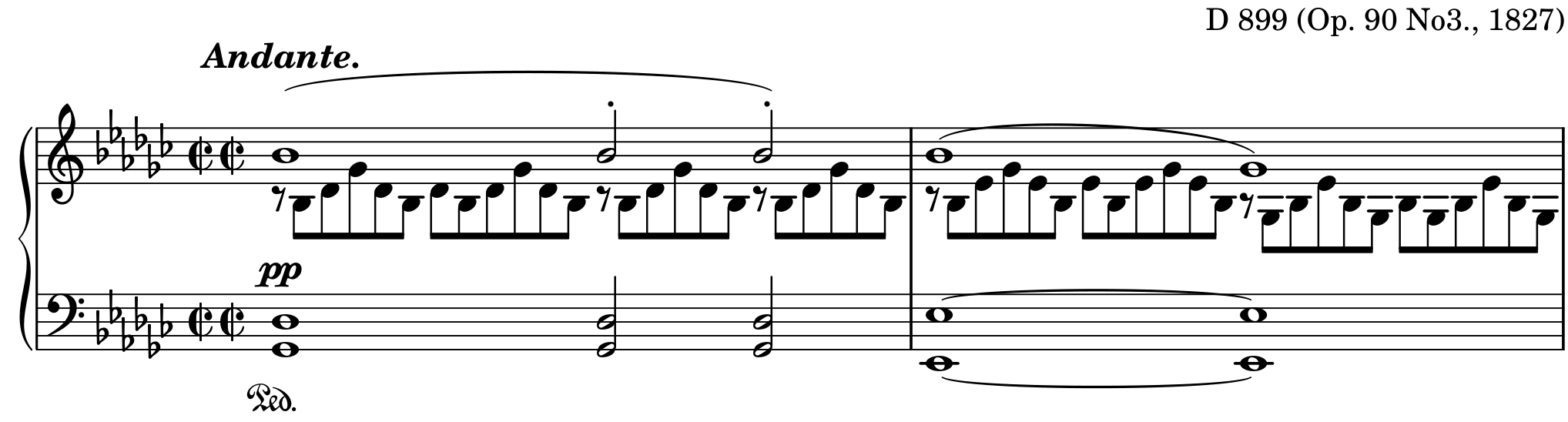
Each half-note beat contains six equal positions in the flowing accompaniment. Some positions are rests in that voice, while the melody or bass sounds above or below them. Keep those rests inside the rhythm. They are not invitations to squeeze the remaining notes together.
One broad beat, three layers
Bar 1, first half-note beat. The six columns are equal subdivisions. Middle C is C4.
Scroll sideways to follow the whole beat.
Position
1
2
3
4
5
6
Melody
B♭4 sounds, then continues through this beat and the next.
Inner voice
Rest
B♭3
D♭4
G♭4
D♭4
B♭3
Bass
G♭2 + D♭3 sound together and continue through this beat and the next.
Keep the first inner-voice rest inside the six equal positions. The melody and bass begin there.
Count the six positions slowly while learning one beat, then feel the larger half-note pulse. In a full bar there are four of those broad beats. If you keep accenting the beginning of every small group, the accompaniment can sound like a succession of starts rather than one continuous motion.
The first melody note lasts for two half-note beats. Two further B-flats occupy the third and fourth beats. Those repeated notes belong to the same opening idea, but the dots under the slur ask for some articulation. Listen for a gentle renewal of the sound instead of either tying all three notes together or making three abrupt attacks.
Melody above a moving hand
I like to hear the melody with the bass before discussing how quiet the accompaniment should be. That reduced texture exposes the phrase: where the melody stays on one pitch, where it moves and how the bass changes its meaning. Once that relationship is alive, the moving notes have something to accompany.
In the first bar, the right-hand B-flat sits above the inner B-flat–D-flat–G-flat figure. Play the melody note, then add one accompaniment group beneath it. The held finger stays available to the melody while the other fingers move. If the whole hand braces to protect the long note, reduce the task to that single group and look at the movement between its notes.
The highest note of an accompaniment group is a common place for an accidental accent. It can be close to the melody and played by a finger that has just moved into position. Listen specifically to that inner G-flat. If it sounds like a second melody, make its arrival lighter within the group rather than trying to rescue the balance by striking the true melody harder each time.
A useful comparison is to play the melody alone with its actual phrasing, then play melody and accompaniment together at the same broad tempo. Does the phrase still arrive and leave in the same places? If the version with accompaniment develops a new hesitation at every change of position, work on those changes in pairs. The issue is no longer simply volume.
Avoid choosing fingerings only for the arpeggio. A convenient pattern underneath may leave the next melody note awkward or force an early release. Test each choice through the next melodic arrival. For the general skill behind this texture, see bringing out a melody inside piano chords.
Bass and pedal
The opening bass supports the harmony without competing with the tune. In bar 1, the G-flat–D-flat interval returns with the melody’s repeated notes. In bar 2, the low E-flat octave is tied across the bar. That contrast matters: a fresh bass attack and a sustained bass are different events, even when the right hand continues flowing above both.
Play the bass with the melody and listen through each change. A low note can carry a great deal of resonance, so a small change in its attack may alter the balance of the whole instrument. The bass should give the phrase a foundation and direction; repeating every entry at an identical, heavy dynamic makes the opening feel blocky.
Add pedal to this reduced texture before restoring all the moving notes. Listen for the new harmony arriving cleanly, with the previous bass no longer clouding it. Then restore the accompaniment and listen again. The extra notes may require a different depth or a more frequent clearing of the pedal on that piano.
There is no useful rule here that every bar gets one pedal. A long 4/2 bar can contain several harmonic events, and their resonance changes with register and dynamics. In the louder middle passages, the same pedal movement used at the opening may retain too much sound. Adjust to what you hear at the change, not to the reassuring feeling of a full pedal under the foot.
Short passages without pedal reveal releases, uneven inner notes and gaps between positions. Return the pedal when you judge the finished sound: this piece depends on resonance as well as finger connection. The guide to clear sustain-pedal changes develops that relationship in more detail.
Bars 25–26: a more urgent conversation
At bar 25, the melody’s accented B-flats and the forte marking change the character. The accompaniment keeps its familiar movement, but the bass now has dotted notes and little rising groups. The music gains urgency through these relationships, not just through an increase in overall volume.
Accented melody notes and forte above dotted bass values and rising groups.
Scroll sideways to read the score.
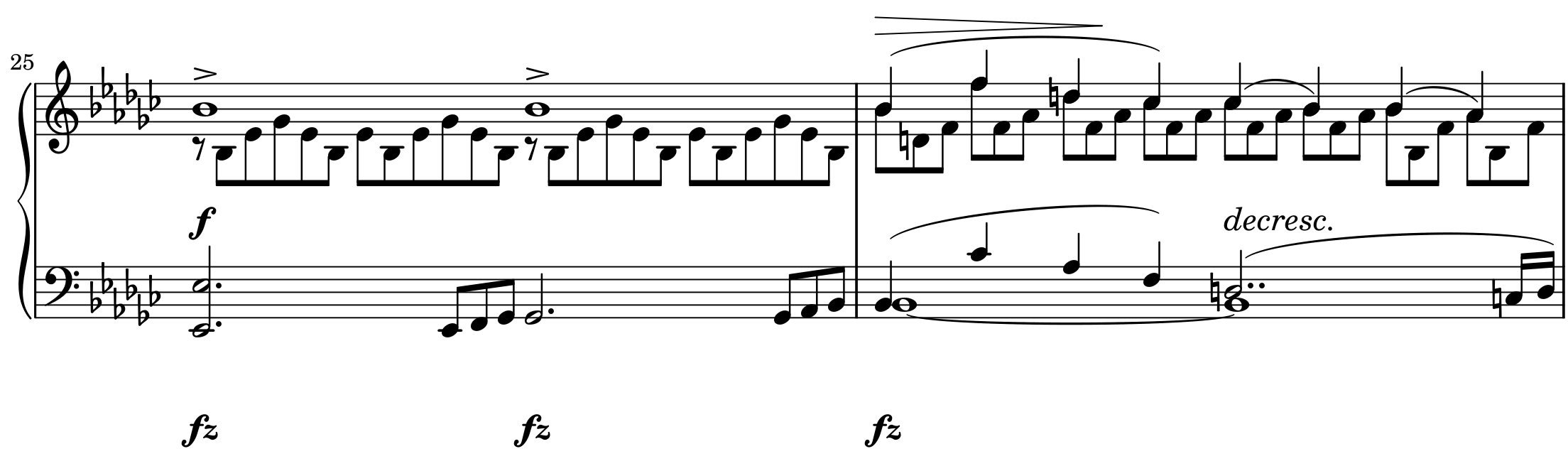
Learn the bass rhythm on its own. In bar 25, the long dotted values leave room for the short rising notes before the next arrival. If you shorten the long note because you are preparing the run, the phrase starts leaning forward too early. If you linger over the run itself, the next harmony arrives late. Hear the complete span from one bass arrival to the next.
Then combine bass and melody without the inner accompaniment. The melody’s repeated B-flats should sound purposeful, with the bass movement answering beneath them. Restore the flowing notes at a level that supports this exchange. A louder passage still has a foreground and a background.
Bar 26 brings more movement into the melody and a descending left-hand line above its held bass. Follow those lines through the printed decrescendo. Staying at the intensity of bar 25 throughout bar 26 removes the phrase’s response and makes the later piano feel like an abrupt volume switch.
I would practise the change of character from the preceding quiet passage as carefully as the forte itself. Start in bar 24 and continue through bar 27. The transition asks you to prepare a different sound while keeping the music’s underlying motion. An unnecessary pause before the stronger entry announces the difficulty instead of the phrase.
Bars 35–36: the accompaniment changes hands
At bar 35, the right hand repeats a low C-flat in long notes while the moving accompaniment is in the left hand. The marked pianississimo makes the texture especially exposed. The left hand now has to manage both its sustained bass and the flowing notes above it.
The quiet C-flat melody remains above a changing bass and inner harmony.
Scroll sideways to read the score.
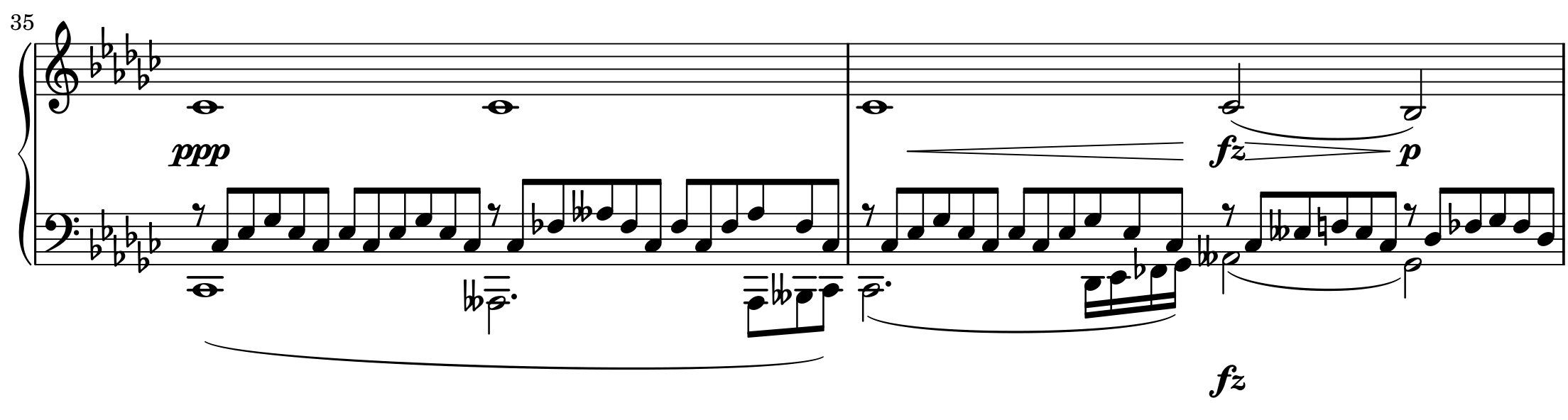
Begin with the right-hand C-flat and the left-hand bass, omitting the moving layer. Listen to the change from C-flat to A-double-flat in the bass within bar 35. The melody remains on C-flat, but the harmony underneath changes its colour. A-double-flat sounds on the same piano key as G natural; its spelling shows its place in this harmonic setting.
Now play the moving left-hand groups separately, then add the bass where it belongs. The bass note should not trigger an accent on every following inner note. Allow the hand to move through the accompaniment while the pedal and the written durations contribute to the sustained harmony.
When the right-hand note returns, listen from the melody’s perspective. Does the left hand create an even background, or does it keep pulling the ear downward? Playing the accompaniment alone successfully is only part of the test. Its sound has to fit beneath that quiet, repeated C-flat.
Bar 36 then grows, reaches an accented point and withdraws to piano. Keep that small rise and fall inside the larger phrase. Treating the whole passage as an exercise in extreme softness misses the movement written into it. The quietness has a changing shape.
The return and the late disturbance
The opening material returns at bar 55, after the fermata in bar 54. Hear that return in relation to what preceded it. The familiar B-flat melody can recover its quiet, spacious character, while your pulse continues to support the inner movement. Begin practising this return before the fermata as well as directly at bar 55; both entrances should feel familiar.
Later, the music approaches a close without becoming entirely settled. The melody and bass continue to alter the harmony, and bars 79–80 make the disturbance particularly visible on the page. The notation temporarily has no key-signature flats, then restores the G-flat-major signature partway through bar 80.
The G-flat-major key signature returns midway through bar 80, before the strongly accented change.
Scroll sideways to read the score.
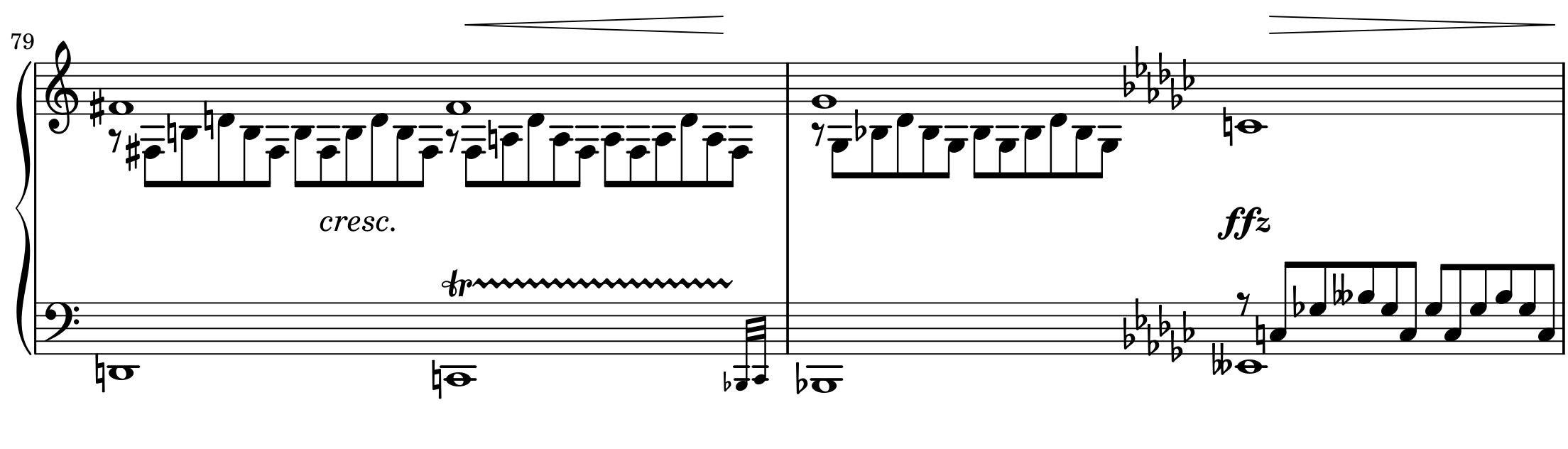
At bar 79, the melody’s F-sharp is the same piano key as the G-flat heard earlier. The surrounding notes have changed, so this is more than a different way of writing a familiar sound. Read the bass and accompaniment together: their accidentals explain why the held melodic pitch now feels unsettled.
Name the altered notes before practising the passage in motion, especially where a natural or double flat changes the shape you expected. In the latter half of bar 80, the melody moves to C natural and the lower texture changes again, with a strong accent marked ffz in this edition. Prepare that event from the preceding swell rather than approaching each accidental as a separate interruption.
This is also a place to reconsider pedal. Retaining the preceding harmony through the new bass and inner notes can blur the very colour change that gives the passage its force. Practise the melodic and bass arrivals slowly enough to hear the difference, then restore the flowing layer and the longer phrase.
The final two bars
The last page returns to quieter sound, but the ending still asks for active listening. In bar 85, the flowing figure is in the left hand and descends towards the final chord. The right hand holds a chord, renews it twice, then arrives at the tied final harmony in bar 86.
In bar 86 the two written chords are tied, with one attack and a sustained final sound.
Scroll sideways to read the score.
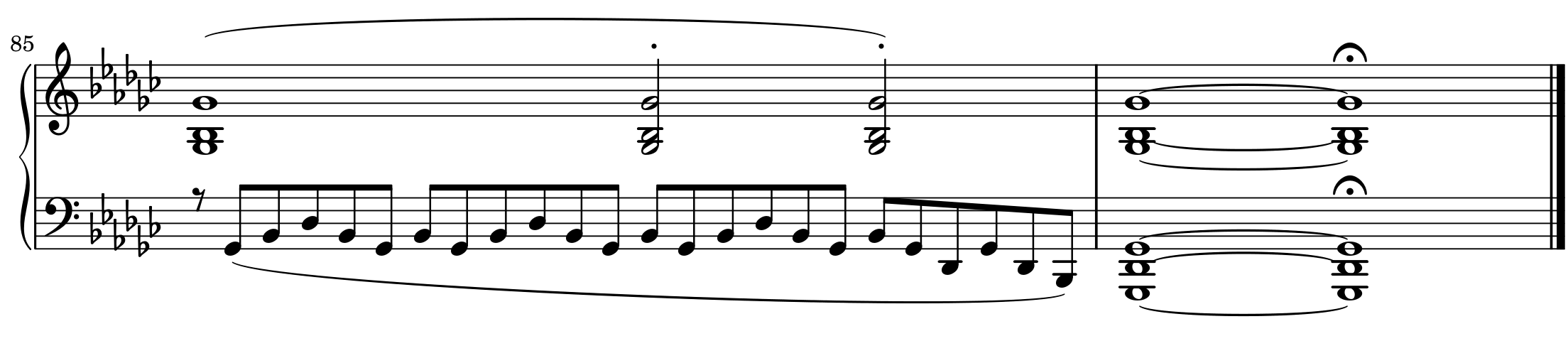
Keep the descending accompaniment audible as a line without letting its final notes become heavy. If the hand anticipates the last bass chord too early, those small notes can bunch together. Practise the descent into the final chord as one gesture in time, first without the right hand, then with the right-hand renewals restored.
The two whole-note chords written in bar 86 are tied. There is one attack followed by a continued sound, with a fermata over the ending. Listen to the resonance before releasing the pedal. Ending the physical movement and ending the sound are separate moments; a hurried foot can cut off a phrase that the hands have shaped carefully.
The closing chords also echo the opening’s pattern of a long sound followed by two shorter renewals. Hearing that relationship can help the ending belong to the whole piece. It is more satisfying than treating the final page as a gradual disappearance after the main work is over.
Practising the complete Impromptu
Give several parts of the piece a place in your practice from the beginning: the opening balance, the stronger bass-led passage, the left-hand accompaniment and the closing harmonic changes. These are different musical tasks. A session devoted only to making the opening more beautiful will not automatically prepare the later ones.
For detailed work, choose a short passage and reduce it according to the problem. Melody with bass reveals direction and harmony. Accompaniment alone reveals movement and grouping. The full texture tells you whether either improvement survives when the voices meet. Keep returning to that full sound; reductions are a way into the music.
As the sections settle, practise their joins. Start before the dynamic change at bar 25, before the left-hand texture at bar 35 and before the return at bar 55. Those starting points prevent the hands from depending entirely on the previous page’s momentum. They also give you useful places to resume if concentration slips during a complete performance.
A recording of one longer span can answer a different question from a close examination of two bars: does the melody still have a destination? Listen once for its line, then for the bass and changing harmonies. If all you hear is a continuous shimmer, revisit the balance before adding more expressive slowing. The piece’s finger connection and release timing and its larger phrasing need to work together.