
Piano Legato Without Hiding the Gaps in Pedal
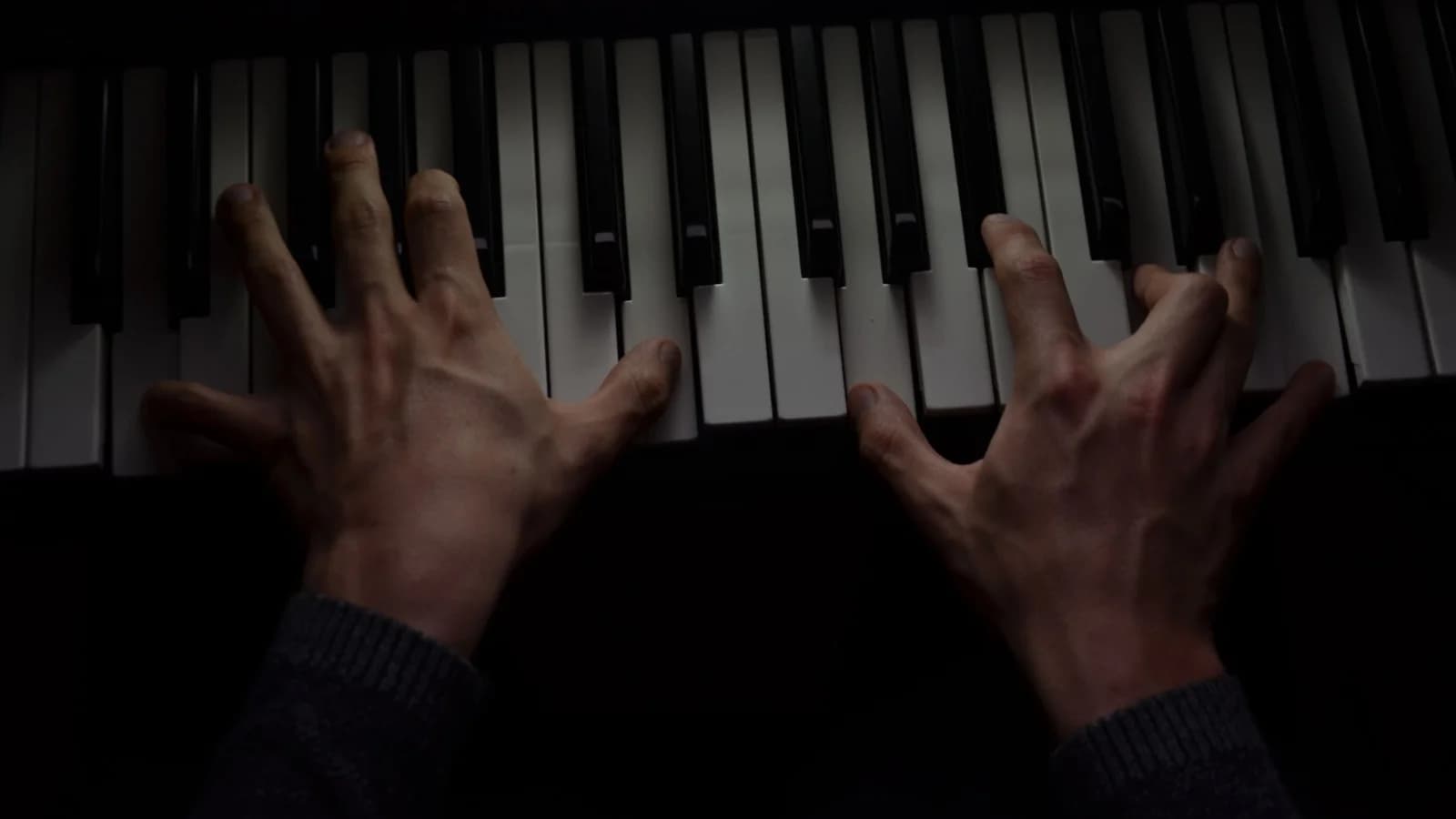
A melody can sound smooth with the sustain pedal down and surprisingly uneven when the pedal comes off. A finger releases early, a thumb arrives with a small accent, or a shift of the hand divides one phrase into two. The pedal fills the room with sound, so the interruption is harder to hear.
Piano legato begins with the relationship between one note and the next: when the first releases, how the second enters, and where the melody is going. Finger connection helps when the notes are within reach. Across a repeated note or a larger move, the ear also needs continuity of timing, tone and phrase. Pedal can then add the resonance the music needs.
The three situations below call for different kinds of attention.
What interrupts the line?
- Neighbouring notes
- Listen for an early release or an uneven next attack. Start with a short pair of notes, without pedal.
- A change of position
- Prepare the destination and hear the phrase through the move. A late or heavy arrival can interrupt the line more than a small separation.
- A repeated pitch
- Allow the key to reset for each new attack. Keep the repeats within the same melodic idea; hold tied notes without restriking.
Listen between two notes
Choose two neighbouring white keys in the middle of the piano, such as E and D. Play E with right-hand finger 3, then D with finger 2, without pedal. Listen to the end of E as carefully as the beginning of D.
Try three versions at a slow, steady pace. First, release E clearly before playing D. Next, hold E while D sounds, so the two pitches overlap noticeably. Finally, bring the release of E close to the arrival of D and listen for a clear connection. The exaggerated versions make the difference audible before you refine it.
One arrival, three release timings
Read left to right. Bars show how long each key is held. The vertical line marks the arrival of D.
Scroll sideways to see the whole comparison.
Release before D arrives
An audible separation is likely.
Release near the arrival of D
Listen for a clear melodic connection.
Keep E after D has arrived
The two pitches overlap as a harmony.
A small overlap can be useful in some musical contexts; a long overlap turns a melodic interval into a simultaneous harmony. An early release creates a separation. There is no single duration in milliseconds that works for every register, tempo and instrument. The important result is a line whose notes connect clearly, with the amount of resonance you intend.
On an acoustic piano, releasing a key allows its damper to return to the strings, where that note has a damper. Keeping the key down lets the note continue to decay. The sustain pedal holds dampers away from the strings, so a released finger no longer tells the whole story of the sound. This is why practising briefly without pedal reveals useful information about the fingers' timing.
Listen to the second attack as well. E and D can overlap perfectly and still sound disconnected if D arrives much louder. Matching the new note to the sound already in the air often matters as much as closing the gap. Play the pair at different quiet dynamics, then extend it to E–D–C while preserving one descending line.
Finger connection in a short phrase
Burgmüller's La Candeur, Op.100 No.1, offers a clear place to hear this. Its first bar contains two groups of G–E–D–C in the right hand, each under a slur. The left hand holds a C-major chord throughout the bar.
C major, 4/4. Right-hand eighth notes form short slurred groups above a held left-hand chord.
Scroll sideways to read the score.
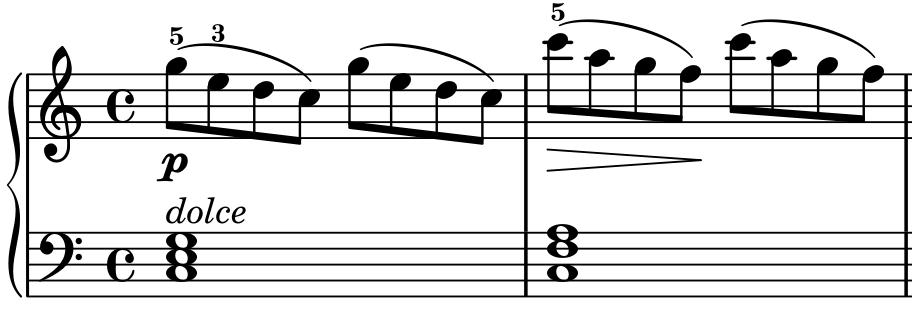
Within the first group, begin with E–D–C. These adjacent notes let you concentrate on the transfer from one finger to the next. Keep the next finger near its key, let it play, and release the previous note as the new sound arrives. Listen for both a gap and an unwanted accent.
Now put the first G back. The printed fingering begins 5–3, followed naturally by 2–1 for D–C. The skip from G to E belongs to the same small phrase. Let the hand accommodate that distance without lifting the whole phrase away from the keyboard between the two notes.
The thumb on C deserves particular attention. If it lands more heavily than E and D, the group ends with a bump. Try E–D–C on its own, making the C an arrival that settles. Then hear G–E–D–C as a single gesture. The dynamic shape can vary with your interpretation, but the thumb should not decide the phrase merely because it is the thumb.
Between the two slurs, the music has a new beginning. Hear the second G as the start of another small unit, rather than stretching the first group's C to make every sound in the bar merge. A slight release can articulate the grouping while the underlying pulse continues. Slurs help organise the musical speech, not just the fingers.
When the left hand returns, keep its whole-note chord quiet enough for the melody to remain clear. Notice whether playing the chord causes the right hand to press harder or release earlier. This is a useful distinction: a melody that works alone but changes with the accompaniment needs attention to the two hands' relationship, as well as its fingering.
I often listen to the end of these small descending groups. The beginning receives plenty of attention; the last note is where the hand may hurry away. Giving that note its place in the phrase can change the whole line without adding more pedal.
Position changes without a break in the idea
A phrase may travel beyond one comfortable hand position. The question is then how to prepare the new position while keeping the musical direction. Holding an old note as long as physically possible can leave too little time to arrive well at the next one.
Start with the destination: play the next note at the desired dynamic, with the hand comfortably placed. Then include the note before the move. Listen for a late arrival, an abrupt change in tone, or an unnecessary pause while you search for the key. Practising just that transition is more revealing than repeating the entire line.
For a scale-like passage, suitable fingering lets the hand travel along the keyboard. A thumb crossing may be part of that journey, but forcing the thumb far under a stationary hand can introduce a delay and an accent. Let the hand move in the direction of the phrase, then judge the result by the connection you hear.
Finger substitution is another option in slower music: one finger silently takes over a held key so another is free for the next note. It is useful where it solves an actual continuation problem. Try it first on a long note, listening for an unintended second attack or release during the exchange. At speed, an unnecessary substitution may make the passage more complicated.
The guide to choosing piano fingering explores these choices in more detail. For legato, evaluate a fingering through the note after the change. A comfortable landing is only part of the task; the phrase still has to continue.
A singing line across a leap
Some intervals are too wide to connect comfortably with the fingers. Kuhlau's Sonatina Op.20 No.1 has a useful example in the first movement: bar 17 moves from B to the B an octave above it, marked piano and dolce. The upper B then leads down through A and G.
First movement, bar 17, 4/4. Treble clef above, bass clef below. B4 to B5 is an octave; middle C is C4.
Scroll sideways to read the score.
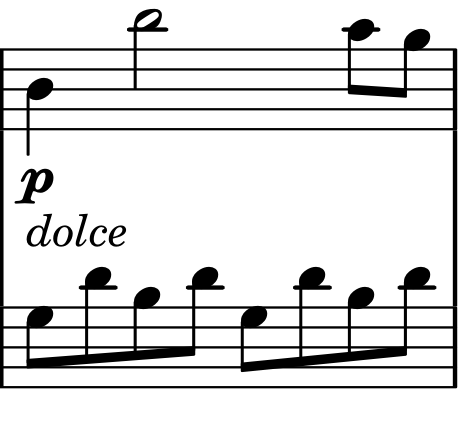
Hear the upper B through to A and G. The leap belongs to a continuing melody.
Sing the four notes before playing them. Notice how the upper B belongs to the line that began on the lower B. The space between pitches does not require a new musical sentence. That relationship is what the hand movement needs to serve.
For a hand that cannot connect the octave comfortably, release the lower B in time to travel, and prepare the upper B quietly. Work on the movement at a manageable pace, then return to the written rhythm. Holding the lower note until the last possible instant and rushing to the upper one often produces a louder landing.
The upper B lasts for two beats. It needs enough clarity to sing, followed by room for its sound to decay towards A and G. A forced attack may make the leap accurate but the phrase clumsy. Compare the upper B played from a prepared position with the same note reached from below; aim for the same kind of sound.
Continue through A and G every time you test the musical result. Stopping on the high B can train the leap as an isolated target, while the passage needs an arrival that opens into the next notes. A tiny physical separation can be much less disruptive than a late, heavy attack.
Pedal may help sustain the connection in a finished performance, provided the harmony remains clear. First establish the timing and tone of the move without it. Then add resonance and listen to what changes. The aim is a convincing phrase on the actual piano, including the places where finger connection alone cannot supply it.
Repeated notes and ties
A repeated pitch needs its key to rise enough for the action to reset before the next strike. Changing fingers can help organise the repetition, but it does not turn two attacks on the same key into a literal finger legato. A tie, by contrast, asks you to hold one sound across the written values without striking again.
Kuhlau places both ideas beside one another near the beginning of the same sonatina. In bar two, a half-note G is tied to an eighth-note G. Three further eighth-note Gs follow. The first of the four written eighth-note heads continues the half note; the next three are fresh attacks.
First movement, bar 2. Both staves use treble clef, C major, 4/4.
Scroll sideways to read the score.
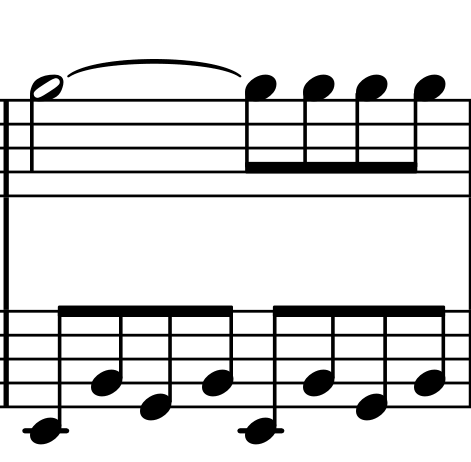
New attacks: beat 1, the second half of beat 3, beat 4, and the second half of beat 4. The tied eighth note has no new attack.
Count the bar slowly in four quarter-note beats. Hold the G through beats one and two and the first half of beat three. Rearticulate on the second half of beat three, on beat four, and on the second half of beat four. Keeping that distinction preserves the long beginning of the gesture.
Now listen to the three fresh attacks as a continuation of the sustained G. Each needs a clear beginning, but none needs to sound like a new phrase. Find a comfortable finger choice, let the key recover between strikes, and keep the attacks proportionate to the line. Try the passage without pedal before deciding how much resonance to add.
The amount of key release required for reliable repetition varies with the piano's action. A grand's repetition mechanism can allow another strike before the key has fully returned; an upright or digital piano may respond differently. Explore the instrument under your hands instead of prescribing one tiny release distance for every keyboard.
Why connected notes can still sound uneven
Legato involves a sequence of changing sounds. A loud first note followed by a much softer one can make the line seem to collapse, even if the fingers overlap. A new note that is too bright can sound like an interruption. The problem may be the shape of the phrase rather than a literal silence between pitches.
Listen to a short melody with your eyes away from the hands. Where does your attention jump? Is it a thumb note, the highest note, or the first note after a change of position? Then compare that note with the sound immediately before it. This gives a more precise task than trying to make every note “smooth.”
A descending line often needs the player to allow its sound to settle. An ascending line may need more intensity, but raising the volume on every note produces a staircase of accents. Sing the phrase and identify its main arrival. Let the smaller notes lead towards it without becoming separate destinations.
The accompaniment changes what the listener hears, too. A melody note may seem to disappear because the other hand has become louder during its sustain. In that case, holding the melody key longer will not solve the whole problem. Reduce the accompaniment and listen again before altering the melodic touch.
This is especially revealing in slow music. Long melody notes decay while the accompaniment keeps producing new attacks. The Alberti bass guide uses Mozart's K.545 Andante to explore that balance. The phrase can remain alive after its initial attack, even as the individual note becomes quieter.
Adding the pedal back
Pedal belongs to the sound of much piano music. Practising without it is a way to hear clearly, then choose what resonance to add. It is not a requirement to make every finished piece dry.
Take one phrase and play it without pedal, attending to its melodic direction. Then add pedal in the places where the harmony and texture support it. Listen for three changes: a gap that is now bridged, a resonance that enriches the sound, or old notes that remain after they should have cleared. Those results call for different adjustments.
When a harmony changes, the timing of the pedal release matters as much as the next press. When only the melody moves over a continuing harmony, the appropriate choice may be different. The separate guide to sustain pedal and clear harmony develops those decisions with examples.
Do another short comparison after adding the pedal. If the phrase only feels fluent when the pedal blurs several attacks together, return to the particular transition that is being covered. If the fingers already shape the melody and the pedal supplies warmth or bridges a necessary move, the two are working together.
A digital piano's reverb setting can also make releases less obvious. Keep the sound settings consistent when comparing attempts. Listening through the same speakers or headphones at a similar level gives you a fairer sense of whether the playing itself has changed.
What to practise in your piece
Choose one short phrase where the line breaks. Identify whether it contains neighbouring notes, a shift, a repeated pitch, or a change in balance between the hands. Then listen to the transition with the pedal off. The useful change might be a later release, a quieter arrival, a different fingering or a better-prepared move.
After working on that transition, restore the beginning and ending of the phrase. Then restore the accompaniment and the pedal the music needs. A connection that sounds convincing in two notes should eventually belong to the larger sentence, with its own direction and breathing.
I want to hear a melody that carries from one note to the next, including the places where the hands must let go. That is a richer goal than keeping every key down for as long as possible. It leaves room for articulation, colour and the character of the piece.