
Bringing Out a Melody Inside Piano Chords

Piano chord voicing is the balance between notes played together. When a melody sits at the top of a right-hand chord, the upper note needs to remain part of a recognisable line while the lower notes supply the harmony. Playing the whole chord louder usually gives you a louder chord, with the same balance problem inside it.
I listen first for the tune. Can I follow where it goes without watching the score? Then I listen to what is covering it: a prominent thumb, a new chord beneath a fading note, or a rough arrival that draws attention away from the phrase. Those produce different sounds and call for different work.
Three things matter throughout this practice:
- The line: hear the melody across several chords, including its quieter notes.
- The balance: give the supporting notes a sound that leaves room for that line.
- The connection: prepare the next shape and listen through the release of the previous one.
Start with a small chord sequence, then try the same listening in Schubert's A-flat Impromptu, D.935 No.2. Its opening makes the relationship especially clear: a soft melody moves above notes that sometimes stay held within the same hand.
One hand, two musical roles
Put your right hand over C–E–G, beginning on middle C. Play G by itself and listen to the sound you want to hear. Next play all three notes together, keeping G in your attention. The lower C and E should be audible as harmony, with G carrying the focus.
If C jumps out, try reducing C on the next attempt while keeping G similar. This is often more revealing than making G progressively louder. You hear how much the thumb was contributing to the chord and how little the melody itself may need to change.
G
above
C + E
A
above
D + F
G
above
C + E
Sing G–A–G, then keep that line in your ear as you add the lower notes. Hear three chords as one phrase.
Now move the shape to D–F–A and back to C–E–G. The upper notes form G–A–G. Sing that little line, then play it alone with the fingers you will use in the chords. Give the A a sense of arrival and let the final G settle. Add the lower notes while keeping that direction.
The three upper notes need not have identical volume. A voiced melody still has a phrase. If you accent every G and A equally, the result can sound like three announcements instead of one musical thought. Listen for the relationship between the melody notes as well as the relationship within each chord.
Preparing a balanced attack
Begin each attempt with your fingers resting on the keys you intend to play. Find a comfortable hand position across the shape before sounding it. From there, play the notes together and judge their balance. Starting close to the keys removes a large landing motion from this first experiment.
Notice whether the supporting fingers become rigid as you try to favour the melody. A hand held tightly in one shape often produces a hard chord or makes the next change awkward. After sounding the chord, let go of the effort used to start it while retaining whichever keys the music requires.
There is no single visible hand angle that proves the balance is right. The position changes with the notes, the fingering and the hand. I would rather hear a comfortable, repeatable difference between G and the lower notes than see an exaggerated gesture that works once.
A useful comparison is to play C–E–G with G prominent, then play it again with E prominent. Keep the notes and timing the same. You are changing the focus inside one sound. Return to G afterwards and listen for a deliberate choice, rather than whichever finger happens to arrive most heavily.


One-to-one classical piano
In person in Ikebukuro or Shinjuku, Tokyo. Online worldwide.

Enea
Concert pianist from Vienna
Pre-launch · Applications open
Together means together
Sometimes a melody appears clearer because its note sounds slightly before or after the rest of the chord. That separation can be an expressive choice in a piece, but it changes the attack. For the simple three-chord exercise, aim for one simultaneous beginning with an unequal balance inside it.
Listen for a little double sound at the start. If you hear one, slow the chord changes and check that all the fingers have found their keys before playing. Work on two adjacent shapes instead of repeating the whole sequence. Then return to the pulse and hear whether the melody remains clear without arriving separately.
A different problem occurs when a supporting note does not sound at all. Bring that note back at a reliable quiet level, then compare the chord again. The task is to balance a complete harmony. Making some notes disappear removes information the piece may need. For soft attacks that fail on an acoustic instrument, the pianissimo guide examines that particular difficulty.
Schubert: the melody above held notes
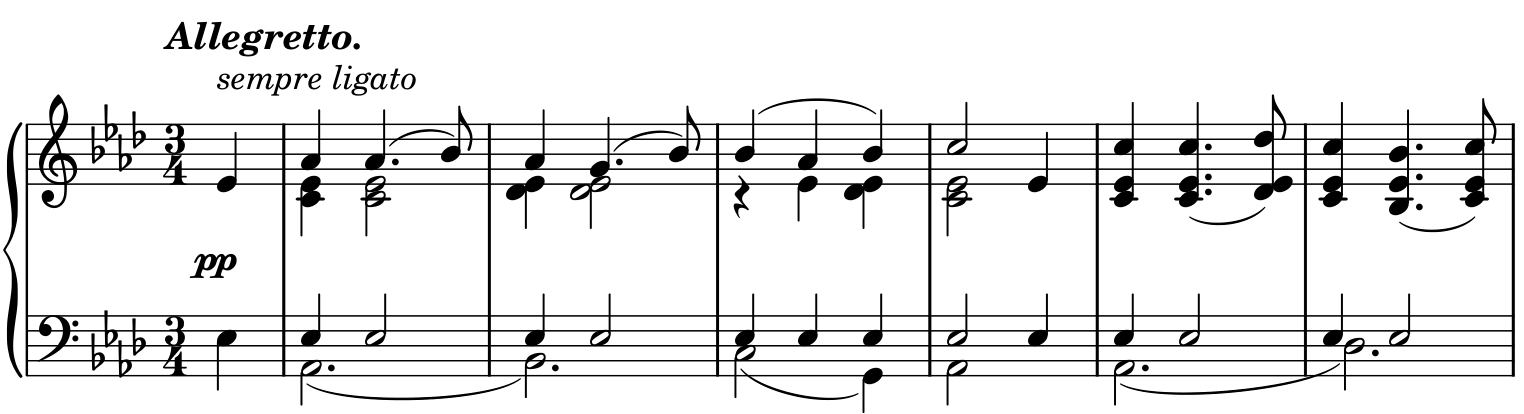
The opening of Schubert's Impromptu in A-flat major, D.935 No.2, is marked pp and sempre ligato. In the excerpt below, the short E-flat pickup leads into the first full bar. Count that full bar as bar 1. The melody rises to A-flat and reaches B-flat at the end of the bar; lower notes in the right hand support it.
Schubert, Impromptu in A-flat major, D.935 No.2: pickup and bars 1–6.
Scroll sideways to follow the score.
Bar 1: the upper voice moves
A-flat leads to the short B-flat at the end of the bar. Keep their melodic connection in your ear.
Bar 1: the lower notes stay
The C and E-flat played on beat 2 last to the end of the bar. They support the change above without another attack.
First play the upper line from the pickup through bar 4. The opening notes are E-flat, A-flat, A-flat, B-flat. Bar 2 continues A-flat, G, B-flat; bar 3 has B-flat, A-flat, B-flat; bar 4 reaches C before returning to the lower E-flat pickup. Keep the written dotted rhythms, so the short B-flats at the ends of bars 1 and 2 lead onward.
Even before adding harmony, decide how these notes belong together. The repeated A-flat in bar 1 can continue the thought begun on the first A-flat. The small rise to B-flat then carries you towards the following bar. Treating every note as a fresh start makes the tune feel laboured.
Now add the right-hand C and E-flat beneath the A-flat in bar 1. On the first beat, the three notes begin together. On beat 2, C and E-flat are written as half notes while the upper A-flat is a dotted quarter note. The upper voice moves to B-flat on the final eighth of the bar; C and E-flat remain held below it.
That last movement is a useful test. Can you hear A-flat leading into B-flat without striking the lower notes again or cutting them short? The score asks the hand to do two jobs at once: sustain the harmony and move the melody. Read the separate stems and note lengths before choosing a fingering that serves them.
The next chord changes the balance
Bar 2 keeps E-flat in the right-hand supporting notes and moves C up to D-flat. Above them, the melody goes from A-flat to G, then B-flat. The inner D-flat and E-flat sit close together, so their sound can attract attention even when neither is especially loud.
Hear the change in harmony while keeping the upper line in front. Try the end of bar 1 into the start of bar 2, rather than beginning each bar from silence. This reveals whether the new D-flat arrives as a sudden accent or becomes part of the continuing phrase.
In bar 3, the right-hand lower voice rests on the first beat while the upper B-flat sounds. The supporting notes return afterwards. Let that change of texture be audible. Voicing includes noticing where the composer has already made space for the melody; filling every moment with the same weight would flatten that detail.
The left hand adds a further layer. Play the melody with the left hand, leaving out the right-hand inner notes briefly. Hear the bass and melody together, then restore the complete right hand. If the line disappears at that point, you have isolated the balance that needs attention. If it was already obscured, listen to the left-hand level too.
Release, fingering and repeated notes
The repeated A-flats in bar 1 require the key to return before it can sound again. Listen to how the first note ends and how the second begins. A hurried lift can make a conspicuous gap; a hand that keeps pressing may delay the next attack. Work at a tempo where you can hear that transition clearly.
Choose fingering over the phrase, including the move to B-flat and the following A-flat. A finger that feels convenient on one chord may leave an awkward change immediately afterwards. Marking the melody's fingering first can reveal where the supporting fingers need to adjust.
Later in the displayed excerpt, bars 5 and 6 use fuller right-hand chords, including octave spans. The melody is now reinforced within a denser sound. Preserve the quiet character as you move from the opening texture into these chords. More notes already add resonance; they do not automatically require a heavier attack from every finger.
If a chord's span prevents a comfortable shape or clean connection, address that separately with a teacher. The guide to piano chords with small hands considers redistribution, rolling and omissions in their musical context. Straining to hold a wide chord will not help you judge a delicate balance inside it.
Pedal and the sound after the attack
Begin the short Schubert passage without pedal so you can hear which notes you hold and release. The written lower half notes then become especially clear. Once that relationship is understood, add pedal while listening to the harmony across the bar line.
Pedal can carry resonance through a connection, but it also sustains a supporting note that arrived too strongly. If the melody becomes blurred after you add it, compare the passage without pedal again. Check the initial chord balance as well as the pedal change; both contribute to what remains in the room.
The melody also fades while later notes arrive around it. Listen beyond the first instant of the chord. A clear upper note at its attack can be covered a moment later by a new accompaniment note. In that situation, shaping the later note more quietly may preserve the line better than beginning the melody with an exaggerated accent.
For a longer example of changing harmony beneath a sustained melody, the Chopin E-minor Prelude study follows the relationship between voicing and pedal through that piece. Schubert's opening gives you a compact place to hear the same question: what stays in the foreground as the surrounding sound changes?
Listening back to a phrase
Record the pickup and first four bars, then listen away from the keyboard. Follow the tune without looking at the score. Notice the exact place where it stops sounding like a continuous line: the repeated A-flat, the short B-flat, the change to bar 2, or the fuller sound when the left hand enters.
Make the next attempt about that place. If the melody is clear but every note sounds accented, shape the line. If the thumb interrupts the tune, reduce its contribution. If the harmony is incomplete, restore the missing note before trying to make it quieter. These are audible differences, not a single instruction to “bring out the top.”
When I hear a passage in a lesson, I also listen for what happens on the second attempt. A useful change survives the move into the next chord and allows the phrase to continue. We can then try it in the surrounding music, where timing, bass and pedal all affect the result.
Vienna Piano School is accepting applications for lessons online worldwide and in person at piano studios in Ikebukuro and Shinjuku, Tokyo. Bring a chordal passage you are working on and we can explore its melody, inner notes and fingering together. The school is preparing to open; start dates and trial arrangements are confirmed by email. Apply for a free 55-minute trial lesson.