
Reading Bass Clef at the Piano Without Counting Every Note
You recognise the melody, but the lower staff keeps stopping you. Each new bass note sends you back to the bottom line to count upwards. By the time you find the key, the phrase has gone.
Start with a few bass-clef landmarks, then read the distance and direction between notes. Connect each landmark to a particular key on the piano. A letter name is only half the answer: the C below middle C and middle C share a name, but occupy different places on the staff and keyboard.
Locate the starting note of a passage before playing it. That small pause tells us something useful. Are we finding a pitch, choosing a finger, or trying to coordinate two hands? Each deserves a different kind of attention.
Three landmarks and one lower note
The bass clef’s two dots sit on either side of the F line, the fourth staff line counted from the bottom. This F is below middle C. In the numbering used here, it is F3; middle C is C4.
Add C3, the C one octave below middle C. It sits in the second space from the bottom of the bass staff. Middle C itself sits on the first short ledger line above the staff.
The diagram also includes C2, two octaves below middle C, on the second ledger line below the staff. These four notes give you useful reference points across the register. Choose a note to see its written position and its keyboard location.
Find the note on the staff and keyboard
Choose a landmark. C4 means middle C.
F3 is the fourth line from the bottom, between the two bass-clef dots. It is the F below middle C.
At the keyboard, find the groups of two black keys. C is the white key immediately to their left. Find middle C, then move one octave left to C3. Play C3 and F3 slowly enough to notice the distance between them. The aim is to connect the staff, the keyboard and the sound.
For a short passage, choose the landmark nearest its first note. A note near the top of the bass staff is often quicker to find from middle C than from the bottom line. As more notes become familiar, you will rely on counting less often.
Steps, thirds and repeated notes
Once you have found the first note, look at the next note’s relationship to it. Moving from a line to the neighbouring space is a step in the letter names. Moving from a line to the next line, or a space to the next space, is a third: one letter name lies between the two.
For example, C–D is a step; C–E is a third. On the staff, C3 and E3 occupy neighbouring spaces with a line between them. Add G3 in the next space and you have three notes arranged in thirds.
The keyboard distance still depends on the key signature and any accidentals. A written step tells you the neighbouring letter name; it does not by itself tell you whether the next key is white or black. If those signs are the part that interrupts your reading, see key signatures and accidentals at the piano.
Repeated notes are another useful pattern. Once you have identified a note, let its repeated position mean “the same pitch again.” Restarting the entire naming process at every note uses attention that could go towards rhythm and phrasing.
A chord you can read as a shape
Here is the left-hand part of the first two bars of Burgmüller’s La Candeur, Op.100 No.1. It is in C major and common time: four quarter-note beats to the bar. Each chord is written as whole notes.
La Candeur, Op.100 No.1, bars 1–2. Left-hand part only; C major, 4/4.
Swipe across the score to see the complete passage.

Find C3, then read the notes above it as a group. Compare the two chords before changing position.
The first chord is C3–E3–G3. Find C3 in the second space from the bottom. The next two notes occupy successive spaces above it. Read the three notes as a C-major chord, then find that group on the keyboard.
In the second bar, the bottom C remains. The upper notes change to F3 and A3. F3 is the line marked by the bass-clef dots; A3 is the top line. Comparing the two chords reveals a simple movement: keep C, and move the other two notes up one letter step.
That comparison is more useful than treating the second chord as three unrelated puzzles. It also gives the hand something to prepare. Before changing, hear the first chord, notice the shared C, and look towards the two new notes.
I would then ask you to play the two bars in time. Hold each chord for its four beats, and hear the change at the beginning of the next bar. Recognising the shape is the reading task; arriving on the next beat is the musical task. If the change interrupts the pulse, practise the movement without repeatedly renaming notes you already know.
Ledger lines near middle C
Ledger lines continue the same pattern beyond the five-line staff. They do not begin a new system. In bass clef, the top line is A3, the space above it is B3, and the first ledger line above it is C4, middle C. D4 sits in the next space above that ledger line.
Keep the ledger line itself in view. A note on the line and a note just above it are different pitches, even when both appear to sit “above the staff.” Learning the small group A3–B3–C4–D4 gives this area a familiar shape.
At the lower end, G2 is the bottom staff line. Moving down gives F2 in the space below, E2 on the first lower ledger line, D2 in the next space, and C2 on the second lower ledger line. Use the diagram’s C2 button to locate that lower C on the keyboard.
These names describe positions, not a hand position to hold throughout a piece. The same left-hand finger can play different notes as the music moves. Read where the music goes, then choose fingering that supports the passage.
A minuet that reaches above the staff
The opening of Petzold’s Minuet in G, BWV Anh.114, offers a useful example near middle C. This is the piece often encountered under the older label “Bach’s Minuet.” The score uses G major, with F sharp in the key signature, and three quarter-note beats per bar.
Minuet in G, BWV Anh.114, bars 1–4. One sharp, F sharp; 3/4 time.
Swipe across the score to see the complete passage.
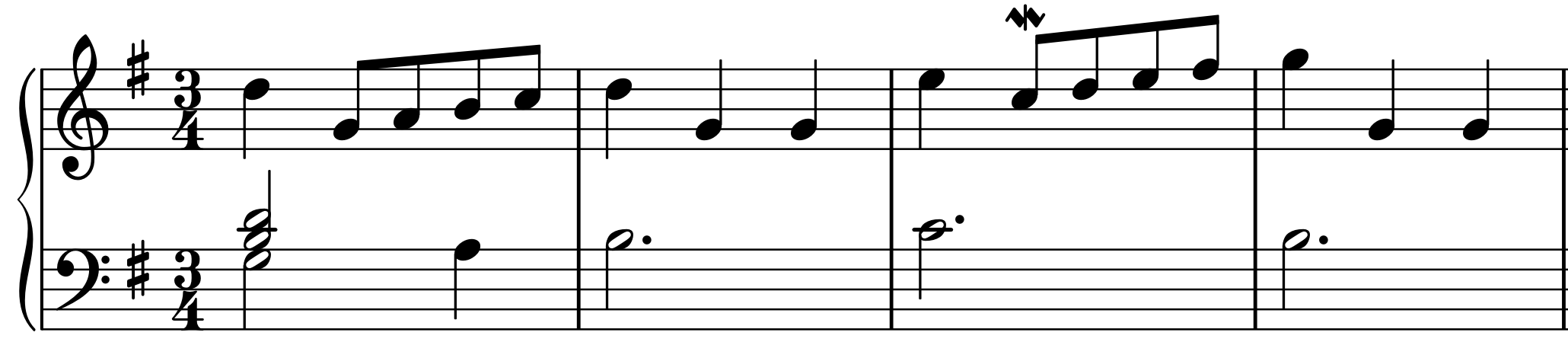
The lower line rises G–A–B–C, then returns to B. Check the octave as well as the letter name.
Look first at the lower staff. Its opening chord is G3–B3–D4. The G sits just below the top line, B is in the space above the staff, and D sits just above the ledger line for middle C. The three notes again form a stack of thirds.
On beat three, the left hand moves to A3, the top staff line. The following bars give B3, then C4, then B3 again. Each of those later notes is a dotted half note lasting the full three-beat bar.
You can follow the lower line as G–A–B–C–B, beginning with G as the bottom note of the opening chord. Find the actual keys before playing. These notes are near middle C; moving an octave lower would preserve the letter names but change the written register.
Try the left-hand part by itself and hear how its longer notes support a three-beat phrase. Then look at the upper staff. It has more movement, while the lower part often stays on one note. Reading the bass in groups leaves time to hear that relationship when the hands come together.
Bass clef and the left hand
Piano music often places the left-hand part on a bass staff, but the clef and the hand are separate instructions. A lower staff can change to treble clef when the writing moves higher. Both staves can also use the same clef.
At a clef change, find a familiar note in the new clef and check its keyboard position. Continuing to use the previous clef’s note names shifts the whole passage. The same applies when you return to a bass clef later in the piece.
If you hesitate at such a change, find the first pitch on the keyboard, then the short pattern that follows. Once the starting point is clear, the interval shapes can help carry the reading onwards.
Reading and coordination
Suppose you can identify and play the left-hand notes alone, but lose them when the right hand joins. The next step is to examine what the hands do together. A passage where both hands move at once asks something different from one where the left hand holds while the right hand continues.
In the Burgmüller example, the left hand keeps a chord sounding while the melody moves. In the minuet, the bass often lasts for an entire bar. Hear that held sound as part of the phrase. A long note still occupies time, even though the hand has fewer new keys to play.
You might combine just the first beat of a bar, then extend through the following beat while keeping the bass in mind. Return to the whole short phrase once the relationship is clear. Our guide to moving from tutorials to reading music discusses the wider transition from copying movements to following a score.
Marking your music
A useful pencil mark draws your attention to a particular decision: the first C3 of a new section, a clef change, or the upper note of a chord that you keep placing an octave too low. It should help you return to the notation.
Writing every letter name can turn the page into a second text that you read instead of the staff. Try marking the starting landmark and then reading the shape of the next few notes. When that shape is familiar, cover the reminder and find the first note again.
For a brief practice session, choose an unfamiliar line with a manageable rhythm. Locate its first note, notice any repeated shapes, and play slowly enough to keep reading. At the end, return to the place where you lost the register or missed a change. A fresh short line gives you a clearer picture of your reading than a piece your hands already remember.
The ten-minute sight-reading guide develops that kind of regular practice. Here the focus is narrower: make the bass staff’s landmarks and intervals familiar, then use them in the music you actually want to play.
Bring a left-hand passage to a trial
If the lower staff keeps interrupting your practice, bring the passage you are working on. We can identify the starting notes, find useful patterns, and hear whether the main difficulty is reading, moving between positions or combining the hands.