
From Piano Tutorials to Reading Music: A Guide for Self-Taught Players
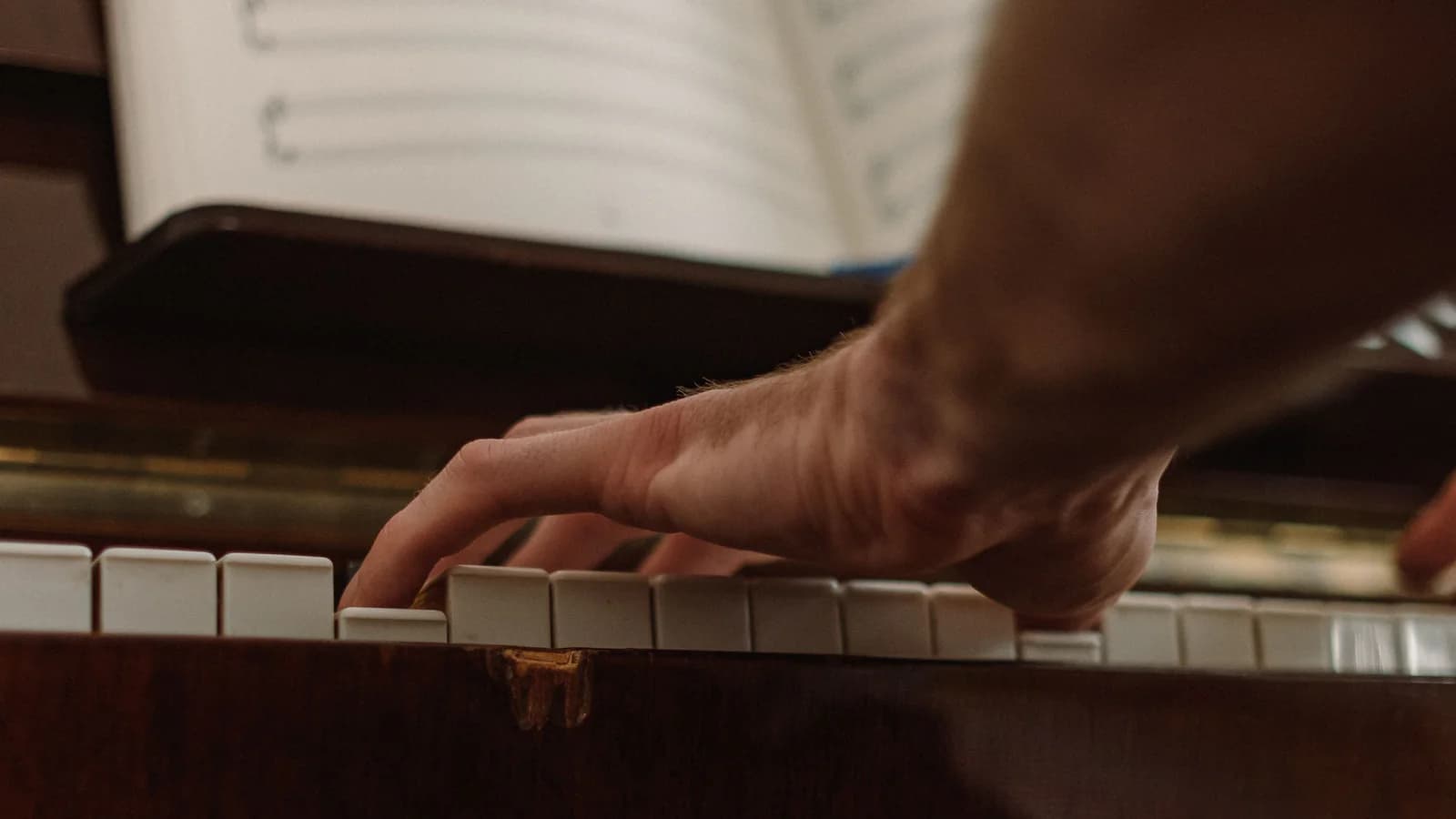
If you can learn a piano piece from a video but struggle to make sense of its sheet music, start by connecting a short passage you already know to the page. Find where its melody begins, how the rhythm is written and what the other hand does. Then read a short unfamiliar passage with similar demands. That second step matters: recognising a tune on the page and learning new music from it are different achievements.
Self-taught pianists often have an uneven mix of skills. You may remember a long sequence, recognise a wrong note immediately and shape a phrase by ear, while a few bars of simple notation take considerable effort. I like to hear something the player already enjoys before choosing a reading example. It tells me what their ears and hands can already do, and where the page has yet to catch up.
For the transition from tutorials to reading music, keep three tasks in view:
- Recognise: connect the sound of a familiar passage to its notation.
- Explain: find the pitches, note lengths and points where the hands meet.
- Read something new: use those same ideas without a demonstration supplying the answer.
The examples below use short passages from Ferdinand Beyer's Op.101. Their modest technical demands leave room to notice how the writing works. The same approach can later help you learn a piece you chose for yourself.
Start with music you know
Choose two to four bars from a piece you learned by watching or listening. Use a score of the arrangement you actually play. A simplified tutorial may change the key, leave out inner notes, move a melody to another octave or shorten an introduction. When the printed version differs, a mismatch can look like a reading mistake even though you have accurately remembered the video.
Play the short passage, then find its first melody note on the page. Identify its letter name and its place on the keyboard. Follow what happens next: the same note again, a step upwards, a skip downwards, or a longer-held sound. Look for a point you can recognise by ear, such as the highest note of the phrase or a repeated chord.
Now follow the score while you play. If your eyes lose their place but your hands continue, stop at the end of the phrase and locate the point where you stopped following. That is useful information. The task is to make the page meaningful at that spot, rather than merely put a score in front of a performance you already know.
Try beginning at the second bar as well as the first. Read its starting note before moving your hand. A memorised sequence often carries you from the beginning; a score can also tell you where to start in the middle. That freedom is one of the first practical benefits of reading.
A sound you can find on the page
Here is a small example of that connection. Find the C one octave above middle C with your right hand. This is C5. Count four steady beats, playing C on beat one and holding it through beats two and three. Play the neighbouring D on beat four. In the next bar, play D again on beat one, hold it for three beats, then play E on beat four.
Listen to the difference between the held sound and the short moving note. The D on beat four leads into another D at the start of the next bar. They are two separate attacks on the same key.
Beyer No.5, right hand, first two bars. C5 is the C one octave above middle C.
Bar 1
Bar 2
The D on beat four of bar 1 and the D on beat one of bar 2 are played separately. Keep all four beats evenly spaced.
Those are the first two bars of Beyer's No.5, shown below with the next two bars. In bar three the long note is E and the short note is D. In bar four, a long D leads down to a short C. The melody rises over the first three bars and then comes back down.
Beyer Op.101, No.5, student part, bars 1–4. Both staves use treble clef. Common time: four quarter-note beats per bar.
Scroll sideways to read all four bars.
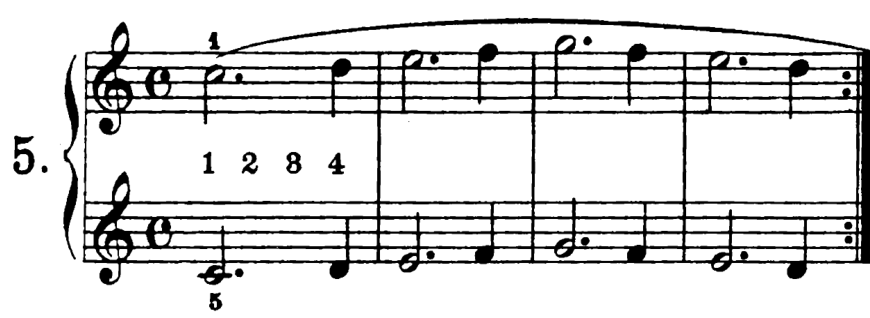
Open notehead + stem + dot: three beats. Filled notehead + stem: one beat. In each bar, the melody changes pitch on beat four.
In the upper staff, the opening C sits in a space. The D is on the next line up; E occupies the next space. The positions show a movement through neighbouring note names. Once you have found the starting C, follow that shape as well as naming each pitch.
The lower staff begins on middle C, one octave below the right hand. In these four bars, both hands play the same note names and rhythm an octave apart. The fingers doing the work differ: the printed opening uses the right thumb and the left little finger. Watch the written notes rather than expecting the same finger number in both hands.
The curved line across the upper melody is a slur, grouping the notes into a phrase. As you read, aim to hear that whole rise and fall. The notes are giving you a musical shape as well as a set of keys to press.

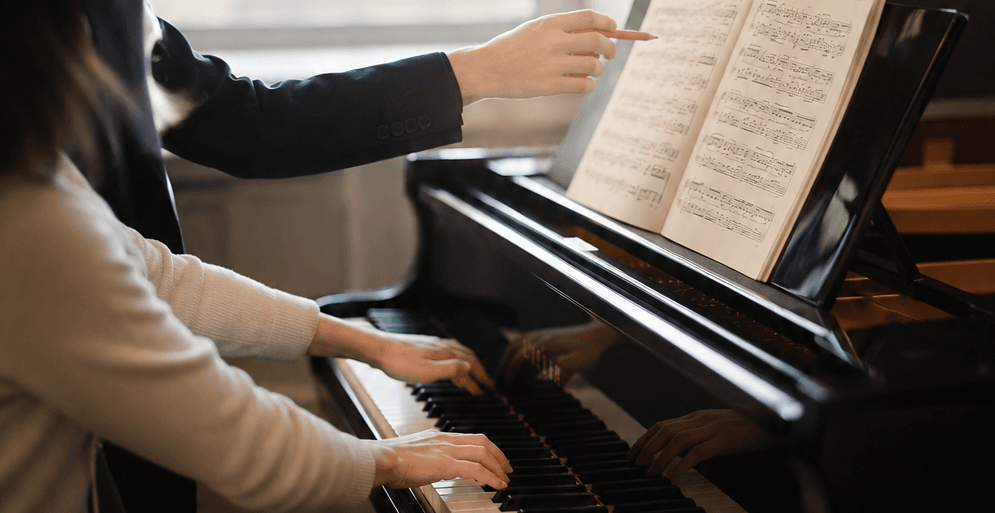
One-to-one classical piano
In person in Ikebukuro or Shinjuku, Tokyo. Online worldwide.
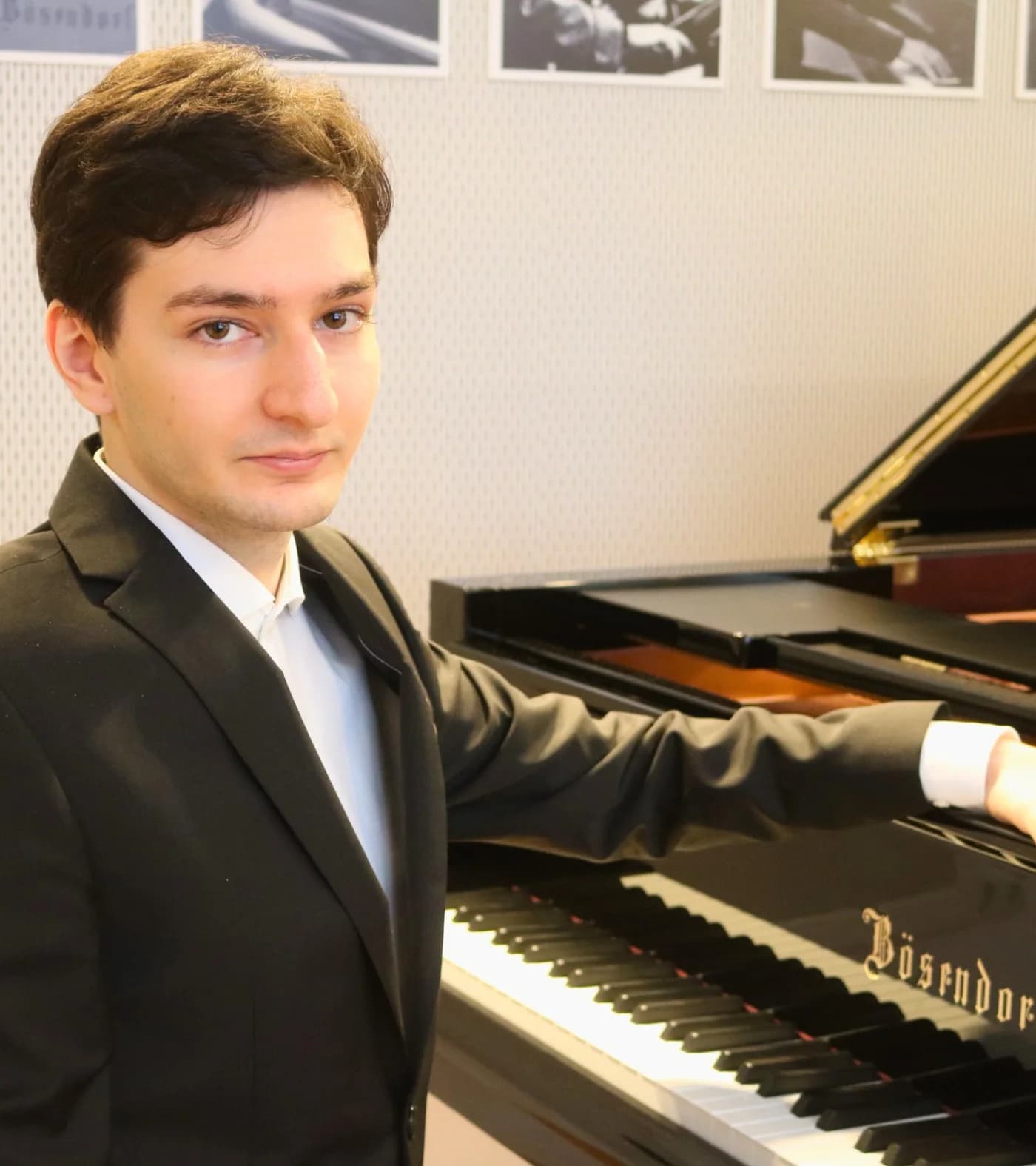
Enea
Concert pianist from Vienna
Pre-launch · Applications open
Read the time inside a note
The first C has an open notehead, a stem and a dot beside it. It is a dotted half note, also called a dotted minim. In this passage it lasts three quarter-note beats. The filled D with a stem is a quarter note, or crotchet, lasting one beat. Together they fill the four-beat bar.
The C-shaped time signature is common time, equivalent to 4/4. Count “one, two, three, four” evenly, with the change to D on four. Holding the first note while counting is part of playing the rhythm. If you release C after beat one and silently wait for D, the timing of the attacks may be correct, but the written duration has been shortened.
There are also numbers in this edition. The small 1 above the first right-hand note is a fingering: use the thumb. The 1, 2, 3, 4 written between the staves are a counting aid for the first bar. The notes' shapes determine their lengths. Separating these kinds of information prevents a common difficulty with tutorial learning, where a finger sequence can become the only remembered instruction.
The dots beside the long notes extend their duration. The paired dots at the right-hand end of this excerpt belong to a repeat sign. They ask you to play the passage again. Their position on the page tells you which job they are doing; a dot is not a single instruction wherever it appears.
You can practise reading the rhythm on one comfortable key before restoring the pitches. Keep the long sound present, then move on the fourth beat. Afterwards, use the actual C–D, D–E, E–D and D–C pairs. This separates a timing question from a note-finding question without losing the phrase.
Read both staves, including the clefs
Both staves in this Beyer excerpt use the treble clef. The lower one belongs to the left hand, but it is not written in bass clef. That is a useful reason to check the symbols at the beginning rather than assume that “top means treble, bottom means bass.”
Find the two opening Cs before starting: C5 for the right hand and middle C, C4, for the left. The left-hand note sits on a short ledger line below its staff. The right-hand C is in the third space from the bottom. Once your hands are in place, follow one pair of bars while hearing their octave relationship.
The vertical alignment shows which notes begin together. Here, every right-hand attack meets a left-hand attack, and both notes are held for the same length. In other music, one hand may continue while the other changes. Look at the lengths and rests in each staff, as well as which noteheads line up.
If combining the hands consumes all your attention, read each part first, then combine one bar. Notice exactly what disappears when the second hand enters. It might be the held note, the fourth beat, the location of the next bar, or the left-hand pitch. Those call for different kinds of work. Repeating the whole passage at the same speed can leave the original difficulty untouched.
An unfamiliar four-bar passage
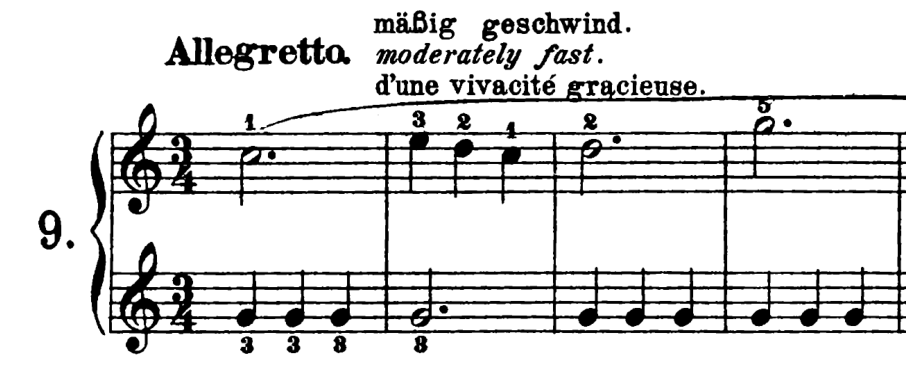
Once No.5 makes sense, try the opening of Beyer's No.9 without hearing a demonstration first. It uses a small right-hand range and a repeated left-hand pitch, but the rhythm and the relationship between the hands have changed. Read the clefs and time signature, find both starting notes, and decide which hand moves while the other holds.
The heading says Allegretto. For this first reading, choose a pace at which you can follow the written information. Read the right-hand line, then the left, before trying them together. The answer beneath the score is there to compare with your reading after the attempt.
Beyer Op.101, No.9, student part, bars 1–4. Read the time signature and the two starting notes.
Scroll sideways to read all four bars.
Check the pitches, rhythm and hands
Starting notes: right hand C5, one octave above middle C; left hand G4, the G above middle C. Both clefs are treble.
Pulse: three quarter-note beats per bar. A dotted half note lasts the whole bar.
- Right hand holds C5 for three beats; left hand plays G4 on every beat.
- Right hand plays E5, D5, C5, one per beat; left hand holds G4 for all three.
- Right hand holds D5 for three beats; left hand plays G4 on every beat.
- Right hand holds G5 for three beats; left hand again plays G4 on every beat.
In bars 1 and 2, the role of holding or moving passes from one hand to the other.
A revealing difference is the time signature. No.9 is in 3/4, so the dotted half note now fills the whole bar. Its length is still three quarter-note beats. In No.5, that same note value was followed by a quarter note before the next bar line. Reading the time signature and the note value together explains the difference.
In the first bar, the right hand holds while the left hand plays three times. In the second, the right hand moves while the left hand holds. If both hands repeatedly follow each other's attacks, play one bar at a time and listen for the sustained sound beneath or above the moving notes. Keep the held key down while the other hand continues.
The second bar of the melody also begins above the opening C, then descends. Before playing it, point to the first note and name it. If you simply continue the movement you remember from No.5, your ear may accept a plausible tune while the page is asking for something else.
Once you have worked through this example, it becomes familiar too. A fresh short passage will eventually be needed to see how the reading transfers. A tutor book with gradual changes can supply that material more consistently than choosing an unrelated new piece every day.
Bring reading back to your own piece
Keep working on music that interests you alongside these short examples. The reading task for an ambitious piece can be small: locate the first note of a phrase, understand a rhythm you have been copying, or identify which chord tone changes in the left hand. Choose something whose notation you can explain afterwards.
Suppose your tutorial teaches a broken chord as a long list of keys. In the score, find the bass note and the notes belonging to the same harmony. Notice when the bass repeats and when it changes. A repeated shape then becomes something you recognise, rather than a new sequence to memorise from the screen. Key signatures and accidentals still matter: a familiar shape can contain a changed pitch.
For a melody learned entirely by ear, read the rests and held notes particularly closely. You may have copied the general contour while missing an early release, a rest between phrases or a note sustained across a bar line. Let the notation refine the version you hear internally. Then listen again to the effect of that detail in the phrase.
Use a video to answer a specific question after making your own attempt. For example, compare how a phrase is shaped, or check a movement you cannot see clearly in the score. Our guide to piano lessons, apps and YouTube discusses what each format can help you notice. Here, the change is that the score begins to supply some answers before the video does.
Signs that reading is becoming independent
Independent reading appears in small, repeatable actions. You can locate a starting note, continue through a simple rhythm, notice when a pattern changes and return to a chosen bar after a pause. You can explain why a note lasts longer, or why one hand waits while the other moves. These are more informative signs than how impressive the memorised piece sounds.
I also listen for whether the reader's ear is involved. If a written line rises but the sound falls, does the player notice? If a long note stops too soon, does the phrase feel interrupted? Existing listening skills can help check what the eyes have understood. Naming notes accurately is useful, but hearing relationships gives the symbols musical meaning.
When a passage still takes a long time, identify the slowest part of the process. Finding the first pitch suggests work on staff landmarks. Knowing every pitch but losing the pulse suggests rhythm reading. Managing each hand alone but losing the held notes together suggests coordination. That distinction helps choose the next example at an appropriate level.
A short daily place for unfamiliar music supports this work. The ten-minute sight-reading routine offers one way to organise it once you can decode a simple passage. Keep some practice for understanding a score carefully and some for following easy music in time. Both contribute to learning your next piece with more independence.
Lessons for self-taught pianists
In a lesson, I would like to hear a piece you have learned in your own way, then try a short unfamiliar score together. The contrast helps us choose what to develop: notation, rhythm, fingering, coordination, or an interpretive detail your ear is already reaching for. The aim is to build a useful reading skill around your playing, with music you have a reason to learn.
Vienna Piano School is accepting applications for one-to-one lessons in English, at piano studios in Ikebukuro and Shinjuku, Tokyo, and online worldwide. The school is preparing to launch; start dates and trial arrangements are confirmed by email. The first trial lesson is 55 minutes and free.
Apply for a free trial lesson and mention what you currently play, how you learned it and what happens when you try a new score. That gives us a musical starting point for the lesson.