
Piano as a Second Instrument: A Guide for Musicians
If you already sing or play another instrument, piano lessons can begin with the music you understand and the keyboard skills you need. You bring an ear for phrasing, rhythm and perhaps harmony. The new work is finding those sounds across the keyboard, reading two staves together and shaping several notes at once.
That combination can feel unusual. Your ear may know exactly what a phrase should do while your hands are still searching for its first chord. Keep both sides of that experience in view: respect the musician you already are, and give the pianist you are becoming music that the hands can learn properly.
The aim might be to find a starting pitch, explore the harmony of a song, prepare an instrumental part with its bass, or enjoy an independent piano piece. Those uses lead to different first lessons. Choosing one gives your piano study a purpose alongside your main instrument.
Choose the first use for your piano playing
A singer who wants to find pitches and check intervals needs secure keyboard geography and a way to hear a melody against its harmony. Playing the complete piano part of a Lied is a much larger task. Begin with the part of the music that will help your own study now, while building towards more demanding uses.
A violinist or flautist may read a treble-clef melody fluently but need time to recognise the bass staff. A cellist may be comfortable below middle C while the upper register feels less familiar. A musician who reads chord symbols may understand the harmony yet have little experience choosing a comfortable keyboard voicing.
Bring one practical goal to the first lesson:
- Find and play a melody with a dependable pulse.
- Hear a passage together with its bass or a simple harmony.
- Learn a short piano piece in which both hands have musical roles.
These goals can develop together, but one should lead the work. “Useful piano skills” becomes a real musical task when you can name the song, passage or kind of rehearsal you want them for.
Keyboard geography and the two staves
Use the groups of two and three black keys to locate notes across the keyboard. C sits immediately to the left of a group of two; F sits to the left of a group of three. Find several Cs in different registers, then return to the one you need without counting every white key from the edge of the instrument.
Connect the staff with an actual register. Middle C is C4 in the pitch labels used below. It can appear on a short ledger line below the treble staff or above the bass staff. Those are two ways of writing the same piano key, not two different Cs.
If one clef is new, spend part of the practice on a few landmarks in that clef. Then read the distance to the next note: a step, a third, a repeated pitch. Your existing sense of intervals is useful here. Reading each unfamiliar bass note as an isolated name can make a simple phrase unnecessarily slow.
At the piano, look across the two staves as well as along them. Notes placed vertically together sound together, even when their shapes or stem directions differ. Before playing a short passage, identify one shared beginning and one place where a hand continues while the other holds or rests.
Four voices in a Schumann chorale
Schumann’s Chorale, Op.68 No.4, offers a clear example of reading vertically and hearing horizontally. In its opening, the upper melody begins G–A–B–A, while the bass starts G–F-sharp–G–F-sharp. Two inner lines complete the harmony. The score has two staves, but the music asks you to hear more than two lines.
Scroll sideways to read the score.
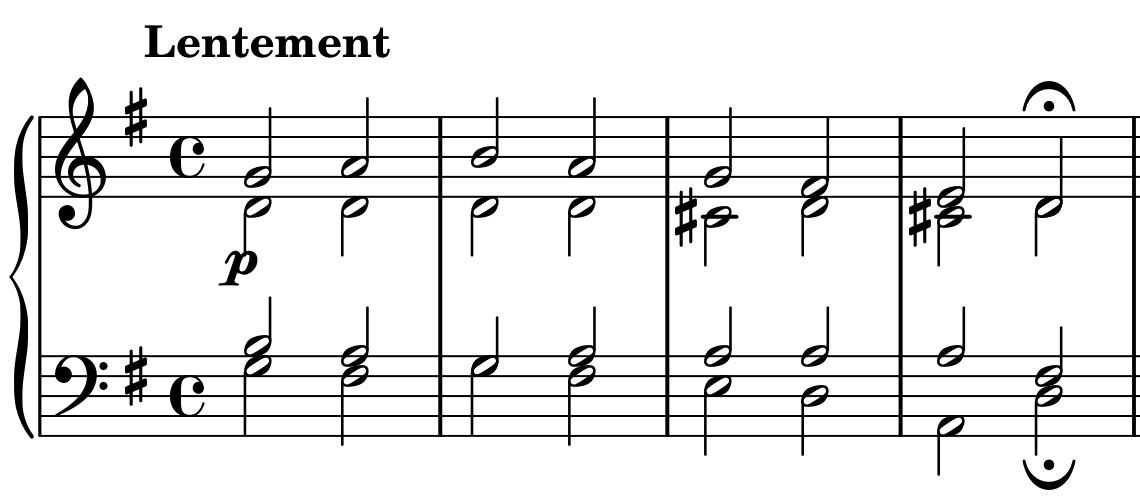
In bar 1, the melody rises from G to A while the bass falls from G to F-sharp. Hear those outer lines before adding the inner notes.
Begin with the upper melody by itself. Sing it, then find it on the keyboard. Next, play the bass alone and hear its different direction. In the first bar, the melody rises from G to A while the bass falls from G to F-sharp. That contrary motion is a musical relationship you can recognise before playing the complete chords.
Now combine just those outer notes slowly. Keep the melody in your ear while the left hand moves. This is a temporary reduction for study; the inner voices return as soon as the outside lines are familiar. A useful reduction preserves the part of the music you are investigating.
The first complete harmony is G–B–D–G, from bottom to top. The next is F-sharp–A–D–A. The first is G major; the second is D major with F-sharp in the bass. Notice that D remains the same pitch in both harmonies. The score still gives it a new half-note on the second chord, so play that new beginning rather than tying it between the chords yourself.
Hearing a chord as moving voices
The keyboard diagrams show those first two harmonies in their written registers. Open each one and compare the notes that move. The left hand has G3 and B3 in the first chord, then F-sharp3 and A3. The right hand has D4 and G4, then D4 and A4.
The first bar, one harmony at a time
Open either chord to see its keys. D4 appears in both; the melody rises while the bass falls.
First harmony: G major
Scroll sideways to see all the keys.
- Left hand
- G3 and B3
- Right hand
- D4 and G4
Second harmony: D major over F-sharp
Scroll sideways to see all the keys.
- Left hand
- F-sharp3 and A3
- Right hand
- D4 and A4
Find the first shape without rushing. Touch the intended keys and play a complete, comfortable sound. Then prepare the next shape and listen to its different colour. Once both are familiar, move between them in the chorale’s pulse. Each chord is a half-note in this opening.
The melody should remain audible inside that fuller sound. A musician accustomed to playing one line may initially give every note of a piano chord equal prominence. Try hearing the upper G and A as the phrase, with the other notes supporting them. Keep the lower harmony present; the aim is a melody within a texture, not a tune above notes that have disappeared.
If the top line is difficult to hear, play it alone again, then add the bass and finally the inner notes. Listen after each addition. The guide to bringing out a melody inside piano chords explores that balance in more detail.
Listening to Jörg Demus
Follow the opening in Jörg Demus’s recording below. First attend to the upper line, then listen again with the bass in mind. The four-part texture gives a pianist several musical responsibilities at once. The task is to keep those lines related while allowing the phrase to continue.
Jörg Demus: Schumann’s Chorale
Nuova Era / The Orchard Enterprises. Listen on YouTube.
Use the recording as a musical reference for the piece, then return to a pace at which you can hear your own two-chord change. A polished performance does not tell you which fingering or movement will suit your present hands. That part of the work happens at the keyboard, with the score and the sound you produce.
For a singer, the chorale can also be a small exercise in hearing a line against other voices: sing the melody while playing only the bass. For an instrumentalist, alternate playing the melody on your main instrument with finding the bass at the piano. Keep the passage short enough that you can remember what you heard between the two attempts.
Touch, fingering and note lengths
The piano gives you a definite attack followed by a decaying sound. A singer, wind player or bowed-string player can continue shaping a sustained note while it lasts. At the piano, the shape of a line depends greatly on how one attack leads to the next, and on the duration and release of the notes.
Listen to a two-note phrase. Does the second note continue the direction you intended, or arrive as an unrelated accent? Try it again with a different balance between the two sounds. Your musical ear can judge the phrase while your hand learns how to produce it.
Finger numbers also need a fresh association. Piano uses 1 for the thumb through 5 for the little finger in both hands. A string player's familiar numbering system should not be carried into a piano score automatically. Read the printed number, locate the hand and try the movement in context. The piano fingering guide explains how to assess a suggested fingering against the phrase.
The other adjustment is independence within a hand. One finger may hold a note while another moves, and a melody can sit above an accompanying note in the same hand. Learn these small combinations slowly enough to hear their releases. Playing every written note is the beginning of the task; keeping its proper length is part of the music too.
A practical harmony exercise
Away from the Schumann passage, try a simple G-major chord in one hand: G–B–D. Then find B–D–G and D–G–B. They contain the same three note names in different orders. Play them slowly and listen to how the lowest and highest notes change the sound.
This is a useful bridge between knowing what an inversion means and finding one at a keyboard. Name the bass note before playing. Then choose two neighbouring shapes and move between them without jumping unnecessarily to a distant register. Allow the hand to move into the new position rather than holding one fixed spread.
For a song you are learning, choose a short phrase whose harmony you already understand. Play its bass notes first, then add a simple chord where you know one belongs. Keep the melody in your ear. If the harmony is uncertain, bring that exact passage to the lesson instead of filling the space with a guessed chord.
A reduction like this is for understanding the music. A complete accompaniment has its own notes, rhythm and character to learn. As your keyboard skills develop, you can restore more of the written texture and hear why the composer chose it.
Practice beside your principal instrument
Keep a small independent piano piece alongside the practical task. The piece teaches you to sustain a phrase from beginning to end, coordinate the hands and listen to a complete texture. Finding pitches for your main instrument is useful, but it will not by itself develop all those piano skills.
Give the new keyboard movement a place in the practice before you are exhausted by other work. A short passage played with attention to sound and release is more useful than repeatedly stumbling through a long piece at the end of the day. Choose an amount of work that leaves you able to hear what changed.
When the hands separately work but the combination falls apart, identify the exact point of coordination. It may be the first simultaneous attack, a held note under a moving line or the moment one hand changes position. The hand-coordination article gives examples of reducing that problem while keeping the rhythm.
Progress may be uneven across skills. You might understand an advanced harmony while learning an elementary keyboard movement, or read a melody quickly but need more time with the bass clef. Choose piano repertoire according to what you can actually play and hear together, while continuing to use the musical understanding you already have.
Piano lessons for an existing musician
Recording: Jörg Demus, Schumann Op.68 No.4, Nuova Era Internazionale / The Orchard Enterprises. Photograph: Fidan Nazim qizi, grand piano and open score, Pexels licence. Keyboard diagrams: Vienna Piano School.