
Alberti Bass Without a Heavy Left Hand: Balance, Evenness and Phrase
The melody begins warmly, but a few bars later the left hand seems to be running the piece. Every return to the thumb makes a small accent. The right hand responds by playing louder, and a quiet Mozart phrase gradually becomes a contest between the hands.
Alberti bass is a repeating broken-chord pattern, usually ordered lowest, highest, middle, highest. To balance it, hear the chord beneath the pattern, give the bass a clear place in the phrase, and keep the recurring upper note from becoming an accidental second melody. Even spacing matters; identical emphasis on every note does not.
The most useful starting point depends on what you hear:
- The whole accompaniment covers the tune: compare the melody with a reduced left-hand chord before restoring the moving notes.
- One note keeps sticking out: listen for the returning thumb and the movement just before it plays.
- The pattern stumbles when the harmony changes: practise the change of chord shape across the bar line or beat, including the note before it.
Here are two examples from Mozart and Kuhlau, followed by ways to carry the same listening into your own sonata or sonatina.
The four-note pattern
Play C–G–E–G with the left hand, using the C at middle C and the E and G above it. The three pitches form a C-major chord. The repeated G gives the accompaniment its characteristic oscillation: out to the upper note, inward to E, then back to G.
One chord, four notes in motion
Read from left to right. Each note takes the same amount of time.
Note 1 · Lowest
C
Left finger 5
Establish the bass
Note 2 · Highest
G
Left finger 1
Keep the thumb quiet
Note 3 · Middle
E
Left finger 3
Complete the chord
Note 4 · Highest
G
Left finger 1
Continue into the next group
Use middle C and the E and G above it. The fingering is a starting option for this shape; the sound should remain a blended accompaniment.
The first note establishes the lowest pitch of this particular shape. In other chords or inversions, the lowest note may be something other than the chord's root. Reading the pattern as a shape is helpful, but hearing its harmony prevents every group from becoming the same four-finger action.
A common starting fingering for this C-major example is 5–1–3–1. The numbers identify little finger, thumb, middle finger, thumb. Try the shape without stretching the fingers rigidly apart. Your hand should be able to move between the lower and upper parts of the chord while keeping the notes within comfortable reach.
The word bass can also mislead the ear. The upper notes of an Alberti pattern often sit quite close to the melody, even when the whole pattern belongs to the left hand. They can compete with the tune more directly than the lowest note does. Listen to their register as well as their volume.
Hear the chord before the pattern
Begin with C, E and G together as a quiet chord. Listen for a blended sound, then play the same pitches as C–G–E–G in evenly spaced eighth notes. The chord supplies the harmonic colour; the broken version supplies motion. Preserve that connection as you alternate between them.
Next, put a simple E–F–G–E melody above it with the right hand, starting on the E above the left-hand G. Give each melody note the length of one complete four-note pattern. Use a comfortable, unhurried pulse, with no pedal initially. You now have a reason to keep the accompaniment quiet: the right-hand line needs space to move and to sustain.
Try the melody once with a single left-hand chord at the beginning of each group. Find a relationship in which the melody speaks naturally. Then restore the four moving notes at that same overall dynamic. If the right hand immediately has to shout, the accompaniment has gained too much weight during the change.
I use this comparison because “softer left hand” can become an endless instruction without an audible reference. A chord and a tune give you a sound to aim for. The task is to retain that relationship while the left hand becomes more active.
The lowest C can have a little presence without turning into a repeated thump. Let the subsequent G–E–G fill out its harmony. Play several groups as one continuing accompaniment, and listen for the tendency to restart everything on each C. A useful bass line supports the phrase across those restarts.
Mozart: accompanying a long melody note
In the Andante of Mozart's Sonata in C major, K.545, the second movement begins in G major and 3/4. The left hand plays sixteenth notes: each four-note pattern occupies one quarter-note beat. There are three patterns in each bar.
G major, 3/4. Three four-note patterns per bar. The left hand changes shape on beat three of bar one.
Scroll sideways to read the score.
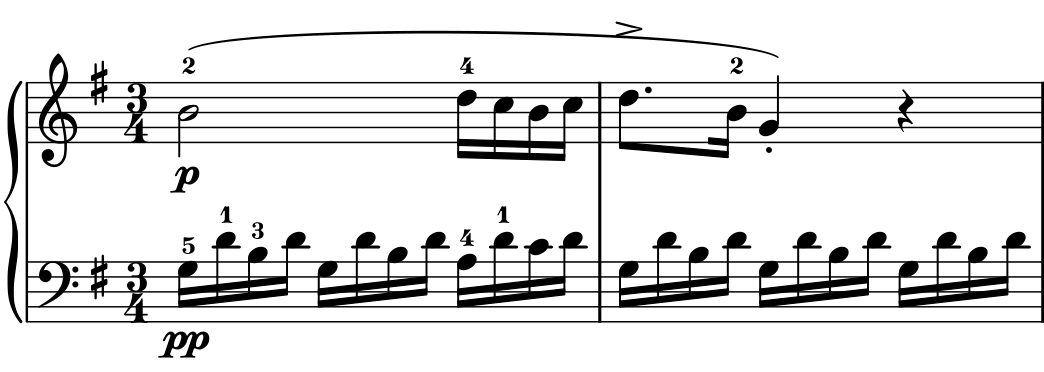
Listen through the held B: eight left-hand notes pass beneath it before the melody moves.
The first right-hand B lasts for two beats. Beneath that single note, the left hand plays eight notes. Once the B has sounded, its natural decay leaves the accompaniment increasingly exposed. A pattern that seems modest at the first attack can cover the end of the sustained note.
Play the B with enough clarity to establish the line, then listen through its full duration. Keep the following left-hand notes below that line instead of letting them build merely because they keep arriving. The melody's four sixteenth notes on beat three should sound like the continuation of the B, rather than a fresh entrance after the accompaniment has taken over.
The harmony also changes inside the first bar. On beats one and two, the left hand has G–D–B–D. On beat three it changes to A–D–C–D, while the right hand moves D–C–B–C. The left-hand D stays in place, but the lower and middle notes move. Read and hear that change before practising the bar as twelve uninterrupted notes.
A useful reduction is the written melody above one left-hand chord per beat: G–B–D, G–B–D, then A–C–D. Keep the three beats even and listen to the change on the third. Restore the sixteenths without inserting a delay before the new shape. The reduction is a way into the passage; the flowing accompaniment returns in the finished music.
In bar two, the melody settles on G and then leaves a quarter-note rest, while the left hand continues. Preserve the difference between the melody ending and the accompaniment stopping. The last beat still belongs to the phrase, and its quiet movement prepares what follows.
First hear this without pedal. Later, add only the resonance that suits the instrument and the passage, listening particularly at the change on beat three. A pedal held indiscriminately through the whole bar mixes the moving harmony. The complete K.545 guide follows the three movements beyond this accompaniment problem.
The recurring thumb
In a 5–1–3–1 pattern, the thumb plays half the notes. If each thumb note is a little too strong, the listener hears a persistent upper pulse: G, G, G, G in the C-major exercise. That repeated pitch can become more noticeable than either the bass or the melody.
Play one group slowly and watch what happens just before the thumb arrives. Does the whole hand drop onto it? Does the thumb lift a long way from the key between its two notes? Does reaching back towards the little finger leave the hand poorly placed for the next G? These observations point to different adjustments.
Try keeping the thumb close to its key and allowing a small, comfortable movement of the hand and forearm towards each part of the shape. The movement should help the notes arrive quietly. A large rocking gesture can create exactly the alternation of accents you are trying to remove. A rigidly fixed hand can make the reach awkward in another way.
Compare two versions: first play the repeated upper note alone at the intended quiet dynamic, then put C and E back around it. Keep the upper note's sound familiar. This exposes whether its extra volume comes from the note itself or from the travel into it.
As the pattern becomes fluent, reduce any exaggerated practice movement to what the passage needs. The useful test is the sound and the ease of continuing into the next shape, rather than achieving one prescribed wrist position. Quiet playing still needs reliable key contact; notes that occasionally fail to speak need a clearer, more controlled stroke.
Kuhlau: a lighter, broader pattern
The opening of Kuhlau's Sonatina in C major, Op.20 No.1, uses the same C–G–E–G order as the exercise. Here, however, the left hand plays eighth notes in 4/4. One four-note group takes two quarter-note beats, so the bar contains two groups.
C major, 4/4. Both staves begin in treble clef. Two four-note patterns per bar, played as eighth notes.
Scroll sideways to read the score.
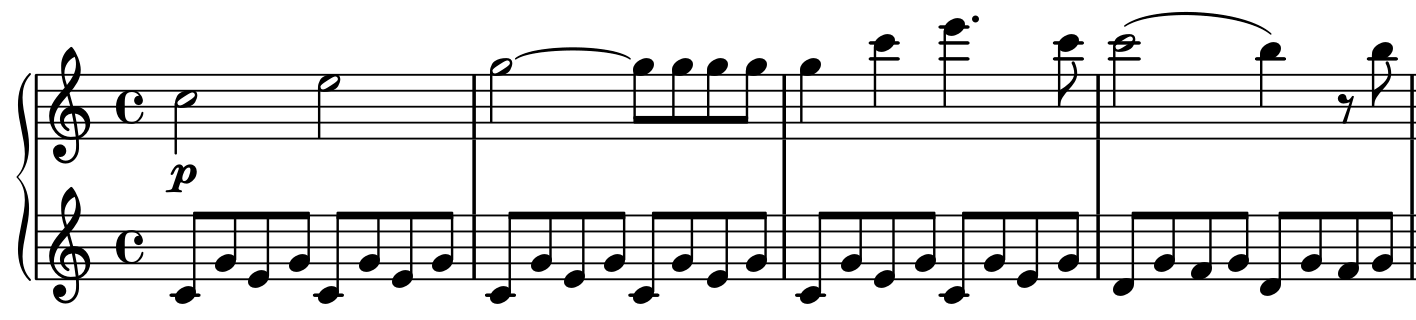
The G stays in the same place when the shape changes in bar four. Hear the new lower and middle notes without interrupting the pulse.
Both staves begin in treble clef. The left hand starts on middle C, close enough to the melody for its upper G to be conspicuous. The right hand's opening C and E are half notes. Each needs to carry across a complete left-hand group.
Compare this with Mozart's Andante. In Mozart, one group fits inside a single beat. In Kuhlau, the same number of notes spans two beats. Counting each four-note group as though it were always one beat would distort the metre of one of the pieces. The pattern's shape does not tell you its speed, beat or character.
For the first two Kuhlau bars, play the right hand over a blocked C-major chord at the start of each half bar. Hear the melody's rise from C to E and then G. Restore the eighth notes while retaining that longer melodic span. Avoid giving the repeated G in the accompaniment an accent every time the thumb returns.
The third bar carries the melody higher, while the accompaniment remains on its C-major pattern. A rising melody can invite greater intensity, but that need not come from increasing every left-hand attack. Let the melody lead the expansion. The bass can support it without doubling its effort note for note.
In bar four the left-hand pattern changes to D–G–F–G. The repeated upper G stays; the lower C rises to D and the middle E rises to F. This makes an especially useful place to practise a chord change without losing the accompaniment's even motion.
Position changes and harmonic rhythm
Harmonic rhythm means the rate at which the harmony changes. The hand may play many notes over one harmony, or change its chord shape within a bar. Learning those change points gives the fingers a destination beyond the next individual note.
The same pattern, a different place in the bar
Mozart · first bar
3/4 · sixteenth notes
- Beat 1
G–D–B–D - Beat 2
G–D–B–D - Beat 3 · change
A–D–C–D
Kuhlau · opening
4/4 · eighth notes
- Bars 1, 2 and 3
- C–G–E–G on beats 1–2
C–G–E–G on beats 3–4 - Bar 4 · change
- D–G–F–G on beats 1–2
D–G–F–G on beats 3–4
For the Kuhlau change, play the last C–G–E–G group before bar four and the first D–G–F–G group after it. Stop after the new pattern has sounded. Listen for a delay before D, a jab on that D, or a suddenly louder G. Each tells you something about how you are arriving at the new shape.
Then compare the two shapes as quiet blocked chords. Keep the common G in your mental picture while noticing that the other two notes move up one white key. A possible fingering is 5–1–3–1 for C–G–E–G and 4–1–2–1 for D–G–F–G. Try it in context; the shape of your hand and the surrounding passage determine the final choice.
The repeated G is still rearticulated in the actual pattern. Thinking of it as a common note does not mean holding its key down throughout. It means knowing which part of the geography remains familiar while the other fingers find their new notes.
Once the change is comfortable, begin earlier in the phrase and continue into the next bar. That longer connection matters: a change practised only from a stop can work perfectly while remaining unreliable during the music. In Mozart's opening, apply the same idea to beat two moving into beat three, rather than waiting for a bar line that comes too late.
Two hands, one phrase
An accompaniment can be quiet and even yet leave the performance strangely flat. This often happens when the left hand has been trained as an automatic loop and the right hand is expected to supply all the musical direction afterwards.
Sing or play the melody on its own and identify its arrival and release. Then accompany that same line, listening through the whole phrase. Some increase in left-hand sound may belong at a fuller moment; a withdrawal may belong at the end. Keep those changes in proportion to the melody, instead of applying a permanent “left hand at minimum volume” setting.
When the hands meet, listen especially to the first note of each group. The bass and melody may arrive together, but they have different roles. Practise that pair alone, at the desired balance, then include the rest of the pattern. Repeating the whole passage louder rarely solves a balance problem that is already present in its first two notes.
A particularly revealing test is to stop the left hand after one complete group while the melody continues. Has the right hand been relying on the accompaniment to feel the pulse? Does its long note still lead towards the next one? Bring the accompaniment back with that melodic continuity intact. Use the interruption briefly as a listening test, then return to the written texture.
Our guide to bringing out a melody inside piano chords addresses another version of this balance problem. Alberti bass adds repeated movement, but the central listening question is familiar: which line should remain in the listener's attention?
Evenness at the musical tempo
Slow practice gives you time to notice the returning thumb and the harmony change. It also changes the physical task. At a very slow tempo, each note can feel like a separate event; at the intended tempo, the group needs to flow without four large preparations.
After a slow, clear version, try one short group nearer the passage's tempo, followed by the first note of the next group. That final note reveals whether the movement can continue. If the pattern rushes or becomes louder, return to a manageable pace and reduce the extra movement before extending the passage.
A metronome can check the quarter-note pulse in both excerpts. In Mozart, four left-hand notes fit between clicks; in Kuhlau, two do. Listen to the spacing inside the beat as well as the arrival at the click. A group can begin and end on time while still squeezing its middle notes together.
When recording yourself, listen once for the melody alone and once for the upper accompaniment note. If the repeated thumb keeps pulling your attention away from the tune, that is a more useful observation than “the whole piece sounds untidy.” Compare recordings made from the same position so that a change in microphone balance does not masquerade as a change in playing.
I want an Alberti accompaniment to give the phrase life. The goal is a clear bass, a moving inner texture and enough space for the melody to speak. Mozart's long opening note and Kuhlau's more buoyant eighth notes ask for that balance in different ways.