
Playing Piano Chords with Small Hands: Redistribute, Roll or Omit?
When a piano chord is too wide for your hand, the useful question is which part of its sound must remain. You may be able to give a note to the other hand, spread the chord into a brief roll, or leave out a carefully chosen doubling. Each choice changes something different: the hand assignment, the timing, or the texture. Read the surrounding music before deciding.
I would first ask a student to play the melody and bass around the chord. That reveals whether the wide shape is a lyrical arrival, a sharply timed accent, or one moment in a moving inner voice. A solution that works beautifully for the first can sound awkward in the second. The aim is to keep that musical role audible in a version the hands can play freely.
- Find the melody, bass and moving inner voices before changing a note.
- Look at what the other hand is doing at the same moment.
- Compare the timing and balance of any rolled or reduced version.
- Test the choice in the phrase, including the move into and out of the chord.
Read the chord's musical job
Start with the outer voices. The top note often carries the melody, while the bass establishes the chord's position and direction. Then look inside: an apparently small middle note may be the dissonance that needs to resolve, or the continuation of a line heard in the previous bar. A crowded chord is easier to judge when you can hear these parts separately.
Consider an F-sharp seventh chord containing F-sharp, A-sharp, C-sharp and E. The A-sharp supplies its major third and the E its seventh. If these notes appear in several octaves, removing one occurrence leaves the pitch class elsewhere, but changes the weight and spacing of the sound. Removing the only occurrence of E changes the harmony itself. “An inside note” is therefore too vague a rule for deciding what to omit.
Also check how long each voice lasts. A note written on the upper staff may belong to an inner line that continues while the melody moves away. If another hand takes it, that hand must preserve its duration and release as well as its starting time. The staff layout is useful reading information; the sound still has to account for all the voices.
Finally, identify the approach. Can the hand arrive in the chosen position from the preceding notes, and can it leave for what follows? A chord reached after a rest presents a different problem from the same shape inside a quick passage. Test that connection before treating a comfortable stationary shape as the answer.
Moving a note to the other hand
Redistribution keeps the written pitches and their timing while changing which hand plays one or more of them. It is particularly worth exploring when an inner note lies close to a hand that is resting, holding a nearby note, or playing a compact accompaniment. Mark the new assignment clearly in the score so that both hands prepare it together.
Suppose the lowest note of a right-hand chord lies near the left-hand thumb. Play the left hand's part with that extra note, then restore the remaining right-hand notes. Listen for an unintended accent at the transferred note. The hand that receives it may make it louder simply because it feels like a new task, even though it still belongs inside the harmony.
Check the next beat as well. A left hand that can take the note now may need to move down to a bass note immediately afterwards. If the added note traps the hand, or has to be released too soon, the redistribution has created another musical problem. Pedal can sometimes preserve the sound during the move, but the harmony and articulation must allow it.
Printed fingering can help you explore the shape, and the guide to choosing piano fingering explains how to compare alternatives. Here the decision goes further: it changes the division of work between the hands. Write down the assignment that works in context, rather than trying a different arrangement on every repetition.


One-to-one classical piano
Online, worldwide. US$40 / 60 min · US$60 / 90 min.

Enea
Concert pianist from Vienna
Free 55-minute trial, online or in person · Ikebukuro & Shinjuku studios from October 2026
Rolling a chord without losing the phrase
A rolled chord sounds its notes in succession instead of at exactly the same instant. It can preserve all the pitches of a wide chord, while allowing the hand to move across the keys. The roll has a musical shape of its own: its direction, speed and arrival change what the listener hears.
Decide which note needs to coincide with the beat. In a melody-led arrival, you may want the upper note to arrive on the beat, with lower notes just before it. In another context, the bass may define the beat and the upper notes follow. Neither arrangement is a universal rule. Play the melody and bass around the chord and hear which timing preserves the phrase.
A common problem is to spend so much time getting through the chord that the next note is late. Another is to hurry the upper note because the hand has finally reached it. Count through the whole bar, then listen without counting. The spread should belong to the line rather than create an extra pause in the middle of it.
Begin with a manageable movement between the lower and upper parts. Let the hand travel; do not keep reaching backwards for notes already played. If the passage uses pedal, listen for the moment it catches the intended harmony and the moment it clears. A broad sweep with blurred harmony may be physically possible yet musically unsuitable. The sustain-pedal guide looks more closely at that listening task.
Omitting a doubling
Sometimes a reduced chord preserves the phrase more convincingly than a conspicuous roll. Before omitting anything, name what each note contributes. Is it the melody, the lowest bass, the only third or seventh, a moving inner voice, or a doubling already present elsewhere? Those roles matter more than the note's position on the page.
A doubled root or fifth can be a candidate, but it still contributes resonance and balance. A doubled third can also be a candidate in a particular voicing. There is no fixed order that makes the bottom or middle note expendable in every chord. Hear the whole phrase with the proposed reduction, especially if the omitted note was part of a line in the previous bar.
Keep the change small enough to understand. Try one version, listen to its effect, then compare another. If you remove several notes at once, it becomes harder to tell which change helped the hand and which thinned the sound. Mark the chosen version in pencil, including any hand reassignment, so that you can discuss the exact result with your teacher.
The next example shows why preserving the harmony and preserving the voicing are related but distinct decisions. All the chord's pitch classes can remain while the weight of its lower register changes. That may be a sensible compromise, but it should be an audible choice.
Chopin's A-major Prelude: the wide chord
In bar 12 of Chopin's Prelude in A major, Op. 28 No. 7, the right hand contains A-sharp4, C-sharp5, E5, A-sharp5 and C-sharp6 at the start of the bar. With middle C labelled C4, the distance from the lowest to highest note is a minor tenth. The left hand contains F-sharp3, C-sharp4, E4 and F-sharp4. Together these notes form an F-sharp seventh harmony.
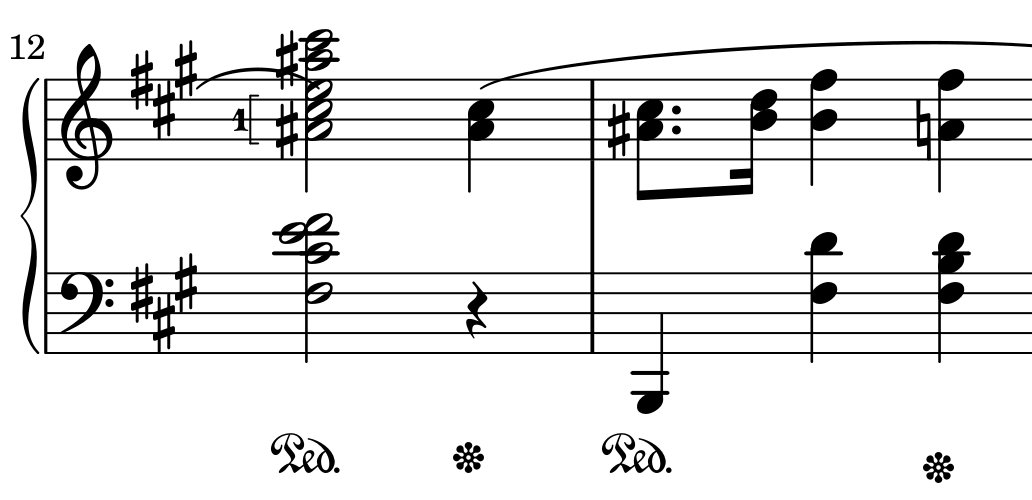
Simply handing the lowest right-hand A-sharp4 to the left hand expands the left hand from an octave to a major tenth, F-sharp3 to A-sharp4. For someone who cannot reach that span, the transfer has moved the difficulty across the keyboard. A redistribution must be judged from both hands' positions, including any necessary release or movement.
One reduction to discuss is leaving out the lower A-sharp4. The upper A-sharp5 remains, so the chord retains its third; the right-hand span becomes C-sharp5 to C-sharp6, an octave. This changes the lower part of the voicing. It also leaves a four-note octave shape, which still needs to suit the player's hand and the approach from bar 11.
One chord, three different changes
Chopin Op. 28 No. 7, bar 12. Original right hand, low to high: A♯4 · C♯5 · E5 · A♯5 · C♯6.
Move the lower A♯ to the left hand
The right hand loses its lowest note; the left-hand span becomes F♯3 to A♯4, a major tenth.
Check the receiving hand's reach and movement before adopting the transfer.
Spread the right-hand chord
All five right-hand pitches remain, sounded in succession.
Hear the arrival of the top C♯6 and leave time for the new phrase on beat three.
Omit the lower A♯4
C♯5 · E5 · A♯5 · C♯6 remain. The right-hand span is an octave.
The third remains at A♯5; compare the lighter lower voicing with the full harmony.
Reading the pitch labels
C4 is middle C. The number changes at each C, so A♯4 lies below C♯5, and A♯5 below C♯6.
The original right-hand span A♯4–C♯6 is a minor tenth. C♯5–C♯6 is an octave. The left hand's original notes are F♯3 · C♯4 · E4 · F♯4.
Another possibility is to retain the full right-hand chord and spread it. Listen particularly to the arrival of the upper C-sharp and the release into the next phrase. In this bar, the wide chord occupies the first two beats; the third beat begins the following phrase lower in the right hand. A large delay at the top can eat into that phrase's breathing space.
I would compare the versions from before the arrival, then continue into bar 13. The choice should preserve the prominence of the upper voice, the harmonic tension and the start of the next phrase. Playing only the difficult chord several times misses the part of the music that tells us whether the adaptation works.
Practising the chosen version
Once you have a plausible version, practise a short approach, the chord and its departure as one unit. Choose a tempo at which the hands can prepare the movement and you can hear the result. Then restore the surrounding phrase. The useful test is whether the musical line survives when the chord is no longer the sole object of your attention.
For a redistribution, hear the transferred note within its original voice. For a roll, keep track of the bass and melody arrivals. For an omission, listen to the remaining balance: a thinner chord can tempt you to strike the surviving notes harder, which changes the phrase again. Each option gives you a different thing to listen for.
A short recording can expose an accent or delay that felt inconspicuous while playing. Compare attempts at a similar tempo and with the same surrounding bars. Ask whether the melody still arrives where you intend, whether the bass is clear, and whether the following notes continue naturally. Keep the version that works as music, then practise it consistently.
If playing the chord hurts, stop. The article on piano tension and pain explains when to stop and seek appropriate help. Before returning to that passage, discuss a playable arrangement or different repertoire with your teacher.
Exams, editions and repertoire choices
For an exam or audition, check the rules for that particular route and year before making a change. ABRSM's 2025–2026 Piano Practical Grades syllabus, for example, permits occasional spreading or omitted notes at wide stretches where the musical result is appropriate, while asking candidates to select pieces suited to their hand size. That wording belongs to those requirements; it does not establish the rules for a different board, an audition or a later syllabus.
Bring the exact bar and your proposed version to the teacher preparing you. Distinguish an editorial fingering suggestion from a change to the sounding notes. If the regulations leave the proposed adaptation unclear, ask the organiser about that passage before committing to the programme. A general assurance that “small hands are allowed to roll” cannot settle every repertoire condition.
The frequency of the problem also matters. One awkward chord in an otherwise suitable piece may invite a thoughtful adaptation. Repeated wide chords at speed, combined with jumps and dense voicing, can make the entire work a poor match for the current player. Look through the whole score when choosing music. The opening page alone may conceal the part that dictates the real demand.
Repertoire choice is a musical decision too. A piece that lets you shape tone, rhythm and character fully can offer more worthwhile work than one whose every phrase is dominated by finding a way around its chord shapes. Keep ambitious pieces in view, while choosing present work that gives you room to listen and move.
Working on a wide chord in a lesson
Bring the score and identify the chord that interrupts the piece for you. I would hear the surrounding phrase, look at what each hand is already doing, and compare a small number of playable versions. We can then work on the sound of the chosen version and the movement into the next part of the music.
Vienna Piano School offers online classical piano lessons for junior-high-school age learners and adults, and in-person lessons at piano studios in Ikebukuro and Shinjuku, Tokyo, from October 2026. Online lessons are US$40 for 60 minutes or US$60 for 90 minutes; regular in-person lessons are US$40 for 55 minutes, including studio use. The first trial is free and lasts 55 minutes.
Use the trial application to tell me which piece you are studying and where the difficulty occurs. For learners under 18, a parent or guardian should contact us. A useful lesson begins with that passage and the musical effect you want to keep.