
Studying Piano at MUK in Vienna: Degrees and Audition Preparation

Studying piano at MUK means choosing a degree, a teacher and a demanding period of musical development. The application starts with the course: an artistic bachelor's degree, a master's degree and a piano pedagogy degree ask different things of the same pianist.
I completed my master's in piano performance at MUK with distinction. When I help someone consider studying there, I want to hear both the playing they bring now and the questions they want to explore. A convincing application grows out of that musical direction, together with careful attention to the university's requirements.
MUK is the Music and Arts University of the City of Vienna, or Musik und Kunst Privatuniversität der Stadt Wien. It is a separate institution from mdw. This guide concerns classical piano at MUK; jazz piano has its own programme and audition requirements.
Application cycle: the piano admissions page currently displays the closed winter 2026/27 round, with a 4 February 2026 application deadline and April 2026 auditions. The audition comparison below describes that published round. For a later intake, use the new piano examination programme and dates when MUK releases them.
Choosing the degree
The artistic BA in Piano develops the foundations of professional musical work across eight semesters. It suits a pianist ready for sustained university study of performance, supported by ensemble work, theory and other subjects. It already assumes substantial training before entry. The first year is not designed to bridge from an early intermediate repertoire to an audition programme. For the BA, MUK does not require a general university entrance qualification such as a Matura, Abitur or high school diploma; the artistic selection remains central.
The MA in Piano is a four-semester course for applicants with a completed bachelor's degree or a qualification MUK accepts as equivalent. Here the question becomes more focused: what do you want to develop beyond your existing training? That might concern a particular repertoire, the relationship between solo and chamber playing, or a persistent technical limitation that restricts your interpretation. Bring a musical reason for further study, as well as the degree documents.
Piano IGP, or Music Education – Voice and Instruments, combines artistic study with learning to teach. Its bachelor's course also lasts eight semesters. Applicants take the artistic selection process and additional pedagogical assessment. Someone attracted to explaining music, observing how others learn and developing a teaching practice should examine this curriculum closely. Choosing it involves a different professional interest, rather than simply adding teaching to the name of a performance course.
Age deserves an early check. MUK lists a minimum age of 17 and a recommended maximum of 25 for the artistic piano BA; the recommendation should not be rewritten as an absolute ban. The piano MA has no age limit, and the IGP BA lists a minimum of 17 with no upper age limit. An older BA applicant should discuss their situation with the admissions office before investing in that particular application.
The university also offers a preparatory course and a Certificate of Performance. These have their own purposes and entry arrangements. Start by choosing the qualification you actually want to earn; this article concentrates on the degree routes.
The course beyond individual lessons
Read the curriculum alongside the professor's biography. The central artistic subject, often abbreviated ZkF on MUK documents, is a major part of the course, but a degree also requires you to work with other musicians, understand musical structures and develop ideas in words.
The linked piano BA curriculum includes chamber music, music history, theory and analysis, as well as further choices in artistic practice. Its 240 ECTS credits represent a full course of study. The MA totals 120 ECTS and includes advanced artistic work, chamber music, theory and research. A student imagining several years spent entirely on solo repertoire should look carefully at that broader programme.
For a pianist, this breadth can change the way a familiar work sounds. Learning to hear a fugue's inner voice helps in contrapuntal chamber writing. Working with a singer exposes moments where an accompaniment breathes too late. Analysis can reveal why an apparently similar return of a theme needs a different weight. These are useful reasons to study the supporting subjects, beyond completing their credits.
When choosing a teacher, listen for the musical qualities you hope to develop. Then consider how the teacher discusses a phrase, works with movement or responds to your interpretation. If you arrange a consultation, bring a piece that reveals a real question in your playing. A polished opening alone may tell you little about how you would work together over a semester.
My own preparation advice is to arrive with an interpretation you can discuss. If you take extra time before a cadence, what are you listening for? If a voice disappears inside a chord, can you isolate it and restore its direction? The point is to have something musical to work on in the room. I explore that relationship between sound, phrasing and shared listening further in what Viennese tradition means in a modern lesson.


One-to-one classical piano
Beginner to advanced. Online, worldwide.
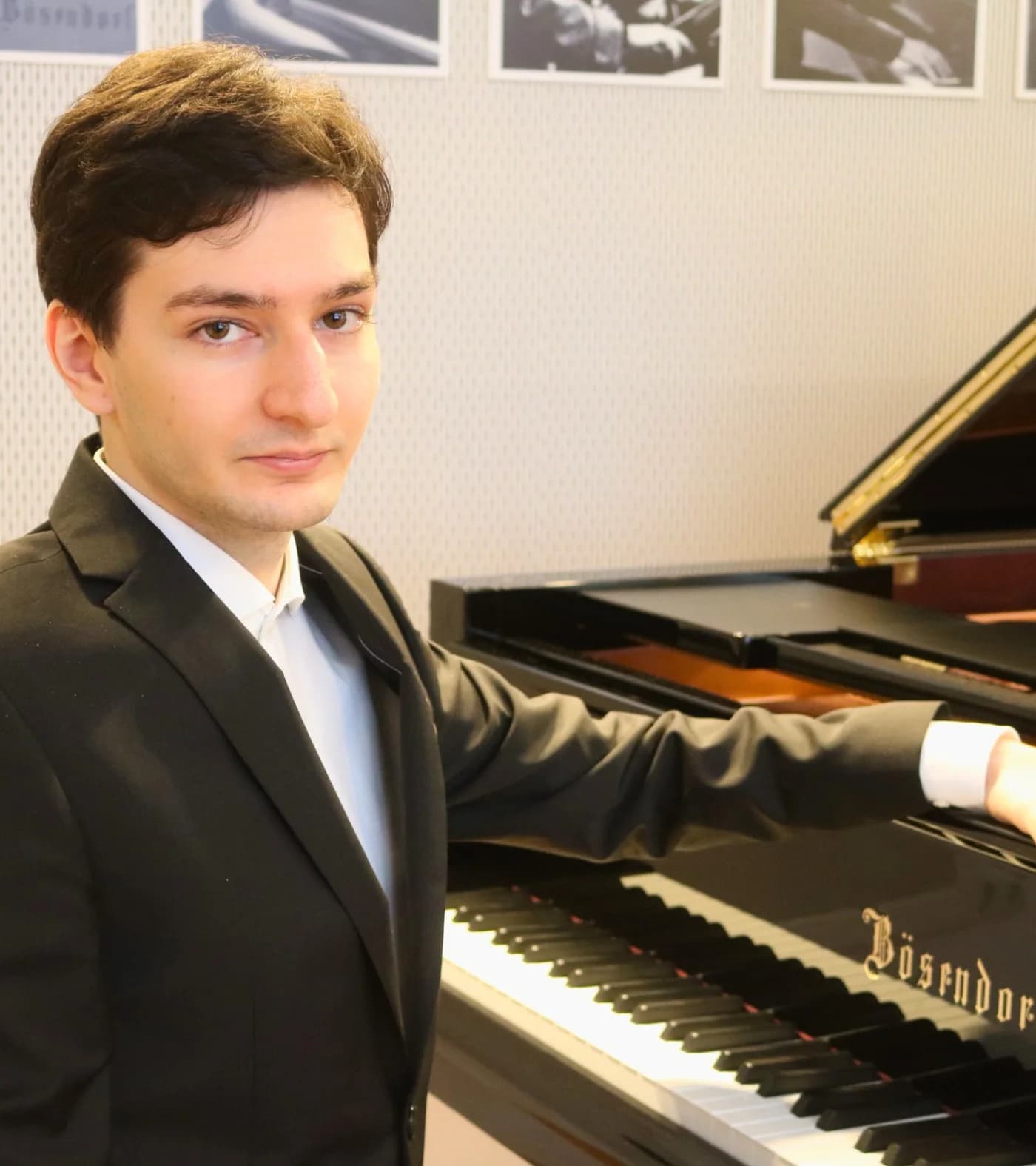
Enea
Concert pianist from Vienna
30 minutes · Tokyo studio from October 2026
BA and MA audition differences
Read the piano-specific examination programme for your course. Small differences in wording affect what you must prepare: a fugue differs from a prelude and fugue, one sonata movement differs from a complete sonata, and a freely chosen work with a minimum duration cannot be replaced by several short favourites.
Selected requirements from the closed 2026/27 round. Read the official piano examination programme for your intake before finalising repertoire.
| Part | Piano BA | Piano MA |
|---|---|---|
| Recorded music | BA:At least 15 minutes | MA:At least 20 minutes |
| Virtuoso selection | BA:One étude or short étude-like virtuoso work | MA:Two virtuoso works from different stylistic eras |
| Polyphony | BA:Fugue without prelude, or strictly polyphonic work; at least three voices | MA:Prelude and fugue, or strictly polyphonic work; at least three voices |
| Other recorded repertoire | BA:Fast Classical sonata movement or suitable variation excerpt; free choice | MA:Freely chosen work lasting at least eight minutes |
| Prepared on-site programme | BA:At least 30 minutes: complete Classical work from the video, Romantic work, twentieth-/twenty-first-century selection, free choice | MA:At least 40 minutes: Classical, Romantic, twentieth-/twenty-first-century and separate contemporary work after 1950 |
Both recordings begin with a German or English introduction of up to two minutes. Playing follows without cuts. The Classical category includes Schubert. Memorisation is required except for contemporary music after 1950.
What the on-site duration means
Prepare the complete requested programme. The panel chooses excerpts on the day, so the minimum programme duration is not a promise that every work will be heard in full. Keep all movements and contrasting sections ready to play.
For the BA, the connection between the recorded Classical selection and the complete work for the later round deserves particular attention. If you submit a fast sonata movement, the remaining movements belong in your preparation from the beginning. A convincing first movement cannot make the slow movement or finale ready at short notice.
At MA level, the contemporary category also needs a careful reading. The published programme specifies a separate work after 1950 in an avant-garde or non-tonal idiom, alongside the other twentieth- or twenty-first-century selection. A recent composition with a familiar tonal language is not automatically a match for that wording. Choose from the actual requirement and ask MUK about an uncertain case before making it central to the programme.
These distinctions give useful information about the breadth you will need. A pianist who has concentrated on Romantic repertoire may have considerable technique while needing time for a substantial polyphonic work. Another may read complex music fluently but have little experience maintaining the shape of a complete Classical sonata. The preparation should address that unevenness.
Repertoire that reveals your playing
After checking eligibility, choose works that let a listener hear what you do well and how you think. For an audition, the title of a difficult piece is only the beginning. Its rhythm, sound, structure and technical control all have to survive a complete performance.
In a fugue, I listen for more than clearly marked subject entries. Can the line continue when attention shifts to another voice? Does the bass keep its direction through a crowded texture? Can you begin in a middle section and still know which voice is speaking? Work on those questions before treating a memory run as proof that the piece is ready. A two-part invention, however beautifully played, also does not fulfil a requirement for at least three voices.
A Classical sonata asks for a different kind of command. You need to hear the proportions of its phrases and the difference between a transition, a new theme and a return. An energetic first movement can become tiring if every arrival carries the same emphasis. In preparation, play a passage once with only the bass and melody, then restore the middle texture. Listen for whether the harmonic movement still shapes your pacing.
For a virtuoso piece, consider what its difficulty reveals. Repeated octaves, rapid figuration and chordal passages present different problems. Select a work whose movement you can organise at a musically persuasive tempo. If the texture becomes consistently harsh or the pulse collapses whenever you try to project, the next step is work on the playing itself. Another increase in speed will not solve those questions.
The freely chosen work can show something the compulsory categories have not yet revealed: a sustained singing line, a sense of dance, an imaginative response to unusual sonorities. Think about its place in the whole selection. Several pieces may each be strong alone yet leave a panel hearing the same kind of gesture repeatedly.
Prepare the quiet and exposed passages as seriously as the climaxes. I would want to hear the end of a phrase, the release of a chord and the transition into a new tempo in a preparation lesson. These moments often tell us where attention is still being spent on remembering the notes. The longer-term work behind that is discussed in setting serious piano goals.
The video and application
MUK's general recording instructions call for a current video made for the application, without editing or post-processing. The picture must show the whole upper body, face, instrument and musical setting clearly. Use a link that opens without a login or an access request, and keep it available until you receive the examination result.
For piano, the published format places a short spoken introduction directly before the uninterrupted playing. Practise that transition. Speaking about your motivation and then finding the character of the opening is a different experience from starting another practice take with your hands already on the keys. Use straightforward German or English to describe why you want to study and what you hope to develop. Speak in language you can also use in a conversation about your playing.
The recording should let the listener follow balance and articulation. Before making a complete take, test a loud passage and a quiet one, listen back away from the piano, and check that the image includes what MUK asks to see. For the equipment and recording work, use our home piano audition recording guide. Here the priority is meeting MUK's format and allowing your playing to speak clearly within it.
Applications go through MUKonline. The registration instructions ask for identification and a photograph, an artistic CV, motivation letter, examination programme and the video link where required. MA applicants also submit their bachelor's or equivalent qualification. There is a €50 application fee; submission and payment must both meet the applicable deadline. The portal's existence throughout the year does not make a missed audition round open again.
Write the repertoire list precisely: composer, work, opus or catalogue number, and the movements you intend to play. In the motivation letter, describe why this course matters to your next stage. For example, wanting to connect a particular repertoire interest with chamber playing gives a teacher more to discuss than praising Vienna's reputation. Your CV and letter should agree with what you actually bring to the instrument.
For degree admission, a complete application and an audition result are different matters. Places are limited. Keep your preparation useful across the other courses you are considering, while adapting each submitted programme to that institution's requirements.
German for study and rehearsal
MUK normally teaches in German. For performance BA and MA programmes, its language guidance sets B1 for initial enrolment; the IGP bachelor's route requires B2. The certificate is not required merely to apply for the entrance examination. The university also publishes exemptions and special arrangements for a lower initial level, which applicants must clarify with MUK for their own case.
This creates two kinds of language work: obtaining the accepted formal evidence and becoming able to use German while making music. A certificate level tells the university something about general proficiency. In a piano lesson, you also need to follow a rapid instruction, identify a place in the score and explain what happened in the previous attempt.
Start practising that exchange with repertoire you already know. Ab der Durchführung means starting from the development section; die Mittelstimme identifies the inner voice; den Bass weiterführen asks you to carry the bass line onwards. Find the relevant place or voice immediately, then play. The connection between the words and the sound is what makes this useful preparation for a working lesson.
You should also be able to say what you heard. A short explanation such as “the inner voice disappeared when I played the chord more strongly” gives the teacher something precise to answer. Practise describing your own playing, asking where to restart and confirming a changed fingering. These exchanges belong beside the hours spent learning vocabulary and grammar.
For IGP applicants, language is part of the teaching interest itself. Explaining a rhythm to someone else, listening to their answer and choosing another explanation require a different kind of fluency from introducing a recital programme. Give that part of your preparation time of its own.
Fees and daily practice in Vienna
Budget from MUK's fee category for your programme and citizenship. From winter 2026/27, the published performance BA/MA semester rate is €410, while the separately listed country group, including Japan, the United States, Canada and Australia, pays €1,380. The corresponding IGP rates are €960 and €1,920. A €26.20 ÖH student contribution is additional. Consult the full country list and the rate for your entry year before setting a budget.
Tuition is one part of the cost. Include accommodation, food, transport, language classes, the audition journey and access to a suitable piano. For international applicants, travel to an audition and moving to Austria to study are separate planning questions. Use the official guidance linked by MUK for the entry and residence arrangements that apply to you.
A practical question to ask before choosing accommodation is where you will do sustained piano work. Find out how university room booking operates and what access you can expect at the times you need. If you plan to practise at home, establish the instrument and playing-hour conditions before committing to a room or apartment.
Imagine an ordinary teaching week: individual study, chamber rehearsals, classes and enough practice to respond to the previous lesson. The important calculation is whether your daily arrangements support that work. A beautiful city and an attractive course become much more tangible when you know where the piano is and how you will reach it.
Preparing with a teacher
The most useful first step is a candid assessment of your present programme. Bring a recent recording, the music you are considering and the degree route that interests you. I would listen for what is already dependable, what needs a different practice approach and whether the remaining repertoire can receive the attention it deserves before the intended application.
That assessment may lead to a change of piece, a longer preparation period or a more focused musical goal. For one pianist, the priority will be balancing three or four voices. For another, it will be finishing all movements of a sonata or learning to explain interpretative choices in German. The work should be specific enough that the next lesson can hear a difference.
Alongside piano preparation, I can help with music-focused German, communication with prospective professors and coordinating the application process. My MUK background informs that work; admission decisions belong to the university. The aim is to help you present your playing clearly and arrive ready to learn.
You can read more about my teaching and training or request a free 30-minute trial lesson to discuss your repertoire and plans. Online lessons are available now for teens and adults, in English, German or Japanese. In-person lessons in Tokyo and Shinjuku begin in October 2026.