What “Viennese Tradition” Means in a Modern Piano Lesson

“Viennese tradition” means something to me when it changes how we listen at the piano. A bass note gives a dance its footing. A short slur gives a melody the inflection of speech. A change of harmony asks for a different colour, even when the printed dynamic stays the same. These are musical decisions we can hear, discuss and work on in a lesson.
I grew up in Vienna and completed my master's degree in piano performance at MUK, the Music and Arts University of the City of Vienna. That background shapes my teaching. What I want to pass on is an attentive relationship with the music: curiosity about the score, a feeling for movement, and the ability to hear your own part alongside another voice.
The connection becomes clearest through three things: the instrument's sound, the character of a dance or song, and the give-and-take between musicians. A historical piano and a small Schubert waltz offer a useful way into all three.
A living musical inheritance
Vienna's musical life brings solo playing into contact with opera, chamber music, song and dance. For a pianist, each asks a different kind of attention. A singer needs room to finish a word. A string player can sustain a note while its colour changes. A dance needs the next step to arrive with conviction. Those experiences can alter the way we play a page of piano music.
The word “tradition” sometimes makes that inheritance sound more uniform than it is. I use it to describe an ongoing musical conversation. Teachers bring different repertoire, instruments and artistic priorities to it; students learn to hear a choice and eventually make their own. A useful lesson gives reasons for an interpretation. “That is how it is done in Vienna” would leave the most interesting question unanswered.
This breadth also appears in the institutions. MUK's piano programme includes work across stylistic periods and performance opportunities in solo and chamber settings. In its 2017 exploration of Austrian pianistic traditions, mdw placed Mozart and Beethoven alongside historical piano making, the Second Viennese School and contemporary approaches to the instrument. That is a much wider field than a single beautiful tone or a preferred tempo.
For an adult learner, the value lies in hearing these connections inside attainable music. A short dance can contain questions about character, balance and timing that remain absorbing throughout a pianist's life. The scale of the piece changes; the care we bring to it can already be serious.
Sound and the instrument
The piano pictured below was made in Vienna by Ferdinand Hofmann around 1790. Now in The Metropolitan Museum of Art, it has a five-octave keyboard and knee levers for lifting the dampers. Its proportions and controls make the distance from a modern concert grand visible.
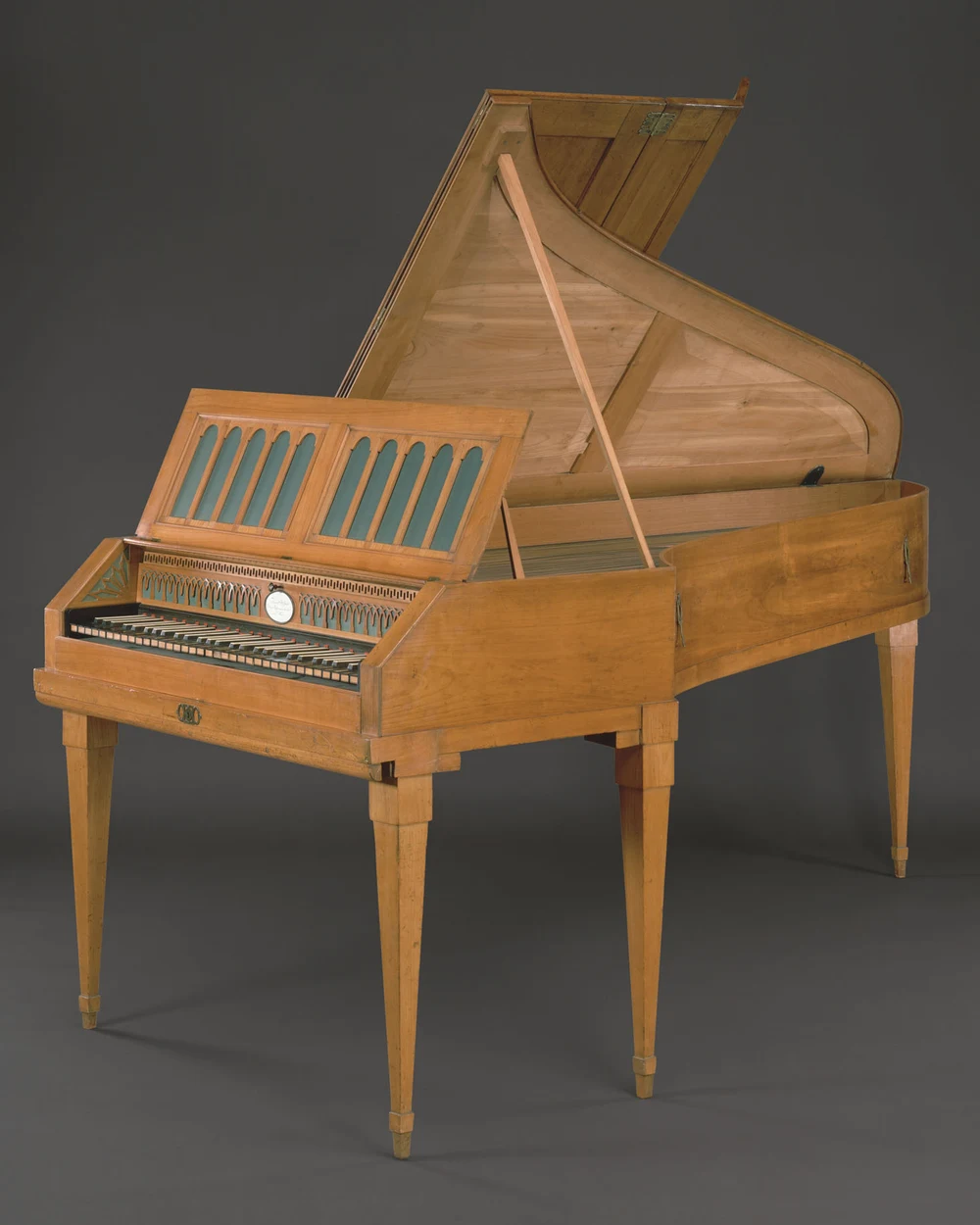
Historical instruments remind us that composers worked with particular keyboards, mechanisms and sounds. The history of the Viennese piano includes the action developed by Johann Andreas Stein and the work of makers in Austria and southern Germany. The word “Viennese” therefore describes a history of instrument making as well as a place of study. These meanings overlap, but they are worth hearing separately.
At a modern piano, my first concern is the sound in the room. A low bass note may continue strongly while a melody moves above it. If the pedal gathers every note into the same resonance, the harmony can obscure the phrase. The answer might be less pedal, a quieter bass, a shorter accompanying note or a different balance within the chord. The ear chooses among those possibilities.
Consider a quiet chord followed by a rest. The chord's beginning, its decay and the moment of release all contribute to its character. I might ask a student to keep the same tempo and change only the release. One version ends abruptly; another leaves a trace of resonance; a third carries sound into the next gesture. Listening to those alternatives gives meaning to the word “clear.”
A digital piano brings its own response, speakers or headphones and pedal behaviour. We work with those conditions. The musical question remains precise: can the listener follow the line, and does the harmony change when the score changes? Historical curiosity should sharpen that question, then return us to the instrument under our hands.
One-to-one classical piano
Beginner to advanced. Online, worldwide.
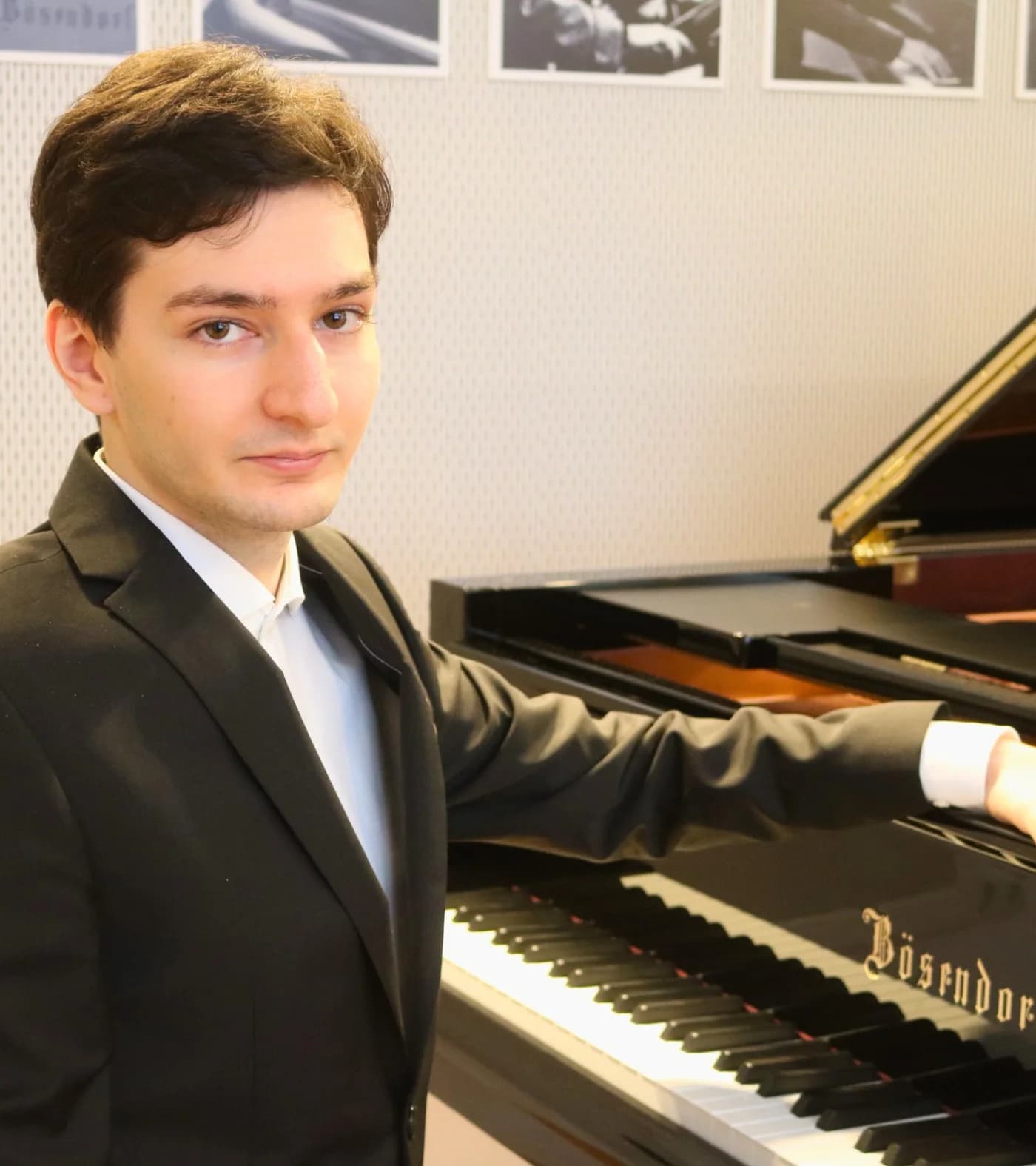
Enea
Concert pianist from Vienna
30 minutes · Tokyo studio from October 2026
Dance rhythm and musical speech
Dance character begins with a sense of where the music lands and how it leaves again. In triple metre, three equal written beats can have different roles. A bass on the first beat establishes the ground; the following chords carry movement through the bar. Playing all three with identical weight can make a waltz sound like three separate events.
I often begin by asking for the accompaniment alone. I listen to the journey from one bass note to the next. If the second chord becomes an extra landing point, we try a lighter sound there. If the third beat hurries, we let it occupy its space before the new bass arrives. The aim is a continuous turn through the bar.
Timing follows the particular music. An automatic early second beat or a recurring delay can become a mannerism when pasted onto every piece in three. Before choosing any rhythmic flexibility, I want to hear the melody, the accompaniment and the phrase together. A written accent, a change of harmony or the approach to a cadence may give the timing a reason to move.
Speech offers another useful image. A sentence has a stressed word, small inflections and a destination. Giving every syllable the same emphasis destroys its meaning; stretching every important word soon sounds theatrical. At the piano, a two-note gesture can have an arrival and a release while the longer line continues.
That is why I enjoy working on modest changes. A lighter second note, a bass that arrives without a thump, or a phrase ending that keeps moving can transform the character while leaving the tempo recognisable. The detailed guide to shaping a Classical phrase explores articulation and larger phrase structure through Mozart.
Schubert at one piano
Schubert's Valses sentimentales, D.779, Op.50, give this discussion a musical setting. The excerpts below come from Hugo Ulrich's four-hand arrangement of the first waltz. The higher player, or primo, carries the opening melody; the lower player, or secondo, provides the bass-and-chord dance accompaniment. The original work is for solo piano. This later arrangement lets us see the musical roles on separate pages.
Schubert · Valses sentimentales, D.779, No.1 · Arranged for piano four hands by Hugo Ulrich
Primo: the higher player
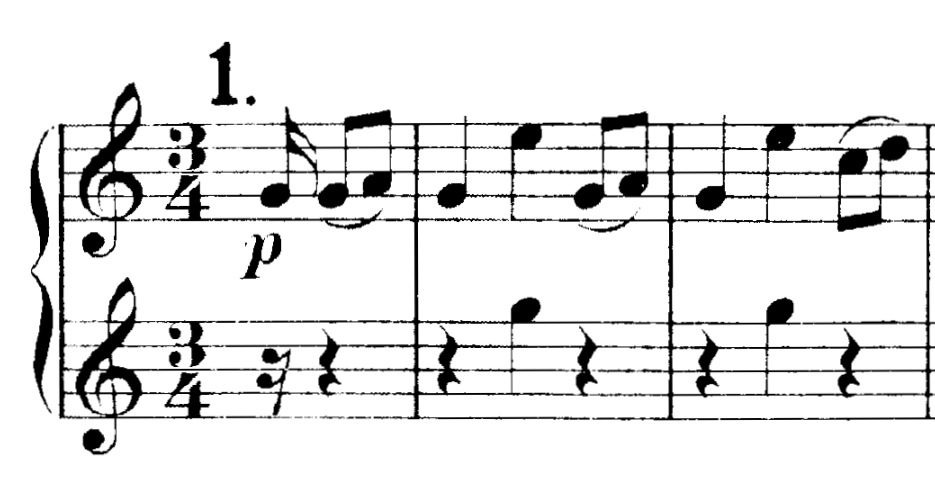
Follow the melody across the barlines. Its small slurred groups sit within a longer line.
Secondo: the lower player
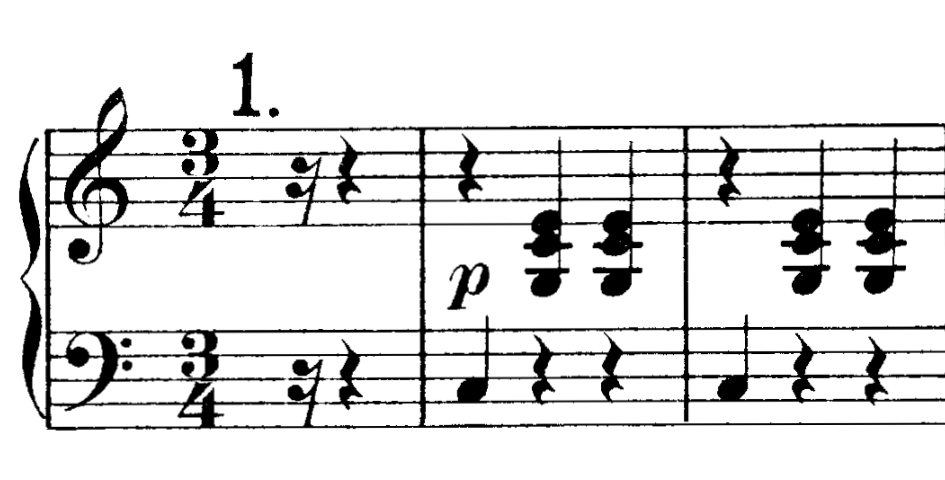
In the first full bars, the bass gives way to two chords. Keep that movement light enough for the melody to speak.
The lower player’s first full bar
- Beat 1Bass
- Beat 2Chord
- Beat 3Chord
The bass has rests on beats 2 and 3; the chord-playing hand rests on beat 1. Listen to their exchange within one bar.
Score context and larger pages
These excerpts reproduce the opening on printed pages 52–53 of the Peters arrangement, plate 7913. Each player has a separate page. The number 7 in the page heading identifies this set within the collected dances; the excerpts show waltz No.1.
Primo full pageSecondo full pageTitle and source pages (PDF)
Look at the lower player's first full bar. The bass sounds on beat one, then rests while the right hand supplies chords on beats two and three. Those rests help define the texture. The page already contains a pattern of sounding and letting go, before either player adds an expressive gesture.
The upper player has a different task: carry the melody across that accompaniment. If both players try to make their own notes equally prominent, the result becomes crowded. I would ask the lower player to give the opening bass a clear presence, then let the chords sit behind the melody. The higher player can listen for that foundation while shaping the line above it.
This is also a revealing lesson in shared time. Two people may agree on a starting speed and still disagree about when the next bar arrives. A small breath in the melody can become a stop if the accompaniment waits too long. Playing the opening again, with attention to the next bass entry, makes the point audible. Both players need to feel where the phrase is going.
The same relationship exists inside a solo pianist's two hands. One hand supplies the ground while the other moves with more detail. When I ask for the left hand alone, I am listening for the partner the melody will have when the hands reunite. The accompaniment should already have character.
Four-hand playing adds something further: the other musician can surprise you. You hear a softer chord, a different inflection or a breath you had not anticipated, and respond. That exchange is part of what I value in musical training. It keeps interpretation alive between people, even in a small piece.
Singing tone and harmonic direction
“Singing” is a familiar instruction in piano teaching, but it needs an object. Which voice is singing? Where is it going? What happens underneath it? A melody can be played smoothly and still sound aimless if all its notes receive the same attention.
I like to ask a student to sing a short line away from the keyboard. The voice often reveals an intended destination that the fingers have been hiding. A note becomes the centre of the phrase; the next one relaxes; a small gap leaves room for the following thought. Back at the piano, we listen for that intention in the actual sound.
The harmony can change the meaning of a repeated melodic note. Imagine the same upper note over two different chords: in the first it feels settled, while in the second it rubs against the harmony. Giving both notes an identical, comfortable sound loses that change. The second may need more presence, or the accompaniment may need to reveal the changing inner voice. The choice depends on the passage.
This kind of listening affects technique. To bring out a line within a chord, the pianist must hear the desired balance and find a movement that produces it. I prefer to work from a particular sound towards the physical solution. “Use more arm weight” is too broad if the real problem is that one inner note is covering the melody.
There is pleasure in discovering how little sometimes needs to change. A quieter accompanying note can reveal a melody that seemed too weak. Holding an inner voice for its full value can give a chord warmth without adding pedal. The task becomes more exact, and the music often becomes more personal: the pianist is choosing which relationship the listener should hear.
The score and personal choice
A tradition survives through scores as well as through people. The Schubert example is a reminder to ask whose decisions are on the page. Ulrich arranged the solo piece for four hands; the division between players belongs to that arrangement. Its musical usefulness does not make it Schubert's original notation.
In everyday lessons, the distinction may involve a printed fingering, a slur or a pedal suggestion. I want students to notice what the edition supplies and what they themselves have become accustomed to doing. A familiar recording can be another powerful influence. After hearing a phrase many times, we may remember the performer's slowdown as though it were printed in the score.
Comparison can be wonderfully productive. Listen to two performances of a short passage and name one difference: the bass is lighter, the rest is longer, or the melody reaches its destination later. Then return to the notation and try the idea. The score gives the experiment its boundaries; listening reveals what the choice does to the phrase.
I also want a student to be able to disagree musically. “I prefer this version because the second phrase answers the first more directly” is a useful artistic statement. We can play both versions, hear the proportion of the whole passage and decide. An inherited interpretation becomes valuable when it develops the player's judgment.
This is where background and individuality meet. My training supplies habits of attention and a range of possibilities. The student's ear, instrument and musical imagination take part in the result. A lesson has succeeded when the player can hear more and make a choice with greater conviction.
Tradition in an online lesson
These ideas travel well because they concern relationships we can demonstrate: melody and accompaniment, sound and silence, one phrase and the next. In an online lesson, we take turns playing and listening. I might demonstrate two ways of releasing a chord, then ask the student to try both on their own piano and describe the difference they hear.
The student's account matters. Their room contains details of resonance that a call may not fully convey. I can hear the direction of a phrase and ask about the sound left after a chord; they can listen locally and report whether the harmony has cleared. Together we work towards a result that belongs to their instrument, rather than copying the surface of my demonstration.
A short passage is often the right scale for this discussion. Bring music whose notes you know well enough to listen beyond them: a dance, a sonatina movement, a song-like piece or a passage from a larger work. The first conversation might concern why the rhythm feels heavy, where the melody loses direction, or which sound should remain through a rest. What a teacher hears in the first eight bars shows how much musical material a small opening can contain.
For me, this is the lasting value of the Viennese background described in my teaching profile. It gives the lesson a musical horizon, and the work happens in the details of the piece in front of us. You hear the bass differently, find a more speaking articulation, or discover that a simpler gesture carries the phrase. Those discoveries belong to the player.
If you would like to explore a passage together, book a free 30-minute online trial lesson. Bring the score you use and a musical question that has stayed with you while practising.