
Moonlight Sonata, First Movement: Voicing and Pedal Beyond the Opening Bars
The first movement of Beethoven’s Moonlight Sonata asks you to hear three things at once: a singing melody, a quiet stream of triplets and the bass that changes the harmony underneath. Its slow pace gives every imbalance time to be heard. A convincing performance comes from shaping those layers through the whole movement, including the rising middle passage and the left-hand echoes near the end.
This guide covers the complete Adagio sostenuto from Op.27 No.2, with bar numbers counted from the first full bar. For an intermediate or returning pianist, it is a substantial study in listening and control. The other two movements have their own demands, especially the fast finale; learning this opening movement is a separate project.
Follow the changing lead voice
- Bars1–4
The sound before the melody
Triplets, descending bass and the first changes of harmony.
- Bars5–22
A voice above the triplets
The repeated-note melody travels through different harmonies and registers.
- Bars23–41
Tension and a wider keyboard
The line rises, the arpeggios expand, and a long G♯ bass supports changing sounds.
- Bars42–59
The return, with a different continuation
The opening voice returns; follow the score beyond its familiar beginning.
- Bars60–69
An echo in the left hand
The dotted rhythm moves down, the triplets subside, and the final chords settle.
Beethoven, Op.27 No.2: I. Adagio sostenuto. Count the first complete bar of triplets as bar 1.
The melody above the triplets
In a lesson, I first want to hear which sound you are following. It is quite possible to play the triplets accurately while the melody disappears between them. The right hand is then doing the accompaniment’s job beautifully, but the voice we came to hear has become an occasional extra note.
The opening four bars establish the sound before that voice enters. At the end of bar 5, two repeated G♯s introduce the melody. In bar 6, the upper G♯ lasts for a dotted half note before the dotted rhythm returns. Meanwhile, the lower fingers continue their triplets. The difference between the stems matters: notes sharing one staff belong to separate lines with separate lengths.
C♯ minor, cut time (2/2). Upper staff: treble clef; lower staff: bass clef. The flowing notes remain triplet eighth notes.
Scroll sideways to read the score.
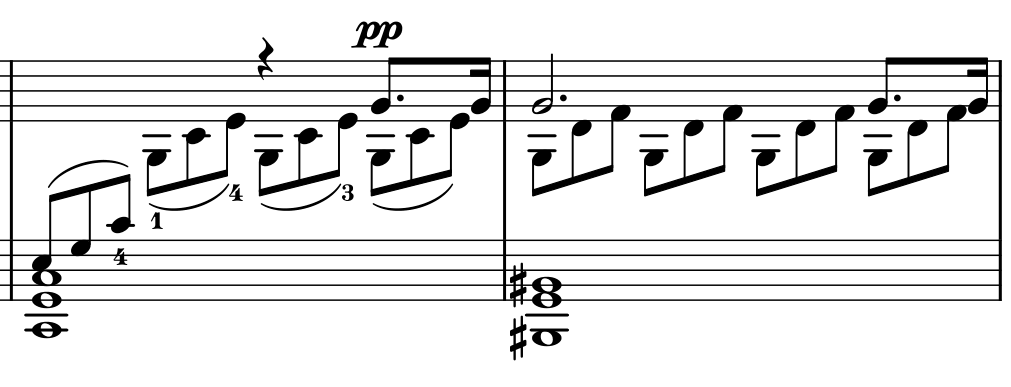
Upward stems trace the melody. The downward stems keep the accompaniment moving underneath its long note.
Play the melody from its first entry through bar 9, leaving out the triplets. Hear how the repeated G♯ eventually rises to A, returns to G♯, and continues through F♯ and B towards E. The same pitch repeated several times still belongs to a phrase. Give it direction through the changing harmony and the arrival ahead.
Next, play the bass with that melody. The move from C♯ in bar 5 to B♯ in bar 6 changes the feeling under the repeated upper note. B♯ is the white key normally called C, but its spelling tells us how it is moving within this harmony. Hearing the two outside voices together gives the passage a shape before the middle is filled in.
Restore the triplets at a quieter level. If they cover the melody, lower their attacks before making the upper voice increasingly forceful. On a piano, a long note decays after it has sounded; pressing harder into the held key will not make it swell. The following accompaniment must leave room for the sound already in the air.
A useful check is to play bar 6, stop after it, and sing the upper line you just heard. If your ear remembers mainly the repeated triplet pattern, the balance still favours the accompaniment. The separate guide to bringing out a melody within piano chords develops that control in a simpler texture.
Dotted rhythm against triplets
The movement is in cut time, 2/2: two half-note beats in a bar. The accompaniment divides each half-note beat into six triplet eighth notes, grouped on the page in threes. During slow work, four quarter-note subdivisions can help you place notes; the musical flow still needs the broader two-beat span.
The melody’s dotted-eighth and sixteenth pair does not coincide with the first and third notes of an accompaniment triplet. Within a quarter-note span, the third triplet note arrives two-thirds of the way through. The melody’s sixteenth arrives three-quarters of the way through, slightly later.
One quarter-note span, divided into 12
Triplet notes start on 1, 5 and 9. The melody starts on 1, then repeats on 10.
Triplet accompaniment
Dotted-eighth + sixteenth melody
The dotted note lasts 9 subdivisions; the short note lasts 3. Use this once to locate the attacks, then return to the flowing pulse.
Tap the triplet with one hand and the dotted pair with the other at a slow, comfortable speed. The grid gives a precise way to discover the relationship: accompaniment on 1, 5 and 9; melody on 1 and 10. Then play the last quarter of bar 5 into bar 6. The short upper note belongs close to the following long note, while the triplets remain evenly spaced.
This distinction also has support in the early source: Henle’s preface describes corrections in the first edition that moved the melody’s sixteenths to the right of the accompanying third triplet notes. It is an expressive detail worth keeping. Once the placement is understood, let go of counting twelve little units and listen to the two lines together.
An overemphatic short note can make the phrase sound twitchy. Give it a clear place in time without punching it out. The musical task is a quiet, insistent repetition that continues into the next bar.

One-to-one classical piano
In person in Ikebukuro or Shinjuku, Tokyo. Online worldwide.
Enea
Concert pianist from Vienna
Pre-launch · Applications open
A quiet pulse with direction
Adagio sostenuto asks for a sustained slow character. A tempo so slow that you lose the next harmonic arrival makes the melody difficult to hold together; a quicker tempo that forces you to snatch at the top notes loses the same line for another reason. Choose a pace at which the melody can be sung through the phrase and the right hand can move freely through the middle passage.
Listen to the start of each triplet group. A little accent every three notes can turn the accompaniment into a repeated pattern of bumps. Practise two neighbouring groups while attending to the last note of the first group and the first note of the second. They should continue the stream across the join.
That does not mean giving every note in the movement identical weight. The bass and the melody have arrivals, and the harmony grows more urgent in places. The distinction is between shaping that longer movement and allowing a habitual thumb accent to shape every few notes for you.
I also listen for what happens before a difficult bar. If the pulse starts slowing several notes before an unfamiliar chord, the hand is probably waiting for information. Practise that approach and arrival together. Keep deliberate phrase timing separate from the hesitation needed to find the next keys.
Pedal and the changing bass
Beethoven’s instruction senza sordini refers here to playing with the dampers raised. It concerns the right, sustaining pedal; it is not an instruction to avoid the left pedal. The resonant sound is part of the music. On a modern piano, your decisions about pedal depth and changes have to account for how long its bass rings and how much sound the room retains.
A fixed rule such as changing at every bar line misses changes within the bar. In bar 3, the bass moves from A to F♯ halfway through, while D♮ enters the upper pattern. Compare those two halves slowly. Listen for the colour of the new harmony and for how much of the old sound remains beneath it.
C♯ minor, 2/2. Treble clef above, bass clef below.
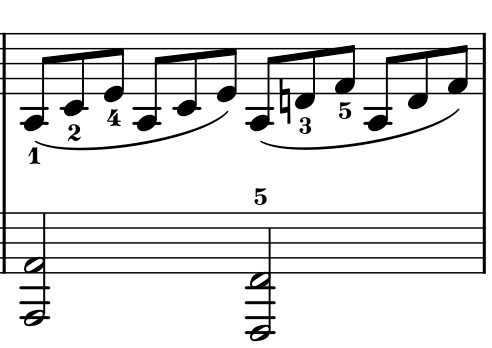 Open full-size score
A in the bass gives way to F♯, while D♮ enters the triplets. Listen to this change when choosing how much pedal to clear.
Begin by playing the passage without pedal to hear the written notes and their releases. Then add a clear pedal change at the harmonic change: play the new bass, lift enough to clear the unwanted old resonance, and lower the pedal again. Keep the fingers on notes that should continue through the change. The new harmony should speak without a dry hole between the two sounds.
From that clear version, explore how much resonance the passage can carry on your instrument. A shallower pedal or a smaller lift may preserve the atmosphere while reducing a heavy accumulation. The useful test is the sound after the change, especially in the bass. A foot movement that looks small can clear a great deal on one piano and very little on another.
Bar 4 adds another question. The bass remains G♯ while the upper notes change. An unchanged bass pitch therefore cannot be the only signal for a pedal decision. Listen through the upper harmonies as well as the bottom note, and preserve the tension of a dissonance that belongs to the score. Cleaning away every friction would remove part of the phrase’s character.
If pedal changes are still unfamiliar, work first with the simpler examples in sustain pedal and clear harmony. In this movement, the foot, held fingers and balance between voices all contribute to the continuing sound.
Changing harmony, bars 9–27
Bars 9–22 take the opening idea into different harmonic surroundings. Watch the natural signs as closely as the four sharps in the key signature. A familiar physical pattern can continue while one pitch changes, and the ear then hears a different colour. Read each new harmony before letting memory supply the next group of notes.
It helps to compare the melody with its bass at the points where the phrase changes direction. Play the outside voices of a short stretch, then restore the triplets without changing the pace of the melody. Choose stretches that include an arrival and the start after it; stopping at every bar can hide how the passage continues.
The new upper entry at bar 23 climbs into a higher register. By bars 25–27, the written swell and retreat make the music more animated than the opening. Keep some range within the quiet sound. If every passage is equally hushed, the growing tension and the later return lose their relationship.
This is also where fingering needs a whole-phrase view. A comfortable fingering for one triplet may leave the hand badly placed for the next melodic note. Test the point at which the upper line must be held while the lower fingers move. Retain its written length with the finger where practical, and plan the movement towards the next position before increasing the tempo.
The middle passage, bars 28–41
A long G♯ bass underlies much of this section. In musical analysis, a sustained or recurring bass beneath changing harmony is called a pedal point. That name describes the notes. It does not prescribe leaving the sustaining pedal fully down throughout the passage.
Above that bass, the right hand travels across a much wider space. Bars 32–36 are especially useful to examine before deciding that the movement is comfortably within reach. The arpeggios rise, change their internal intervals and descend again. The task is to follow a line across the keyboard while retaining the quiet character.
C♯ minor, 2/2. Upper staff: treble clef; lower staff: bass clef. The moving right-hand line starts in the lower staff.
Scroll sideways to read the score.
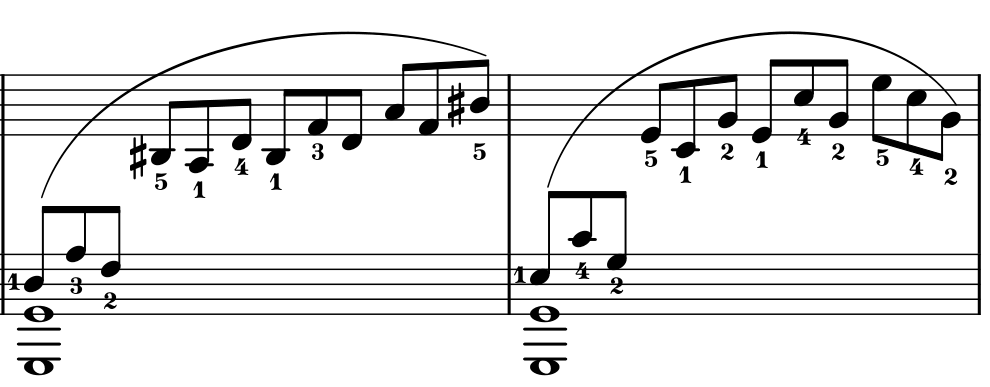
The bass stays on G♯; the right hand changes its route. Plan the hand’s movement across each complete arc.
In bars 32–33, first find the lowest and highest notes of each arc. Then trace the notes between them at a pace that allows the arm to travel with the hand. Several notes printed in the lower staff still belong to the moving right-hand line. Staff position alone does not assign the hand.
Work across each finger crossing, including the note before it and the note after it. The thumb should arrive at its new place as part of the hand’s travel, rather than forcing the other fingers to keep stretching from the old position. Keep the wrist responsive to the route of the notes; avoid holding the whole hand open as if the arpeggio were one enormous chord.
As the line rises, a brighter register can make it seem louder even without a large increase in attack. Listen to the whole arc from its low beginning. Shape its growth deliberately and carry the descent beyond the highest note. Otherwise the crest receives all the attention and the return becomes an untidy retreat.
In bars 37–41, the line comes down towards the register of the opening. Follow the changing clefs and the held inner notes. This is preparation for the return: the sound gathers back into a narrower space. Include bar 42 when practising the end of this passage so that the returning voice emerges from what precedes it.
The return at bar 42
The familiar dotted G♯ entry comes back at the end of bar 42. Its recognition has more effect when the triplets have settled underneath it. Resist the temptation to announce the return with a much louder melody; the changed register and harmony already do considerable work.
Play bars 5–9 and then bars 42–46. Notice how the familiar beginning leads to a different continuation. At bar 46, the line moves on into a new upper entry rather than simply repeating the first section. A memory based only on the opening pattern can send the hands down the wrong route here.
Continue through bars 47–59 with the bass in mind. The later harmonic changes give the melody another span of tension and release before the closing passage. Marking every few bars with the same swell would obscure those differences. Hear where the phrase is going before deciding where its sound should grow.
The quiet return at bar 59 also needs a complete melody note. Reducing the sound too early can leave the end of the phrase inaudible. For notes that fail to speak at this level, the guide to playing pianissimo without losing notes offers a focused way to work on the attack.
The left-hand echo and final chords
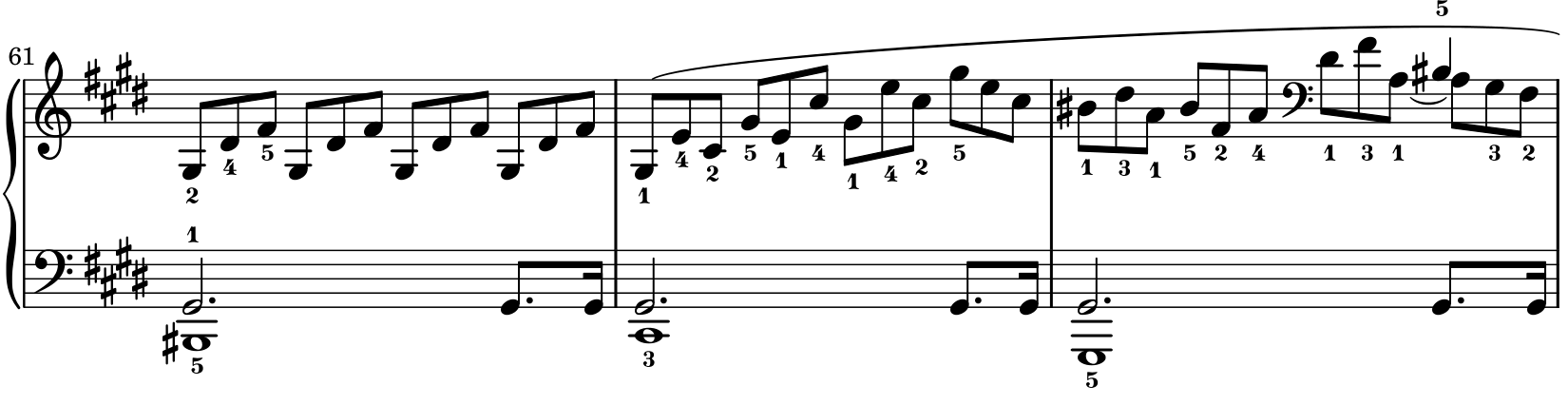
At the end of bar 60, the dotted repeated-note idea moves into the left hand. In the following bars, G♯ carries that rhythm above the lowest bass notes, while the right hand’s triplets open out again. The leading voice has changed hands and register.
Bars 61–63, in C♯ minor and 2/2. The upper staff changes from treble to bass clef in bar 63; the lower staff stays in bass clef.
Scroll sideways to read the score.
Bars 66–69: both staves now use bass clef
Scroll sideways to read the score.
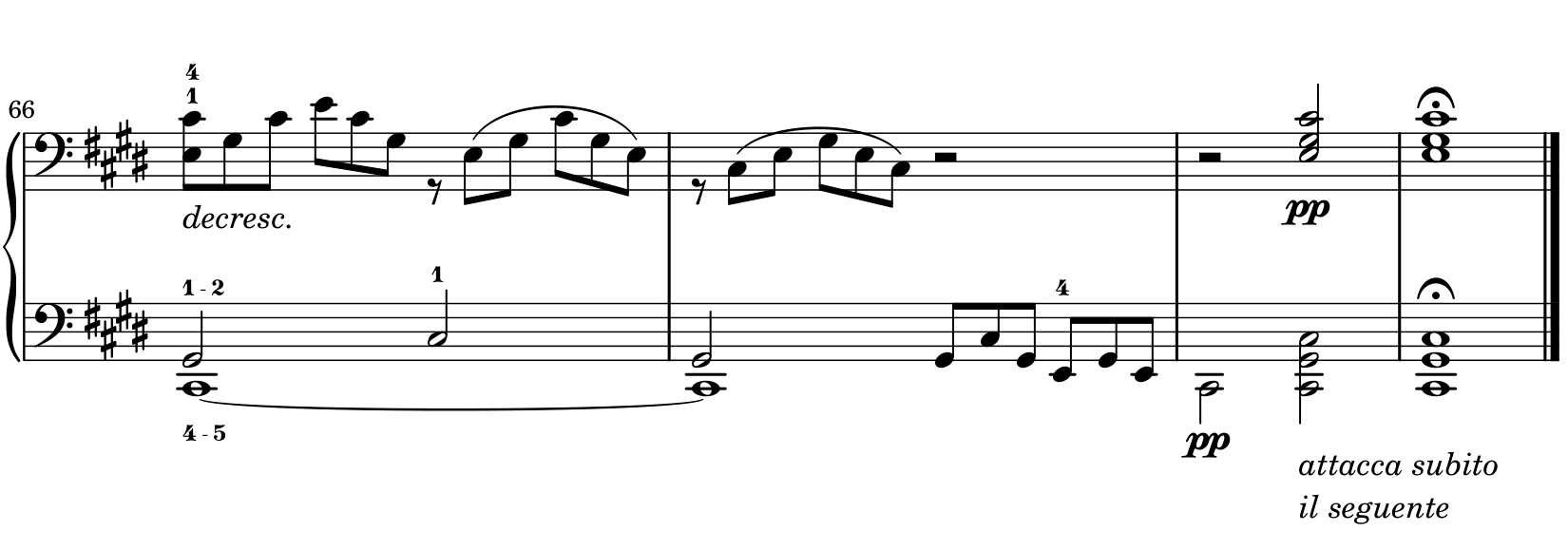
Keep listening after the right hand stops: the left hand completes the triplets before the two quiet closing chords.
Play the upper part of the left hand alone from the end of bar 60 through bar 63. Hear it as a continuation of the earlier voice. Add the lower bass, then the right hand, keeping the dotted rhythm audible through the arpeggios. More volume from the entire left hand would make the bass heavy; the distinction is within that hand.
Bars 66–67 narrow the gesture further. The left-hand line moves from G♯ to C♯ and back, then continues the triplets after the right hand rests. Follow that transfer to its end. If your attention leaves with the right hand, the last moving notes can sound like remnants instead of the conclusion of the phrase.
In bar 68, the low C♯ sounds before the fuller chord halfway through the bar. Give that space its written length, then listen through the final chord and its fermata. A quiet ending still has rhythm and a deliberate release. The score also directs an immediate continuation into the following movement when the sonata is performed complete.
Working on the whole movement
After studying a passage, play into it from the music before and continue beyond it. A balanced bar 6, an unhurried middle arpeggio and a clear left-hand echo each need to belong to the same movement. An occasional uninterrupted recording can reveal where the phrase loses direction even after the local difficulty has been solved.
The most useful question for a lesson is often very specific: “The melody disappears here,” “This pedal change sounds dry,” or “My tempo changes when the arpeggio rises.” Bring the complete score and the passage in its present state. Hearing the sound and seeing the movement together lets me address the cause and demonstrate a musical alternative.
Vienna Piano School is accepting applications for piano lessons in English, online worldwide and in person at piano studios in Ikebukuro and Shinjuku, Tokyo. You can apply for a free 55-minute trial lesson to work on this movement or discuss suitable repertoire. The school is preparing to open; lesson start dates and trial arrangements are confirmed by email.