
How to Listen to Your Own Piano Recording Without Getting Discouraged
To get something useful from a recording of your piano playing, begin with a short passage and one question. Listen through once, notice a musical detail worth keeping, then replay for something specific: a pulse that changes, a melody that disappears, or an ending that does not quite settle. Write down where it happens before choosing what to practise.
“That sounded bad” is an understandable first reaction, but it gives you very little to work with. A useful listening note describes an event you can find again. The method below helps turn playback into a manageable practice decision, with a worked example and a worksheet for your next recording.
Give a short recording a clear purpose
Choose a phrase or a short section that you can already play reasonably comfortably. Include its beginning and ending, plus a little of the surrounding music if you are checking a transition. A few bars may be enough. A complete performance has a different purpose: it shows how the larger musical shape and your continuity hold together.
Before pressing record, choose a question you can answer by listening. “Does the melody remain audible when the left hand gets busier?” gives the replay a focus. “Is this good enough?” leaves the standard undefined. If you have no particular concern yet, listen once and choose the question afterwards.
Use the recording method you already have, provided the playback is clear enough for that question. Make a brief sound check, especially at the loudest point. For questions about rhythm, an ordinary clear recording can be useful; judging a very quiet inner voice may require more care with placement and playback. The online piano recording and camera setup guide covers practical starting points.
Listen to the whole phrase before stopping it
For the first pass, put your hands away from the keyboard and let the chosen passage finish. Listen for the musical direction: where the phrase begins, where it moves, and how it ends. If it is a video, try listening without watching first, so your attention stays on the sound you are trying to assess.
Write down one specific thing that works. Perhaps the melody stays clear through the opening, the final note has room to sound, or a difficult transition keeps moving. This is information to preserve during the next attempt. Changing everything at once can also disturb something that was already convincing.
Then return to your chosen question. The sequence below separates hearing the phrase, examining a detail, and comparing a new attempt. The number of listens is a working suggestion, not a target to complete regardless of what you hear.
The strips show where to direct your attention: a whole passage, one moment, then the same moment in two takes.
- 01Whole passage
Hear the phrase
Let the passage finish. Name one musical detail to keep.
- 02One question
Locate one detail
Replay for one question. Note where it happens and what remains uncertain.
- 03Same passage
Compare a new take
After a small practice test, record the same passage. Check the original question again.

One-to-one classical piano
Beginner to advanced. Online, worldwide.
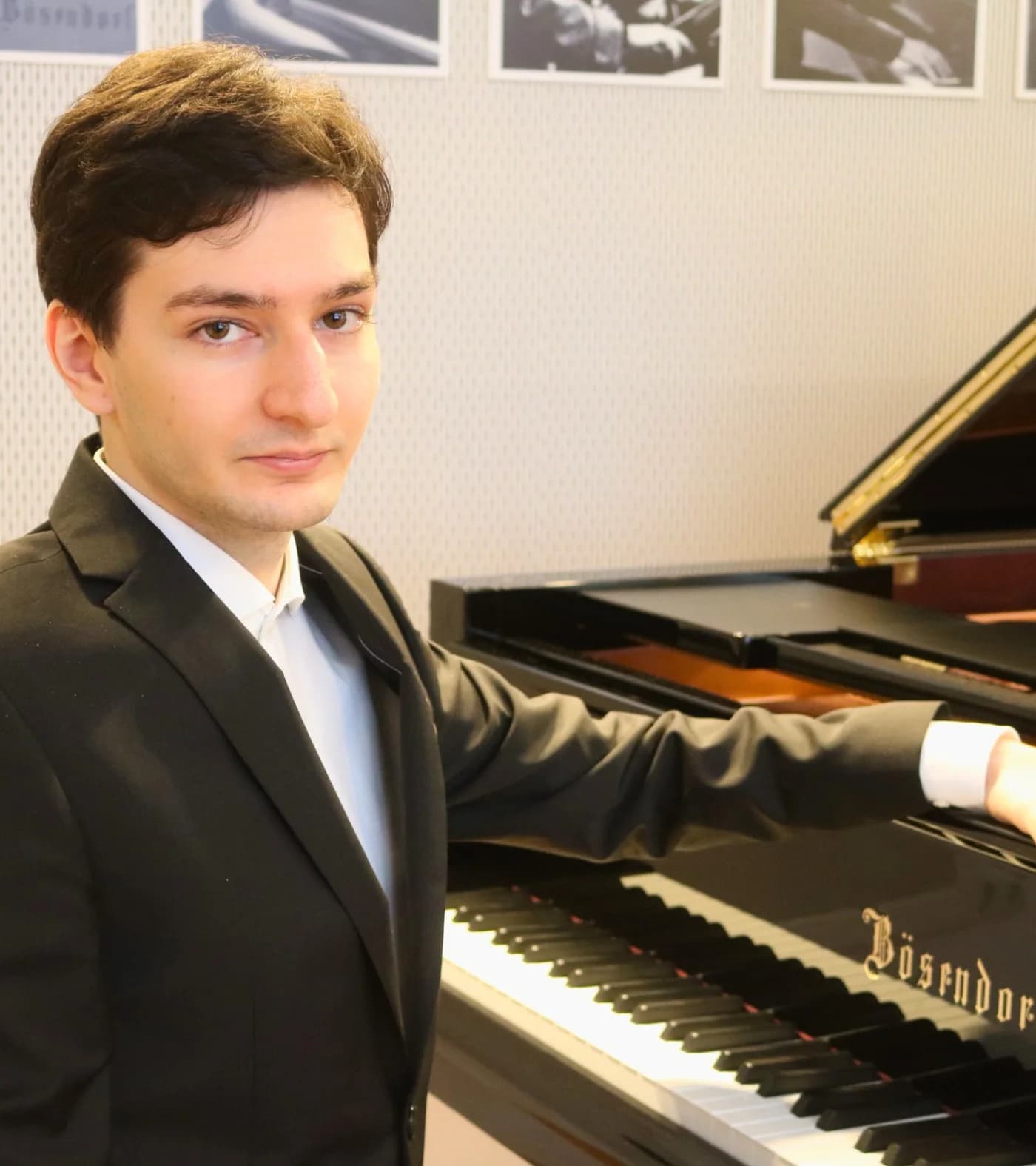
Enea
Concert pianist from Vienna
30 minutes · Tokyo studio from October 2026
Turn a judgement into an observation
A useful observation gives you a location and something audible. “The pulse becomes quicker in the second half of the phrase” is more workable than “the rhythm is terrible.” Mark a bar number or playback time in your own recording, then replay a little before and after it. The surrounding music helps distinguish an isolated event from a pattern.
Keep the observation separate from its possible cause. A gap before a new bass note does not, by itself, prove that the left hand needs more speed. The movement may be uncertain, the note may be poorly remembered, or the pause may have been an expressive choice. The next step is to check what you intended and choose a small test.
The following is an illustrative practice example, not a report about an actual student or recording. Imagine a phrase intended to keep a steady pulse while the left hand moves to a new position.
Illustrative example: the intended pulse is steady. These are sample notes, not findings from an actual recording.
- What is heard
- The opening keeps moving, but there is a gap just before the left hand reaches its new bass note.
- What is uncertain
- The recording does not establish whether the destination, the movement or the intended timing caused the gap.
- One test
- Check the left-hand destination, then prepare that move earlier in a short, comfortable practice attempt. Put it back into the phrase.
After recording the same phrase again:
If the gap is shorter
Check whether the melody and the intended pace still work. Keep the useful change and try it again later.
If the gap remains or the difference is unclear
Keep the observation. Check the notes and intended timing with the score, or take the question to a lesson before making the same attempt repeatedly.
Other listening goals need equally precise questions. For balance, ask whether you can follow the melody through the accompaniment. For articulation, compare the lengths and separations of notes that you intended to match. For phrasing, listen to the approach to a destination and the space after it. Mechanical noise belongs in a separate note unless it interferes with the musical question.
Choose one of these concerns for the next attempt. A deliberate change of tempo or an unequal articulation may be part of the interpretation, so compare what you hear with the score and your musical intention. Listening critically does not mean making every note equally loud, equally long or mechanically regular.
Check what the recording can actually tell you
The microphone hears from its own position, and the playback system presents that captured sound. Neither is identical to sitting at the keyboard or listening elsewhere in the room. Microphone placement can change the apparent balance, attack and amount of room sound. A close, prominent key noise should therefore prompt a check before it becomes a conclusion about your technique.
Keep the device position, recording settings and listening volume consistent when comparing two attempts. Otherwise, a change in the recording conditions can be mistaken for a change in the playing. If loud chords sound distorted, make another sound check and correct the recording before assessing their tone. If a melody seems unusually distant, check whether the same impression remains through another familiar playback device.
A recording can reveal a result without explaining the movement that produced it. Even a video shows only one angle. Treat an uncertain cause as a question for practice or a lesson. There is no need to diagnose your hands from a sound file.
A commercial performance can help you explore an interpretation, but use it to ask a musical question, such as how a phrase moves towards its ending. Its instrument, room and recording production can differ substantially from your practice setup. For a close comparison of your own work, use two recordings of the same passage.
A second take is most useful when it follows a specific musical decision. Reference photograph.
Use the worksheet to compare one change
Keep your notes short enough to use at the piano. The worksheet asks for the passage, the listening question, something to preserve, an observation, an uncertainty, one test and the result of the comparison. You can type on the page or download the blank sheet for printing.
Your listening sheet
Use these fields while listening. Copy your notes before leaving; the printable PDF is a blank sheet.
Download the blank listening sheet (PDF, 1 page)After listening, return to the instrument and try the chosen change in a small enough passage to understand what happens. If the test is to prepare a left-hand move earlier, first check the destination without rushing, then put the movement back into the phrase. The practice-loop guide explains how to test a possible cause without repeatedly playing the whole piece.
Record the same passage again. Play the two takes at a comparable listening volume and return to the original question. Did the gap become shorter? Is the melody easier to follow? Does the ending have the shape you intended? Also check whether the detail you wanted to preserve is still there.
An inconclusive result is useful to record honestly. Write “the difference is unclear” or “the gap remains” if that is what you hear. One successful attempt is a reason to test the passage again later, rather than assume that the change is permanently established.
Stop when the replay has given you a task
Repeatedly replaying a passage can become a way of collecting faults without changing the next practice decision. Once you have a location, an observation and a reasonable next step, close the player and work on the music. You do not have to finish a list of everything that could improve.
If listening starts to feel overwhelming, shorten the passage or choose an easier question. Hearing whether a particular note arrives before or after the beat is more bounded than judging the emotional effect of an entire movement. You can also leave the recording and return later, when you are ready to listen for that one detail.
Keep occasional dated recordings of the same passage, with a brief note about the question or practice condition. Comparing against an earlier attempt can show changes that are easy to miss in day-to-day work. It can also reveal what still needs attention. There is no need to record every repetition or to publish a practice recording.
A small recording task can fit into an ordinary session: capture the passage, listen, practise one change and compare. The 30-minute practice plan shows how focused work can sit alongside reading, technique and playing for enjoyment.
Bring the unclear part to a lesson
Sometimes the useful outcome is a better question for your teacher. You may hear that a melody loses direction but be unsure which notes need attention, or notice a recurring pause without knowing whether the problem lies in reading, fingering or movement. Describe the passage and what you hear, including what you have already tried.
A teacher can help connect the recorded result to the score, the musical intention and what happens when you play the passage again. In a free 30-minute trial lesson, we can hear a short section and discuss a useful next step. Online lessons are available now, with in-person lessons in Tokyo beginning in October 2026.
For your next recording, choose a phrase you know, write one listening question and leave space for one observation. The aim is to finish with something specific to do at the piano.