
Stop Repeating the Whole Piece: A Better Practice Loop
You reach the awkward passage, hesitate, recover, and finish the piece. Then you start again. The familiar opening feels reassuring; the awkward passage feels much the same. After several runs, you have spent plenty of time at the piano without discovering why that moment keeps failing.
A useful practice loop gives each attempt a question to answer. Describe what you heard, choose a small passage that contains it, test one possible explanation, and compare the result in the original music. Repetition still matters. The difference is that you know what you are repeating, what you hope to hear, and what the next attempt can tell you.
Start with something you can actually hear
“The passage is bad” gives you little to work with. “The short note arrives too early” points to a particular event. “The melody disappears when the left hand enters” identifies a relationship between sounds. “There is a pause before the new chord” gives you a place to investigate.
Keep the observation separate from its possible cause. An early note does not automatically mean you need a different fingering. You might be misreading the rhythm, anticipating a movement, or losing track of the beat while reading ahead. Each explanation suggests a different experiment.
Choose one audible goal for the next attempt. You can care about rhythm, tone and phrasing throughout the session without trying to repair everything simultaneously. The loop below is a way to make that choice and decide what follows.
Notice and name
Describe one audible difference.
Isolate and ask
Choose a passage and one possible explanation.
Change one thing
Try a small experiment with a clear purpose.
Test the music
Return to the original passage and listen.
Did the intended sound improve?
Yes: widen the context
Add the approach and continuation. Check again after a pause.
Unchanged or unclear: revise the question
Change the test or investigate another explanation.
Before you leave: record what happened and the next comparison to make. That becomes the start of the next loop.
A worked example: the opening of Schumann’s march
Consider the first bar of Schumann’s Soldiers’ March, Op.68 No.2, from Album for the Young. Both hands begin with the same rhythm: a dotted eighth note, a sixteenth note, an eighth note, then an eighth rest. The first two durations have a three-to-one relationship. They should not drift towards two equal notes.
The close-up below comes from a historical printed edition. The wider view keeps the opening in context; fingerings and expressive additions belong to this particular teaching edition.
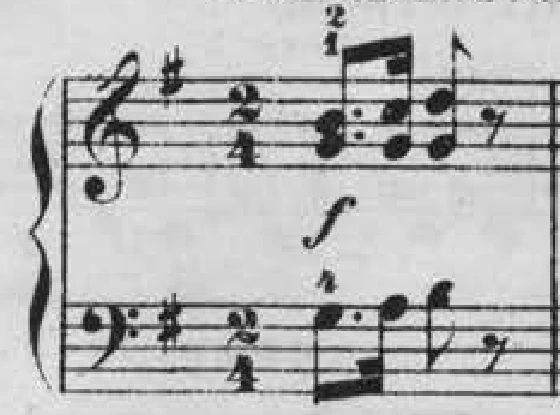
Listen for: a long first note, a short note just before beat two, then space for the rest. Keep two steady quarter-note beats.
The two opening durations occupy three sixteenths and one sixteenth. The following eighth note and eighth rest complete the bar.
See the wider passage and read the notes
Bars 1–6, with the full opening instruction, Munter und straff, and this edition’s expressive markings. The close-up above shows bar one below that instruction.
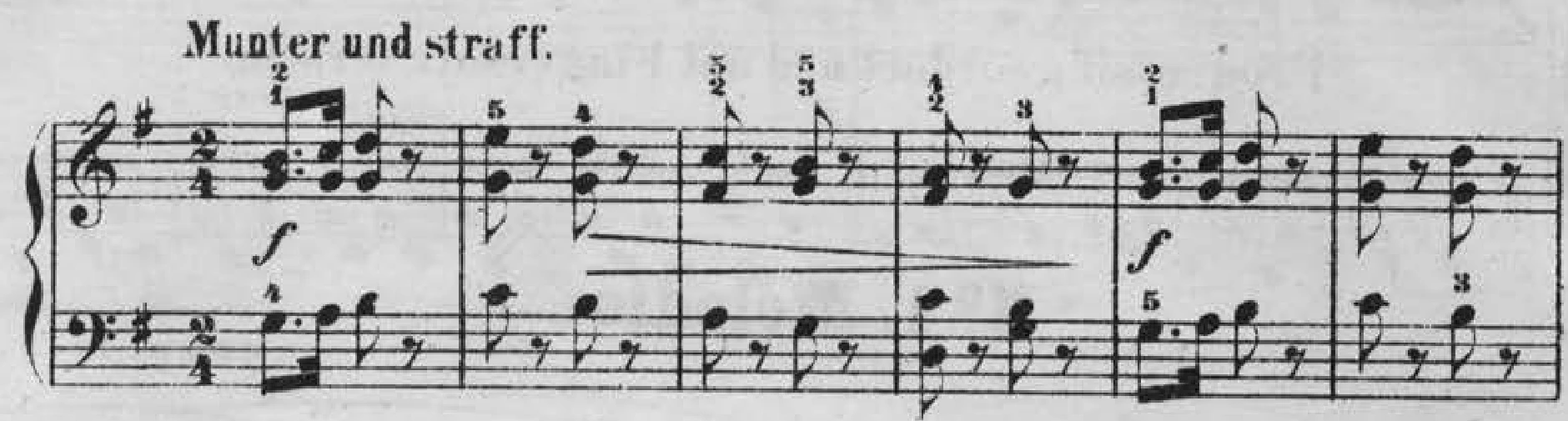
Bar one, selectable transcription: treble and bass clefs; one sharp, F-sharp; 2/4; forte. Right hand: G4 with B4 (dotted eighth), G4 with C5 (sixteenth), G4 with D5 (eighth), eighth rest. Left hand: G3 (dotted eighth), A3 (sixteenth), B3 (eighth), eighth rest. C4 denotes middle C. The hands share the same rhythm.
Suppose the opening sounds almost like three evenly spaced notes. That is our hypothetical practice problem. Before choosing an exercise, make the goal specific: preserve the long-short opening while keeping the second beat and the final rest in place.
The rest matters. Getting the first two notes right and then rushing into the next bar would leave a different rhythmic problem. Choose an endpoint that lets you hear the whole first bar and the arrival into bar two. You do not need the entire piece to make that comparison.
If you are working on different repertoire, use the same distinction: describe the audible event before deciding which technical explanation to pursue.

One-to-one classical piano
Beginner to advanced. Online, worldwide.
Enea
Concert pianist from Vienna
30 minutes · Tokyo studio from October 2026
Choose a test that answers one question
First ask whether the rhythm is clear away from the notes. At a comfortable pace, speak an even sixteenth-note subdivision: “one e and a, two e and a.” Tap on “one,” the “a” just before two, and “two.” Leave the second half of beat two silent, while the count continues.
This removes the changing pitches and the need to coordinate two hands. It gives you a useful question: can you place the short note immediately before the second beat while the beat stays steady?
If that is unclear, work out the rhythm before changing fingerings. Count slowly enough to hear the subdivisions as equal. Once the pattern is clear, say or tap it without the spoken subdivisions while retaining the two-beat pulse. Counting is a temporary aid; the musical aim is a lively march, not a permanently spoken exercise.
If tapping is comfortable but the played rhythm changes, the difficulty may lie in applying that timing at the keyboard. Try the right hand alone with the written notes. Then compare with both hands. A difference between those versions helps narrow the question, although it does not prove a single cause.
Our guide to bringing the hands together in piano practice develops those reductions more fully. Here, use only the reduction that answers your current question.
Change one thing, then compare the original passage
Suppose you can tap the pattern and play the right hand accurately, but the sixteenth arrives early when both hands join. Try one change: keep the quiet spoken subdivision while playing both hands at the same comfortable pace.
Listen for the short note just before beat two. Then play the original bar again without speaking, continuing through its rest into bar two. Did the long-short relationship remain clear? Did the next bar arrive on time? Did the sound retain its character?
This comparison is essential. An exercise can become fluent while the passage stays unchanged. The return to the music tells you whether the exercise is helping with the thing you actually wanted to play.
Keep the comparison reasonably consistent. If you simultaneously slow down, change the fingering, remove the left hand and count aloud, an improved result will not tell you which change helped. You can use all those options over a session; separate them when you want to learn from the result.
An unchanged result is useful information too. Perhaps counting aloud adds another task. Perhaps the difficulty occurs when moving between the actual notes. Revisit the question instead of repeating the same exercise more insistently. If you cannot hear the difference clearly while playing, a short recording can let you listen afterwards for that single event.
Put the passage back into its surroundings
A successful isolated attempt is a reason to expand the test. In the Schumann example, play through the next few bars at the same pace. Listen for whether the opening still has its dotted shape once your attention moves towards the following music.
For a problem later in a piece, start before it. Include enough of the approach to reproduce the real transition, then continue beyond the difficult moment. Starting directly on the troublesome note can hide the preparation that was causing the hesitation.
If the passage works alone but fails in context, move the practice boundary. You may need to investigate the approach rather than polish the same isolated notes further. Ask whether reading ahead, a position change or the end of the previous phrase alters what happens next.
Increase speed only when you can still judge the intended result. A correct slow version is useful, but the quicker version needs its own listening check. Avoid declaring a passage finished because one attempt went well. Return after working on something else, and see what survives without the immediate lead-in of repeated attempts.
Leave a useful note for tomorrow
A practice record does not need to document everything. Its most useful job is to tell you where to begin and what to compare when you next sit down.
For the Schumann example, an illustrative note might read:
- Place and goal: bar one; keep the dotted opening clear and the rest in time.
- Test: tapping was clear; both hands made the short note early.
- Change and result: counting subdivisions helped during the exercise; the uncounted return was still uncertain.
- Next question: can the same rhythm remain clear with both hands after a pause, without speaking?
That note records a partial result honestly. “Practised Schumann for twenty minutes” tells you what occupied the session, but not what to try next. “Fixed the rhythm” may claim more than you have tested.
At the next session, first hear the passage without immediately repeating yesterday’s exercise. If it holds together, move on to a new musical question. If it does not, the note gives you a starting point instead of sending you back through the whole piece by habit.
To fit this kind of focused work into a limited practice window, use our thirty-minute piano practice plan. The schedule gives the session shape; the question gives each attempt a purpose.
Keep a place for complete performances
Playing the whole piece remains valuable. A run-through can reveal where concentration fades, whether the pacing makes sense, and how well you recover after a slip. It also gives you the pleasure of playing music beyond the passage currently under repair.
Decide the purpose before you begin. During a diagnostic run, notice a small number of places to revisit afterwards. During performance practice, continue through mistakes and practise recovery. During detailed work, stop where the question needs attention. These are different uses of your time, and a session can include more than one.
If you repeatedly reach the same uncertainty, bring that moment to a lesson: the passage, the sound you want, what you have tried, and what changed. A teacher can help distinguish a reading problem from a coordination or musical-planning problem, and choose a manageable next step.
Vienna Piano School offers live online piano lessons and a free thirty-minute trial. You can request a trial lesson and mention a passage that keeps resisting practice. It gives us a concrete starting point for hearing your playing and discussing how to work on it.