
Changing Piano Teachers at an Advanced Level: What to Keep and Reconsider
When you change piano teachers at an advanced level, bring the music you are already working on, the score you actually use, and a clear sense of what you want to develop. Preserve the parts of your playing that work while you investigate the changes that have a musical purpose. A new teacher's first suggestions should lead to something you can hear and explore at the piano.
An advanced pianist arrives with a history: fingerings learnt over years, familiar ways of shaping a phrase, successful performances and persistent difficulties. Some habits are valuable. Others have outlived the problem they originally solved. The interesting part of a transition is discovering which is which.
I find the most useful question is often quite small: what should sound different in this phrase? “Rebuild my technique” can be an ambition, but it gives you little to work with on Tuesday evening. A quieter accompaniment beneath a sustained melody, or a scale that continues through a thumb crossing, gives the discussion a musical centre.
The first music to bring
Choose material that shows both your strengths and your unfinished work. Before the first meeting, gather:
- One familiar piece or movement that represents your present playing.
- One passage where you repeatedly lose the sound, movement or continuity you want.
- Your marked score, including the edition and fingerings you currently use.
- Any approaching performance date and the practice time you actually have.
A recently performed movement reveals how you sustain a complete argument. A difficult passage reveals how you work when the answer is unfinished. Together they say more than a list of the hardest pieces you have played.
If your programme is large, choose contrasting examples rather than attempting to present everything. A Bach fugue and a lyrical Romantic work raise different questions about listening and coordination. Explain whether each piece is newly learnt, being restored after a break, or already part of your performing repertoire. A hesitant first reading should be understood as a first reading.
Keep one short recording from before the change, ideally a complete movement or a substantial section. Later, it can answer a more useful question than “Do I feel better?” You can compare whether the bass remains audible, the return has a different character, or a transition keeps its pulse.
Your marked score
The copy on your music stand contains decisions that a clean score conceals. A fingering may avoid an uncomfortable stretch. A pencilled breath may mark the end of a thought. A pedal reminder may have been added for a particular hall. Bring those decisions into the conversation before replacing them.
Distinguish the printed musical text, editorial additions and your own annotations. An Urtext edition seeks to present the composer's text from the surviving sources; that does not make every printed fingering a command from the composer. Check the edition's introduction and commentary when the origin of a marking matters. Pencil, a second colour or a dated note can keep a newly tested option separate from an established choice.
Suppose a teacher suggests a different fingering in a passage you have played for years. The useful question is what the change allows: a legato connection, a quieter thumb, a better position for the following chord, or an articulation that the old pattern obscures. Write down that purpose alongside the numbers. If you later forget why you changed them, the numbers alone are a poor explanation.
Try the new fingering across the entry and exit of the passage. A comfortable solution to three notes can leave the hand badly placed for the fourth. The broader guide to choosing piano fingerings develops that relationship between the local pattern and the surrounding music.
What to keep, test and set aside
A change of teacher can make every familiar choice feel provisional. Give the work some proportion. Keep a reliable piece in circulation, choose a small part of another piece for investigation, and identify the questions that can wait.
The example below shows how three pieces can have different jobs during the same transition. Your own list may contain only one or two works. The point is to know which decisions are open in each one.
Three pieces, three purposes
Keep in circulation
Bach: C-minor Fugue, BWV847
Recently performed
Keep the complete movement fluent while listening for the subject in each voice.
Retain settled fingerings; flag the one entry that still gets lost.
Explore closely
Brahms: Intermezzo, Op.118 No.2
Notes secure; balance still changing
Compare a stronger melody with quieter supporting voices in one phrase.
Choose the balance by listening, then carry it into the next phrase.
Read alongside
Beethoven: Sonata Op.13, Adagio
New reading
Establish the pulse and distinguish melody, inner movement and bass.
Discuss fingering before a repeated pattern becomes automatic.
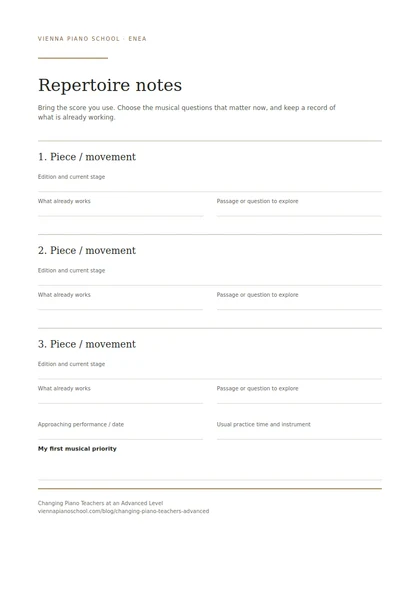
One page for the music you are bringing, what already works and the question you want to explore.
This is especially useful when new ideas compete for attention. Perhaps you want to change the movement in fast passages, reconsider pedalling in Brahms and learn a new sonata. Each may be worthwhile, but changing all three at once can make it hard to hear what any one adjustment has achieved.
Choose one recurring musical problem as an early priority. If accompaniment is covering the melody in several pieces, explore that relationship across two contrasting textures. If the problem occurs only in one awkward turn, investigate that turn before treating it as a fault in your whole technique.
When advice sounds contradictory
One teacher asks for more weight; another asks you to lighten the hand. One says to connect a phrase; another wants more space. These statements need a passage, a sound and a context before they can be compared.
Ask what the teacher is responding to in the performance they have just heard. “More weight” might be an attempt to give a melody presence. “Lighter” might concern the accompaniment beneath it. Even when the advice concerns the same notes, the two teachers may have heard different versions of your playing, on different instruments and at different stages of preparation.
Put the alternatives beside each other at the piano. Play a short phrase with your established approach, then try the proposed change. Listen for the intended result and for any new difficulty it creates. In a singing passage, a more prominent melody may be welcome, but an accent on every melody note can destroy its direction. The phrase decides whether the experiment is working.
Useful questions are direct: “Which voice should I hear more clearly?” “Where does this phrase arrive?” “Can we compare the two releases?” These invite a musical explanation without turning the meeting into a defence of the previous teacher.
Sometimes there is a real difference of interpretation. You may prefer a steadier pulse where the new teacher imagines more flexibility. Explore what each reading does to the harmony and the larger phrase. Your judgement should become more informed through the exchange; advanced study involves developing that judgement, as well as following instructions.
A change inside one phrase
Imagine a quiet chordal melody whose upper line disappears as the phrase descends. Your old practice method was to make the melody stronger. The new suggestion is to reduce the inner voices instead. Both actions can change the balance, but they will not necessarily produce the same colour.
Play the melody alone, hearing where it moves and where it settles. Add the bass, then the remaining notes. If the melody still has direction with less inner sound, you have found a different balance without forcing the top note. If the harmony becomes empty, restore enough of the supporting voices to give the phrase its character.
A change is useful when you can explain that result. “I am using less pressure” describes a sensation. “The middle notes no longer cover the melody, and the chord still sounds full” connects the experiment to the music. Both observations can matter, but the second gives your ear something to recognise next time.
The same principle applies to articulation. Try releasing a phrase-ending note earlier while keeping the pulse moving into the next phrase. Then compare a later release. The question is whether the musical thought has finished, whether the silence has shape, and whether the next entry still belongs to the same tempo. Avoid changing the release, tempo, fingering and pedal simultaneously: you would have several possible explanations for one result.
Performances and bigger technical changes
Tell the new teacher about a recital, examination or audition at the beginning of the transition. The date affects what can be explored deeply and what has to remain dependable in performance.
With a recital close, identify the passages that threaten continuity and the adjustments that have an immediate audible benefit. A clearer bass entry or a better planned breath between phrases may settle quickly. Replacing a long-established fingering throughout a fast movement usually demands more time to become dependable, especially under pressure.
Keep a distinction between the version you are preparing to perform and the version you are exploring. You can test a new movement slowly in a short passage while maintaining the current performance elsewhere. If the existing approach causes pain, stop that activity and seek appropriate help; a performance deadline is not a reason to continue through pain.
With a longer study period, a short work can give a technical change room to develop. Choose music that exposes the intended sound clearly. A piece with spare textures may reveal uneven releases more directly than a dense virtuoso passage. The easier notes serve a demanding listening task. Agree how that work relates back to your larger repertoire, so it does not become an indefinite detour.
A different piano or lesson setting
A move to another city can bring a change of teacher and instrument together. A brighter grand may make the accompaniment seem too strong; a different action may reveal uneven attacks that were less obvious at home. Play a familiar phrase, listen to the balance, and let the new teacher know which instrument you normally practise on.
If the transition also involves online study, establish a camera view that shows the keyboard and the movements under discussion. Agree how to compare recorded sound with the live call. A microphone's automatic volume adjustment can alter the apparent difference between a quiet accompaniment and a louder melody. It is sensible to compare a short recording made with stable settings as well as the sound arriving through the call.
Make the musical question specific enough to survive the change of setting. “The left-hand chord covers the melody on the second beat” can be checked in a room, on a recording and in the score. “My sound is wrong” leaves too many possibilities open.
Closing one relationship, beginning another
A teacher may have contributed years of valuable work even when your next stage calls for a different approach. A brief, direct message can acknowledge that work and state when you intend to finish. Check the practical arrangements you have agreed, including notice and any remaining meetings.
If a short conversation between teachers would help, ask both people first. The useful information is musical: repertoire studied, current priorities, an approaching performance and any agreed restrictions on the work. You can also carry those details yourself. The transition should not depend on producing a formal dossier or persuading one teacher to endorse another.
In a conservatoire or university, the change may involve an assigned class or institutional process. Ask the department how a transfer works before assuming it follows the arrangements of private study. Keep the educational conversation and the administrative requirements distinct.
Recognising a useful beginning
After several meetings and some time practising, return to the passage and recording you brought at the start. Can you hear a difference you understand? Can you reproduce it on your own? Do you know what to try when the old difficulty returns?
You might still be adapting to an unfamiliar fingering while already hearing a more continuous phrase. You might play the same tempo with less unevenness, or recover a voice that used to disappear. These are specific changes to examine. Faster repertoire turnover is only one possible sign of progress.
If every piece has been replaced and you cannot explain the direction of the work, ask for a discussion of priorities. If a suggestion remains unclear, return to the sound it was meant to change. A useful beginning leaves you with both something worth preserving and a worthwhile question for the next practice session.