
Bach’s C-Major Fugue, BWV 846: Hearing and Practising Four Voices

Bach’s C-major Fugue, BWV 846, fits into twenty-seven bars, yet it can feel more demanding than a much longer piece. Four musical lines share two hands. A new voice enters while another is halfway through its thought; a held note needs to survive underneath moving fingers; the tune you were following slips into the middle of the texture.
I find this fugue most rewarding when the practice begins with a question about listening: which line can I still hear after the next voice arrives? Finding every subject entry on paper is useful. Keeping those lines alive at the piano is the real work.
Three features deserve attention from the start:
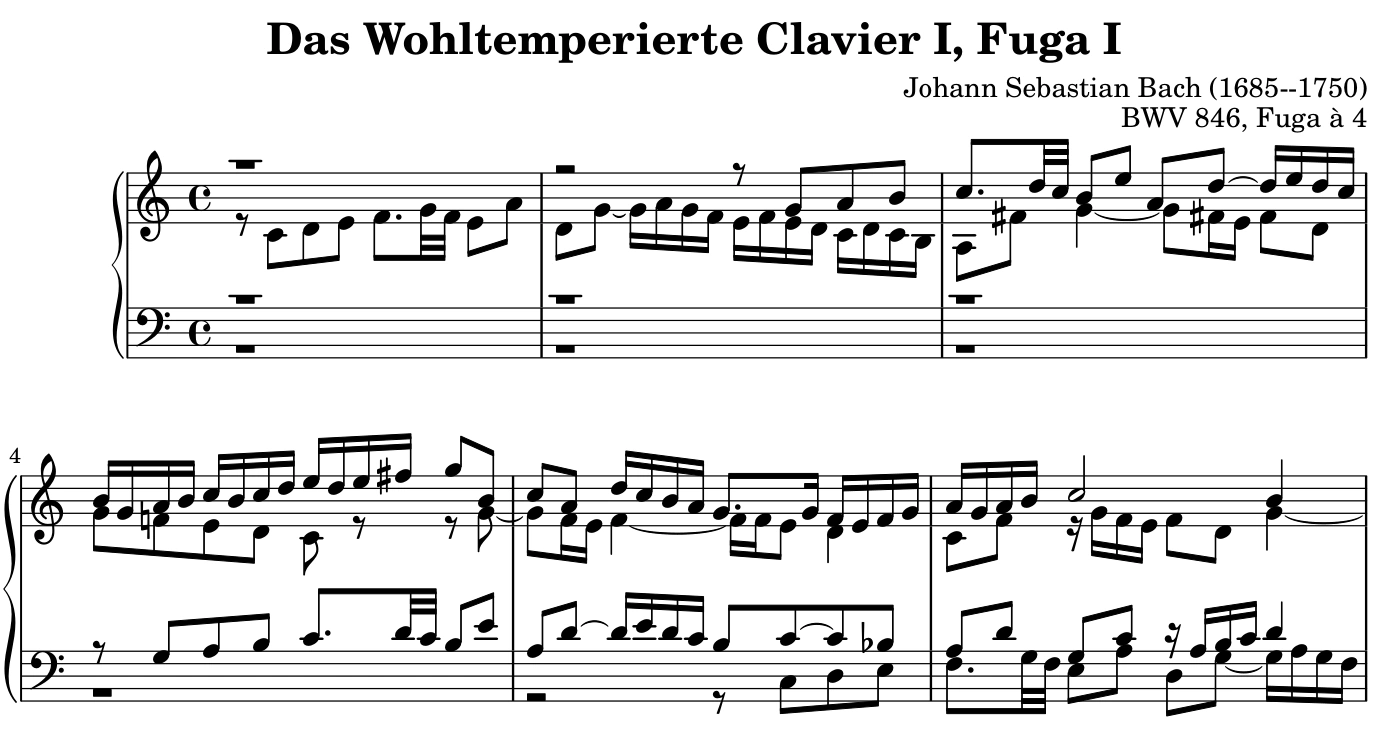
- The first entries arrive in the order alto, soprano, tenor, bass, on the offbeat positions shown below.
- From bar 7, subject entries overlap. One voice must continue speaking as another begins.
- The last four bars hold a bass C while the upper voices keep moving. The arrival in the bass and the end of the music happen at different moments.
This is the fugue that follows the familiar C-major Prelude in Book I of The Well-Tempered Clavier. The prelude guide explores its broken-chord texture; here the task is to hear several melodies at once.
Subject and first entries
Play the opening alto line by itself. It begins with an eighth-note rest, then C–D–E–F. The small quick turn above F, the leap to A and the subsequent drop to D give the phrase more personality than a simple rising scale. Sing its shape before deciding how strongly each note should sound.
The short notes need their written proportions. In the first bar, the dotted eighth note on F is followed by two thirty-second notes, G and F. Those two quick notes occupy the final part of the third beat; they should not steal the time needed by the longer F. Try counting the quarter-note pulse while playing just this voice. Then allow the detail to settle into the larger phrase.
The first entry of each voice
Count four quarter-note beats, each divided into two eighth notes. The coloured position marks the first note of the entry.
1. Alto
C4 · middle C
Bar 1, “and” of beat 1
2. Soprano
G4 · above middle C
Bar 2, “and” of beat 3
3. Tenor
G3 · below middle C
Bar 4, “and” of beat 1
4. Bass
C3 · an octave below middle C
Bar 5, “and” of beat 3
The starting note alternates C–G–G–C. The same rhythmic profile helps the ear recognise the subject in a new register.
The second entry starts on G in the soprano. The third also starts on G, an octave lower in the tenor. Only the fourth, in the bass, returns to C. Hearing these different starting registers matters more at first than attaching a theoretical label to each entrance.
The map uses C4 for middle C. Its highlighted positions show beginnings, not accents: entering on the “and” of a beat does not mean hitting that note harder. Give the first note a clear place in the pulse, then carry the line forward.
Bars 1–6: four voices join the conversation
Scroll sideways to read the score.
Two voices before four
Bars 1–3 provide a remarkably good listening test. Play the alto alone through all three bars, including what it does underneath the soprano entry. Next play the soprano alone, counting its rests. Finally combine them and listen through the alto phrase while the soprano begins above it.
The temptation is to transfer all attention to the new tune. Then the older line becomes a collection of quiet notes with no direction. In bar 2, keep hearing the alto’s descending movement after the soprano G has entered. On the next attempt, reverse your attention and follow the soprano. Both readings should be possible without a drastic change of tempo.
For an especially revealing version, sing one line while playing the other. A quiet hum is enough. If the sung line disappears at precisely the same place each time, that is a useful clue: you may know the finger sequence there more securely than the melody. Return to that small stretch, hear its destination, and combine the voices again.
Hands-separate practice remains valuable for finding notes and movements. Voice practice answers a different musical question. One hand can contain two lines, and a line can be shared between hands. Learn what each voice says, then choose a practical way to distribute it at the keyboard.
Held notes, rests and fingering
In four-part writing, a note’s ending is part of the counterpoint. Releasing a held note as soon as another finger moves can leave a hole; keeping every available finger down can blur the rhythm. Read the ties and rests as carefully as the attacks.
At the beginning of bar 3, for example, the soprano’s dotted rhythm sits above an alto line that moves into a tied G. The two parts have different jobs. Practise their releases slowly enough to hear which voice is still sounding. The ear should distinguish a note being sustained from a note being repeated.
Choose fingerings across several notes, especially where one finger has to remain down while the others move. If the next note is comfortable but the following one forces a break, the fingering has solved too little of the phrase. Mark the decision at the point where the movement begins, rather than only at the awkward landing.
A finger substitution can preserve a long note while freeing another finger, but it earns its place only when the change is quiet and dependable. Sharing an inner note between the hands may be simpler. My preference is to choose the solution that preserves the sound with the least distracting movement, then repeat it consistently. The fingering guide develops this kind of phrase-based choice.
Voice identity also survives a change of register. Follow the continuation, stem direction and rhythm when two lines approach or cross. Simply colouring every highest note as “soprano” can produce a misleading analysis. Likewise, the two staves are a way of presenting the music, not a guarantee that every printed upper-staff note belongs to the right hand.
Stretto: overlapping entries
Bar 7 changes the listening problem. The soprano starts the subject on C on the “and” of beat 1. The tenor follows on G on the “and” of beat 2, just one quarter-note beat later. The first entry is still unfolding. This overlap is called stretto.
Bars 7–8: the entries overlap
Scroll sideways to read the score.

Begin with those two voices alone across bars 7–8. Hear the soprano’s first rising notes, then let the tenor’s entrance join them. Continue both lines past their opening notes. An exaggerated emphasis on each entry can make the music sound like alternating announcements; the interest lies in the phrases continuing together.
The bass adds a second challenge: its shorter notes are already moving underneath. Add that line at a tempo where its motion stays light enough for the two subject entries to remain audible. If the texture suddenly feels crowded, isolate the tenor with the bass. This pairing tests whether the inner entry can keep its shape beside a busier neighbour.
The alto, meanwhile, holds its G through the first beat of bar 7 and then rests. That rest helps open the texture. Holding on beyond its written length would add a fifth piece of activity for the ear to sort out. Letting a voice leave cleanly can reveal the next entry as effectively as playing that entry louder.
Balance and the middle of the fugue
Once the opening is familiar, avoid making it the starting point of every practice attempt. The later entries need the same acquaintance. Around bars 14–15, the alto and tenor begin again before the bass and soprano join. Start before an entry when possible, so the music leading into it becomes part of the preparation.
I like to bring an inner voice temporarily into the foreground, even a little more than I would in performance. That makes its rhythm and direction unmistakable. After hearing it clearly, reduce the emphasis until it belongs to the full texture. The aim is a listener who can choose to follow that voice, not a permanently loud middle part.
Different combinations expose different problems. Soprano with bass reveals the outer shape and harmonic support. Alto with tenor uncovers inner movement that can disappear inside the hands. A subject-bearing voice with the busiest accompanying line tests the balance at a crowded moment. Choose the pair that answers the problem you hear, rather than working mechanically through every possible combination each day.
Chromatic notes also deserve more than correct finger placement. Play the voices together slowly at a point where the harmony changes, then continue to hear where the tension goes. A sustained note can become expressive because the notes around it change. Repeatedly lifting it to “bring it out” would destroy that particular effect.
Articulation, tempo and pedal
A four-voice fugue needs relationships between sounds, not one identical touch applied to everything. Try a slightly clearer separation between two notes in a voice, then try a more connected version. Listen to the phrase and the surrounding parts. A useful articulation makes the line easier to recognise without breaking it into syllables of equal weight.
Keep that question separate from speed. Choose a working tempo at which you can preserve long notes, place the quick figures and follow an inner voice. If the opening feels comfortable but bars 7–8 become confused, those overlapping entries are a better guide to the current tempo than the first solitary line.
For pedal, begin by hearing what the fingers themselves sustain. The guide to legato and pedal explains how to distinguish a connected line from accumulated resonance. In this fugue, a long pedal can conceal rests and carry previous harmonies into the next ones. Any added resonance should leave the voice endings and changes of harmony intelligible.
At the same time, a dry rehearsal sound is a means of checking the parts, not an instruction to make every performance brittle. Judge the final amount of resonance on the instrument and in the room where you are playing. The test is audible counterpoint, including the quiet notes between the entries.
The last four bars
The bass reaches C in bar 24 and sustains it through bar 27. In the score it appears as tied whole notes. This is a pedal point: a sustained bass note beneath changing music. The term describes the musical texture; it does not by itself prescribe holding down the piano’s sustaining pedal.
Bars 22–27: moving lines over a held bass
Scroll sideways to read the score.
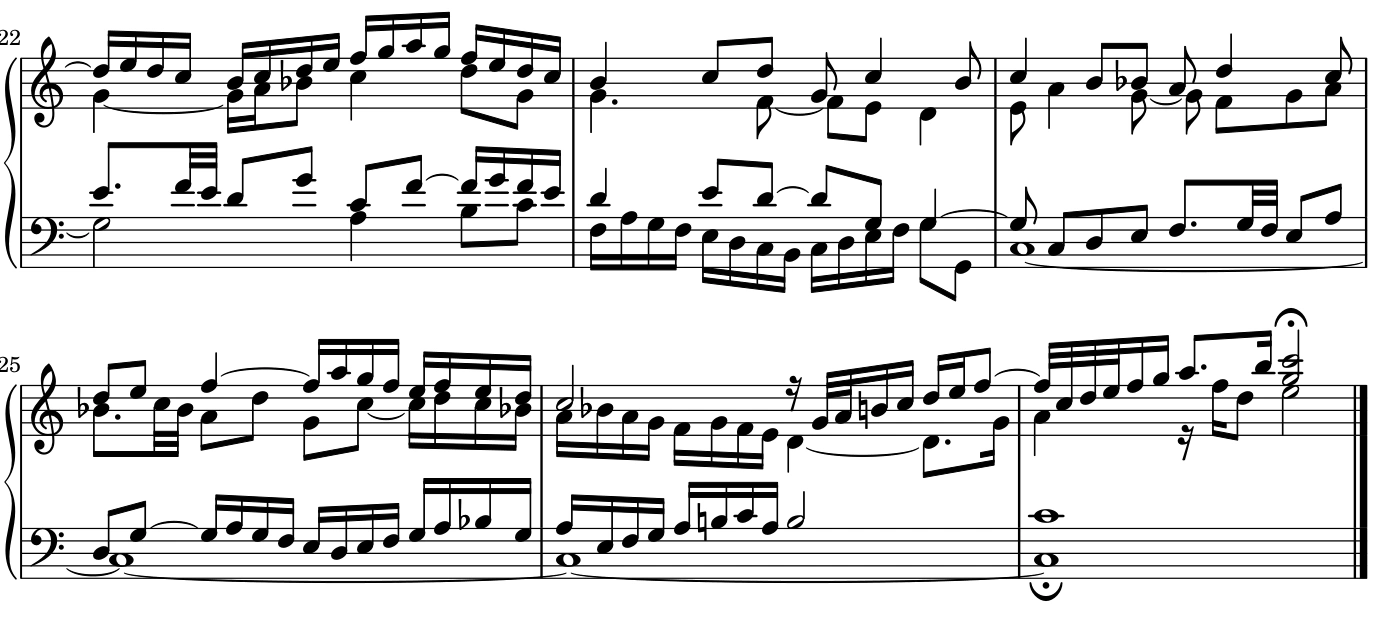
Play the upper three voices over that C and hear how much activity remains after the bass has arrived. The tenor continues its line, the alto moves through the middle, and the soprano rises into the final flourish. An early relaxation of tempo can make this passage feel finished before those voices have said their last words.
Practise from bar 23 so that the moving bass leads into the held note. Then sustain the C with its finger while finding the upper voices’ connections. If you choose to add pedal for colour, keep listening for the changing notes above it. Holding the bass and blurring all the upper movement are separate acoustic results.
The final fermata belongs to an arrival the whole texture has earned. Hear the upper parts reach it, let the last harmony settle, and release with an intention about how the sound should end.
Listening to the complete fugue
Listen to Edwin Fischer’s recording of the C-major Fugue, issued by Warner Classics. Follow one voice for a short passage on the first listening, then listen again to the whole texture. Keep the score nearby, but occasionally look away: can you still hear where a new line begins?
Bars 7–8 make a useful comparison with your own playing. Ask whether you can hear a continuing phrase after the overlapping entry arrives. At the ending, listen for the difference between the bass reaching C and the upper voices completing their movement. These are musical questions to bring to a performance, rather than a request to copy a pianist’s timings.
Finish a practice session with a continuous stretch long enough to recover the fugue’s flow. A few beautifully isolated entries will only become counterpoint when the lines between them have somewhere to go.