
Bach’s C Major Prelude BWV846: More Than an Even Arpeggio
Bach’s C major Prelude, BWV846, can feel wonderfully approachable. The hands learn a repeating shape, the page has no key-signature sharps or flats, and the opening sounds familiar almost immediately. Then a different problem appears: every bar sounds like the previous one, even when the notes are correct.
Practise the changing harmony and the held notes alongside the flowing semiquavers. The pattern supplies continuity; the bass, inner voices and changing tension give that continuity a destination. Later, the repeated G in the bass and the final three bars need their own attention.
Play this prelude with fewer notes for a moment. When we hear the bass and a few notes of each harmony, the piece begins to speak in longer sentences. Returning to the written pattern should preserve that sense of movement.
What makes BWV846 difficult?
The opening is more accessible than the complete musical task. You need to coordinate two hands within one stream of notes, sustain selected notes while others move, read changing accidentals and keep the pulse alive through a long harmonic journey. The ending also leaves the familiar pattern behind.
For a returning adult or an early intermediate pianist, it can be a rewarding piece to study slowly. If reading both staves is still very new, a shorter piece may give more immediate experience of phrasing. Read through the last page before deciding: the first bar alone gives an incomplete picture of the demands.
This guide concerns the prelude, the first movement of the Prelude and Fugue in C major from Book I of The Well-Tempered Clavier. Learning the prelude does not imply that its accompanying four-voice fugue is the next suitable assignment.
The first pattern: two hands, one pulse
Scroll sideways to read the score.

In the opening bar, the first eight semiquavers unfold as C–E–G–C–E–G–C–E, then repeat. Using middle C as C4, the left hand takes C4 and E4; the right hand takes G4, C5 and E5. The first two sounds therefore belong to the left hand, although the ear hears one continuous figure.
Count the first two beats as “1 e & a, 2 e & a”. The left hand enters on “1” and “e”; the right hand begins on “&”. A common unevenness appears at that handover: the right hand waits, then squeezes its notes together. Try just the first four sounds, listening for equal spacing across the change of hand. Continue through the second beat before adding the repeated figure.
The first two beats: eight note entries
C4 is middle C. Each beat has four equal positions, with a continuous handover from left to right.
- 1C4LH
- eE4LH
- &G4RH
- aC5RH
- 2E5RH
- eG4RH
- &C5RH
- aE5RH
Hold C for two beats and E from its entry to the end of beat two. The same eight-note sequence begins again on beat three.
The bass C is a half note, held for two beats. The E begins one semiquaver later and continues through its tied values until the next half-bar. These are sustained voices underneath the moving right hand. Keep the keys down for their written durations while allowing the moving fingers to release after their notes; check that the wrist and arm remain free to follow the phrase.
Choose a fingering that lets the right hand travel through G–C–E without gripping a fixed shape. Write it down once it works in context, including the move to the next bar. The fingering guide explains why the following notes matter as much as the shape under the hand.
Four bars of harmony
The first four bars offer a useful listening experiment. Bar 1 contains C–E–G. In bar 2 the bass C stays, while D–F–A changes the sound above it. Bar 3 moves the bass down to B beneath D–F–G, and bar 4 returns to the opening C-major harmony.
Play the bass and the remaining chord tones slowly, spreading them between the hands as needed. Listen to the second and third harmonies leaning towards the fourth. Then restore the broken-chord pattern while remembering those changes. This reduction is a practice tool; its purpose is to reveal the movement already present in the written notes.
Notice especially that a repeated bass does not mean an unchanged chord. If your ear follows only the C in bars 1–2, it can miss the change above it. Conversely, following only the highest note loses the foundation that gives that change its character.
Avoid giving every two-beat figure its own large swell. The result can sound like a series of small waves with no coastline. Let the short figure sit inside the four-bar motion, with enough steadiness for the arrival to feel earned.
Beyond the opening: bars 5–19
The opening pattern continues, but the harmony travels. In bars 5–11, listen to the bass as a line: C, C, B, B, A, D, G. At first it moves very little; the later D-to-G movement gives a stronger arrival. Try playing those bass notes alone at the pace of whole bars, then add the inner notes and finally the complete texture.
Scroll sideways to read the score.

Bar 11 arrives on G major. The G bass remains in bar 12, but the B becomes B-flat and the right hand includes C-sharp. That alteration changes the atmosphere immediately. It deserves attentive listening even if the fingering feels almost familiar.
Read bars 12–19 in small harmonic groups. The bass moves G–F–F–E–E–D–G–C, with changing notes above repeated basses. Mark an accidental because you understand which pitch changes, then check its effect on the rest of the bar. The two halves of a bar should agree unless the notation tells you otherwise.
I would rather hear a slow performance that notices these changes than a faster one that treats the middle as more copies of the opening. Once the notes are secure, ask where each small group wants to arrive. That question gives the repetition a purpose.
A complete performance
Listen to the prelude at the start of Richter’s recording, with the score nearby; the fugue follows. Follow the bass beneath the surface pattern. As you reach the last part of the piece, notice when that bass settles on G, and listen for the eventual arrival on the low C. These are landmarks you can then find in your own playing.
Sviatoslav Richter: Prelude and Fugue in C major, BWV846
RCA Gold Seal. Listen on YouTube.
On a second listening, follow the upper notes instead. Which harmonies feel settled, and which seem to ask for another bar? A recording can open possibilities for timing and sound; your practice tempo should still let you hear and control the notes you are playing.
The darker turn: bars 20–24
After the C-major arrival in bar 19, bar 20 adds B-flat above a C bass. The bass then moves to F in bar 21, F-sharp in bar 22 and A-flat in bar 23, before reaching G in bar 24. The written pattern stays familiar while the harmony becomes more unsettled.
Scroll sideways to read the score.

Practise the arrival into each new bass note with the preceding half-bar. Starting directly on the difficult chord can solve its fingering while leaving the approach uncertain. Include enough of the preceding music to hear what is changing and to prepare the new position without a sudden gap.
Keep some space in the sound for what follows. If every surprising harmony becomes your loudest point, the longer build has nowhere to go. Try a restrained version first, then decide which changes deserve greater weight.
The bar numbers here follow the 35-bar version. Some editions contain an extra bar after bar 22, often called the “Schwencke measure”. It is absent from Bach’s autograph; its presence in later editions shifts the subsequent numbering. If your score has 36 bars, compare this passage before matching numbers with a teacher or recording.
The long G bass: bars 24–31
From bar 24 through bar 31, the lowest note remains G. This is a pedal point: a sustained or repeated bass beneath changing harmonies. The term describes the musical texture, not an instruction to hold down the piano’s sustain pedal for eight bars.
Scroll sideways to read the score.
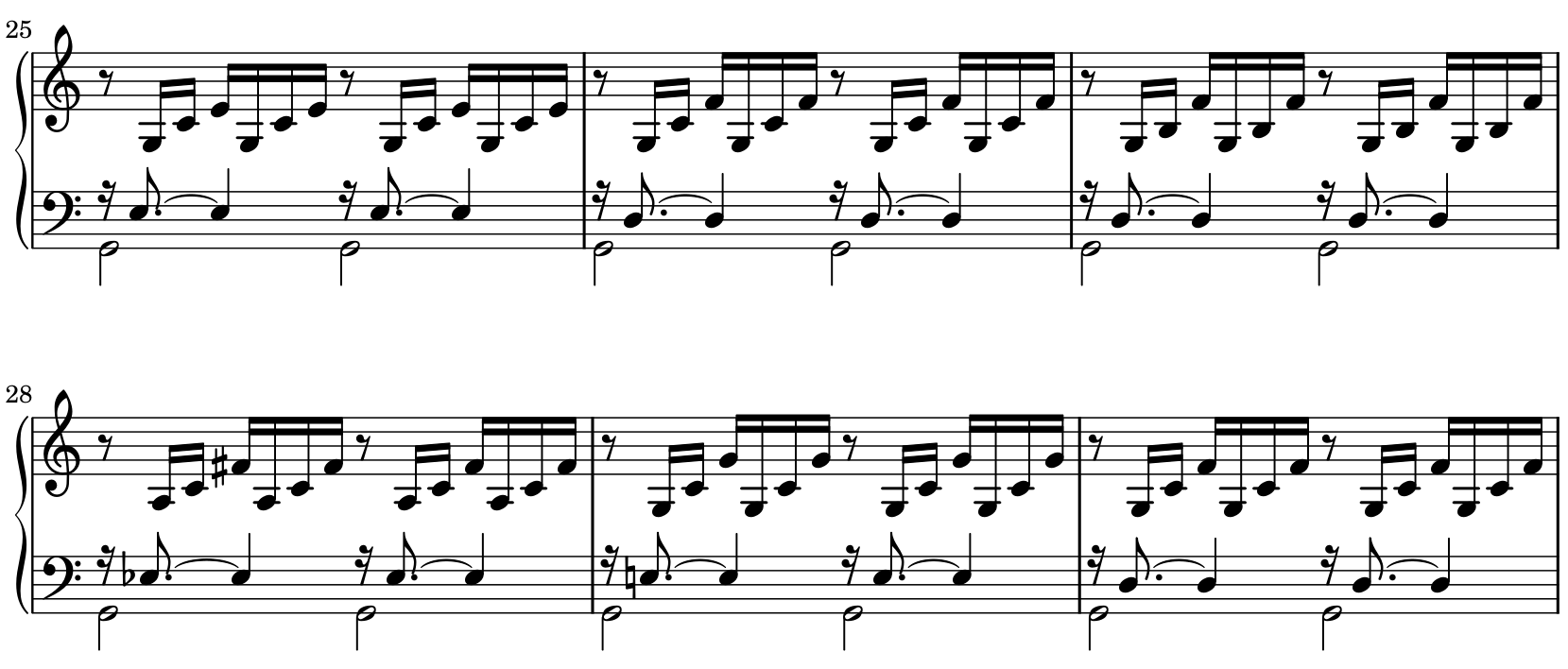
The changing upper notes create the activity. In bars 25–27, listen to E rising to F in the upper part, while the harmony beneath it changes. Bar 28 introduces E-flat and F-sharp; bar 29 replaces that E-flat with E-natural and reaches a higher G. The repeated bass makes these colours particularly audible.
Try playing bars 24–31 with a quiet, consistent bass while letting the upper harmonies develop. Then choose how much the bass itself should participate in the build. This separates a deliberate increase in intensity from the habit of hitting every low note harder.
The high G in bar 29 offers a possible point of emphasis, but the phrase continues. Carry the sound through bars 30–31 towards the low C of bar 32. A convincing interpretation connects the local peak with what comes after it.
Sustain pedal and clarity
Begin by hearing what the fingers sustain in the score. Then experiment with the pedal as a way of colouring and supporting that sound. A bright room, a resonant grand and a digital piano may produce quite different results from the same foot movement.
In bars 1–2, listen specifically for the old E and G carrying into the new D–F–A harmony. Lift sufficiently to clear the previous sound as the new harmony arrives, then listen to the new resonance. If the change becomes a hole in the phrase, coordinate the release with the new bass rather than lifting far in advance.
One pedal change per bar is an experiment, not a rule for the whole prelude. The lower register and closer dissonances later in the work may call for a clearer or more frequent release. Compare a short passage with and without pedal, preserving the same finger-held notes in both versions. The sustain-pedal guide explores this listening process in more detail.
The ending: bars 32–35
Scroll sideways to read the score.
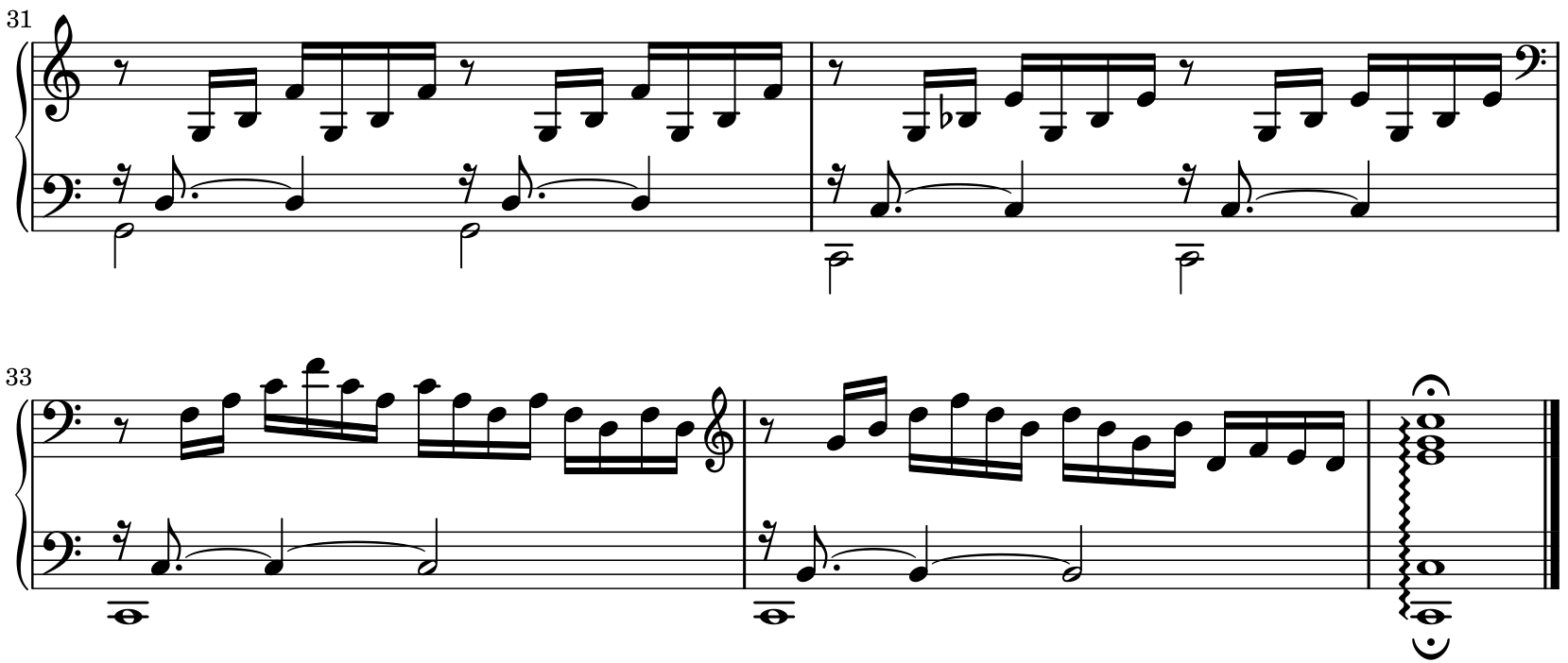
Bar 32 brings the bass down from G to low C, but the piece has not finished. The B-flat in the upper texture keeps the harmony moving. In bars 33–34, the right hand leaves the repeated two-beat figure and makes longer gestures, while the low C lasts through each whole bar.
Read those two bars separately before practising them at the opening tempo. In this edition, the right-hand staff changes to bass clef for bar 33 and returns to treble clef for bar 34. Identify the actual register before trusting the familiar appearance of the noteheads.
The left-hand upper note also changes from C in bar 33 to B in bar 34. Hear that small movement against the low C beneath it. In the final bar, the whole-note C-major chord and fermata let the accumulated motion come to rest.
Practise from bar 31 to the end so that the change of pattern grows out of the previous music. Shape any broadening across the gesture; repeatedly stopping at each new difficulty breaks the ending into pieces. Finally, listen through the decay of the last chord. The release belongs to the phrase too.
Bringing the whole prelude together
Useful starting points include the G-major arrival at bar 11, the C-major arrival at bar 19, the repeated-G passage at bar 24 and the low-C arrival at bar 32. Being able to begin at these places helps you hear the structure and reveals where memory depends entirely on starting from the beginning.