MUK CoP or Mozarteum Postgraduate Piano: Choosing Further Study

A pianist can finish a degree and still have a clear reason to keep studying: a recital programme that needs time to mature, a particular repertoire to explore, or a teacher whose musical approach opens a new direction. Austria offers courses for that stage, but their names conceal important differences.
MUK’s Certificate of Performance, usually shortened to CoP, and Mozarteum University’s Postgraduate Universitätslehrgang in Piano, or PGL, both provide focused artistic study. They have different admission conditions, curricula and costs. Neither should be chosen simply because it sounds like another name for a master’s degree.
I completed my master’s in piano performance at MUK with distinction. When discussing further study, I want to know what the pianist hopes to change in the music, as well as which qualification they already hold. A year with a strong purpose can be valuable; another line on a biography is a much weaker reason to move abroad.
Before comparing teachers or cities, establish four things:
- The qualification you hold and whether it meets the course’s entry conditions.
- The certificate or degree you want to receive.
- The musical work you hope to undertake during the course.
- The full cost and time available for that period of study.
Certificate, postgraduate course or master’s
A master’s degree is a degree programme with its own admission and completion requirements. A certificate course can also involve advanced playing, substantial work and assessment, while awarding a different qualification. The level of the pianist and the title of the qualification are separate questions.
MUK’s CoP ends with a certificate. Mozarteum’s piano PGL is a university course taken after relevant advanced performance study; successful completion is documented by a certificate. Calling either one “my master’s” would misdescribe what was studied. Likewise, completing one does not by itself establish admission to a later degree or automatic recognition of credits elsewhere.
This distinction matters if a future employer, scholarship or doctoral programme asks for a particular degree. Start with that requirement. Then consider whether the proposed artistic study serves your musical aims alongside it. If you are looking for an initial piano degree, the MUK piano degree guide addresses a different stage of the decision.
MUK: Certificate of Performance
- Entry qualification
- A completed degree is not compulsory. Artistic ability at master’s-entry level and an available place are required.
- Study structure
- Two semesters, 60 ECTS. Principal study, additional artistic work, portfolio, mentoring and final assessment.
- Award
- Certificate of Performance. This is a certificate course, not a master’s degree.
- Application timing
- Individual audition dates; CoP applications can be made at any time.
Mozarteum: postgraduate piano
- Entry qualification
- Relevant performance master’s or equivalent diploma in the principal subject. Teaching and instrumental-pedagogy degrees do not qualify.
- Study structure
- Two semesters, 20 ECTS. Principal-study tuition with optional additional subjects.
- Award
- Postgraduate university-course certificate. The qualifying master’s or diploma comes before this course.
- Application timing
- Annual admission process. The piano page still displays the closed 2026 round; await the next course-specific dates.
Does a certificate lead automatically to another degree?
No. A later programme assesses its own entry requirements. Ask that institution which previous qualifications it accepts and whether any study can be recognised before choosing a course for that purpose.
MUK’s Certificate of Performance
The most significant admission detail is easy to overlook: a completed degree is not compulsory for MUK’s CoP. The university primarily addresses musicians with conservatoire or university training, but its dedicated admission information allows another background if the required artistic ability is demonstrated. The standard is that expected for admission to a master’s programme, and a course place must be available. MUK lists no upper age limit for piano CoP.
This makes the route worth examining for a well-trained pianist whose formal education took a different path. It does not make it a course for catching up from intermediate playing. The repertoire, stylistic understanding and independence expected at that level remain substantial.
The published curriculum sets a two-semester course of 60 ECTS. It includes principal artistic study, additional artistic practice, portfolio development, mentoring and a final assessment. Principal-study teaching comprises 30 units of 50 minutes across the course; the curriculum allows agreed block scheduling when needed. The additional artistic work is chosen in relation to the study focus and available resources.
For a pianist, I would read that structure as an invitation to define a project. Perhaps your solo playing is secure but collaboration remains unfamiliar. Perhaps you want to study a group of works deeply enough to programme them in recital. Discuss how the main lessons and additional activities would support that purpose. An attractive course description cannot replace a conversation about the work you actually intend to do.
The portfolio also suggests a useful habit: keeping evidence of artistic development. A programme, rehearsal reflection or recording can show what changed over the year. The interesting part is the connection between the work and the playing, rather than the number of items collected.

One-to-one classical piano
Beginner to advanced. Online, worldwide.
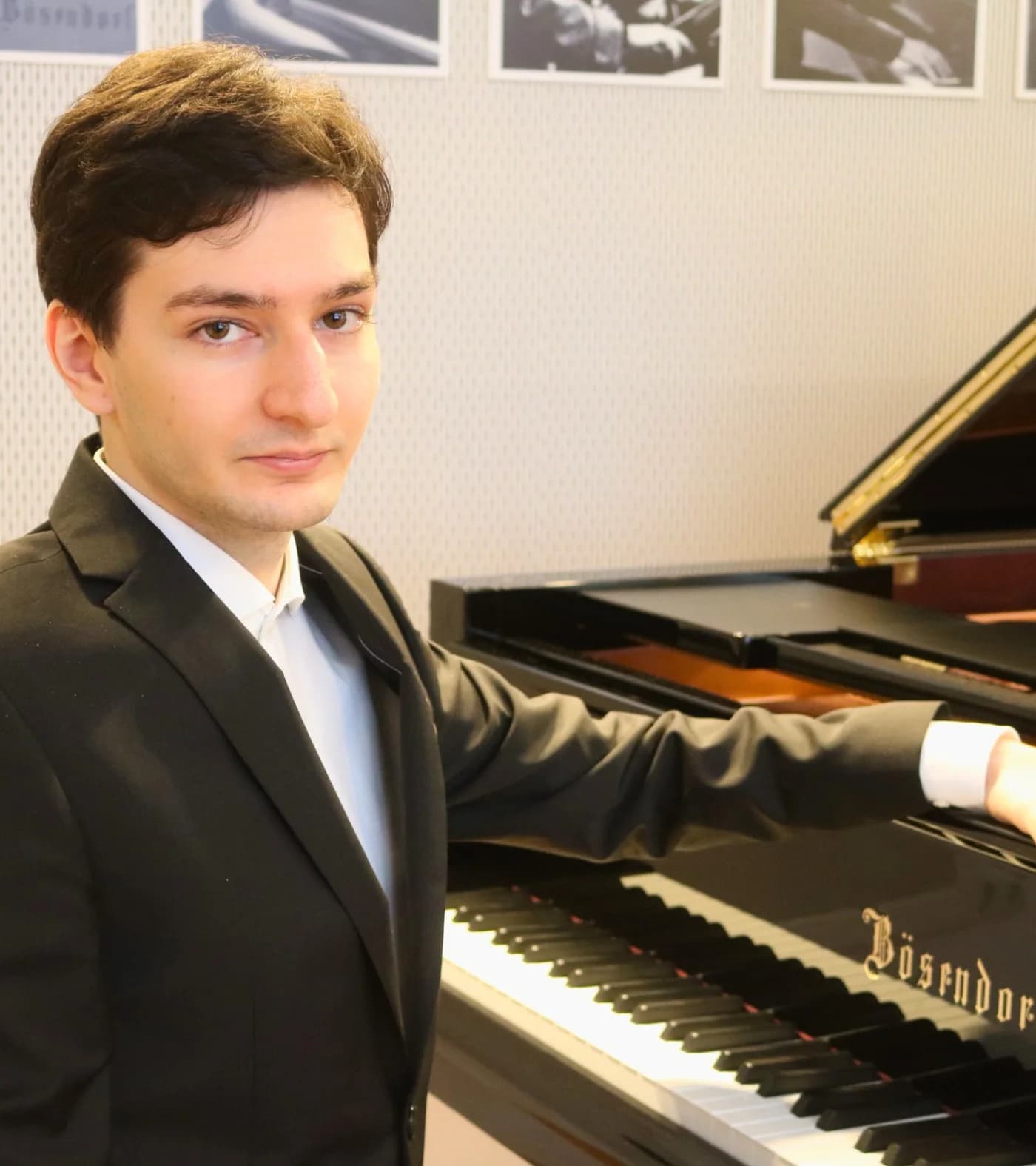
Enea
Concert pianist from Vienna
30 minutes · Ikebukuro & Shinjuku studios from October 2026
Mozarteum’s postgraduate piano course
Mozarteum’s entry requirement is more specific. Its piano PGL requires a relevant performance master’s or equivalent diploma in the principal subject from a recognised institution. A bachelor’s alone does not satisfy that condition. The university explicitly excludes a teaching or instrumental-pedagogy qualification as the qualifying route for this performance course.
If the title of your degree does not identify piano clearly, your documents need to establish the principal subject. The university assesses the previous qualification; describe it accurately rather than translating every advanced award into “Master of Music.” A document called a diploma in one country may represent a different level of study from a diploma elsewhere.
The curriculum provides two semesters and 20 ECTS, centred on individual principal-study tuition. Optional subjects can supplement that work according to the available offer. Assessment takes place through the artistic teaching; completion rests on successfully finishing the principal-study courses, rather than a separate final panel examination.
The different ECTS totals at MUK and Mozarteum describe different course structures. They do not mean that one teacher gives three times as much useful musical attention as another. Examine the actual teaching, additional work and intended outcomes. For Mozarteum, ask how the concentrated piano study would develop something beyond the performance training already completed.
The Mozarteum piano application guide gives broader institutional context. The PGL discussed here has its own qualification threshold and advanced repertoire demands, so keep its information separate from the undergraduate route.
Auditions and application timing
MUK’s CoP application asks you to present your background, motivation, repertoire and proposed artistic programme. The assessment considers the playing and the purpose of the study, including discussion of the applicant’s goals. Its piano page describes application videos, with an on-site appointment possible by arrangement. Confirm the format for your individual application with the admissions office.
CoP audition dates are arranged individually. MUK’s registration guidance expressly allows CoP applications at any time. Do not copy the general piano BA/MA deadline onto a CoP plan. An individual date still requires an agreed application process and an available place.
A motivation statement should give the panel something musical to discuss. “I want to improve my technique” is broad. “In large Romantic works, I lose the long line when the texture becomes dense” identifies a real artistic problem. Pair that observation with repertoire in which the panel can hear both your present strengths and the direction you propose.
Mozarteum uses document review, video selection and an audition in Salzburg. Its currently published PGL piano information still gives the closed 2026 application round. As of September 2026, those February application and June audition dates are historical; use the next course-specific announcement for a future application.
The published repertoire illustrates the scale of preparation. It includes Bach, selected Beethoven or Schubert sonata repertoire, virtuoso works including a Chopin étude, substantial Romantic repertoire, early twentieth-century music and a work from 1945 onward. The live requirements include the complete selected sonata and a Romantic work or group lasting at least 20 minutes. A short piece supplied at the examination is prepared for the later live round. Memory exceptions apply to the contemporary work and the supplied piece.
Read the official piano list for the exact permitted sonatas and the allocation between video and live rounds. The short piece also rewards a habit that can be neglected after years of preparing large works: opening unfamiliar music, hearing its character, and making sensible decisions without weeks of rehearsal.
A musical purpose for the year
The strongest reason for either course is a gap you can hear in your playing and want to investigate. “More repertoire” may be part of that, but quantity alone gives little direction. Choose a musical question that can sustain a year of lessons, practice and performance.
One example is the relationship between detail and large form. A pianist may play each phrase beautifully while a long sonata movement loses momentum. Work might then concern how transitions accumulate energy, how much time a return can bear, and which climaxes belong to the movement’s central argument. Studying several movements across a year can reveal habits that remain hidden when only one audition piece is polished.
Another purpose could be developing a more varied sound within dense textures. In a Brahms intermezzo, the melody may sit inside the hand rather than above everything else. Hearing the bass and the harmonic movement changes the way that voice is projected. The task is not simply to play one note louder: it is to preserve the line while the surrounding texture breathes.
A third pianist might want more independence. After a degree, it is possible to play very well while still waiting for a teacher to decide every fingering, tempo or programme choice. Further study can include bringing an interpretation to the lesson, explaining its reasoning and testing it against another view. That kind of disagreement, when it stays close to the score and sound, is productive.
I would choose a small number of substantial aims and leave room for discovery. A proposed recital can provide direction without fixing every work before the first lesson. The teacher may hear a need that your original plan missed, or suggest music that exposes a valuable contrast. A focused year should have enough shape to guide the work and enough flexibility to respond to it.
Teaching language and musical conversation
Mozarteum states that its postgraduate university courses do not require a German-language certificate. That is a formal admission point, not a description of every conversation you will have while studying. Discuss the teaching language with a prospective professor, especially if you expect to work mainly in English.
MUK’s published German-certificate rules for degree programmes should not automatically be transferred to CoP. Ask the admissions office about your course and the teacher about the language used in lessons and any additional activities. These are different people answering different parts of the same preparation.
For the piano work, language becomes most useful when it describes something you can hear. You might explain that an inner voice disappears when you add pedal, or ask whether a phrase should continue through a written rest. Practise the words beside the keyboard, then play the passage. A short question attached to a clear musical example is more valuable than a polished speech about your love of music.
The same principle applies to a first conversation with a professor. Say what you have studied, what you are playing now and why their teaching interests you. The guide to contacting a piano professor in Germany or Austria explains the initial approach. An encouraging conversation is a useful beginning; the institution’s formal selection still determines admission.
Fees and the study budget
The current tuition figures are €3,760 per semester for MUK CoP, listed from winter semester 2026/27, and €1,000 per semester for Mozarteum’s postgraduate keyboard course. Both also require the ÖH student contribution, currently €26.20 per semester for 2026/27. Use the course-specific fee, rather than the institution’s ordinary bachelor’s or master’s tuition rate.
At those published rates, two semesters amount to €7,520 in MUK course fees or €2,000 in Mozarteum course fees, before the student contribution and living costs. Fees can change for a later intake. These figures describe the listed courses; they do not establish what accommodation, travel or a suitable practice arrangement will cost you.
A realistic budget should protect practice time. If the plan depends on work hours that leave very little time at the piano, the value of the teaching may be difficult to realise. Consider accommodation, transport, access to an instrument and the travel needed for the application separately from tuition.
Ask about the rhythm of the year as well. Weekly lessons, agreed teaching blocks, performances and periods away from the city can produce different demands on your schedule. Discuss the arrangement before committing to a way of living that makes attendance or preparation difficult. The practical plan should support the musical purpose you chose.
Choosing the next period of study
Begin with your present qualification and a recording or live performance that represents your current playing. Then write a short account of what you want further study to change. Those three things reveal much more than a list of admired institutions.
A pianist with a relevant performance master’s can investigate Mozarteum’s PGL eligibility and consider whether its concentrated structure suits the next stage. A pianist with a less conventional formal background may have a reason to enquire about MUK CoP, provided the artistic level is appropriate. Someone who needs a master’s degree for a specific future purpose should examine degree programmes directly.
In my lessons, we can assess the proposed repertoire, work on the musical issues behind that study plan, and prepare German or English for discussion with professors. I can also help with professor communication and coordinating an application. The course choice should emerge from your playing, qualifications and goals, rather than from treating further study as an automatic next step.
Vienna Piano School offers online lessons now, with in-person lessons at piano studios in Ikebukuro and Shinjuku, Tokyo, starting in October 2026. Learners of junior-high-school age and adults can request a free 30-minute trial. For an advanced-study enquiry, bring your current repertoire and the question you hope another period of study will help you answer.