
Finished an Adult Piano Method Book? What to Study Next
Finishing an adult piano book is a satisfying moment. You have worked through unfamiliar notation, coordinated the hands and turned a collection of exercises into music. Then the last page raises a question the book may leave open: what should you play next?
Start with the exact book you have completed, then choose music that develops your playing beyond those familiar pages. Continuing the same course can be useful. So can studying a short original piece alongside it. The decision depends on how you read, keep time and listen when the music is new.
When an adult brings me a completed method book, I want to hear a piece they enjoyed and look at a little unfamiliar music together. That combination tells me more than the number printed on the cover.
After Alfred or Faber: the next volume
Check the full series name as well as the book number. Alfred’s Basic Adult All-in-One Course and Faber’s Adult Piano Adventures have different sequences. A “Book 2” in one course is not a universal piano level, and completing it does not automatically correspond to an ABRSM grade.
Find your place in the series
| Completed book | Next discussion | What to check |
|---|---|---|
| Alfred Adult All-in-One, Book 1 or 2 | The next volume in the same three-book course | Review any rhythm or reading demand that still interrupts a phrase. |
| Alfred Adult All-in-One, Book 3 | Choose repertoire and targeted study around your playing | Decide what you want to develop: independent reading, coordination, sound or style. |
| Faber Adult Piano Adventures, Book 1 | Adult Piano Adventures, Book 2 | Keep easier reading alongside the new material. |
| Faber Adult Piano Adventures, Book 2 | Basic Piano Adventures 3A for review, or 3B when progressing confidently | The publisher’s adult FAQ gives both options; choose by how you play. |
Swipe across to read all three columns.
With Alfred’s Adult All-in-One, reaching the end of Book 1 or Book 2 leaves another volume in the same course. After Book 3, the more useful discussion is about repertoire and the skills you want to develop. With Faber, the publisher gives a specific bridge from Adult Book 2 into the Basic series, with room for review at Level 3A.
Before buying, look at several pieces throughout the proposed volume. Can you understand the rhythm, recognise the hand positions and begin reading a phrase? Some new demands are welcome. If every bar requires prolonged decoding, the book will be doing several jobs at once, and a gentler bridge may serve you better.
The publisher’s sequence gives a starting point. Your playing decides how to use it: work steadily through the volume, select the material that fills a gap, or combine it with a piece chosen for its musical interest.
What carries into a new piece?
A well-known piece can feel fluent because the hands remember it. That is part of learning music. The question at this stage is how much of the score you can understand independently when those familiar movements are absent.
Try a short passage that is easier than the last pieces in your book. Read the clefs and time signature, find the starting notes, and look for a repeated rhythm or shape. Play at a pace that lets the phrase continue. Listen for the point at which the pulse breaks: a chord change, an unfamiliar bass note, perhaps a move away from the position in which you started.
That interruption identifies useful work. If note finding absorbs all your attention, add easier reading alongside your main piece. If the notes come readily but the accompaniment overwhelms the tune, choose music that develops balance. If the rhythm is clear while counting but disappears at the keyboard, work on coordinating the pattern at a slower pulse.
For learners who have relied heavily on videos, my guide to moving from piano tutorials to reading music explores that transition in more detail. Here, the aim is to choose the next material with a clear musical reason.
A short Schumann example
Schumann’s Melody, Op.68 No.1, shows why a modest-looking piece can teach a great deal after a method book. The opening has a singing right-hand line over moving left-hand notes. Both staves begin in treble clef. Reading the lower staff automatically as bass clef would immediately send the left hand to the wrong notes.
Swipe across the score to follow the complete phrase.
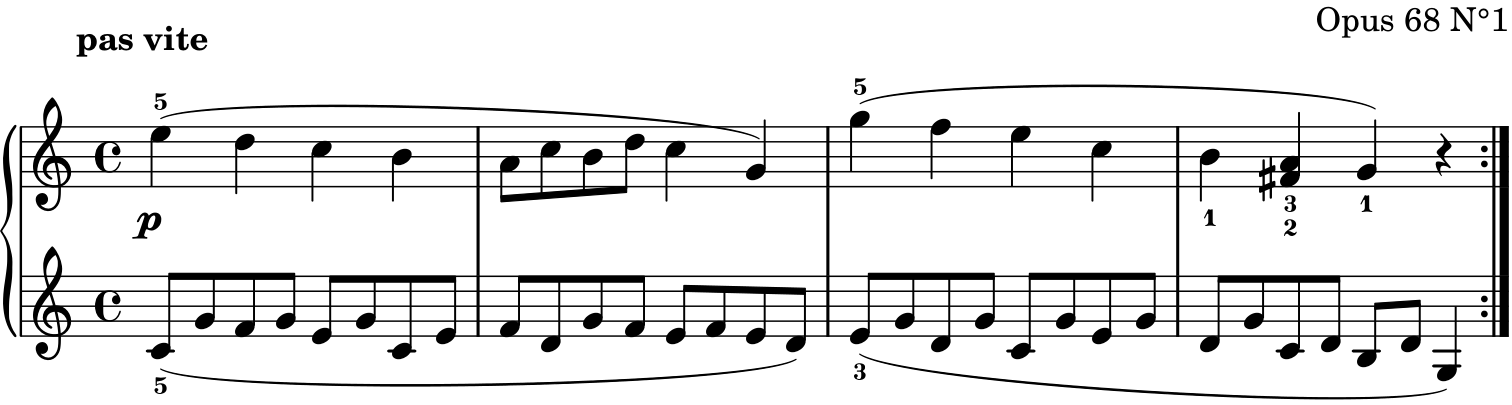
Hear the melody through the moving accompaniment. In bar 4, follow the phrase into the left hand after the right hand releases.
In the first bar, the melody descends E–D–C–B in quarter notes. The left hand plays eighth notes, two for each melody note. First hear those four right-hand notes as one line. Then add the accompaniment and ask whether you can still follow that line through the sound.
A teacher might play the left hand while the student plays the melody. Teacher and student can hear the phrase together before the student takes responsibility for both parts. When the hands are reunited, listen for the same balance: the moving notes should support the tune without taking over its shape.
Bar 4 adds another useful detail. The right hand has a rest on the final beat while the left hand plays a low G. The phrase continues through that handover. If the pianist stops listening when the right hand finishes, the last bass note can become an afterthought or a heavy landing.
This is a good next piece for someone ready to work on melody, accompaniment and phrasing. For another player, its moving left hand may still demand too much attention. In that case I would choose a simpler texture first, then return to Schumann with a clearer sound in mind.
Listen to the piece as a whole, following the melody above the moving accompaniment. At the end of the opening phrase, keep listening through the right-hand rest to the left hand’s final note.
Jörg Demus: Schumann’s Melody, Op.68 No.1
Nuova Era. Listen on YouTube.
Two useful routes forward
A continuing course with supplementary repertoire suits a player who values a clear sequence. The course introduces reading and coordination demands in an organised way; a separate piece gives those skills a musical home. For example, the course might introduce a new accompaniment pattern while the supplementary piece develops a quieter left hand in a texture you already understand.
A small repertoire programme with targeted exercises suits a player whose reading is established and who wants to explore more original music. I would choose contrasting demands: perhaps a lyrical miniature with a clear melody and accompaniment, alongside a short dance in which articulation and a steady pulse shape the character. Each piece has a reason to be there.
These routes can meet. A teacher may bring back one page from a method book to address a rhythm that is causing trouble in your current piece. Equally, an adult following a course can spend time on a favourite piece without abandoning the sequence. The book remains a useful resource rather than becoming a test of loyalty to one system.
Choosing original repertoire
Short pieces make good companions to a method course because you can study their complete shape. There is a beginning to prepare, a contrasting moment to understand and an ending to finish. You also have enough attention left to hear whether the music sounds like a song, a dance or a little dramatic scene.
Look through the entire score before choosing. A comfortable first line can be followed by a wider hand position, denser chords or a new rhythmic combination. Check repeats and endings too. My article on choosing classical piano music for your level gives a fuller way to assess those demands.
An arrangement can be a good choice when the musical goal is to play a favourite tune with a manageable accompaniment. Read the edition’s description so that you know what you are learning. A simplified version and the composer’s complete original may share a title while asking very different things of your hands.
If one particular work is the reason you started, give it a place in the discussion. Preparatory music can address its demands; a suitable passage can also provide a starting point. Lessons centred on one piece can still develop reading, technique and interpretation through the music you care about.
Reading and technique alongside repertoire
Keep some music that you can read with a steady pulse at first or second encounter. Your main piece may take sustained work; this easier material gives you experience recognising patterns without memorising every bar first. Choose enough variety that you meet different starting notes, rhythms and accompaniment shapes.
Technical work is most useful when you can hear its purpose. If a change of hand position interrupts the phrase, study that movement within a small pattern and return to the phrase. If a thumb note sticks out in an otherwise quiet accompaniment, listen to the pattern’s balance rather than simply repeating it faster.
Scales and chords also belong to musical understanding. Finding the notes of the key and recognising a familiar chord can make a new passage less mysterious. Connect that knowledge to the score in front of you: notice where a chord changes, where the melody settles and which note needs to remain audible.
For a learner still consolidating the basics, the adult beginner foundations guide covers the relationship between first pieces, reading and coordination. At the end of a method volume, those same skills begin to travel into a wider range of music.
A manageable next selection
I would rather hear two pieces developing in different ways than a growing pile of half-started books. Keep a familiar piece to enjoy, choose one main study piece, and have easier reading available. That gives practice some variety while leaving time to listen closely.
Judge the next stage by changes in the playing. Can you begin from the middle of a phrase? Does a new passage take less time to understand? Can you make the melody clearer without simply making everything louder? Can you return the next day and find the same sound? These are useful signs of independence.
There will also be musical discoveries that a checklist cannot capture: a phrase suddenly sounds conversational, a quiet accompaniment gives the melody room, or a piece you thought was simple holds your attention for another week. That is a worthwhile reason to stay with it.