
Can You Take Piano Lessons to Learn Just One Piece?
Yes. Piano lessons can begin with one piece you want to play, whether that is a melody you have loved for years or a work you have already started and cannot quite finish. The useful question is what that piece asks of you, and which version of it you want to learn.
A piece can give your study a clear purpose. Reading, fingering, rhythm and sound become relevant because they change music you care about. But there is a difference between learning a recognisable tune, playing a complete arrangement and preparing the complete original score. Agreeing on that goal belongs near the beginning.
- A complete original: keep the composer's full texture and include the contrasting sections.
- An arrangement: choose a version whose accompaniment, register and length suit your present playing.
- A first milestone: work towards a complete musical section while building the skills for the rest.
I would start by asking what draws you to the piece. Someone who loves its singing melody may be happy with a thoughtful arrangement. Someone fascinated by the changing harmonies and inner voices may want precisely the details that a simplified version removes. Those are different reasons to sit down at the piano.
Original score or arrangement?
Before deciding that a piece is too difficult, check which score you are looking at. Two editions bearing the same title can ask for very different things. An arrangement might put the melody in a comfortable register, replace a wide accompaniment with smaller chords or shorten the work. An edition of the original usually keeps the musical substance, although editors may add fingerings and other guidance.
An arrangement is a musical choice in its own right. Listen to the version as a whole. Does the melody still have room to breathe? Do the important bass changes survive? Does it end convincingly? A version that feels satisfying from beginning to end is a better goal than one chosen solely because its first line looks easy.
If your aim is the original, say so. The next decision is how much preparation it needs. Reading a short phrase with effort is different from spending the whole session decoding almost every note. When reading, movement and coordination are all unfamiliar at once, a smaller piece can give you something complete to play while the larger work develops.
The broader question of readiness is covered in choosing a classical piano piece at the right level. For a one-piece goal, the important detail is whether the chosen score preserves the musical experience you are seeking.
The whole piece: a Für Elise example
Beethoven's Für Elise makes the distinction particularly clear. The opening alternates E and D sharp before settling into its familiar melody. Much of the early passage passes the musical movement between the hands. Later, the right hand has rapid groups of notes over a separate left-hand accompaniment. Another contrasting section introduces repeated low notes and chords before an ascending passage.
Knowing the opening gives you a foothold. It does not measure all those later demands. That is why I would look through the complete score with you before making a plan around the piece.
Swipe across the score to follow the complete line.
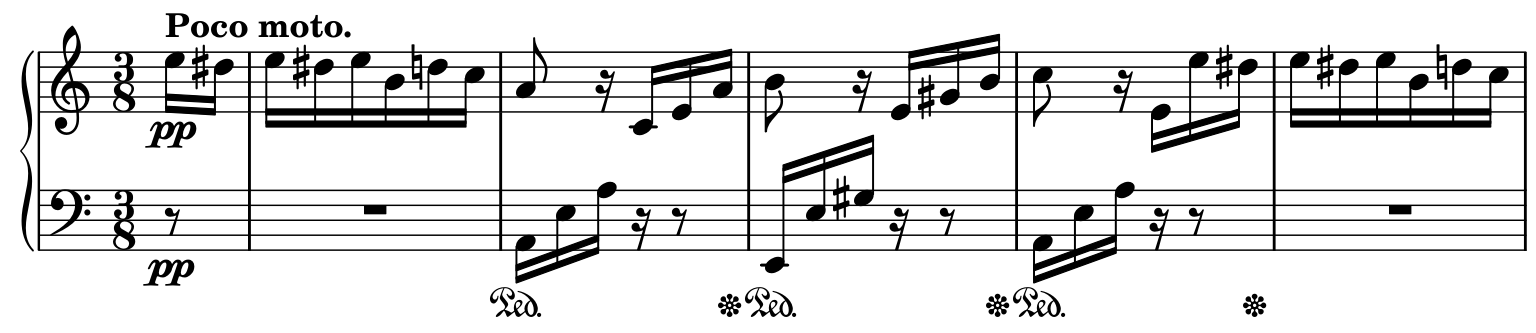
The melody and broken chords pass the sound between the hands. Follow the phrase through each change of hand.
Open the score imageIn the opening, listen to how the left-hand broken chord leads into the next right-hand notes. A small pause between the hands can interrupt the phrase even when every pitch is correct. Useful work here might involve the last two notes in one hand and the first two in the other, joined in one continuous movement of sound.
Now compare bar 31. In this score, each eighth-note beat contains four right-hand thirty-second notes. The left hand has its own notes and rest. Learning this passage involves reading the pattern, finding a workable fingering and coordinating the accompaniment at the chosen pulse. Simply repeating the opening will not prepare all of that.
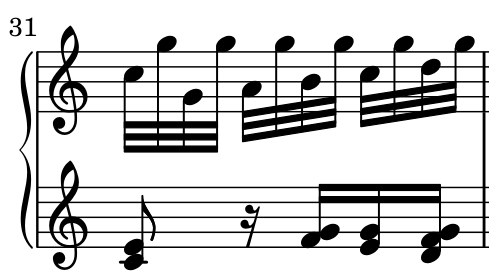
Four right-hand notes fill each eighth-note beat. The left-hand rest and chord entries make this more than a right-hand speed exercise.
Open the score imageThis example is a reason to choose a starting point, not a verdict on whether you should play Beethoven. A returner with some fluency may work directly on the later passage. A new learner may begin with an arrangement and learn a short original section alongside it. A player who already knows the notes may need to work mainly on balance and continuity.
Listen to the complete performance below with the score's changes of texture in mind. Notice when the familiar theme returns, and how different the intervening sections are from the opening. The listening question is about the scope of the work, rather than matching a concert pianist's speed.
Wilhelm Kempff: Beethoven’s Für Elise
Decca. Listen on YouTube.
What a teacher adds
Teaching one piece is more than supplying the next fingering. The same audible problem can have several causes, and the useful practice depends on finding the relevant one.
Suppose your melody disappears whenever the left hand enters. You might understand the notes perfectly well. Playing the melody alone can reveal that its long notes already lose direction; adding the bass may then make that weakness more obvious. Or the melody may sing freely alone, while the left hand arrives with a much heavier attack. Those two situations need different attention.
In the first, I would work on the melody's direction and where it rests. In the second, try a smaller left-hand sound while keeping the right-hand phrase intact. The test is the resulting music: can you still hear the melody carrying across the accompaniment? “Practise more slowly” offers little help until we know what the slower attempt is meant to change.
A lesson can also uncover a fingering that works in isolation but fails at the join. The final finger in one group affects how the hand reaches the next. Trying a short passage with the preceding and following notes often tells us more than repeating the troublesome group alone.
These are useful lessons even if the piece remains your only substantial work for a while. What you learn belongs to that music, and it can later travel to other music with similar demands.
Preparation that serves your chosen music
There is a reasonable concern behind the request to learn just one piece: you want to spend your time on music that matters to you. A teacher should be able to explain why an additional exercise or piece belongs in that work.
For a passage built from broken chords, preparation might mean finding the chord as a comfortable hand shape, then moving through its notes without holding the hand rigidly open. For a melody over repeated chords, it might mean singing or playing the melody alone and then adding a very quiet accompaniment. The connection should be audible when you return to the score.
Sometimes an easier complete piece is the better preparation. It gives you room to learn a particular skill without managing every difficulty at once. A short melody-and-accompaniment piece, for example, can let you explore phrase endings and balance before those same questions appear inside a much denser texture.
Ask what the preparation is for. “This will help you keep the melody alive while the left hand changes chord” is a useful answer. A long sequence of unrelated exercises, with no return to your chosen piece, leaves your original musical interest outside the lesson.
For a pianist returning after a long break, this preparation may also reveal which habits remain familiar and which need rebuilding. Remembering the sound of a piece and having the coordination to play it today are separate parts of the same project.
Practice between lessons
A piece-led approach still needs a way to practise when the teacher is absent. Start with the change you heard in the lesson. If a phrase became smoother because the hand moved earlier, keep the preceding note in your practice. If the accompaniment became quieter, preserve that balance while gradually extending the passage.
Take a short section and give it a musical destination. Play into the next phrase or landing note, rather than stopping automatically at the difficult bar line. After a few attempts, return to a longer stretch and listen for the same change. A beautiful isolated bar that disappears inside the piece is unfinished work.
Practise some beginnings away from the first page. Start at the contrasting section, at a return of the main theme and near the ending. This tests whether you know those places as music, rather than only as the next events in a memorised chain. It also prevents every short practice session from giving most of its attention to an already familiar opening.
There is more detail on testing a practice idea in the diagnostic piano practice guide. For one chosen work, keep the central question small: what should sound different when I play this passage again?
Time, deadlines and finishing
The title of a piece cannot tell us how many lessons it will take. Your starting point, the score version, the passages that need new skills and the practice you can sustain all affect the work. A useful early assessment identifies those demands and gives you a first musical milestone.
If you have a birthday, gathering or other occasion in mind, mention the date before settling on the version. A complete arrangement may suit the occasion better than an original that repeatedly breaks down. Another option is a self-contained section with an agreed ending. Decide that openly, so the goal and the available preparation time belong together.
“Finished” also needs a musical meaning. For playing at home, you may want a steady, expressive performance from beginning to end. For playing to other people, you may also want to recover after a slip and begin from several places. For a recording, you may care about details of balance and pedalling that only become obvious on playback.
Once the piece reaches the standard you want, play it regularly for enjoyment. You can then decide whether to deepen it, choose another piece or explore a skill it has made you curious about. One piece can be the entire reason you begin, without deciding everything you will want from the piano later.