
ABRSM Piano Scales and Arpeggios: Answering the Examiner’s Request
Knowing a scale and being able to produce it when someone asks are slightly different skills. At home, one familiar pattern often leads into the next. In an ABRSM Practical Grade, the request arrives from outside that sequence: a key, a form, perhaps a hand or an articulation. Your first task is to recognise the complete musical instruction.
I listen to the beginning as carefully as the middle. A pianist may have fluent fingers but pause because the requested pattern has no clear starting point in the mind. Another may start promptly, then discover halfway up that the hands have followed the wrong version. Those two problems need different practice.
This guide focuses on answering the request accurately, with selected Grade 8 examples, original notation and a printable practice sheet. It complements the broader guide to using scales in repertoire practice.
- Identify the requested key, pattern, hands, range and articulation.
- Hear the opening and know where the hands begin before playing.
- Compare the response with the request, then practise the particular point that failed.
Your grade’s requirements
Work from the piano specification that applies to your exam, together with its corrections. ABRSM’s 2027–2028 piano repertoire changes do not change the supporting tests, but an old scale list from a different period can still describe a different set of requirements. Check the actual grade page rather than assuming that a book remembered from childhood remains current.
The technical requirements are played from memory, in even notes, without pedal, ascending and descending through the specified range. Individual rows determine details such as hands, articulation and position. Read those details with the general instructions; a familiar heading such as “arpeggios” does not contain the whole request.
Performance Grades do not have a separate scales-and-arpeggios component. Our comparison of the two ABRSM piano routes explains where this preparation belongs.
The examples below use Grade 8 because several distinctions are especially clear there. They are a selection for study, not a complete requirement list. For another grade, keep the method and replace the examples with the items on your own page.
Hearing the whole request
Listen until the instruction is complete. “A minor” identifies a tonal area, but it does not settle every possible detail of the task. A harmonic scale, a melodic scale and an arpeggio have different notes or patterns; similar motion and contrary motion also ask the hands to travel differently.
Before starting, make a short musical decision: the first notes, the direction of travel and the kind of sound. This can be quick once the pattern is familiar. It should feel like preparing the opening of a phrase, rather than mentally reading through a long administrative checklist.
If you have not heard the request clearly, ask for it to be repeated before playing. In practice, have someone read requests in an order you have not arranged yourself. Without a partner, write your own requirements on slips of paper and draw one. The important change is that the previous scale no longer supplies the cue for the next.
Try the six requests here. First decide what each means; then open its answer. At the piano, you can use the same cards to practise giving a complete response from memory.
Six Grade 8 practice requests
Read a request and decide on the opening notes and pattern before revealing the answer. These examples explore distinctions within the requirements; use the syllabus for the complete list. C4 is middle C.
A harmonic minor scale, similar motion, staccato
Hands together, four octaves, beginning one octave apart. G sharp belongs to both the ascent and descent.
F-sharp major arpeggio
Grade 8 requires second inversion: C sharp–F sharp–A sharp. Hands together, four octaves, legato.
C major scale, hands a sixth apart, legato
Four octaves. The tonic is the upper note; one starting position is left E3 and right C4.
Chromatic scale a major sixth apart, staccato
Start on left E flat and right C. Hands together, four octaves. Both hands move in semitones, preserving the major sixth.
Dominant seventh in C
The chord is G–B–D–F. Hands together, four octaves, legato, ending with the specified resolution to C.
C major staccato scale in sixths, right hand
Two octaves, hands separately. The right hand plays both notes of each sixth, with the tonic as upper note.
Key and starting note
An arpeggio’s key names the harmony. Its inversion determines which member of that harmony comes first. In F-sharp major, the chord contains F sharp, A sharp and C sharp. Starting on F sharp gives the root-position arrangement; beginning on C sharp places the fifth underneath and gives second inversion.
For the selected Grade 8 arpeggio, that distinction matters before either hand moves. If the word “F-sharp” automatically sends the fingers to F-sharp keys, the key has been recognised but the position has not. Practise naming the chord, finding its fifth and hearing the opening from there.
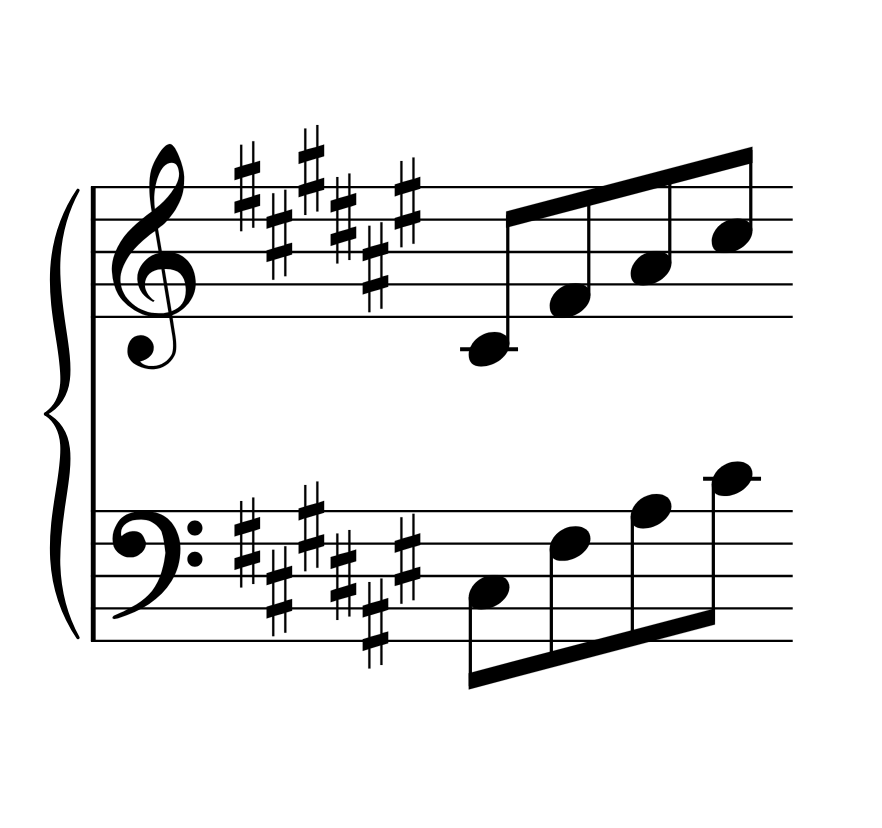
F-sharp major: the second-inversion opening
The first four notes in each hand are C sharp–F sharp–A sharp–C sharp. The exam requirement continues through four octaves and returns.
 Open the notation at full size
A dominant-seventh request presents a related trap. “In C” refers to the key towards which the dominant harmony points. The dominant seventh is G–B–D–F, resolving to C; a C7 chord would answer a different harmonic question.
Play that harmony slowly and listen to its resolution before running the arpeggio. The final arrival should be part of the musical idea from the outset. If you remember only the pattern of four chord tones, the required ending can feel like an unexpected extra note.
This is where a little harmonic understanding saves a great deal of uncertain repetition. You can reconstruct the starting point from the chord and its function, instead of relying entirely on a memorised location on the keyboard.
Harmonic and melodic minor
The word “minor” can conceal a switch that the ear needs to notice. In A harmonic minor, G sharp leads towards A, and it remains part of the descending scale. In the conventional melodic-minor scale, the raised sixth and seventh belong to the ascent, while the descent returns through G natural and F natural.
Play the upper part of each form slowly and sing its direction. A harmonic-minor descent contains A–G sharp–F–E. The melodic-minor descent contains A–G–F–E. That changed interval is audible; it is more than a label attached to an otherwise identical finger pattern.
When a request produces the wrong form, practise choosing between the forms before adding more speed. Say which one you will play, hear its upper notes, and start. Then choose the other form. Repeating one version ten times may make that version fluent while leaving the choice itself uncertain.
Keep this exercise connected to the exact requirement. Some rows specify a particular minor form; others require more than one to be prepared. The heading and the row work together.
Two meanings of sixths
“Hands a sixth apart” describes the interval between the two hands. Each hand plays a single line. “A scale in sixths,” when specified hands separately, asks one hand to play the two notes of each sixth together. The interval name is shared, but the physical and musical tasks differ.
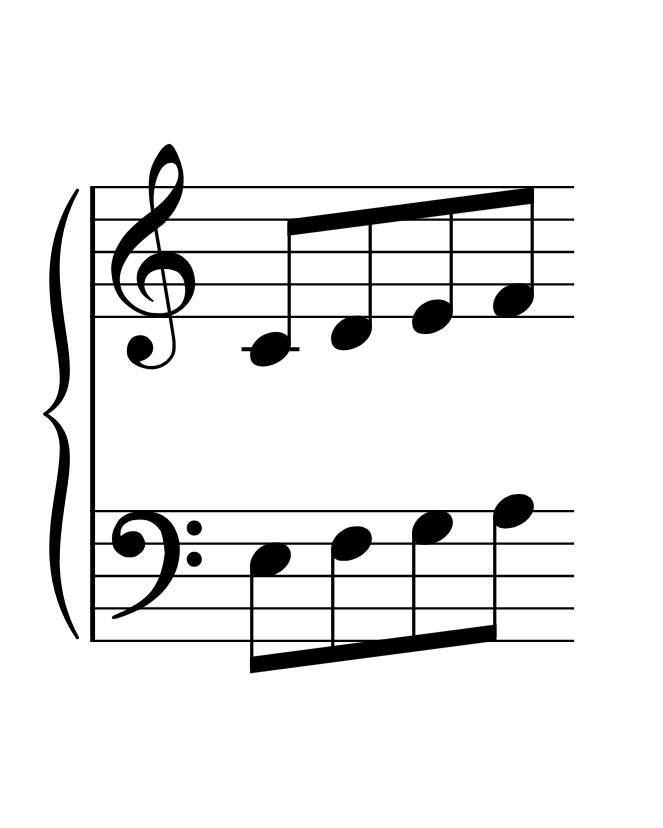
In the C-major examples below, the upper line starts on C and the lower line on E. The first interval is a minor sixth. As the notes move through the major scale, the quality of the sixth changes according to the diatonic notes. Compare that with a chromatic scale held a major sixth apart: there, both lines move by semitone and preserve the same interval size.
Two meanings of “sixths”
Hands a sixth apart
Sixths in one hand
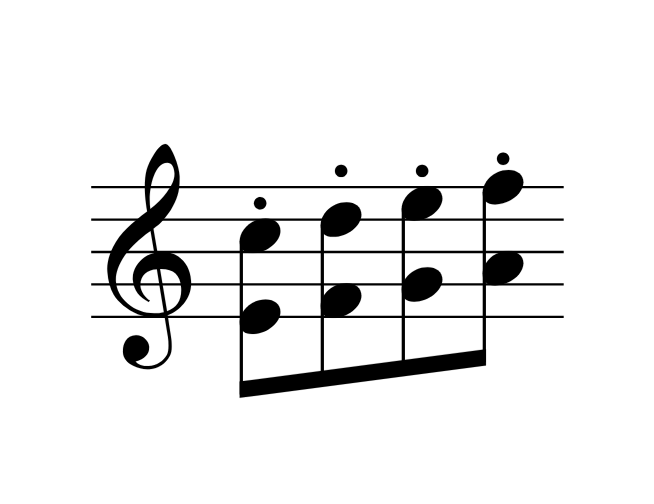
Both show the opening four pairs in C major. E to C begins as a minor sixth; the diatonic scale uses both major and minor sixths as it continues.
Listen for coordination in either texture. With one note in each hand, are the two attacks together? With two notes in one hand, does one voice consistently arrive first? A small unevenness can be hard to notice when the fingers are occupied with reaching the next position.
Work on a short group in a comfortable range and hear the two sounds as a pair. For staccato, let both notes release together before moving. More force does not solve a late note or an unclear release. The precise fingering and movement deserve individual attention, especially in double-note work.
Fingering and the return journey
A fingering that works for the opening must also support the passage through the octaves and the turn at the top. Test it in the complete direction of travel. The place where a hand reverses can reveal uncertainty that an ascending-only repetition never exposes.
ABRSM permits fingering that produces a successful musical result. Treat the printed fingering as a considered starting point, then judge any alternative through the sound and the movement it allows. Our guide to choosing piano fingering develops that process in more detail.
Once a solution is settled, practise its important transitions deliberately. Starting again at the very bottom each time can use most of the attention on the notes that were already secure. Begin just before the uncertain crossing, continue through it, and then restore it to the complete scale.
Be clear about the top note and the descent as well. An extra repetition at the turn, or an unplanned pause before coming down, changes the rhythm. Hear the return as the second half of the same movement rather than a fresh task beginning after a stop.

Tempo, articulation and sound
The syllabus speeds are guidance. Read the note value attached to a number and its rhythmic grouping; a bare metronome number does not describe how many notes you play in each pulse. Build a pace at which the pattern remains clear, even and controlled throughout its range.
Listen for the note that becomes louder at a thumb crossing, the hand that hurries through a familiar group, or the descent that accelerates. Those details give speed practice a purpose. Simply reaching the last note sooner can leave the unevenness intact.
Legato and staccato also require distinct sound intentions. In legato, listen to the continuity across the changes of finger and position. In staccato, listen to the consistency of the spaces and releases. The movement that gives one result may need adjustment for the other, while the pulse remains steady.
I want the first few notes to tell me which articulation the pianist intends. If the opening is vague, the rest often becomes a negotiation between habits. Practising a clear opening at a moderate pace can be more useful than repeatedly pushing through the full range at a speed that obscures the sound.
Recall or execution?
After a response, distinguish uncertainty about the instruction from difficulty in playing it. If the starting notes were unclear, work on identifying the key, chord or interval. If the correct pattern was known but a crossing stumbled, work on that movement. If the notes were accurate but the pulse changed, listen to their spacing.
The distinction keeps practice honest. A scale can sound secure after three immediate attempts because the first attempt supplied the reminder. Return to it after playing something else and see whether the opening is still available. That is closer to the task of responding to a new request.
Likewise, a hesitation does not prove that every octave needs more repetition. You may need a clearer association between the spoken name and the opening. Speak the name, locate the first notes, hear a short beginning and then play. Gradually let that preparation become more concise.
Use the sheet below for observations worth keeping. “Needs work” is too broad; “started the F-sharp arpeggio on the root” or “left hand rushed after the turn” names the next practice task. One clear observation is more useful than marking an entire page as uncertain.
Compare the request with the response
Write the requested item, the opening you had in mind, what happened in the playing and one thing to practise next. Fill it with requirements from your own grade.
Download the recall sheet (PDF, one page)Bringing it together
As the exam approaches, alternate focused work with short sets of unfamiliar requests. In focused work, stop and solve the troublesome point. In a complete response, establish the opening and play the requested range with a musical sound. Both experiences belong in preparation.
Cover the different types on your grade page over time rather than selecting only the patterns that feel satisfying. Keep listening when an item becomes familiar. Technical work can become so automatic that a repeated unevenness starts to sound normal to the player.
The useful goal is a response in which the instruction, the imagined sound and the hands agree. You know what was requested, you know how it begins, and the first notes already belong to the music you intend to play.