
Preparing for ABRSM Grade 8 Piano: A Musical Study Plan

Preparing for ABRSM Grade 8 piano means bringing several abilities to a dependable level at the same time. A convincing opening, a fast passage that works on a good day and a completed repertoire list can all be encouraging signs. The harder question is whether your playing stays musically clear across the whole programme and the other requirements of your chosen exam.
I listen for the quieter evidence of readiness as well as the impressive moments: a melody that remains audible inside a chord, a steady pulse through a change of texture, and a pianist who can continue after a slip without abandoning the phrase. These qualities grow through specific work. Repeating the entire programme seldom improves all of them equally.
Start with three things: your exam route and syllabus, a recent sample of your playing, and the musical problems that sample reveals. From there, a study plan can give the most important work enough attention without allowing the rest of your musicianship to disappear.
Confirm the Grade 8 requirements
For Practical Grade 8, prepare three pieces, one from each of Lists A, B and C, together with the specified scales and arpeggios, sight-reading and aural work. For Performance Grade 8, prepare four pieces for a continuous recorded performance, including the required list selections and an eligible own-choice piece. The performance as a whole is also assessed.
Both routes have an entry prerequisite. Before booking, check that you have passed ABRSM Grade 5 or above in Music Theory or Practical Musicianship, Grade 5 in an eligible Practical Jazz subject, or an accepted alternative. An earlier piano grade alone does not meet this requirement. Our comparison of Practical and Performance Grades explains the routes and prerequisite in more detail.
The piano syllabus changes on 1 January 2027. The 2025 & 2026 repertoire remains available through 31 December 2027 under the overlap rules; the three set selections must stay within one syllabus. For a Performance Grade using the older syllabus, the video must be uploaded by that deadline. Establish the applicable syllabus before building your preparation around particular pieces.
Hear what is ready, and what is fragile
A useful first recording includes more than your favourite opening. Hear a complete piece, a difficult middle section and the ending of a longer run. The first shows how you carry a musical argument; the others reveal problems that a fresh start may hide.
Choose a passage where the musical intention is clear to you. Perhaps the melody should rise through a phrase while the accompaniment stays light. If the result still sounds heavy, separate the possible causes. Is the melody too quiet, the inner part too loud, or the bass over-resonant because the pedal has retained an earlier harmony? Each calls for different work.
Turn a listening observation into useful work
The tune disappears inside a chord
Listen to the melody alone, then add the inner notes more quietly.
Then listen: Hear the whole phrase, including its changes of position.
A fast section loses its pulse
Find the precise movement or rhythm that interrupts the flow.
Then listen: Join the passage to the music before and after it.
The last piece sounds less settled
Listen for the first point where concentration or balance changes.
Then listen: Hear that piece again after an earlier part of the programme.
Treat an observation as a starting point for listening. “Bar 12 is difficult” is less useful than “the melody disappears when the right hand changes position.” The second description suggests what to hear, where to begin and how to recognise a change.
Make the same distinction with tempo. A section played slowly with clear rhythm is at a different stage from one that is fast but regularly loses its pulse. Gradually building speed makes sense in the first case. In the second, establish the rhythm and the movement that is disturbing it before asking for more speed.
A score example: Beethoven's singing line
The Adagio cantabile from Beethoven's Pathétique Sonata, Op. 13, is a List B option in the 2027 & 2028 Grade 8 syllabus. Its opening shows why readiness cannot be judged by speed or the number of notes on the page.
Beethoven, Op. 13, Adagio cantabile: bars 1–4
Both staves use bass clef. Hear the upper melody, the inner sixteenth notes and the bass as three layers.
Scroll sideways to read the score.
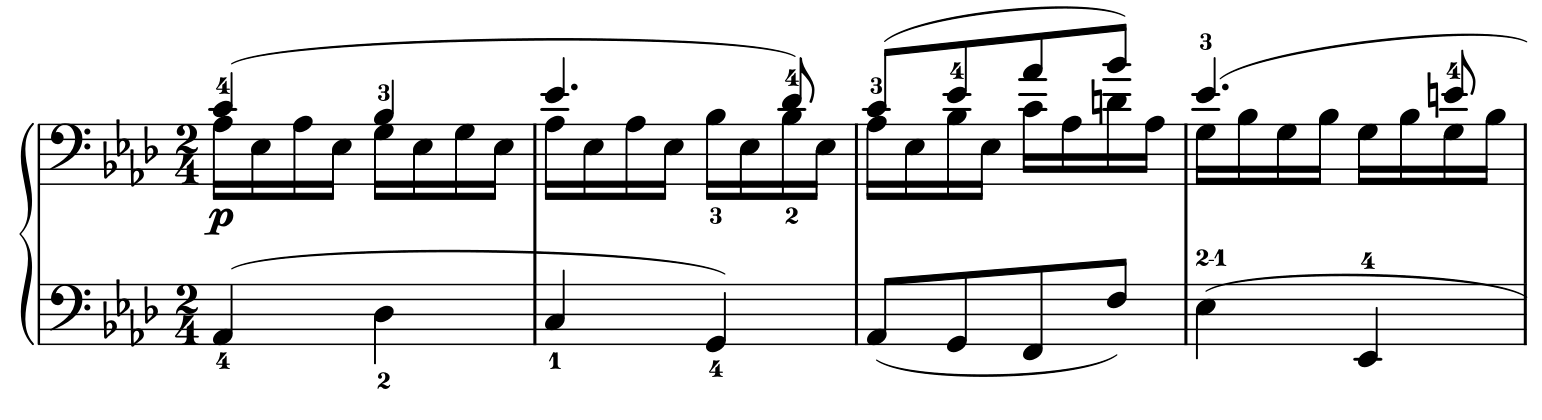
In bars 1–4, the right hand carries both a melody and an accompanying figure. The left hand supplies the bass. Play the melody alone first, keeping the length of its notes and hearing where it leads. Then add the inner notes softly enough that the same line remains clear.
That comparison can reveal a precise task. If the melody shortens as soon as the accompaniment returns, work on the connection between the upper notes while keeping the rest of the texture quiet. If every inner note creates a new accent, practise the accompanying figure as a gentle, continuous movement, then restore the melody. If the bass covers everything, listen to the left hand and pedal together.
I would return to the whole phrase after this work, rather than judge the result from one beautifully balanced chord. The aim is a singing line that survives the movement between chords.
Bars 51–52: the melody returns over triplets
Both staves use bass clef; the key signature has four flats. The accompanying sixteenth-note triplets create six small notes within each quarter-note beat.
Scroll sideways to read the score.
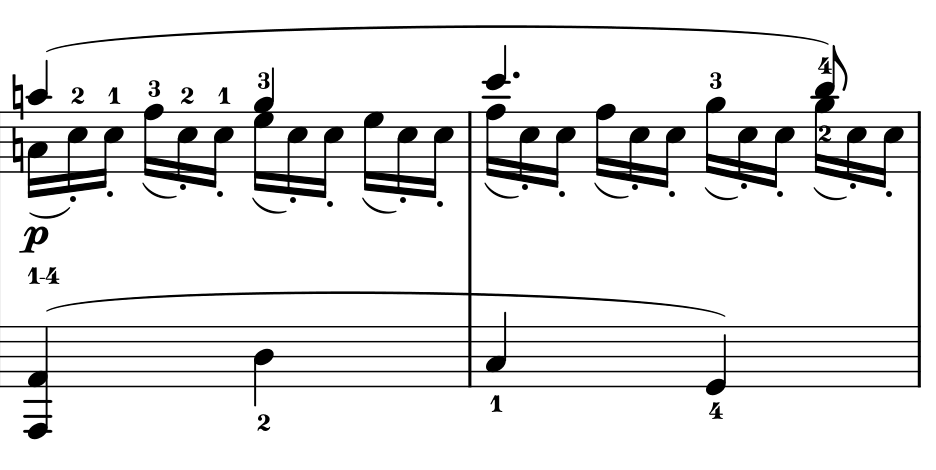
When the theme returns in bars 51–52, the accompanying motion has changed to sixteenth-note triplets. The melody can still have breadth while the smaller notes move beneath it. Compare the beginning and this return: does the greater activity underneath make you hurry the tune or play the accompaniment louder?
This is a useful Grade 8 preparation question even if you choose another work. Find a place where familiar material returns with a different texture. Test whether the musical character remains convincing when the technical conditions change. That is more revealing than practising only the easiest appearance of a theme.
Choose pieces as a complete workload
A programme needs music you can develop with interest over time. It also needs a realistic balance of demands. Three pieces that all require a large increase in speed, difficult stretches or unfamiliar notation may compete for the same kind of practice before any one of them becomes secure.
Look inside each work. Where is its greatest technical demand? What makes its character distinctive? Which passage will probably take the longest to understand? A slow work may require delicate voicing; a quick one may require rhythmic lightness more than sheer speed. A familiar composer is no guarantee of a familiar pianistic problem.
With a teacher, read and try representative sections before committing to the entire programme. Include a middle passage and the ending. This is especially valuable when the opening is attractive and manageable but later pages introduce a different texture or much wider movement.
Once the programme is chosen, let the pieces develop at different rates. One may need detailed reading, another may be ready for phrase work, and a third may need occasional complete performances. Giving all three the same amount and type of practice can waste time on what is already reliable while leaving the real obstacle untouched.
Technical work for the Practical route
Grade 8 technical requirements extend beyond ordinary similar-motion scales. They include work such as scales a sixth apart, double-note scales, whole-tone patterns and second-inversion arpeggios. Use the current specification to identify the exact keys, ranges, articulations and hand combinations.
The first useful distinction is between knowing the pattern and responding confidently when it is requested. If a second-inversion arpeggio takes several guesses to begin, slow practice of the complete arpeggio may miss the problem. First establish its starting position and hear the harmony; then play it through with an even pulse.
If the notes are familiar but one part of the keyboard produces uneven sound, work on that stretch at a manageable speed. Listen across the hand's position changes, especially where a thumb or a large movement creates an accent. The sound should tell you whether the movement is improving.
I like technical work to retain a musical direction. A scale has an arrival and a return; an arpeggio has a harmonic identity. The guide to connecting scales with repertoire develops that relationship without turning every piece into an exercise.
Keep a record of the requirements that are unreliable, and revisit them among items you can already play. A fixed daily sequence can conceal hesitation because you always know what is coming next.
Reading and listening alongside repertoire
For the Practical route, give sight-reading and aural work time from the beginning of preparation. Their progress depends on repeated musical encounters, while a prepared piece becomes more familiar with every practice session.
In sight-reading practice, choose material that lets you maintain a useful sense of pulse and phrase. Notice whether your attention is caught by individual notes or whether you can see patterns, bass movement and points of arrival. After the attempt, inspect the specific place where you lost the thread. Then read something new, so the activity continues to involve reading rather than recall.
Grade 8 aural work includes following a lower voice, singing a lower part from notation, recognising harmonic movement and describing what is heard. The exact task matters. Listening only for the most prominent tune will leave some of this work untouched.
Bring this attention back to repertoire. Follow the bass while someone else plays, sing a short inner line, or hear the approach to a cadence before naming it. Our article on hearing cadences at the piano connects the sound of an arrival with the harmony that produces it. These are useful musical habits for Performance Grade candidates too, although that route has no separate supporting tests.
Build a week around musical priorities
Begin the week by choosing two substantial priorities. One might be voicing in a slow piece; the other might be continuity through a fast passage. Give each a short, clearly bounded passage and decide what you want to hear when you return to it.
Across the week, maintain contact with the other pieces. Play a phrase, revisit a transition or hear a complete section, according to its stage. For the Practical route, include technical, reading and listening work regularly. For the Performance route, the fourth piece needs the same musical attention as the three set pieces, along with time to hear how the programme fits together.
A listening sheet for the week
For each of two priorities, note the work and passage, what you hear, what you will try, and what changes when you listen again. Keep a separate note about the whole programme and your other work.
Download the one-page listening sheet (PDF)Use the sheet to record the musical observation, the work you tried and what you heard on a later day. “Less pedal at the change of harmony; melody stayed clear” tells you more than ticking a box marked “practised.” If the same problem remains, change the task or ask for another listening perspective.
A complete run near the end of a practice cycle can show whether the week's work has carried into performance. Follow it with focused listening. If a previously troublesome join now works but the ending has become rushed, you have a new priority for the next cycle.
Rehearse the demands of your route
For a Practical Grade, include rehearsals in which another person asks for the technical requirements and gives the other tasks. Responding to an instruction, starting without a long preparation ritual and moving from one kind of activity to another are part of the experience.
For a Performance Grade, rehearse complete recorded programmes on several separate occasions. Hear the final piece after the preceding music, and listen to the contrast between openings. A particularly good single take is encouraging; consistent performances across different days provide more information about what is dependable.
Check the playing conditions as well. A different piano may change how much accompaniment you hear, and recording can reveal a balance that seemed clear from the bench. Work with that information. The objective is an interpretation that remains audible under the conditions in which it will be assessed.
When is it time to book?
There is no useful universal number of months for Grade 8 preparation. Someone who has already developed the supporting skills and has suitable repertoire underway faces a different task from someone learning several new kinds of technique at once.
Look for evidence across the programme: you can establish each piece's character, maintain continuity, recover musically and finish with concentration. For the Practical route, include dependable responses across the supporting work. For the Performance route, include a valid programme and a recording setup you have actually tested.
Discuss the remaining weaknesses with your teacher before choosing a date. Some need a small adjustment; others need a period of learning that a deadline will not shorten. A sensible exam date gives that work room to develop while keeping a clear destination in view.
Grade 8 is a worthwhile musical milestone. The best preparation leaves you with more than three or four familiar pieces: it strengthens the way you read, listen, practise and communicate the next work you choose.