
Playing an Unfamiliar Grand Piano: A Short Soundcheck Guide
An unfamiliar grand piano can make a familiar piece feel newly exposed. A quiet chord speaks more abruptly than expected; the bass carries longer; a pedal change that sounded clear at home leaves a blur in the hall. The useful question is what this piano needs for the music you already know.
A short soundcheck is most valuable when you bring a few recognisable passages and listen to the result. Test a quiet opening, a melody over accompaniment, and a fuller phrase with a clear release. Together, they tell you more about your performance than a hurried tour of every difficult bar.
I like to finish an instrument trial by returning to the opening. The first attempt tells me what feels unfamiliar. The second tells me whether the small adjustment I have chosen actually serves the phrase.
Three passages for a short soundcheck
Choose the passages before arriving. Each should be secure enough that you can listen beyond the notes. A soundcheck becomes less informative when all your attention goes into remembering a fingering or surviving a difficult leap.
The card below suggests how to use roughly two minutes when a venue gives you that much playing time. Its timings are flexible. A sustained melody may answer the balance question quickly; an unusually sensitive pedal may deserve more of the available time.
Three sounds to hear in about two minutes
A flexible allocation within the time the venue permits. Use passages you know from your own programme.
About 30 seconds
A quiet opening
Do the soft notes speak reliably? Does the seat and pedal position suit the passage?
About 45 seconds
Melody and changing harmony
Can you follow the long melody note? Does the new harmony emerge clearly after the pedal change?
About 45 seconds
A fuller sound and its release
Do the voices remain audible as the sound grows? What remains after fingers and pedal release?
Return to the opening with one adjustment, and hear whether it helps the whole phrase.
Confirm what the organiser permits. A rehearsal slot, a few preliminary notes and a separate warm-up room offer different opportunities. For example, ABRSM’s 2025–2026 Practical Piano specification allows candidates to adjust the stool and try a few notes before beginning; it also says that practice on the public-venue exam piano cannot be arranged beforehand. That is a useful distinction, not a promise of a two-minute rehearsal at every exam.
When only a few notes are allowed, prioritise the response you will need at the beginning: a quiet attack, a short chord with pedal, and the feel of releasing it. At a recital with a longer rehearsal, the same questions can be explored through complete phrases.
The seat and the first quiet sound
Set the bench before judging the keyboard. Check the distance while playing both near the centre and farther out, then put your foot on the right pedal. A comfortable keyboard distance that leaves the pedal just beyond easy reach needs reconsideration. Use the shoes intended for the performance, so their sole and heel are part of the trial.
Start with a short phrase at a moderate dynamic, then repeat it quietly. This gives you a reference for how the piano responds as the attack becomes smaller. Going straight to the faintest possible sound can turn the first encounter into a search for the point at which notes disappear.
Listen for every note in a quiet chord. If its top note fails, try the chord again with a clearer melodic attack and a lighter accompaniment. If the whole chord jumps out too strongly, reduce the attack while keeping the movement decisive enough to sound the notes. Compare the result immediately, in the same register and at the same tempo.
Separate the feeling of the key from the sound it produces. A keyboard that feels unfamiliar under the fingers may still give you an excellent soft sound. Equally, an easy-feeling action can encourage you to play louder than intended. Use the audible phrase as the reference for the next attempt.
If your programme contains a trill or repeated notes, try a small part of that figure after the quiet opening. Listen for reliable renewal of the sound as the key returns. The repeated-note guide explains that specific adjustment in more detail. During a short trial, keep the fingering you have prepared and find how much release this instrument needs.
Melody and accompaniment
A grand piano may offer a bass that is much more present than the one you practise on. If you answer by making everything louder, the melody and accompaniment can grow together while their relationship remains unchanged. First try reducing the competing layer.
Take a phrase with a sustained melody and moving accompaniment. Play it once with your usual balance. On the next attempt, keep the melody’s intention and make the accompaniment quieter. Listen through the end of the long melodic note: does it remain part of the line, or do the newer accompanying attacks take over?
Chopin’s E-minor Prelude, Op.28 No.4, shows this particularly clearly. The right hand sustains long notes while the left hand repeatedly renews its chords. If this piece is already familiar, the opening makes a useful comparison. Otherwise, choose a passage from your own programme with the same musical relationship.
Chopin Op.28 No.4: upbeat and bars 1–3
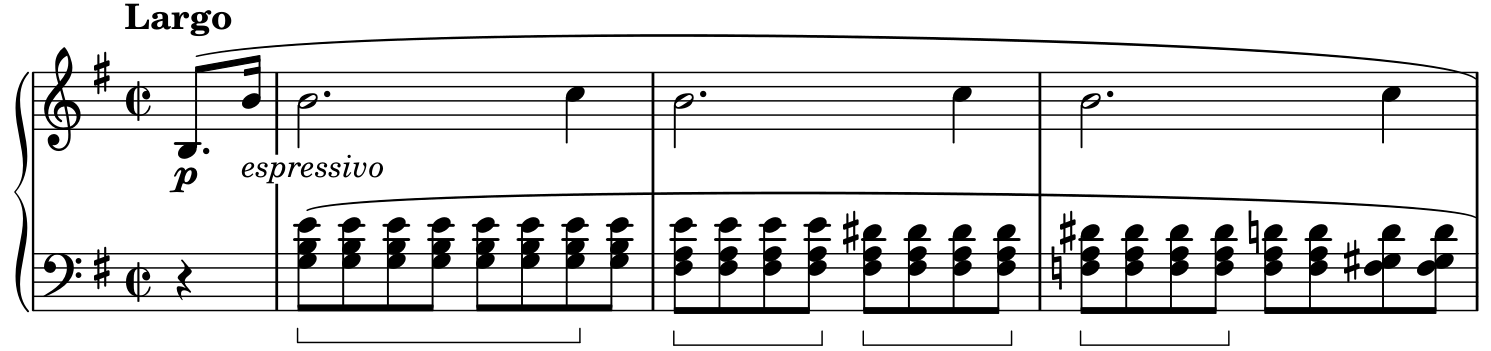
Hear the sustained melody, the moving inner voice and the pedal resonance within the same passage.
Open the enlarged scoreThe left hand changes within the bar. In bar 2, its upper note moves from E to D-sharp while the bass stays on F-sharp. That small change can be obscured when the pedal carries too much of the previous chord. It is therefore a good place to hear both balance and harmonic clarity, rather than judging the piano from a single sustained chord.
Play the passage first with the fingers carrying the written durations, then add your usual pedal. If clarity changes, you have a useful comparison: how much comes from the balance of the hands, and how much from the sustained resonance? Keep the phrase moving while you adjust one of those elements. The complete Prelude discussion develops its voicing and harmonic changes beyond this short example.
The pedal’s useful range
Begin by finding where the right pedal changes the sound. Play a middle-register chord, depress the pedal, release the keys and listen. As you slowly let the pedal rise, notice where the held resonance begins to clear. Repeat with the bass register used in your piece. The distance your foot travels is only useful when you connect it to what the dampers are doing audibly.
Then try two harmonies from the music. Hold the new notes with the fingers while clearing the old pedal, and listen for the new harmony to emerge. A change that is too late can leave the earlier notes over it; one made too early can interrupt the connection. The practical target is the musical change you want to hear.
On a resonant instrument, try a shallower pedal or a more complete release at a troublesome change, then repeat the phrase. These are alternatives to compare. If you alter depth, timing, balance and tempo together, it becomes difficult to tell which adjustment helped. A short rehearsal rewards a small change whose effect you can hear.
“Half pedal” describes a useful range of partial damping; it does not identify the same halfway point on every pedal. Find the effect on this instrument instead of reproducing a remembered ankle position. Keep listening to the bass as well as the melody, because a clear treble can sit above accumulated low resonance.
Test the left pedal if you intend to use it. On a grand, it shifts the action and changes the colour as well as the volume. Play a short phrase with it released and engaged, keeping your intended dynamic similar. Decide whether that colour belongs in the passage. A quiet sound should remain controllable with your hands as well.
The keyboard and the audience hear different things
The sound at the bench is one listening position. A person farther into the room may hear a different balance and a different amount of lingering sound. That difference makes an outside listener useful during a rehearsal, particularly when the bass feels overwhelming close to the instrument or the melody seems too small.
Two listening positions
- 1 · At the keyboard
- Feel the key response and hear the sound from the playing position.
- 2 · In the audience
- Compare the melody, accompaniment and lingering sound of the same phrase.
Ask one focused question after playing a short phrase: “Can you follow the melody through the accompaniment?” or “Does the new harmony clear at this change?” A broad question such as “Is it good?” gives you less to work with. Repeat the same passage after an adjustment so the listener can compare it.
A recording made from an audience position can offer another perspective if recording is permitted. Use it to compare clarity and balance between attempts. Phone microphones and automatic level adjustment can change the impression of loudness, so a recording is a reference rather than a measurement of the hall.
In a lively room, hear what happens after a chord is released. You may want a cleaner pedal change or a more distinct separation between gestures. In a dry room, attend to the continuity of the melody and the timing of the accompaniment before simply adding more pedal. Keep the character of the piece as the reason for the adjustment.
The fuller sound and the ending
Try a short, stronger phrase from the programme. Hear whether the melody still stands above the texture and whether the bass gives the passage weight without covering its movement. Choose a passage you can play securely; a soundcheck does not need your most strenuous climax to reveal the instrument’s dynamic range.
Let its ending ring. Then practise the release you actually intend: fingers, pedal and the space before the next gesture. This is particularly useful when your piece ends quietly or includes a silence after a strong chord. The room continues to participate after your hands have stopped moving.
If the lid position or bench is unsuitable, ask the venue staff about the available setup. If you hear a persistent buzz, a sticking key or a pedal that will not clear, identify the note and the circumstances for them. Physical setup and instrument faults belong with the people responsible for the piano; your musical adjustment begins with the instrument that is available to play.
Carry one decision into the opening
Return to the beginning with the most useful observation in mind: perhaps the left-hand chords need less weight, the first pedal change needs a fuller release, or the quiet melody needs a more definite attack. Play the whole opening phrase and listen to its direction.
Keep that decision brief enough to remember as music. “Let the melody remain above the chords” is more useful at the first note than a catalogue of everything that felt different. The instrument trial has done its job when your attention can return from the unfamiliar piano to the phrase you want to share.