
Repeated Notes on Piano: Fingering, Release and Rhythm
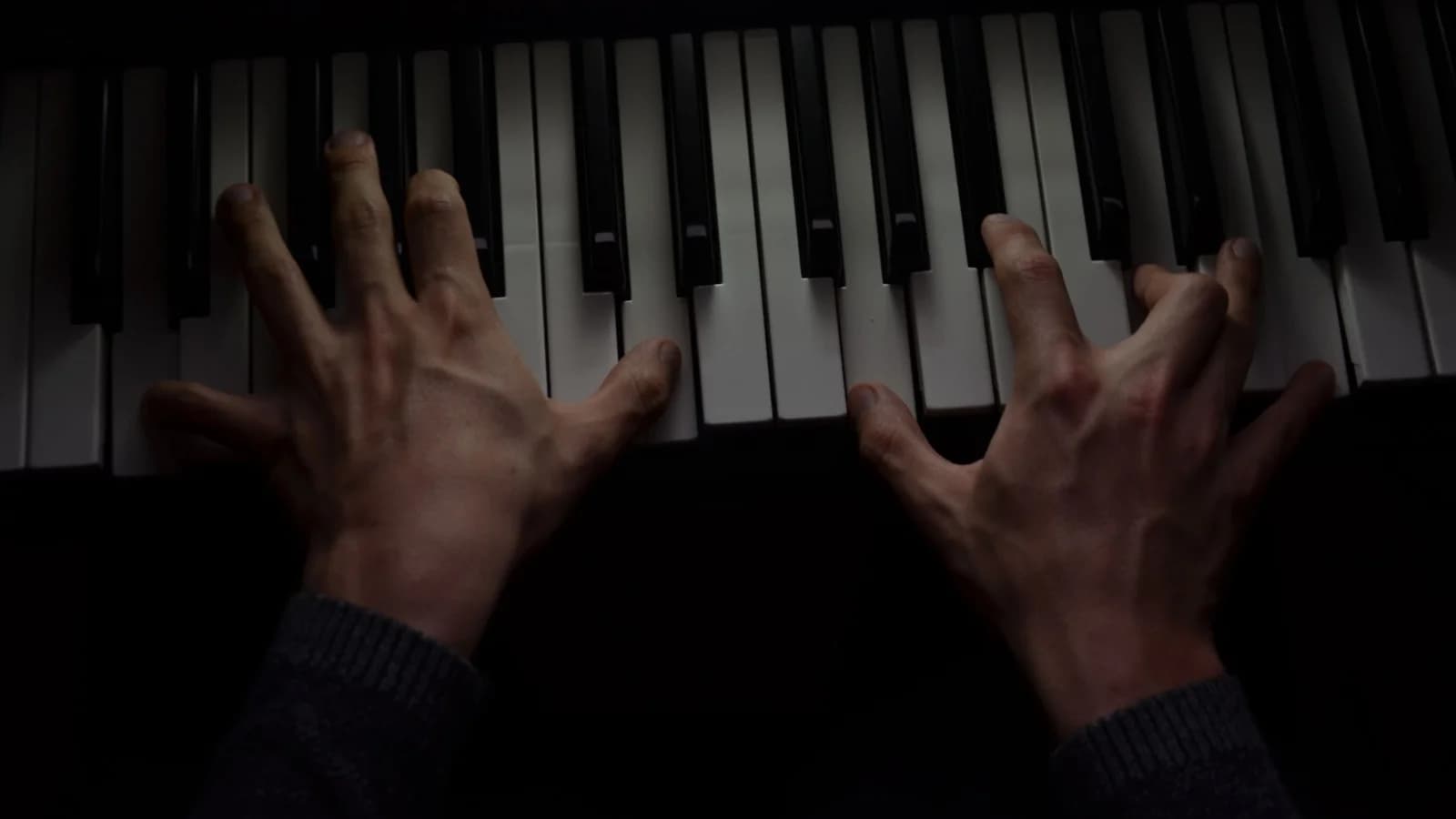
Repeated notes ask the piano to do something deceptively demanding: sound the same pitch again before the previous gesture has quite finished. A run can move on to another key. A repeated-note passage must make the same key ready for every new attack.
Changing fingers can help, but the numbers alone do not solve the passage. The key must return far enough, each new finger must arrive in time, and the repetition must still carry the rhythm and direction of the music. A reliable fingering is the one that does all three on the instrument you are playing.
Start by identifying what you hear:
- A note disappears: investigate the key’s return and whether the previous finger is still holding it down.
- All notes sound, but the rhythm stumbles: compare the spacing between attacks and the change from one finger to the next.
- The notes are even but sound like a drill: listen for accidental accents, the surrounding phrase and the transition out of the repeated pitch.
The key must reset
Press a comfortable middle-register key, then try to play it again while continuing to hold it fully down. The second movement produces no new attack. To repeat the note, the action has to reset as the key rises. This small return is part of every successful repetition, whether you use one finger or several.
At a slow tempo, play two notes with the same finger. Feel the key rise between them. Then try the pair with fingers 3 and 2. The third finger has to release its pressure before the second finger can make a fresh attack. If both fingers press into the key together, changing fingers has added a new complication without creating a new sound.
Keep the trial short enough to hear the two attacks separately. A chain of twenty notes can conceal the moment at which the movement stops working. Two reliable notes, followed by three or four, give you something useful to compare. Extend the group when its last note is as clear and controlled as its first.
Release and staccato are related, but they are not the same musical instruction. The key needs a return even in a singing repeated-note melody. The ear can hear continuity through balance, timing and resonance. The guide to staccato, dots and slurs explores how release changes the articulation of a phrase.
One finger or changing fingers?
For a few unhurried repetitions, the same finger may give an uncomplicated result. It can also keep the hand well placed for nearby notes. Replacing a settled single-finger repetition with an elaborate cycle is worthwhile when it improves the sound, the movement or the arrival at the next pitch.
Alternating two fingers, such as 3–2, gives each finger time to leave while the other prepares. A three-finger sequence such as 3–2–1 distributes the repetitions differently and is often useful in fast figures. Other choices exist, including different starting fingers. The surrounding notes and the position of the hand determine which alternatives deserve a trial.
Use the following patterns on one comfortable white key, slowly enough that all three can be compared. Keep the sound moderate and the rhythm equal. This is a listening comparison, not a competition to find the fastest row.
Six attacks, three finger patterns
Compare these slowly on one white key with the right hand. 1 = thumb, 2 = index, 3 = middle finger. Six sixteenth notes fill one bar of 3/8.
| Count | 1 | & | 2 | & | 3 | & |
|---|---|---|---|---|---|---|
| One finger | 2 | 2 | 2 | 2 | 2 | 2 |
| Two fingers | 3 | 2 | 3 | 2 | 3 | 2 |
| Three fingers | 3 | 2 | 1 | 3 | 2 | 1 |
In 3–2–1, the thumb arrives on attacks 3 and 6. Its arrival should not automatically become an accent: the finger cycle and the beat pattern are different.
With one finger, listen for a gradual increase in effort or a shortened last note. With two fingers, listen for a strong–weak alternation that you did not intend. With three fingers, pay particular attention to the thumb. A thumb that arrives with a heavier attack can make every third note prominent, even when the music groups the notes differently.
I judge a proposed fingering by the last repetition and the note that follows it. A pattern can feel beautifully organised in the middle of a loop and still leave the hand poorly placed for the next pitch. Include that destination from the beginning of the comparison. For a broader discussion of choosing numbers around a phrase, see how to choose piano fingerings.
Scarlatti: six notes within one bar
Scarlatti’s Sonata in D minor, K.141, makes repeated notes a defining musical idea. The opening is in 3/8. Each of the first six bars contains six right-hand sixteenth notes on one pitch, while the left hand gives a chord at the start of the bar. The repeated pitch changes from bar to bar; at bar 7, the right hand moves into a descending figure.
Scarlatti K.141: bars 1–13
The first system contains bars 1–6. At bar 7, on the next system, repeated pitch gives way to a moving line.
Scroll sideways to read the score.
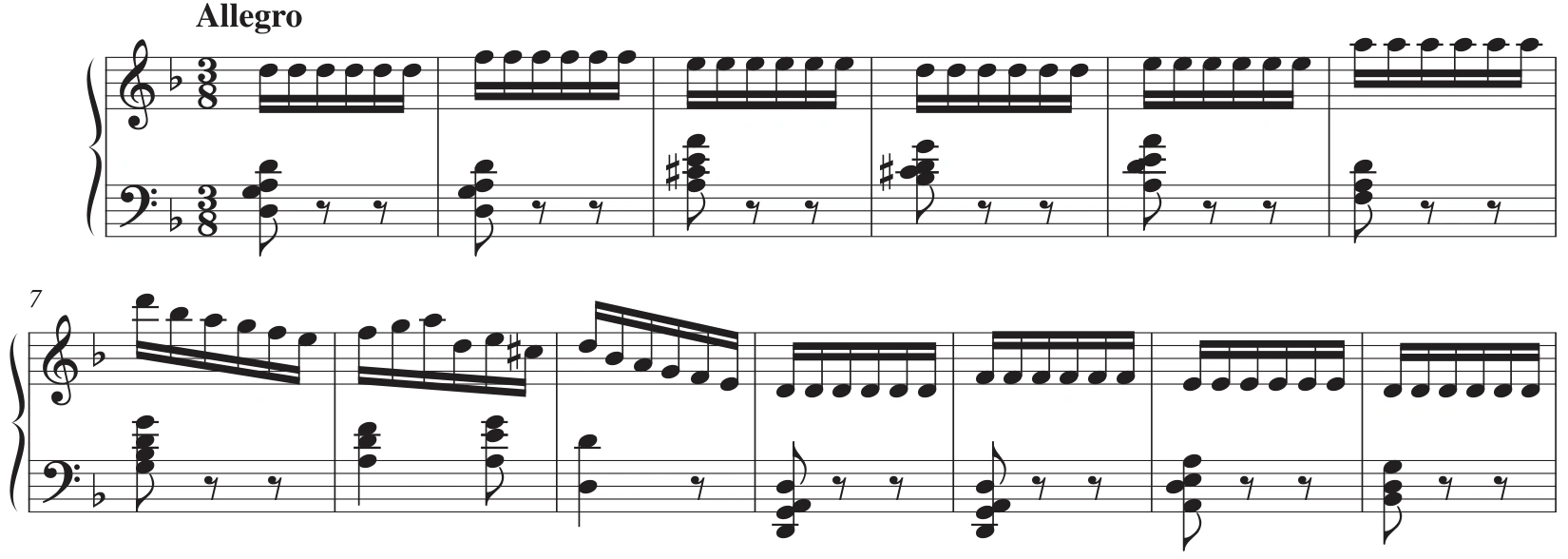
This is demanding repertoire, but a single opening bar makes the problem easy to see. Six evenly spaced attacks fill the bar. A 3–2–1 cycle fits twice into those six notes, yet its two finger groups are not the same as three pairs of sixteenths. If the thumb automatically accents attacks 3 and 6, it imposes a pattern that comes from the hand rather than from the musical phrase.
For a slow study, count the six notes as “1-and, 2-and, 3-and”. Listen for equal spacing while the fingers change. Then feel the six notes moving within one larger bar. The left-hand chord marks the start of that larger movement; it gives the right hand a point of departure without requiring six separate emphatic attacks.
First try the right-hand group followed by a pause. Next add the left-hand chord and its written releases. Finally continue into the next bar. Each version answers a different musical question: can the key repeat, can the hands begin together, and can the pulse continue through a change of pitch?
After the opening bars, include the transition into bar 7. A repeated-note practice loop can encourage a hand position that suits only one key. The descending line requires you to leave that position in time. Practising the final repetition together with the first few moving notes shows whether the fingering serves the actual sonata.
For a performance reference, Martha Argerich’s K.141, published by the Singapore Symphony, puts these figures in their full musical setting. Follow the changing pitches and the left-hand punctuation through the opening, then listen to the move into the descending line. The useful model is the phrase carried by the repetitions, rather than a tempo target to copy.
Grieg: repeated notes that sing
At the start of Grieg’s Arietta, Op.12 No.1, the melody repeats G four times in eighth notes above a broken-chord accompaniment. The effect is far removed from the brilliant opening of the Scarlatti. Here, the challenge is to renew the note without turning the melody into four identical taps.
Grieg, Arietta, Op.12 No.1: bars 1–4
Listen to repeated pitch as a singing melody: renewed attacks shaped into one phrase.
Scroll sideways to read the score.
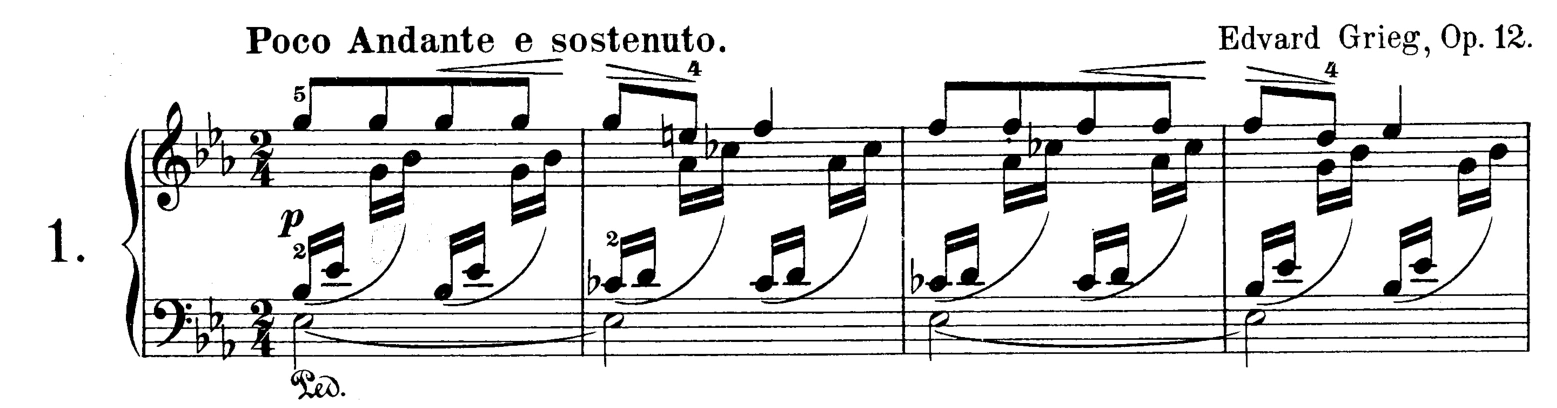
Play the melody alone and sing its direction. The pitch stays the same during the first bar, but the phrase does not stand still: the next bar changes the melody and the harmony. Shape the four Gs with that continuation in mind. A tiny change of balance can suggest movement without pushing the tempo forward.
Try a fingering that leaves room for the next melodic notes and for the accompaniment. In this texture, some of the hand’s work happens below the melody, so a repeated-note cycle chosen in isolation may occupy a finger you need elsewhere. Restore the complete texture before deciding which solution works.
Listen especially to the second and fourth Gs, which fall between the main quarter-note beats. If they become shorter or weaker merely because of a finger change, the line can acquire an unintended lilt. If all four are attacked too strongly, the accompaniment disappears beneath the repeated melody. The aim is a renewed singing sound that still belongs to one phrase.
The contrast between these two examples is useful. Scarlatti exposes rapid repetition and rhythmic grouping; Grieg exposes continuity and balance. A movement that succeeds in one passage still needs to be judged in the other musical setting.
Grand, upright and digital pianos
The instrument affects how much key return a repeated note needs. A grand piano’s repetition mechanism allows a new attack before the key has returned all the way to the top. An upright has a different action, and its response to rapid repetition can feel quite different. Regulation and the condition of the individual instrument also matter.
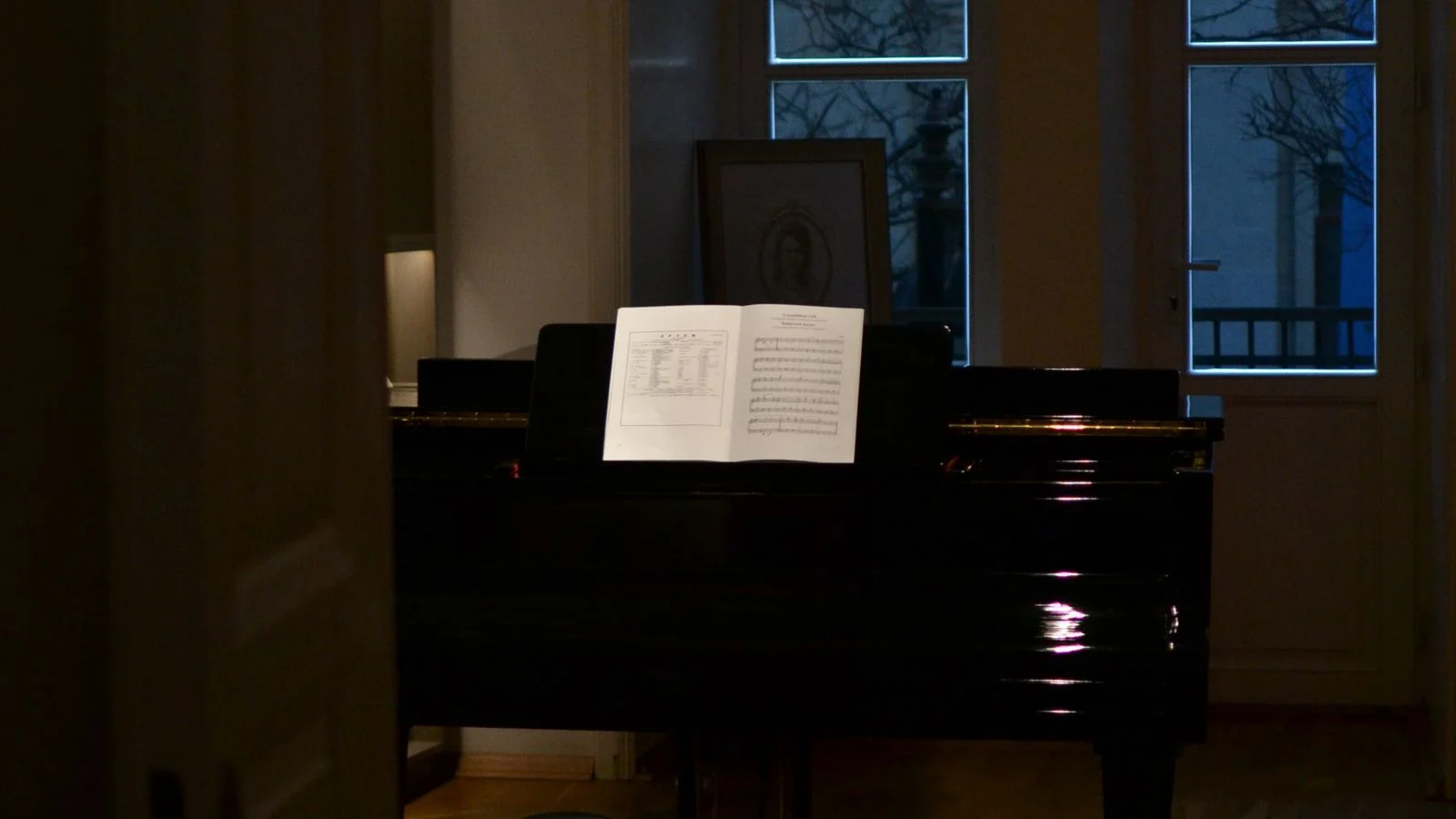
On an unfamiliar piano, begin with a few quiet repetitions at a comfortable pace. Let the key return clearly, then explore a smaller release while listening for reliable attacks. If notes begin to disappear, give the key more return and slow the figure. Pushing harder into a key that has not reset is unlikely to solve that particular problem.
Digital pianos use sensors and an action whose repetition response varies by model. The useful comparison is therefore the actual result: which notes sound, how evenly they arrive, and how much movement the instrument needs. A fingering that works at home may require a different release on another keyboard.
If a single key repeatedly fails while neighbouring keys respond to the same slow test, note that distinction and have the instrument checked. It is useful information about the piano, rather than a reason to practise the troublesome key harder. For ordinary practice, choose a tempo at which the instrument and the movement respond consistently.
Rhythm without a thumb accent
A repeated-note figure often becomes uneven at the same place in the finger cycle. Listen for a short gap before the thumb, a strong thumb attack, or a delayed return to the middle finger. These are different problems, even if all three make the passage sound bumpy.
Keep the first comparison rhythmically plain. Play a few equal notes, stop, and recall which pair sounded uneven. Isolate that pair, including the release of the first finger, then put it back into the group. This focuses the work on the transition you actually heard.
A brief rhythmic variation can then expose a rushed change: lengthen one note of a pair and shorten the next, then reverse the pattern. Use it at a comfortable tempo, and return promptly to equal notes. The variation is useful when it improves the original spacing; it should not become the only version in which the fingers cooperate.
Avoid adding a louder accent simply to prove that a new finger has arrived. In the Scarlatti pattern, the thumb is a participant in the sequence, not a permanent conductor of the rhythm. Let the written metre, the bass and the phrase determine the larger shape.
Take the fingering into the phrase
Once a short group is dependable, extend it into the real entrance and exit. Begin a few notes before the repetitions, continue through them, and finish on the next meaningful arrival. Keep the chosen fingering long enough to hear it in context instead of changing numbers after every attempt.
Record a short version at a manageable tempo. Count the attacks, listen for unwanted accents, then listen again without counting. Does the line move somewhere? Is the accompaniment still audible? Does the first new pitch arrive naturally? These questions reveal whether the technical improvement has become part of the music.
A successful repeated-note passage is more than a sequence in which every note sounds. The key returns reliably, the fingers arrive without obstructing one another, and the rhythm carries the phrase. When those elements agree, speed can grow from a movement that already has a musical purpose.