Choosing a Swiss Music Master’s for Piano: Finding the Right Course
Choosing a music master’s in Switzerland starts with the work you want to do at the piano. A course centred on broad performance development, a specialised chamber-music degree and an advanced soloist programme can all lead to a Master of Arts. Their daily work, entry expectations and final performances may be quite different.
For an international pianist, a useful shortlist records four things beside each university name:
- The full degree, major and specialisation.
- The musical work you would develop during the course.
- The qualifications and audition material required for that route.
- The teaching language and accepted evidence of proficiency.
The examples here come from Zurich University of the Arts (ZHdK), Bern University of the Arts (HKB) and the Basel Academy of Music within FHNW. They show how to read a programme closely and judge its relevance to your next stage of study.
Performance, specialisation and teaching
A performance master’s develops the pianist’s artistic work across repertoire, interpretation and professional practice. It can include substantial chamber music, contemporary music and other areas of study. A specialised performance master’s concentrates that work more sharply, perhaps on solo concert performance, an established ensemble or new music. A pedagogy master’s gives teaching its own sustained training alongside artistic development.
01Music Performance
Which parts of my performing practice need sustained development?
Principal study, solo repertoire and a broader artistic curriculum. Read the required ensemble and supporting work.
02Specialized Music Performance
What established direction am I ready to pursue intensively?
A defined specialisation, such as solo performance, an existing chamber ensemble or contemporary music. Each route has its own entry expectations.
03Music Pedagogy
How do I want to develop as a musician and teacher?
Artistic study alongside teaching practice, pedagogy and reflection on how other people learn.
When I talk with a pianist about postgraduate study, I want to hear a musical ambition with some detail. “I want to improve my technique” leaves a great deal open. Wanting to sustain the long line in a late Romantic sonata, rehearse more independently with a singer, or explore the sound of a fortepiano gives us something to discuss. The question is then which course offers the teaching and experience that the ambition needs.
Consider what has already changed during your bachelor’s degree. You may have acquired a wide solo repertoire while having relatively little experience making rehearsal decisions with others. Or you may be an experienced chamber player whose solo performances need a stronger sense of architecture. A master’s can extend the work you already do well and give serious attention to a part of your musicianship that has had less room to grow.
Reading a major and its options
ZHdK’s MA Music Performance in Piano has a 90-credit major within a 120-credit degree, normally studied over four semesters. The major is the principal subject area. The remaining study can be organised through minors or an Individual Area of Study, subject to the programme’s combination and admission conditions. Read the whole structure before assuming that every attractive option will fit into the same timetable.
- 90 credits
- Piano major
The main artistic programme, including its supporting and final work. - 30 credits
- Additional study
Minors or an Individual Area of Study, within the permitted combinations.
Inside the 90-credit piano major
- Core
- At least 64 credits
- Extension
- At least 15 credits
- Profile
- At least 5 credits
- Graduation
- At least 6 credits
These are the minimum areas in the piano major’s published structure. The major is one part of the full 120-credit degree.
The major itself also includes more than individual piano lessons. ZHdK’s regulations divide the piano major into Core, Extension, Profile and Graduation areas. Its final requirements include a repertoire examination, a public recital, a master’s colloquium and a piano-accompaniment examination. That last requirement is a useful reminder to look beyond the solo recital when considering what the degree asks of you.
The application begins with the major; ZHdK normally places the minor choice after the admission process, with some exceptions. Both begin in the first semester. Explore possible combinations early, then confirm their entry conditions and availability. A minor can give a defined body of work a place in your degree; an Individual Area of Study offers another way to build the additional study from suitable courses.
Try describing an option in terms of a rehearsal or lesson. Historical performance might mean testing articulation and balance on a different instrument. Collaborative work might mean reading a singer’s text, deciding where the accompaniment breathes and adjusting a piano texture to another instrument. A course name becomes useful when you can imagine the musical work behind it.
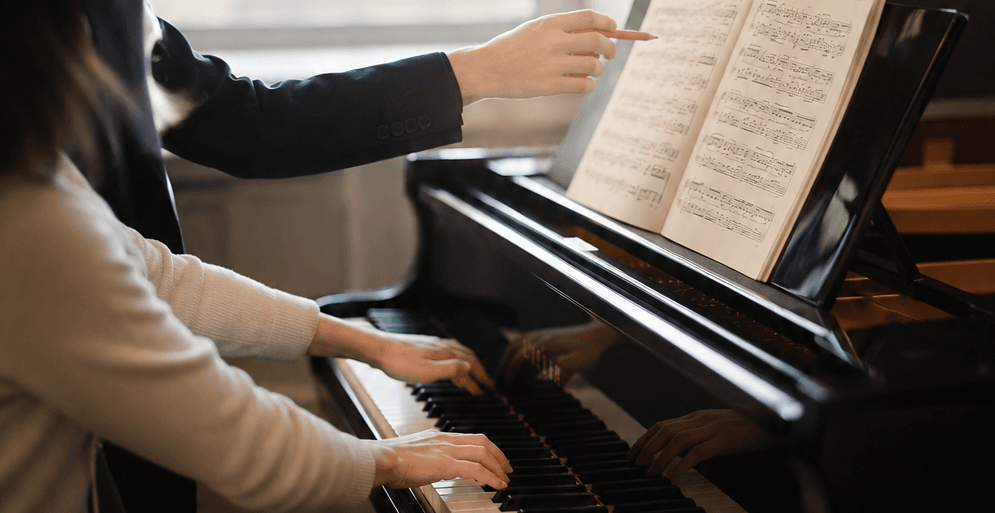
One-to-one classical piano
Beginner to advanced. Online, worldwide.
Enea
Concert pianist from Vienna
30 minutes · Ikebukuro & Shinjuku studios from October 2026
A performance master’s in practice
HKB’s MA Music Performance in Classical Music is a 120-credit course, normally lasting four semesters. Its curriculum combines principal study with artistic practice, theory and research, options and a final project. The current piano module plan includes fortepiano or harpsichord study and a year-long collaborative-piano placement. These are substantial musical experiences to consider when comparing courses.
A pianist accustomed to a modern grand can learn a great deal from how a phrase responds on a historical keyboard. The balance between bass and treble, the length of a sound and the way articulation carries a line invite fresh decisions. That work can return to a familiar Mozart movement: a left-hand figure that previously sounded like a continuous cushion may acquire a more active, conversational role.
Collaborative piano raises a different set of questions. If a singer takes time over a word, the pianist must hear how the bass and harmony support that timing. In a violin sonata, a phrase may pass between instruments while the piano retains a moving inner part. Preparing only your own notes leaves much of that conversation unexplored. Listen to the other part, learn where it breathes and practise the transition between leading and following.
A broad performance course can therefore suit a pianist who wants both stronger solo playing and more experience with other musicians. Look for the actual obligations in the module plan: what is taught regularly, what forms part of an assessment and what remains an optional project. HKB’s degree also includes written work alongside the final performance, so developing an interpretation includes learning to explain it.
Specialised solo and chamber routes
“Specialized Music Performance” covers several different directions at HKB, including chamber music, new music, research, Music in Context and solo performance. The published course distinguishes a first master’s of 120 credits from a second master’s of 90 credits. The chosen specialisation determines the relevant curriculum and audition; the title alone cannot tell you what to prepare.
For chamber music, HKB describes study as an established ensemble. That is a different starting point from a pianist hoping to meet chamber partners after arrival. The audition information asks the group to prepare four complete, demanding works in different styles and to provide an artistic dossier and repertoire history. The ensemble’s shared development is central to the application.
Think about the work between rehearsals. In a piano trio, knowing when the cello needs space does not settle how the three players will carry the phrase into the next bar. You may need to compare bowing, articulation, harmonic timing and the weight of the piano’s inner voices. An ensemble specialisation offers a context for developing that shared judgement over time.
Basel’s specialised Solistin/Solist master’s has a more explicitly soloistic focus. Its regulations describe a level of specialisation that normally builds on previous master’s study. The formal admission route nevertheless allows a music bachelor’s degree or equivalent preparation, followed by the required assessment and allocation of a place. These statements concern different things: formal eligibility and the artistic stage at which the course is usually undertaken.
For a soloist route, assess the breadth and reliability of your performing experience. Can you maintain a substantial recital programme while learning another work? Can you shape the whole of a concerto movement, including the passages where the orchestra carries the main material? In a two-piano rehearsal, listen through the orchestral reduction and practise entering with the character already alive. The next stage of study should have a musical purpose you can demonstrate.
A place for pedagogy
A pianist who wants teaching to be a substantial part of their professional work should examine pedagogy programmes directly. HKB’s Classical Music Pedagogy master’s combines artistic practice with pedagogy, options, minor study and a master’s thesis. Its course description includes practical teaching experience through projects, workshops and schools.
Teaching requires close listening to someone else’s process. Suppose a learner repeatedly rushes an accompaniment under a sustained melody. Demonstrating a polished performance gives them a sound to imagine, but you also need a way for them to hear and change the relationship themselves. You might ask them to sing the melody while playing the accompaniment, or to notice where the harmony changes beneath the long note. Then you listen to what the attempt reveals.
That interest in another person’s learning can sit alongside ambitious performance goals. When comparing degrees, ask how much supervised teaching and reflection the curriculum contains, which learners you would work with, and how principal-study lessons continue through the course. The answers will tell you more than treating pedagogy as a general alternative whenever a performance audition feels demanding.
Language matters particularly in this setting. Explaining a task, understanding a learner’s response and discussing an observed lesson require sustained communication. HKB’s Classical Music Pedagogy requirements specify German or French at least at B2, with C1 preferred and good receptive understanding of the other language. The certificate is due at the start of study under the published rules.
What the audition asks you to show
Read the audition requirements after identifying the exact route, and compare their musical demands with your current repertoire. HKB’s published Classical Music Performance sheet asks for four demanding works, which may be complete works or movements, from three freely chosen periods. It also includes a conversation and a task sent in advance; part of the programme is expected from memory.
Its specialised soloist sheet asks for six complete, demanding works in different styles, plus an assigned piece announced approximately three weeks before the examination. The jury selects up to 40 minutes shortly before the audition. This is a different preparation burden: a much larger body of music has to remain available, and there is new material to absorb while maintaining it.
ZHdK’s current piano master’s page describes a video preselection followed by a live assessment. The video includes a virtuoso étude, a first movement of a Classical sonata and a freely chosen work or movement, with a separate short spoken motivation statement. Its live programme is broader, and the assessment includes sight-reading and a discussion of study and professional aims. Use the programme-specific instructions for the intended intake when deciding the final list.
Across these formats, a useful early recording gives you evidence to discuss with your teacher. Listen for whether the musical character survives a difficult passage, whether a quiet section remains present and whether the ending follows from what came before. A performance can be accurate yet reveal little about the player’s understanding of the piece. Choose repertoire that gives your musical judgement room to be heard.
I also ask applicants to speak about a passage they have changed during their preparation. What did they hear in the score? What did they try at the keyboard? Why did one version persuade them? A specific answer, supported by playing, has more substance than a list of qualities they hope to acquire. Our guide to listening to your own piano recording offers a way to turn that listening into the next piece of work.
Languages and the next intake
Language conditions belong to the degree and major. ZHdK’s Music Performance regulations allow German or English for the piano major, with B2 as the certificate route alongside other accepted evidence such as relevant previous study. They allow conditional admission with proof completed by the end of the second semester. This master’s rule should be checked in its own right, rather than copied from the piano bachelor’s requirements.
HKB’s Classical Music Performance and specialised soloist requirements use B1 in German, French or English. Where English is the applicant’s first language, the published rules also require basic German or French at A1. Other HKB specialisations have their own entries in the language document, and the pedagogy route has the higher German/French requirement described above.
Basel’s Solistin/Solist regulations require adequate command of the teaching language, normally German or English. The assessment committee decides whether language evidence is needed and in what form. The programme does not supply a universal CEFR level in that clause. Give the university your exact course and language background when asking what evidence it needs.
A language plan should also include the work you will actually discuss. Practise explaining a phrase, asking a rehearsal partner to begin at a particular entry and describing what changed after a lesson. Even where English is accepted for admission, German can broaden your participation in a German-speaking musical environment. Choose language support around the situations you expect to encounter.
Check the year on every deadline and audition sheet. ZHdK’s spring-2027 piano master’s application window closed on 1 September 2026; its page says information for the next autumn admission process will appear in mid-November. HKB’s pages still contain some 2026 application details while linking a 2027 examination schedule. Treat a previous cycle’s repertoire sheet as a planning reference until the university confirms the intended intake’s instructions. Basel’s soloist page currently lists September 2027 entry and a 15 December–1 March application window.
Choosing teachers and a direction
Once the course structure looks promising, investigate the teaching in relation to your music. Listen to the professor’s performances, read the programme’s account of principal study and explore the ensemble or specialist work that interests you. A possible lesson or conversation can then address a real musical question: voicing in a dense texture, the pacing of a long movement or how you approach a score for the first time.
Describe your background and intended degree accurately when making contact. Include the repertoire you are working on and the question behind your interest. Ask the administration about course combinations, formal qualifications and documents; discuss interpretation and possible study with the relevant teacher. Our guide to emailing a piano professor in German-speaking institutions gives a concise structure for that first message.
Before deciding, return to the music you hope to be making at the end of the degree. Imagine a recital programme, an ensemble project or a lesson you could teach with greater understanding. Compare that ambition with the course’s required work, available teaching and language demands. The most useful choice gives your next years of practice a clear direction.
Vienna Piano School offers piano preparation and music-focused German and English support for learners of junior-high-school age and above, including adults considering postgraduate study. Lessons are available online now, with in-person teaching at piano studios in Ikebukuro and Shinjuku, Tokyo from October 2026. Bring a course shortlist and current repertoire to a free 30-minute trial lesson. We can discuss your playing, musical language and communication with prospective teachers as you prepare your application.