
Schumann’s Of Foreign Lands and Peoples: Melody Above the Inner Voices
The opening of Schumann’s Of Foreign Lands and Peoples seems to sing almost by itself. A melody rises, turns and settles, with a stream of triplets underneath. At the piano, however, those triplets can quickly cover the tune. The piece then sounds busy where you wanted it to sound intimate.
Practise three musical roles: melody, moving accompaniment and bass. They do not correspond neatly to three hands, or even to one role per hand. In particular, the right hand carries the melody while also completing the accompaniment figures that begin in the left.
I like to begin by asking where the melody is going before changing anyone’s touch. A clear destination often tells us which note needs more presence and which supporting notes can recede. The aim is to hear a phrase through the texture, rather than make every melody note equally loud.
Difficulty and character
This is the first piece of Kinderszenen, Op.15, usually translated as Scenes from Childhood. The title evokes childhood; the musical demands include sensitive voicing, layered rhythm and phrase shaping. It is a worthwhile intermediate study, especially for an adult drawn to German Romantic repertoire.
The notes occupy only a short score, but the texture asks the hands to do several things at once. A pianist who can play the melody and accompaniment separately may still need substantial work to combine them. That is a meaningful stage of learning this piece, rather than a reason to turn every session into another uninterrupted run-through.
Schumann’s reflections on the collection describe an adult looking back towards childhood. That context invites imagination without prescribing a story for every bar. There is room for curiosity, tenderness and a little unease in the changing harmonies.
The opening: three layers
Scroll sideways to read the score.
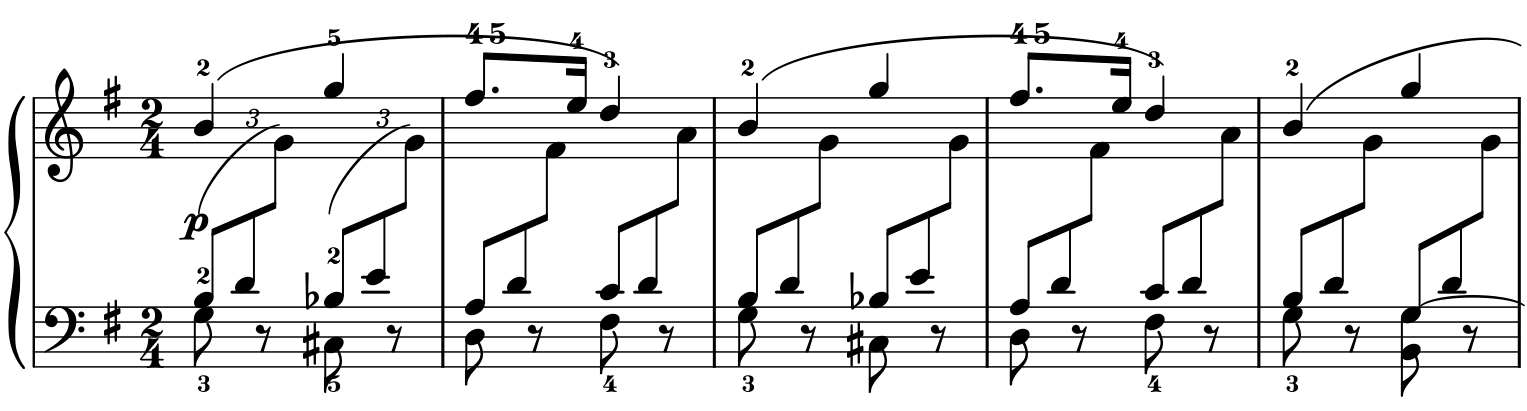
The key signature has one sharp, F-sharp, and the metre is 2/4. In bar 1, the melody moves from B4 to G5, a rising sixth. Here C4 means middle C. The two quarter notes give you a broad melodic gesture above six smaller accompaniment notes.
The first accompaniment triplet is B3–D4–G4. In the displayed edition, its first two notes are written on the lower staff and its third on the upper staff. The left hand begins the figure and the right hand completes it beneath the melody. The bass G3 sounds at the beginning of the beat as a separate voice.
Play that triplet on its own, using the hand distribution you intend for the piece. Listen for an even, quiet continuation into the right hand. Its final note should not announce that the hand has changed. Then add the melody B and sustain it while the accompaniment passes underneath.
On the second beat, the melody reaches the higher G, but the harmony also changes: the bass becomes C-sharp and the accompaniment contains B-flat, E and G. That brief change of colour is part of the opening’s interest. Listen to it before deciding how strongly to play the melodic arrival.
Singing above the accompaniment
Try the melody alone for the first eight bars. Follow the rise from B to G, the falling F-sharp–E–D, and the later phrase that turns towards C. Decide how the long notes lead into the shorter ones. A melody practised without its accompaniment should still have direction and a convincing pulse.
Next, play the melody with the bass, leaving out the triplets. This gives the phrase a harmonic foundation without the constant inner movement. When you restore the triplets, keep listening to the same outer voices. The accompaniment fills the space between them.
If the tune disappears, first make the supporting notes quieter. Simply playing the melody harder can produce a heavy sound and a stiff hand. Practise one beat, then two: sustain the melody while the fingers playing the inner notes move and release. Let the hand adjust its position as the notes require instead of holding every finger at one height.
The larger sixth at the opening deserves particular care. Prepare the high G while the B is still sounding, so that the leap feels like part of the song. A small amount of movement can help you arrive comfortably; reaching early with a rigid hand often makes the accompaniment louder.
The guide to voicing piano chords explores the related problem of giving different notes different weights. Here, that balance has to survive while the inner part keeps moving.
Dotted rhythm against triplets
In bar 2, the melody begins with a dotted eighth-note F-sharp, followed by a sixteenth-note E. Underneath, the accompaniment divides the beat into three equal parts. These two written rhythms do not place every note at the same moment.
Read literally, the third accompaniment note arrives two-thirds of the way through the beat. The short melodic E arrives three-quarters of the way through it, slightly later. Both lines then reach the next beat together.
Bar 2, beat one: the written rhythm
The width represents one beat. Accompaniment is above; melody is below.
With twelve equal subdivisions, the triplet starts at 0, 4 and 8; the short E starts at 9. This shows the relationship of the written note values.
For a slow practice experiment, divide one beat into twelve equal spaces. The triplet entries fall at 0, 4 and 8; the short melody note falls at 9. Tap the two rhythms before returning to the keys. Once you hear the relationship, let the counting recede so that the phrase keeps its natural flow.
There is an interpretive history here. Henle’s commentary notes that a later autograph aligns some of these noteheads, while the first edition places the sixteenths after the last triplet note; scholars and performers have debated the execution. The diagram explains the written values. Distinguish a deliberate rhythmic choice from an accidental habit of pulling the short note onto the triplet.
The first ending: bars 6–8
Scroll sideways to read the score.
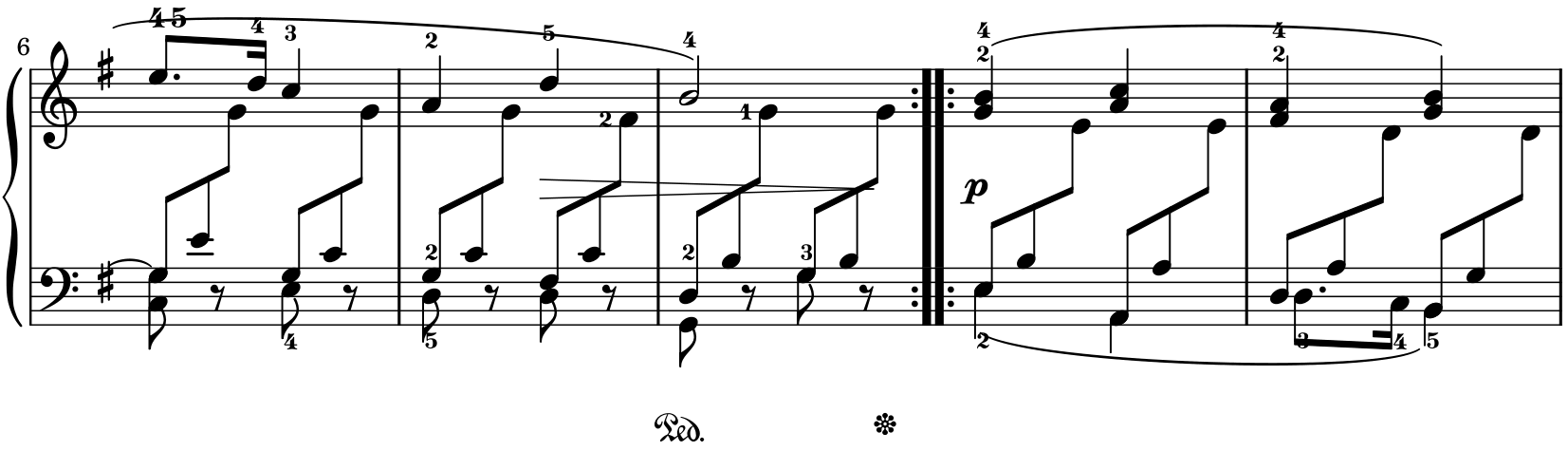
In bars 5–6, an inner G in the left hand is tied across the bar line. Keep hearing that held note while the bass and triplets change around it. If you release the whole left hand every time a new figure begins, this quieter connection disappears.
The melody in bars 6–8 moves through E–D–C, then A–D, and settles on a half-note B. The written diminuendo helps the phrase withdraw towards its close. Avoid making the final accompaniment note louder simply because the melody has stopped moving.
Bar 8 closes the first section and carries a repeat sign. Give the final B its full musical space, then recover the opening pulse for the return. An increasingly long pause before every repeat can make the piece sound more hesitant than its gentle character requires.
A complete recording
Alfred Cortot plays the complete first piece from Kinderszenen in this Warner Classics recording. Listen once for the melody as a continuous line. Then return to the opening and follow the accompaniment across the hands, noticing how often its notes fall between the melody’s entries.
Alfred Cortot: Of Foreign Lands and People
Warner Classics. Listen on YouTube.
For another listening, follow the bass after the repeated opening section. It becomes more active in the contrasting passage. Keep that change in mind when practising: the work contains more than a tune with an unchanging background.
The contrasting section: bars 9–14
The melody changes character at bar 9. It now begins with pairs of notes in the right hand, while the bass moves in a more sustained, shaped line. Keep the upper note of each pair audible without making the lower note disappear. Those lower notes supply warmth and harmony.
Scroll sideways to read the score.
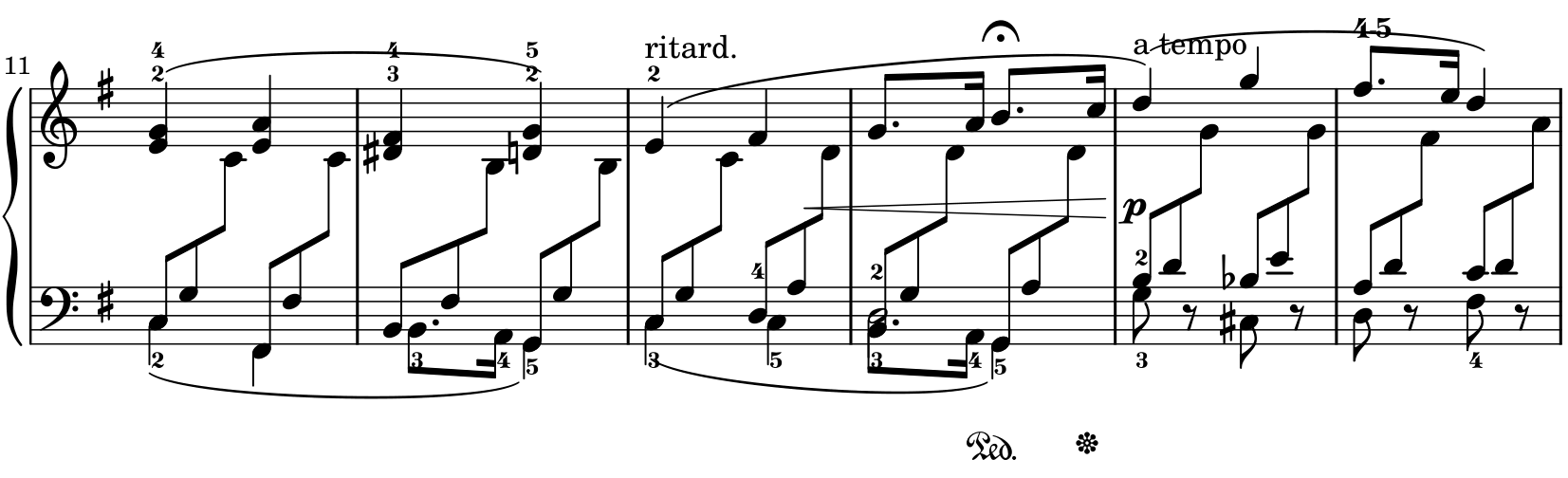
Try playing just the right-hand pairs in bars 9–12. Listen to the upper line B–C, A–B, G–A, F-sharp–G. Then add the bass without the triplets. The conversation between the outer voices becomes clearer when the continuous inner motion is temporarily removed.
The bass has its own dotted rhythms in bars 10 and 12. Practise those as a phrase, then combine them with the triplets. This is another place where reading by musical role helps: “left-hand practice” alone still contains both bass and accompaniment, which may be the very relationship you are trying to hear.
At bar 13, the melody begins to climb from E through F-sharp. In bar 14 it continues G–A–B–C, leading into D at the start of bar 15. Hear this ascent as a route towards the returning music. The written ritardando and the fermata over B in bar 14 invite space, while the short C still leads onwards.
Try the transition with very little slowing first. Establish where the phrase is going, then add the amount of time that lets it breathe. If the pause becomes a complete loss of motion, the returning theme can sound like a new piece rather than the continuation of this one.
The return and final phrase
Bar 15 marks a tempo. The familiar accompaniment returns, and the melody starts D–G, rather than the opening B–G. That first note grows out of the preceding ascent. Listen through the join instead of treating the return as a reset button.
Scroll sideways to read the score.
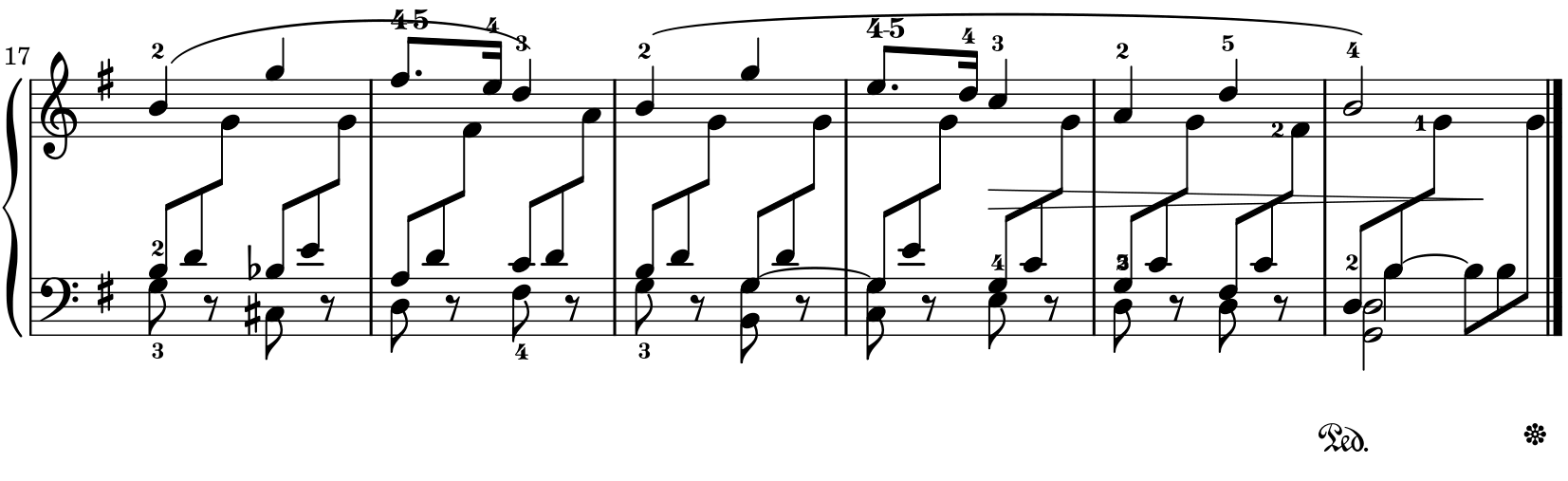
Bars 17–22 revisit the familiar material and bring it to its final close. The held inner G returns across bars 19–20. In bars 20–22, the melody turns through E–D–C, A–D and the last B, while the diminuendo withdraws the sound.
Compare bar 8 with bar 22. The melody reaches the same B, but the final bar has a more sustained low foundation: G and D are written as half notes. The inner accompaniment still moves. Let the final harmony support that movement without introducing a fresh accent at the end.
Practise the last four bars from a comfortable, unhurried tempo. Keep the melody present as the sound diminishes; quiet playing loses its shape when all the layers simply become equally faint. Listen through the last accompaniment note and the eventual release of the resonance.
Pedal and the changing bass
The pedal can support the singing sound, but it can also conceal a lost inner tie or a blurred change of harmony. Begin with the finger-held notes you can sustain comfortably, then add pedal while listening to what remains from the preceding beat.
Bar 1 is a useful test. Its harmony changes on the second beat, with C-sharp in the bass and B-flat in the accompaniment. Holding one full pedal through the bar blends that change with the opening G-major sound. Compare a clear change of pedal at the new harmony, listening for continuity without the old bass lingering prominently.
The lower notes in the contrasting passage can make a small room sound fuller very quickly. Use the bass as a guide to what needs clearing, and listen to the upper line while the foot moves. The exact depth and frequency of changes depend on the instrument and the sound you choose; the score’s pedal signs do not replace that listening.
The guide to Romantic rubato considers timing across a phrase. In this piece, a supple melody still needs an accompaniment whose pulse you can feel. Practise the relationship clearly before adding more freedom.
Working on Schumann in a lesson
A useful lesson might begin with just the first two bars: whether the melody sustains, how the triplets pass between the hands, and where the harmony changes. Those details recur throughout the piece, but the middle section and ending then ask us to adapt them to a different musical purpose.