
Satie’s Gymnopédie No.1: Quiet Balance, Bass Leaps and an Unhurried Pulse
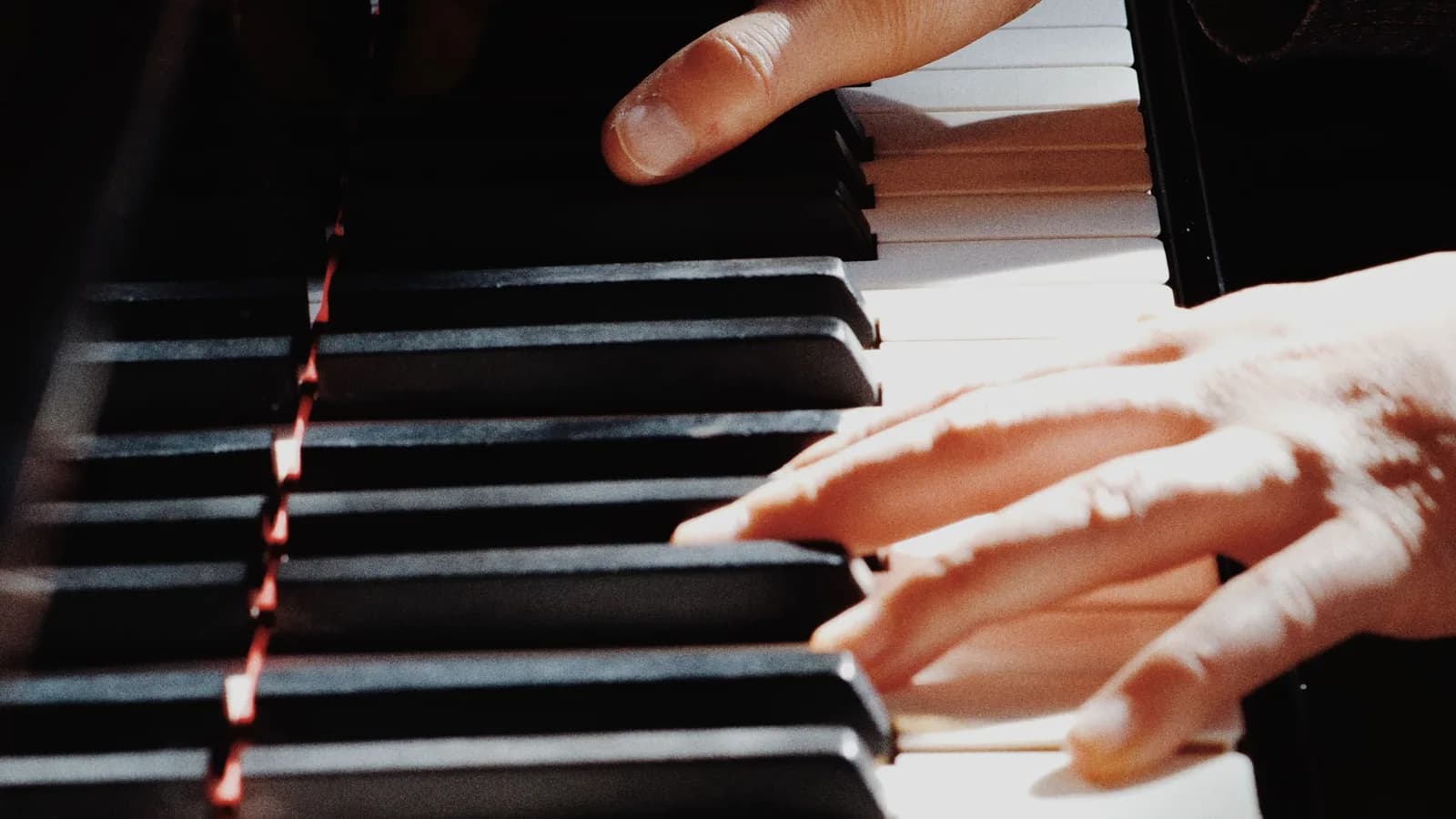
Satie’s Gymnopédie No.1 sounds spacious because so little happens at once. A low bass note, a chord above it, a melody that seems to arrive without effort. Playing it reveals how much that spaciousness depends on timing and balance. A late chord makes the bar hesitate; a heavy chord covers the tune; a pedal change can either renew the harmony or remove the sound that holds it together.
The piece is a useful project for a returning or intermediate pianist who wants to develop quiet control. Its slow pace gives you time to move, but also exposes the shape of each movement and every new attack. The aim is to let the listener hear a continuous musical thought through all that space.
One bar, two accompaniment attacks
- 1Bass sounds
- 2Chord joins
- 3Sound continues
- The left hand travels
- Pedal carries the bass while the hand moves to the chord.
- The melody has its own line
- Its first entrance is on beat two of bar 5. Later held notes continue across several bars.
- The harmony changes
- The familiar rhythm supports new colours, and the two endings resolve differently.
The bass and chord pattern
The opening is in 3/4. The bass sounds on beat one, and the chord enters on beat two, lasting through beat three. There is no new accompaniment attack on the third beat. That distinction matters: an imagined “oom-pah-pah” pattern can make you shorten the chord or add a physical accent where Satie has written a continuing sound.
The first four bars establish the accompaniment before the melody enters. The bass alternates G and D. Above G, the chord contains B, D and F♯; above D, it contains A, C♯ and F♯. Taken together, bass and chord give G major seventh and D major seventh harmonies. The shared F♯ is part of their distinctive colour.
3/4, with F♯ and C♯ in the key signature. Treble clef above, bass clef below.
Scroll sideways to read the score.
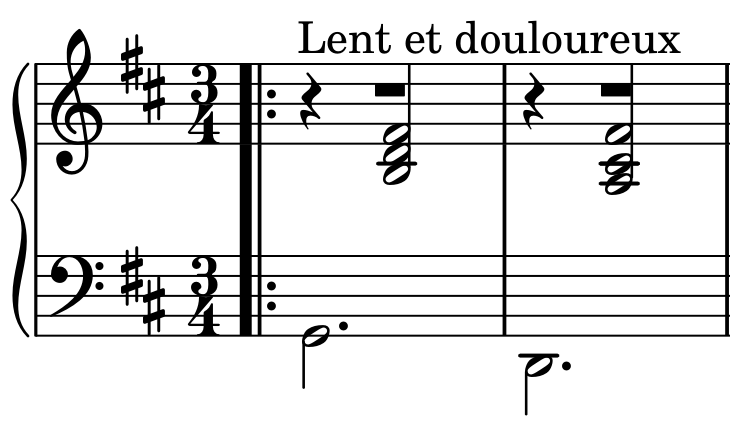
The left hand plays the low bass and the chord printed above it. The chord lasts through beat three.
Although the upper chords are printed in the treble staff, they belong to the left-hand accompaniment. The staff shows pitch and musical organisation; it does not assign every note on it to the right hand. Following the accompaniment across both staves also prepares you for its later move into the bass staff.
Learn the two chords as shapes before adding the bass notes. Play each at a comfortable, quiet level, hearing all its notes arrive together. Then practise the journey from the bass G to the first chord, and from bass D to the second. The two journeys differ. Memorising “jump upwards” leaves out the particular destination your hand needs.
Moving to the chord
A reliable leap begins with knowing where to land. Place the left hand on the chord and notice its position among the black keys. Move down to the bass, sound it, then return to that same chord shape. During an early comparison, you can arrive on the chord keys silently before playing them. This separates finding the keys from producing the sound.
Once the destination is clear, put the movement back into the bar. There is one quarter-note beat between bass and chord, followed by two beats before the next bass. Use that unequal amount of time. Waiting over the low note until almost beat two creates a hurried last-moment leap, even in a slow piece.
Pedal supports the low bass while the hand leaves it. Trying to hold the written dotted half note entirely with the finger would prevent the same hand from reaching the upper chord. Sound the bass, catch its resonance with the pedal, and let the hand travel. The arm carries the hand towards its next position; the fingers prepare the chord they are about to play.
I listen for the arrival as much as the accuracy. A chord can land on all the right keys and still sound startled, as if the hand has narrowly caught a departing train. A quieter, coordinated arrival usually begins with a clearer destination and an earlier movement. Repeating the same rushed jump more forcefully tends to preserve the problem.
Keep enough contact and control to sound the whole chord. Hovering high above it and then dropping suddenly makes a soft arrival difficult to judge. Test a smaller, more direct journey, then listen to whether the bass and chord still belong to the same pulse.

One-to-one classical piano
In person in Ikebukuro or Shinjuku, Tokyo. Online worldwide.
Enea
Concert pianist from Vienna
Pre-launch · Applications open
Beat three and the slow pulse
The opening instruction, Lent et douloureux, asks for a slow, sorrowful character. A slow pulse still has a direction. The space after the chord on beat two must carry you towards the next bass, rather than becoming a pause of uncertain length.
Try counting three even quarter-note beats through four bars of accompaniment. Listen especially to the distance from the chord to the next bass: it is twice the distance from bass to chord. If that longer space contracts, the music starts to limp. If it expands every time, each bar becomes an isolated event.
A metronome can reveal this without becoming the whole interpretation. Use a quiet click on each quarter note for a short passage, then turn it off and keep the same relationship between the three beats. Later, the phrase may breathe, but the hands should not need extra time simply to find their notes.
Choose a tempo at which the melody can remain in your ear through its long notes. An extremely slow tempo can make those notes decay before the phrase feels complete. A faster one may conceal uncertain landings while losing the piece’s weight and stillness. The useful tempo lets both the movement and the listening continue.
The melody enters on beat two
The first melody note comes in bar 5, on the second beat: F♯, then A on beat three. The bass has already begun the bar. Starting the melody as though it were a new downbeat displaces its relationship with the accompaniment.
3/4, two sharps. Treble clef above, bass clef below. Upward stems trace the melody; the lower chord notes belong to the accompaniment.
Scroll sideways to read the score.
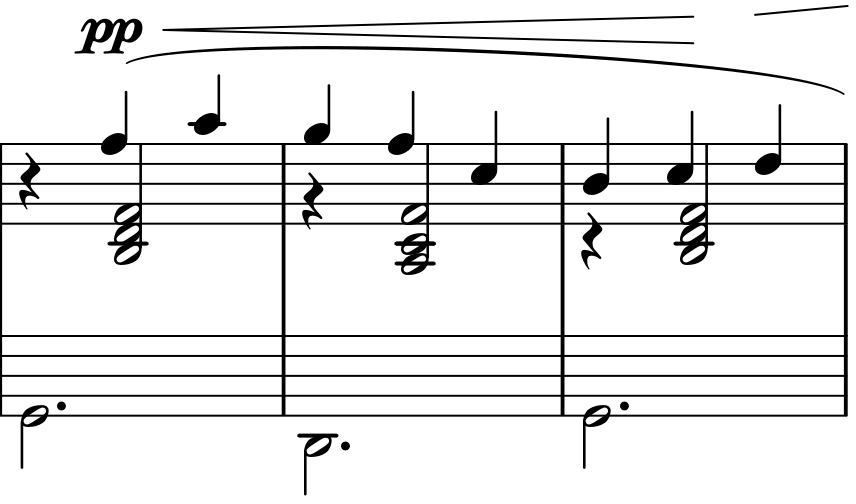
Hear the rest before the first F♯. The melody joins a bar that has already begun.
Play the melody alone from bar 5 through its descent and arrival on the long F♯ in bar 9. Count the initial rest as part of the phrase. Hear the line rising from F♯ to A, then moving through G, F♯ and C♯ before its lower continuation. Its longer shape matters more than giving every note a separate expressive swell.
Next, add only the bass notes. This reveals the space between the line and its harmonic support. When you restore the chords, keep the same melodic direction. In bar 5, the first melody note and the accompaniment chord sound together, but they have different jobs. The melody needs a clear beginning; the chord needs to provide colour without taking over that beginning.
A useful balance check is to play the chord alone, then the melody note alone, then both together. Listen to the combined result at the same distance from the instrument. It is easy to judge the right hand as sufficiently clear when hearing it alone, then miss how much the complete chord masks it.
For a broader approach to this problem, see bringing out a melody within piano chords. In Satie, the balance must also survive after the initial attack, while the melody decays and the accompaniment continues.
The long F♯ and the shared key
Bars 9–12 contain a detail that makes “hold the melody and keep everything else quiet” an incomplete instruction. The melody’s F♯ is tied across all four bars. That same F♯ is also the top note of the accompaniment chords that return on beat two.
3/4, two sharps. Treble clef above, bass clef below. The melody's F♯ is tied across the four bars; the accompaniment also contains that same F♯.
Scroll sideways to read the score.
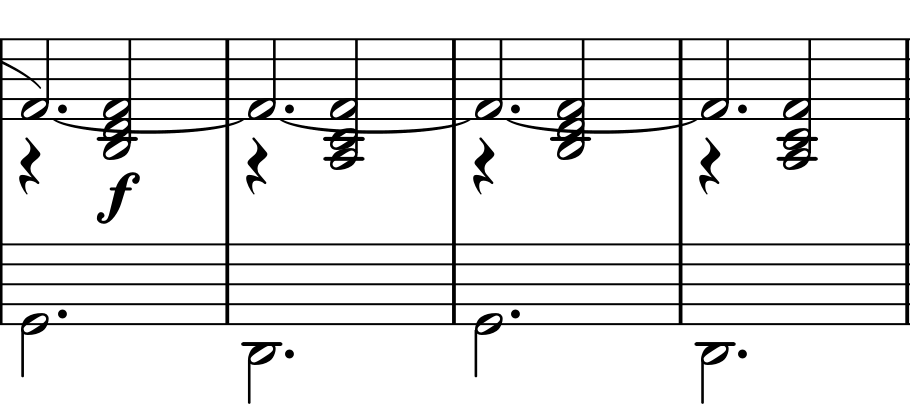
The shared key must be released to sound again. Practise its rearticulation as part of the chord while keeping the longer melodic line in your ear.
The piano has one key for that pitch. You cannot keep it fully depressed with one finger while another finger repeatedly sounds it as part of the accompaniment. The notation gives two musical roles to a shared pitch, and the playing has to make their relationship convincing.
First, hear the long melodic line without the doubled F♯ in the accompaniment. For this practice reduction, play the melody and the remaining chord notes. Listen through the four bars to understand the continuity Satie’s tie describes. Then restore the complete chords and work on a quiet rearticulation of the shared key, so that it belongs to the chord without sounding like a new, accented melody note each time.
The practical fingering and transfer between the hands need to be tested on the passage itself. The sound is the criterion: a chain of prominent F♯ attacks will change the phrase; an indistinct accompaniment will remove its harmonic motion. A teacher can help find a distribution and release that preserves both.
The passage also carries a forte marking, followed by pianissimo when the melody returns at bar 13. The piece has a wider dynamic range than its familiar quiet atmosphere sometimes suggests. Let the fuller sound have depth and harmonic presence, then hear the change at bar 13. The bass and chord should still arrive together in their intended places, with no hard accent caused by the leap.
Pedal that carries the bass
The opening accompaniment needs resonance between notes that the left hand cannot physically join. Begin by hearing one complete bass-and-chord harmony. Then listen to how much of it remains when the next bass arrives.
A useful first experiment is a pedal renewal with each new bar: sound the new bass, lift enough to clear the previous harmony, then lower the pedal again before leaving the bass key. The new bass should continue while the hand moves to the chord. If it vanishes during that movement, the pedal has not caught it; if the old bass remains prominently underneath, the change has not cleared enough sound.
This is an experiment to refine by ear, rather than a rule that every bar requires the same depth. A resonant grand can retain much more sound than a small upright. Listen for the particular mixture of pitches, not merely whether the result seems pleasantly blurred.
Beat two normally adds notes to the harmony established by the bass. Automatically clearing the pedal again at that point can remove the bass just as the chord arrives. Compare the result with carrying the bass beneath the chord. You should hear one supported harmony, with its low foundation still present.
Where a melody note continues across a pedal change, keep it with the finger when the writing allows. The shared F♯ passage needs the more particular solution above. Pedal and finger duration work together, but the score determines what each has to sustain. The sustain-pedal guide offers simpler comparisons for hearing a clean change without a gap.
Changing harmony under the held E
The accompaniment begins to move away from the opening alternation before bar 19. Listen to the bass changes in bars 17–18, then to the E that supports the next phrase. These changes deserve attention even though the rhythm remains familiar.
In bars 19–21, the melody holds E while the accompaniment changes underneath and around it. The chords are now printed in the bass staff. In bar 20, the accompaniment even reaches above the held melody note. The voice you are following is not automatically the highest key sounding at that moment.
3/4, two sharps, with a written F natural in bar 21. Treble clef above, bass clef below. The accompaniment chords are now written in the lower staff.
Scroll sideways to read the score.
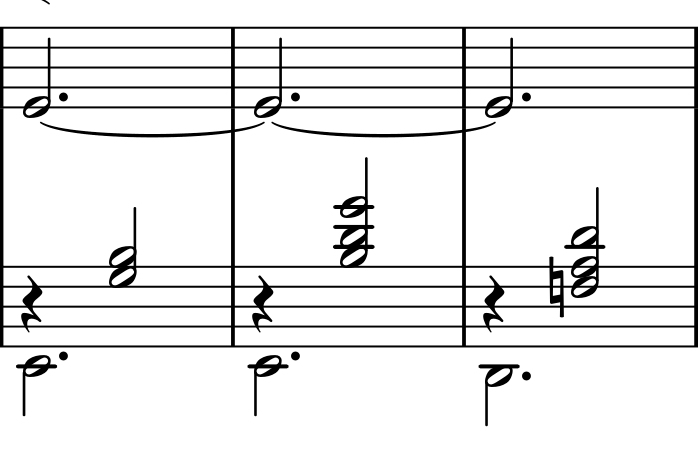
Keep the melodic E while listening to the new bass and chord. A held note can change its meaning without a new attack.
Play the held E with each harmony in turn. Hear the difference between the first E-minor colour, the added notes of the next chord, and the D bass with F natural in bar 21. The melody has stayed, but its relationship to the harmony has changed. That is an expressive event without a new melody attack.
This passage is particularly useful for pedal work. At bar 21, preserve the melody E with the finger while the new D bass and altered chord become clear. A pedal that simply accumulates the preceding sounds weakens the change. A pedal lifted before the finger has secured E can break the line.
From bar 22, the melody moves again: A–B–C natural, then a continuation that rises and falls over a bass pattern increasingly centred on D. The natural signs matter. Keeping the opening two-sharp signature vaguely in mind while overlooking the accidentals changes the colour of the whole section.
The two endings
Much of the music returns, but its two endings lead to different final harmonies. The score shown here uses a repeat with first and second endings; other editions write both spans out in full. In that full layout, the first span ends at bar 39 and the complete piece ends at bar 78.
The later version changes the melodic route as well as the closing chord. Compare the two endings before learning the whole return by habit. In the first, a high G moves to F♯; in the second, it moves to F natural. The accompaniment and later melody also change. That lowered note introduces a different colour well before the final chord.
The two closing pairs of chords
Treble clef above, bass clef below; 3/4 and a two-sharp key signature. In an edition that writes both spans in full, these are bars 38–39 and 77–78.
Scroll sideways to read the score.
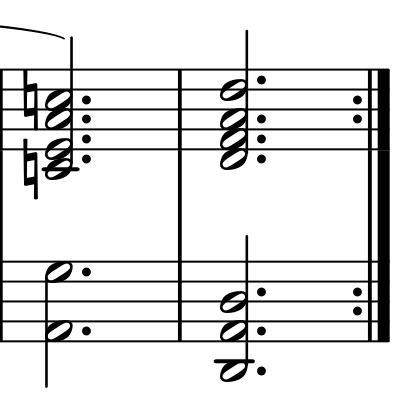
The final chord contains F♯. The music then returns to its opening.
Scroll sideways to read the score.
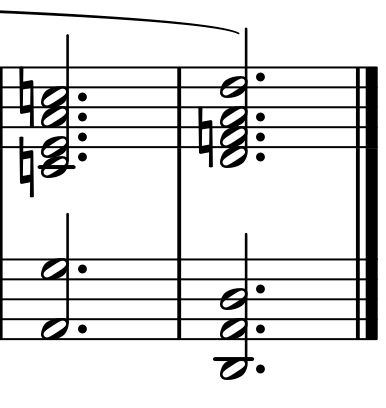
F♮ changes the last chord's colour. Listen through the whole phrase to its release.
Both endings approach their last chord through a harmony containing C natural, E and A, with G also sounding. The first then settles on D major, with F♯. The final ending settles on D minor, with F natural. Play those two closing pairs side by side and listen to how differently they resolve.
At this point the familiar bass-on-one, chord-on-two pattern has given way to full-bar chords. Let their written length register. Treating the last two chords as just another pair of accompaniment jumps misses the change in texture and the weight of the ending.
The final sound needs time, but decide its release by listening to the complete phrase and the room’s resonance. A long pedal hold added automatically after every performance can become disconnected from what preceded it. Hear the D-minor colour, allow its decay, and finish the sound deliberately.
Learning the whole piece
For a first reading, learn several short landmarks: the opening accompaniment, the melody’s entrance at bar 5, the shared F♯ in bars 9–12, the held E in bars 19–21 and the two endings. Together they show the main kinds of listening and coordination the piece asks for.
Once those are familiar, join them into longer spans. Include the bar before a difficult passage and the bar after it. The first bass note of a passage may be easy to locate in isolation but feel different when reached from the previous chord. The same is true of returning from the first ending to the opening accompaniment.
A short recording can answer a musical question that is difficult to hear while watching a leap. Listen once for the melody’s continuity, and another time for the spacing between bass and chord. If the tune disappears, locate the accompaniment attack that covered it. If the pulse hesitates, find whether the delay happens before the chord or before the next bass. That tells you which movement to revisit.
For someone returning after a long break, the first goal might be a convincing opening phrase and reliable pedal changes. For an intermediate pianist, the greater challenge may be the long melodic notes, the dynamic contrasts and the different colour of the return. The work can deepen as the hands become more familiar with it.
Working on Satie in lessons
I would use a passage of Gymnopédie No.1 to listen to the relationship between movement and sound: where the left hand begins its journey, how the chord arrives, and whether the melody keeps its place in the texture. A small change in timing or balance can be heard immediately when we return to the whole phrase.
Vienna Piano School is accepting applications for piano lessons in English, online worldwide and in person at piano studios in Ikebukuro and Shinjuku, Tokyo. You can apply for a free 55-minute trial lesson to work on Satie, another piece you are learning, or a suitable return to the piano. The school is preparing to open; start dates and trial arrangements are confirmed by email.