
Piano Staccato: How to Read Dots, Slurs and Musical Context
A staccato dot tells a pianist to articulate a note separately. It does not, by itself, tell you exactly how long to hold the key, how loud to play, or how high to lift your hand. Those decisions come from the rhythm, the surrounding notes and the character of the phrase.
This is why a neat row of identical, very short notes can still sound wrong. A quiet accompaniment, a witty Mozart ending and a broad, singing passage may all contain dots, yet each needs a different kind of separation. The useful question is: what should the listener hear between this note and the next?
- Dots alone: hear the release and the space between notes, while keeping the written rhythm.
- Dots beneath a slur: give the notes individual articulation within a shared gesture, often called portato.
- A dot at the end of a slur: consider the release of that group; it does not make every preceding note staccato.
- A dot beside a notehead: this changes the written duration. It is an augmentation dot, not an articulation mark.
How short is staccato?
“Half its written value” can serve as a first classroom demonstration. It is a poor universal rule for performance. At a slow tempo, half of a long note may leave a conspicuous hole; at a fast tempo, a tiny release may already make the line sound distinctly detached. The register and the instrument also affect how much separation reaches the ear.
Keep two decisions separate: when the note begins, and when it ends. Four staccato quarter notes still begin on four successive quarter-note beats. If you release each note early, the remaining time belongs to the space before the next beat. Bringing the next attack forward changes the rhythm rather than improving the articulation.
Try four comfortable notes in the middle register, one on each beat, without pedal. First let each note approach the next. Then leave a small gap, and finally a wide one. Keep the tempo and volume as steady as you can. The contrast should come mainly from the releases. The graphic below shows that distinction without assigning one length to the printed dot.
Change the release, keep the beat
Compare four quarter notes. The coloured bars show how long each key is held, with the sustain pedal raised.
Small gaps: every note still starts on beats 1, 2, 3 and 4.
These are comparison examples, not prescribed lengths for staccato.
After this comparison, return to a phrase from your piece. Choose the version that makes its movement intelligible. A springy dance might need clear air between notes; a slower, weighted gesture might lose its shape if every sound disappears almost immediately. I listen especially to the space after the note. It often reveals more about the articulation than the finger movement does.
Dots, slurs and portato
A slur gives notes a relationship. In a simple piano melody it commonly asks for a connected group, but its musical effect includes direction, balance and the way the group ends. Making every note equally loud and merely holding the keys until their replacements arrive can produce mechanical legato.
When several notes carry dots beneath one slur, both signs matter. The notes retain their individual identity, while the phrase continues across them. Portato is a useful name for this combination. Try a gentle, deliberate renewal of each note within one line, rather than four isolated jabs. Depending on the music, the audible gaps can be very small.
The placement of the dots is crucial. A two-note slur with a dot on its final note may indicate a light release of that pair. It is different notation from four notes that each have a dot beneath a longer slur. Look along the whole group before deciding how to play the first note.
Also distinguish a slur from a tie. A tie joins two written notes of the same pitch into one sustained duration; the second note is not struck again. Dots under a slur over repeated notes call for renewed attacks. Reading the curve together with the noteheads, rhythm and articulation marks prevents this small-looking difference from changing the phrase entirely.
Mozart: connected pairs and detached notes
In the first movement of Mozart’s Sonata in C major, K.545, the rapid scale passage leads into a particularly useful articulation contrast. In the edition shown here, bar 11 alternates two-note slurs with pairs of individually dotted eighth notes. The following bar has detached quarter notes and a quarter rest.
Mozart K.545, first movement: bars 10–14
C major, 4/4. Find bar 11 on the right of the first system, then bar 12 at the left of the second.
Scroll sideways to read the score.
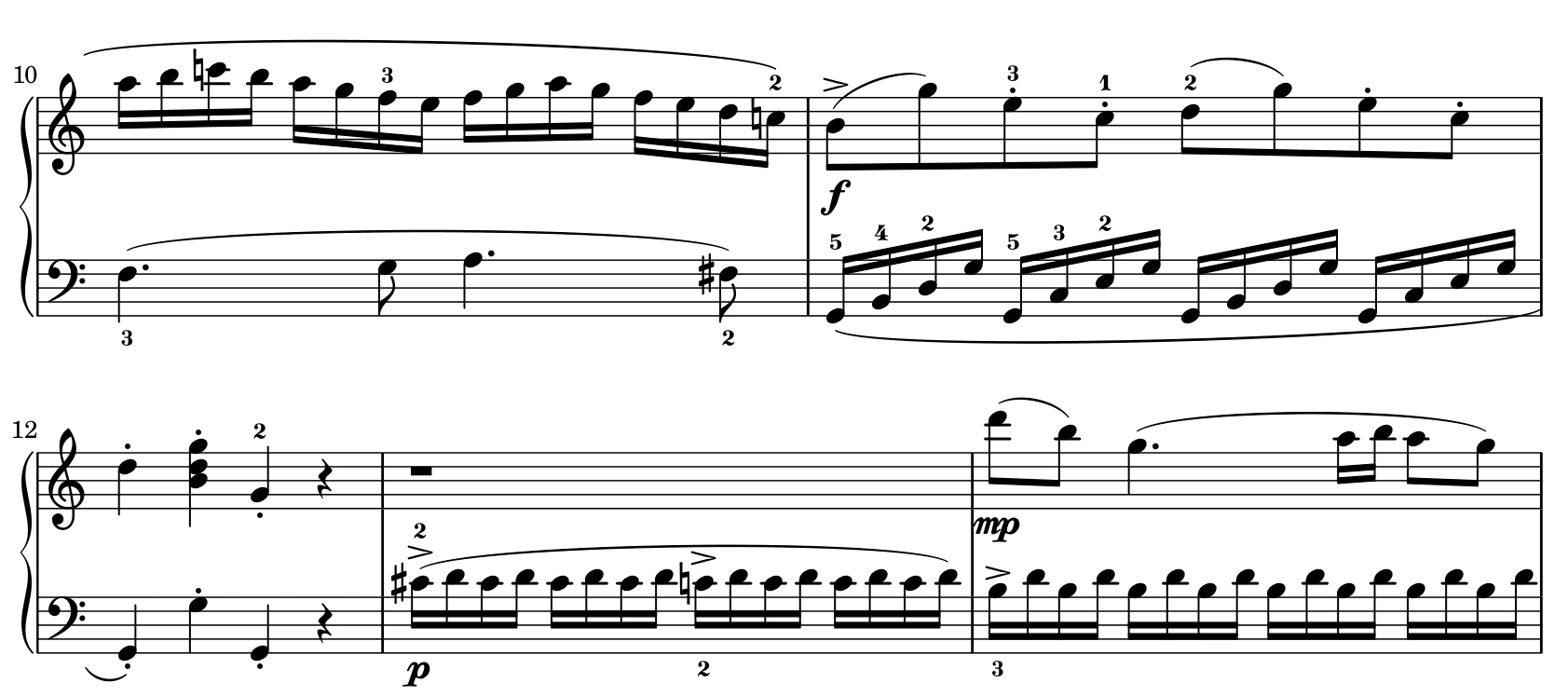
Read the right hand of bar 11 in four pairs: B–G, E–C, D–G, E–C. The first and third pairs have slurs; the second and fourth pairs have dots. The rhythm remains a continuous succession of eighth notes. What changes is the way those notes are grouped and released.
Play the right hand alone, keeping the same pulse through all four pairs. Connect B to G, then give E and C separate releases. Connect D to G, then repeat the detached E and C. Listen for the alternation. If all eight notes have the same short attack, the slurs have disappeared; if everything merges into one stream, the dots have disappeared.
Next restore the left hand. Its moving accompaniment continues underneath the right-hand releases, so the texture can sound fluent even when the melody is clearly articulated. Trying to create complete silence between every right-hand note would miss that relationship. The space belongs to one voice within the texture.
Bar 12 changes the scale of the gesture. Its quarter notes occupy larger rhythmic units, followed by a written rest. Let those attacks stand on their beats, and keep counting through the final rest before the left-hand passage begins. A hurried last note followed by a vague pause weakens the arrival that the preceding scales have prepared.
For listening, use Walter Gieseking’s recording of the first movement. Follow the score from the scale passage into bars 11–12 and listen for the relationship between the right-hand grouping and the accompaniment. Then replay your own two bars. The question is whether the change of articulation is audible within the phrase, rather than whether each note matches a measured fraction of Gieseking’s recording.
Grieg: four chords beneath one slur
Grieg’s Watchman’s Song, Op.12 No.3, offers a different setting. Its opening is marked Molto Andante e semplice. In bar 3, counting after the upbeat, four quarter-note chords carry dots beneath a slur in each hand. The notation asks you to consider the four chords as a group while articulating each one.
Grieg, Watchman’s Song, Op.12 No.3: opening
Counting the first complete bar as bar 1, bar 3 contains the four chords. Notice the dots and the shared slur together.
Scroll sideways to read the score.
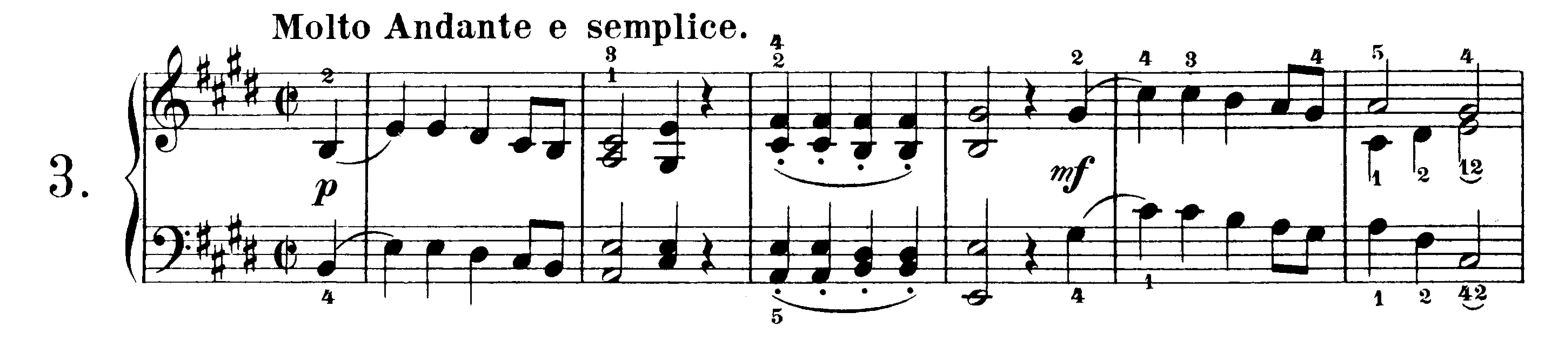
Begin with the top notes of those chords, keeping the line calm and listening through to the longer note in the following bar. Then add the remaining chord tones without losing that continuity. The chord changes should speak distinctly, but the succession should still feel like a single part of the melody.
Now compare two deliberately different readings. In the first, make the chords very clipped, with large gaps. In the second, give each chord more body and a modest release before the next. Listen to how the following sustained note changes meaning. Does it grow naturally from the four chords, or does it sound like the start of an unrelated sentence?
I would begin this passage with a broad, unforced articulation. The slow character and the shared slur give the chords weight and direction. That is an interpretative starting point grounded in this passage, rather than a command to use the same touch whenever a dot appears beneath a curve.
Both hands need attention. If the right hand releases while the left hand holds on, the harmony may remain almost continuous. If the lower chords are much stronger, they can turn the gentle articulation into four heavy accents. Practise the chord sequence quietly enough to hear the top line, then judge the balance with the opening melody included.
Release, touch and pedal
On an acoustic piano, releasing a key normally allows its damper to return to the strings when the sustain pedal is up. This is the practical connection between key release and a shortened sound. The highest strings have no dampers, and the room continues to resonate, so listening is more useful than expecting every release to create absolute silence.
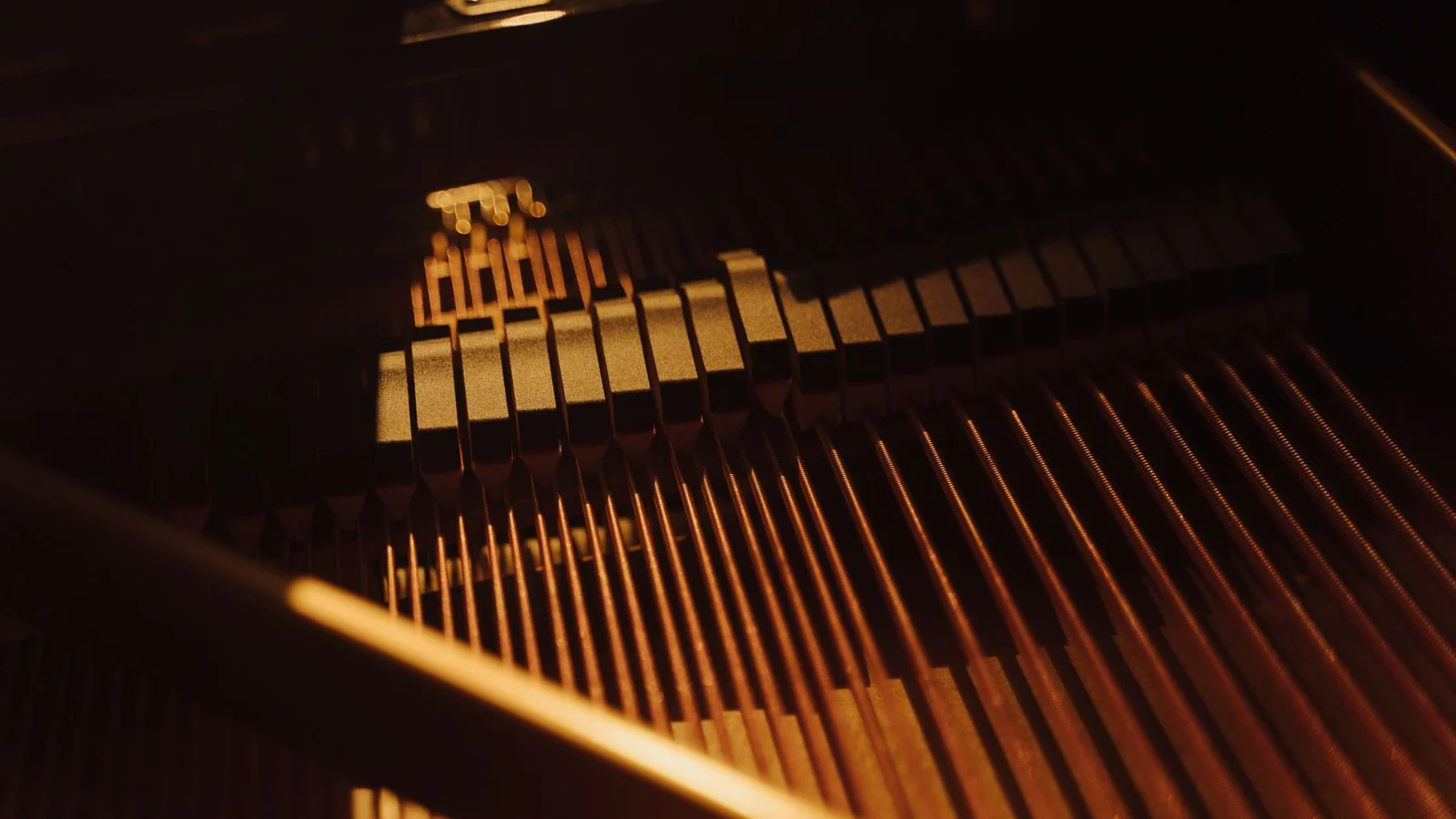
With the sustain pedal down, releasing the fingers does not stop the sustained strings in the same way. A detached touch can therefore sit inside a resonant sound. The attacks may remain individually audible while their tails overlap. This is why pedal and staccato can appear together without cancelling each other.
For a passage that sounds blurred, first try it without pedal and listen to the releases. Then bring the pedal back according to the harmony and the desired resonance. Compare the two results in the whole phrase. The guide to clear sustain pedalling develops that separate listening task.
Staccato also does not require a large upward movement. At a moderate tempo, a small, well-timed release can give ample separation. A more energetic passage may involve more movement, but lifting higher is not a reliable way to make the articulation more musical. If every short note becomes louder, reduce the attack and keep the release audible. You are practising a soft detached sound, not merely a smaller version of a loud one.
When the marks differ between editions
Some editions add slurs, dynamics, fingerings or articulation suggestions. Historical notation also contains distinctions that a modern beginner’s symbol chart cannot fully explain. A dot and a wedge, for example, should prompt a closer look at the edition and the particular work, especially if the distinction seems inconsistent.
Start with the preface or editorial comments, and compare the corresponding passage elsewhere in the movement. In a repeated theme, a changed articulation may be meaningful; it may also reflect a difference in the surviving sources or editorial decisions. Follow the evidence before turning a single printed sign into a rule about a composer’s entire style. The Urtext and piano-edition guide explains how to investigate those differences.
For the Mozart example above, the practical comparison concerns the markings in the reproduced edition. Its printed dynamics and fingerings should not all be treated as Mozart’s own instructions. The articulation exercise still has a clear purpose: hearing the difference between connected pairs and individually released notes in a flowing texture.
A phrase to take back to the piano
Choose a short passage in your current piece that mixes slurs and dots. Read it once away from the keyboard: where does each group begin, which notes actually carry dots, and what continues in the other hand? Sing or speak its rhythm before deciding on the physical gesture.
At the piano, compare two releases while keeping the attacks on the same rhythmic positions. Then play the preceding phrase and continue beyond the passage. The final choice should survive that larger context. An attractive isolated staccato means little if it interrupts the sentence or makes the next entrance late.
When you record the result, listen for three things: the written rhythm, the grouping, and the balance between the hands. A good articulation allows all three to remain audible. The dot has done its work when the music speaks with the right separation and direction.