
How to Practise with a Metronome Without Depending on Every Click
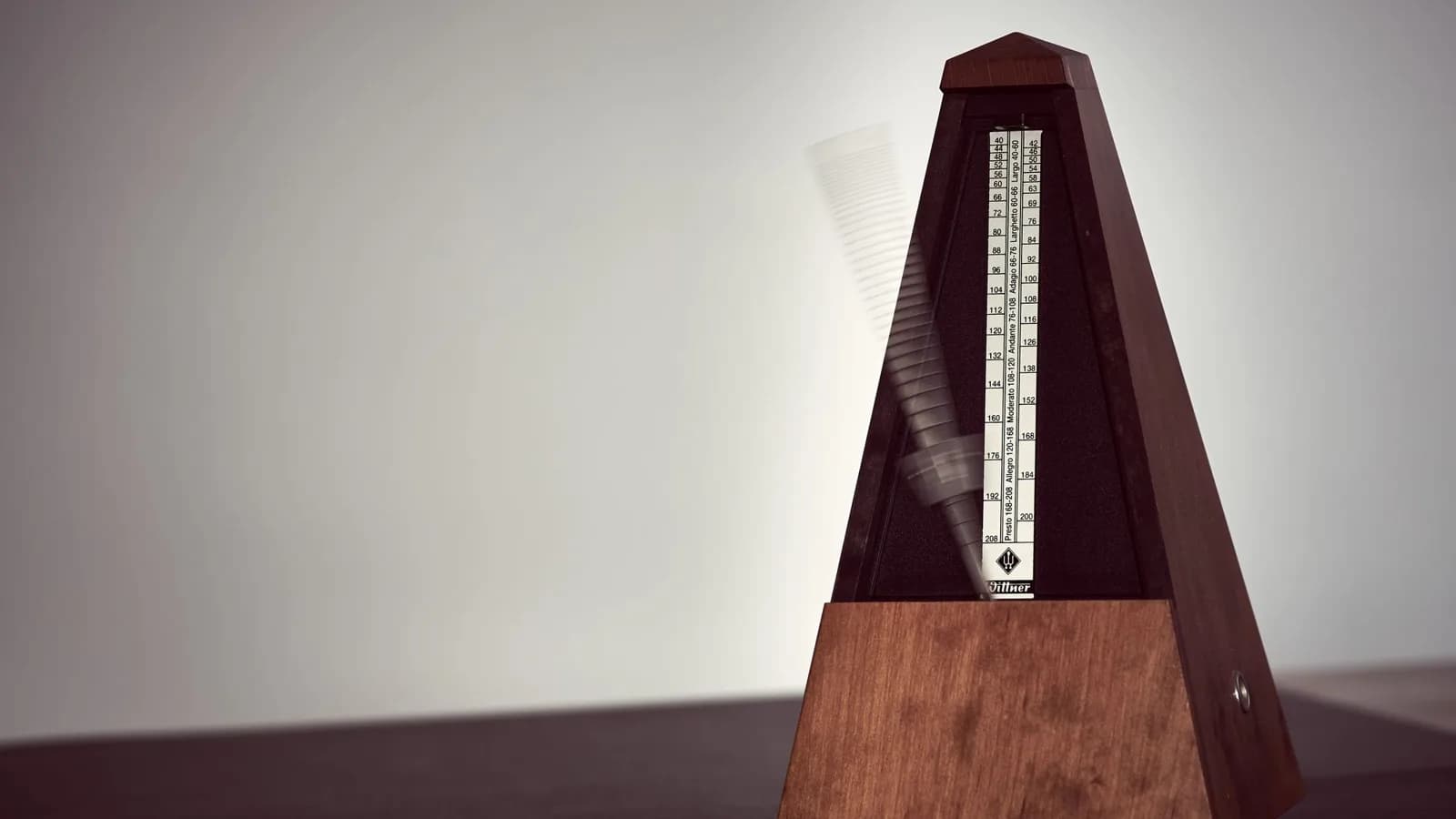
A metronome is most useful when you know what happens between its clicks. Start with a short passage that you can already play, match a clearly chosen beat, and listen for the exact place where your timing changes. Once the passage stays steady, give yourself fewer clicks while keeping the music at the same tempo. Finally, play without the device and hear whether the phrase still moves naturally.
In a lesson, I am interested in the moment just before a player gets out of time. A rushed scale, a long note that ends early and a left-hand jump that arrives late call for different work. Turning the metronome up or down tells us little until we know which event is changing the pulse.
- Decide which note value each click represents.
- Use a passage whose notes and fingering are already familiar.
- Reduce the number of clicks only while keeping the same musical speed.
- Finish by listening to the phrase without the metronome.
The beat behind the notes
The beat is the recurring pulse; the rhythm is the pattern of sounds and silences placed against it. In a straightforward 4/4 passage, you might count four quarter-note beats per bar. A melody can move twice within one beat, hold a note across several beats, or leave a beat silent. The metronome can keep marking the quarter notes through all of those changes.
Before playing, count a bar aloud with the clicks. Then speak the rhythm of your passage over that same pulse. If the spoken rhythm already shifts, begin there. If it remains clear until you add the keyboard, look at the notes, fingering or coordination that interrupts it. This small comparison prevents a reading problem from becoming a long session of trying to follow a machine.
Also check the beat unit in the music. A number on its own does not tell you whether the marking refers to a quarter note, half note or dotted quarter. In 6/8, for example, a dotted-quarter pulse groups the six eighth notes into two beats. Setting a device to tick once per eighth note gives a different level of guidance from ticking twice per bar. Choose the level deliberately and count it before you start.
A metronome accent can help identify the first beat, but its volume is not an instruction to strike that piano note harder. The musical weight of a bar comes from the harmony, melody and phrase as well as its metre. Keep the click audible enough to hear alongside your playing, without letting its sound cover the tone you are trying to produce.
Following and anticipating
If you wait to hear each click before moving, the note will arrive after it. Instead, listen to several clicks, continue that spacing internally, and let the next note meet the next click. A spoken count-in gives you time to establish the pattern before the first piano sound.
Try this with one comfortable key. Play four evenly spaced notes with four clicks, then keep the same pulse while changing to a short familiar melody. Notice whether a change of finger alters the spacing. If it does, keep the melody small and work on that transition. There is little value in adding a whole page while the same two-note connection keeps stopping the beat.
Listen for the relationship over several notes, not just a single apparent coincidence. A piano attack and a sharp click can sound like two separate events when they are slightly apart. That can be useful feedback, but the aim is a continuing pulse. Chasing every tiny discrepancy by speeding up and slowing down makes the following notes less stable.
I would rather hear a short passage finish with a clear pulse and one identifiable hesitation than hear a player make six hurried corrections to catch the device. Play to an agreed stopping point, name where the timing changed, then work on that place. The metronome has given you a location; the next step is musical practice at that location.

One-to-one classical piano
Online, worldwide. US$40 / 60 min · US$60 / 90 min.
Enea
Concert pianist from Vienna
Free 55-minute trial, online or in person · Ikebukuro & Shinjuku studios from October 2026
Two bars from Petzold
The opening of Christian Petzold's Minuet in G major, BWV Anh.114, shows why clicks and melody notes need separate jobs. In the first bar, the right hand plays D as a quarter note, then G–A–B–C as eighth notes. There are five right-hand attacks across three quarter-note beats. In the second bar, D–G–G gives one right-hand note on each beat.
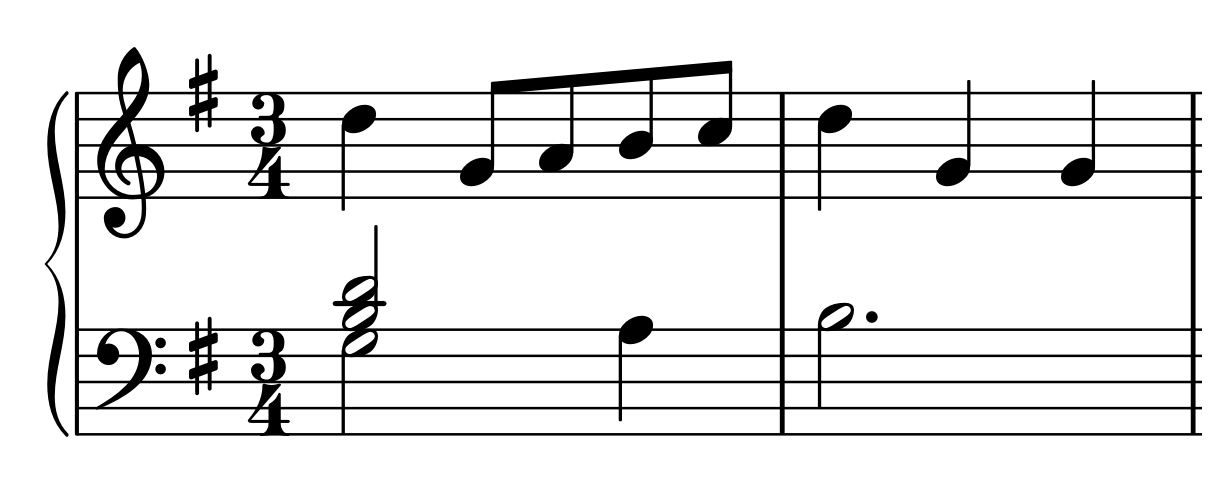
Count the first bar as “one, two-and, three-and.” The first D fills beat one. G and A share beat two; B and C share beat three. On the next D, the count returns to one. Listen for the change from eighth notes to quarter notes: the notes become less frequent, while the beat keeps its previous pace.
First play just the melody with one click per quarter-note beat. Then add the left hand, whose opening chord lasts for two beats before the A on beat three. A frequent temptation is to hurry the four rising eighth notes, then wait for the next bar. Matching the next downbeat alone would hide that unevenness. Hear the spaces within the bar as well as its beginning.
Once those two bars are comfortable, continue into the surrounding phrase in your own score. The excerpt is a place to listen closely, rather than a reason to repeat the opening indefinitely. If adding the left hand disrupts the same beat each time, work on that connection using a smaller part of the phrase; the practice-loop guide explains how to choose such a boundary.
Fewer clicks, the same tempo
Reducing clicks is useful only when you retain the pulse they previously marked. In 4/4 at quarter note = 80, setting an even click to 40 and assigning it to beats one and three leaves the piano at the same tempo. Setting it to 20 and assigning each click to beat one leaves four quarter-note beats between clicks. The display changes; the music's speed does not.
One tempo, three amounts of support
4/4 · quarter note = 80 throughout · each bar lasts 3 seconds
Every beat
80 clicks/min
- 1Click
- 2Click
- 3Click
- 4Click
Each click marks one quarter-note beat.
Beats 1 and 3
40 clicks/min
- 1Click
- 2Carry
- 3Click
- 4Carry
Carry beat 2 and beat 4 between clicks.
Once per bar
20 clicks/min
- 1Click
- 2Carry
- 3Carry
- 4Carry
Carry beats 2, 3 and 4 before the next click.
Check the transition without playing
Count “one, two, three, four” with four clicks at 80. Keep that counting speed when the device changes to 40: the clicks now meet “one” and “three.”
At 20, each click meets “one.” All four counts still fit into the same 3 seconds. If your device cannot reach 20, use the 40-click version.
Begin with the every-beat version. When the passage repeats steadily and you can hear its rhythm without waiting for the click, try one click on beats one and three. Count through the intervening beats before playing. Choose a plain, evenly spaced click or set the device's accent pattern to match the intended grouping; an unrelated accent cycle can be distracting.
A once-per-bar click asks you to carry a longer interval. Some mechanical metronomes cannot run as slowly as 20 clicks per minute. Keep the two-click version, or use a device that actually supports the lower rate. Increasing your playing speed simply to fit the metronome's lowest setting changes the exercise and may put the passage beyond your present control.
The arithmetic changes with the metre. For the minuet in 3/4, a quarter-note pulse of 90 corresponds to one click per bar at 30. Dividing 90 by two would put clicks every two beats, moving their position within successive three-beat bars. That is a different, more demanding exercise. Start with the clear one-click-per-bar relationship if you are ready to reduce support. These numbers illustrate spacing, not a prescribed performance tempo for the minuet.
Listen to the final beat before the next click. Players often shorten it when they expect the return of beat one. Continue the same spacing right across the bar line. A successful meeting with the next click should sound like the consequence of a steady bar, rather than a jump made at the last moment.
Long notes, rests and silent bars
Some timing problems emerge when there is less to play. A long note gradually fades, and a rest offers no new attack to mark the passing time. Keep hearing the pulse through that space. Counting can support it while you learn the rhythm, but listen to the sustained sound too: holding a note is part of playing the phrase.
Try a short 4/4 pattern on one key: play a quarter note on beat one, rest on beat two, then play a half note on beat three and hold it through beat four. Repeat in the next bar. With a click on every beat, there are four clicks but only two piano attacks per bar. Notice the difference between releasing for the rest and sustaining through a beat that has no new note.
After the pattern is settled, leave one complete bar silent while you continue counting, then return on the next beat one. Keep the metronome running for this first version. Your piano is silent; the click still marks the passing beats. If the return is late, check whether you lost a count or waited to hear beat one before preparing to play.
An app with a gap or mute function can later remove the clicks for a planned bar. Check how that setting counts audible and silent bars before using it. A partner can also supply the beats, fall silent for a bar and return. Use a short gap at first. The purpose is to notice whether your pulse carries through silence, not to win a contest for the longest stretch without support.
Reading the drift
Different patterns of drift suggest different questions. If the whole passage gradually moves ahead, compare the spacing of repeated figures and the length of sustained notes. If it falls behind at one leap, look at the preparation for that move. If the hands stay steady separately but lose time together, inspect what each hand does at the first point of disagreement.
Be specific about where you hear it. “I rush” describes an impression; “the last two eighth notes before the bar line become shorter” identifies something you can change. A brief recording with the clicks audible can help you locate that point. Listen once for pulse and once for the musical line, rather than trying to assess every aspect of the performance simultaneously.
Landing correctly at the end is not proof that the middle was even. A rushed group followed by a hesitation may use the same total time as a steady group. Return temporarily to a click on every beat if the wider spacing conceals that pattern. Reducing support is useful because it reveals what you carry yourself, not because a lower metronome setting is automatically more advanced practice.
If the passage is too difficult to play and listen to at once, simplify it. Take one hand, a smaller fragment or a slower musical tempo, and establish the written rhythm again. Decide separately when to restore the notes and when to reduce clicks. Changing several demands together makes it harder to hear which one was responsible for the improvement.
Pulse and musical freedom
After a short passage has become steady, switch the metronome off and play the complete phrase. Listen for its destination, the balance between voices and the way the ending releases. The phrase should retain motion even where the surface rhythm becomes sparse. A regular practice pulse gives you a reference from which to hear those choices.
I do not want a metronome exercise to erase the character of a minuet or make every cadence sound identical. Equally, calling every hesitation “expression” leaves the difficult joins untouched. Play a deliberately steady version and then a shaped version. Ask what you changed and why: perhaps a cadence has more space, while a running passage still travels cleanly towards it.
An intentional slowing at a marked ritardando will move away from an unchanged click. Practise the underlying passage first, then turn the device off to work on the transition and any return to tempo. Trying to remain attached to an unchanging beat while also performing a written tempo change creates conflicting instructions.
The useful comparison is whether the freedom sounds chosen and repeatable in its musical purpose. You might allow slightly different amounts of time in successive performances while keeping the same direction. A stumble that occurs whenever the left hand has to move is a different matter. Work on that move, then return to the expressive phrase.
Bringing the passage to a lesson
Bring a short passage and describe the setting you used: which note value the click represented, its rate, and where the timing changed. “Quarter notes at 72, late at the left-hand leap in bar four” gives a teacher something to hear immediately. A short recording can also preserve what happened when you practised alone.
For an online lesson, the teacher can listen to your piano and metronome through your microphone; we should not try to play together across the call as though there were no transmission delay. Once the timing question is clear, the device can go off while we examine the movement, rhythm or phrase behind it. The online lesson guide explains how this listening and feedback works.
Vienna Piano School teaches junior-high-school age learners and adults online, and in piano studios in Ikebukuro and Shinjuku, Tokyo, from October 2026. Online lessons are US$40 for 60 minutes or US$60 for 90 minutes; in-person lessons are US$40 for 55 minutes, including the studio. The first trial is free and lasts 55 minutes. Use the trial application to tell me which piece loses its pulse and where. A parent or guardian should contact us for learners under 18.