
What Actually Happens in an Online Classical Piano Lesson?
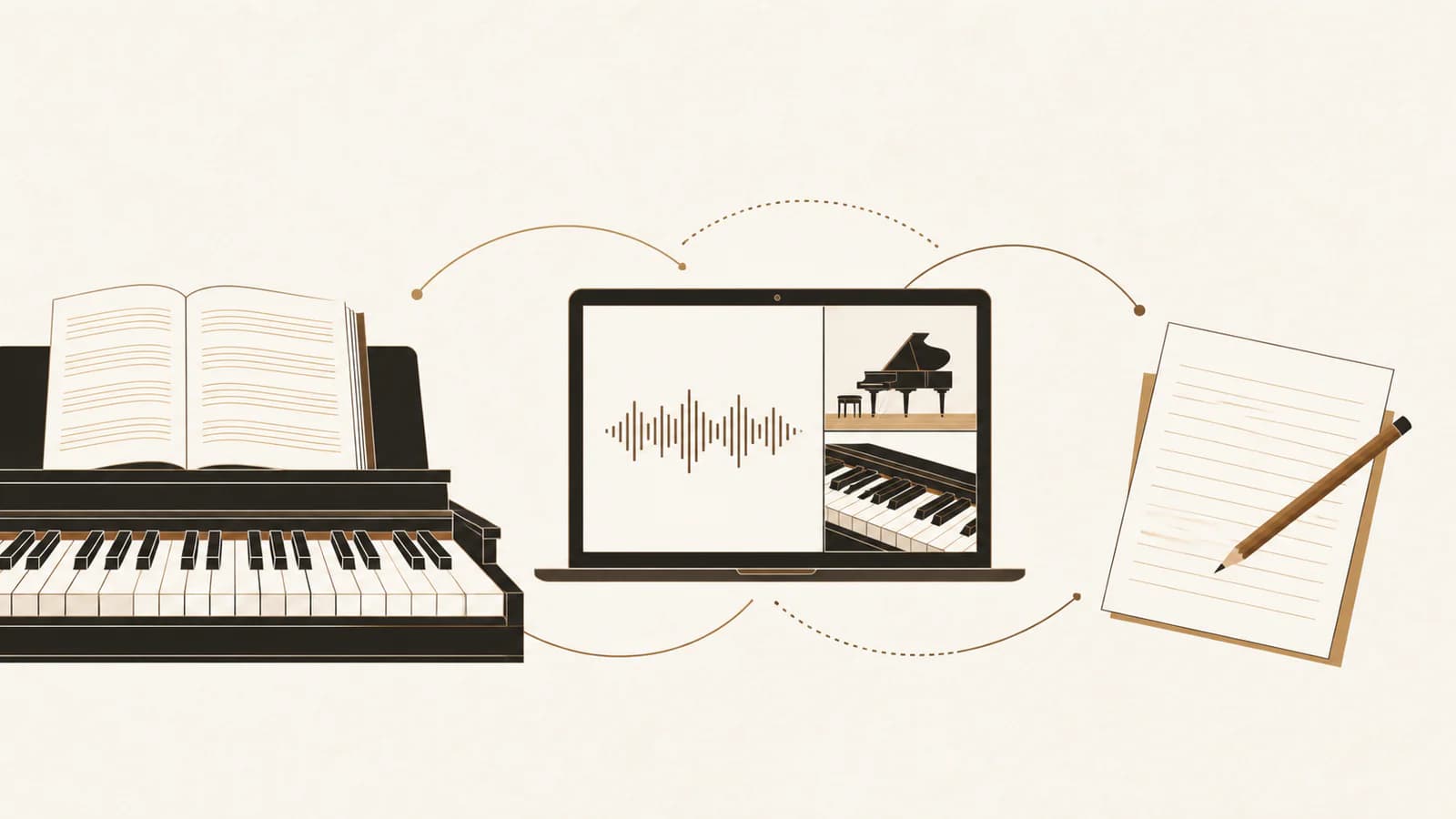
An online classical piano lesson is still a live, one-to-one working session. We listen to your current playing, choose the musical or technical issue that matters most, work on its cause, and finish with a practical plan for the days before the next lesson. The camera and microphone are tools; the lesson itself is not a streamed lecture.
It is not identical to sitting beside the same piano. Sound reaches the teacher through a microphone, the camera has a particular point of view, and an ordinary video call introduces delay. A useful online lesson acknowledges those limits and works with them deliberately.
The lesson starts with the playing you have today
You do not need to arrive with a polished performance. A student who is already working on a piece may begin with a movement, a page, or only the passage causing trouble. A complete beginner can begin without a prepared piece at all.
The first play-through is not an examination. It gives the teacher enough information to decide what deserves attention first. That may include:
- whether the notes and rhythm are secure;
- where coordination or movement becomes unreliable;
- how melody, accompaniment, articulation, and pedal are balanced;
- whether the phrase has a clear direction; or
- how the passage has been practiced so far.
Trying to correct all of these at once rarely helps. The first important decision is narrower: what single change would make the rest of the work clearer?
That question also keeps an online lesson personal. Two pianists can bring the same piece and need very different work. One may need a more stable pulse; another may have the rhythm but lose the melodic line inside a heavy accompaniment. The score is the same. The lesson is not.
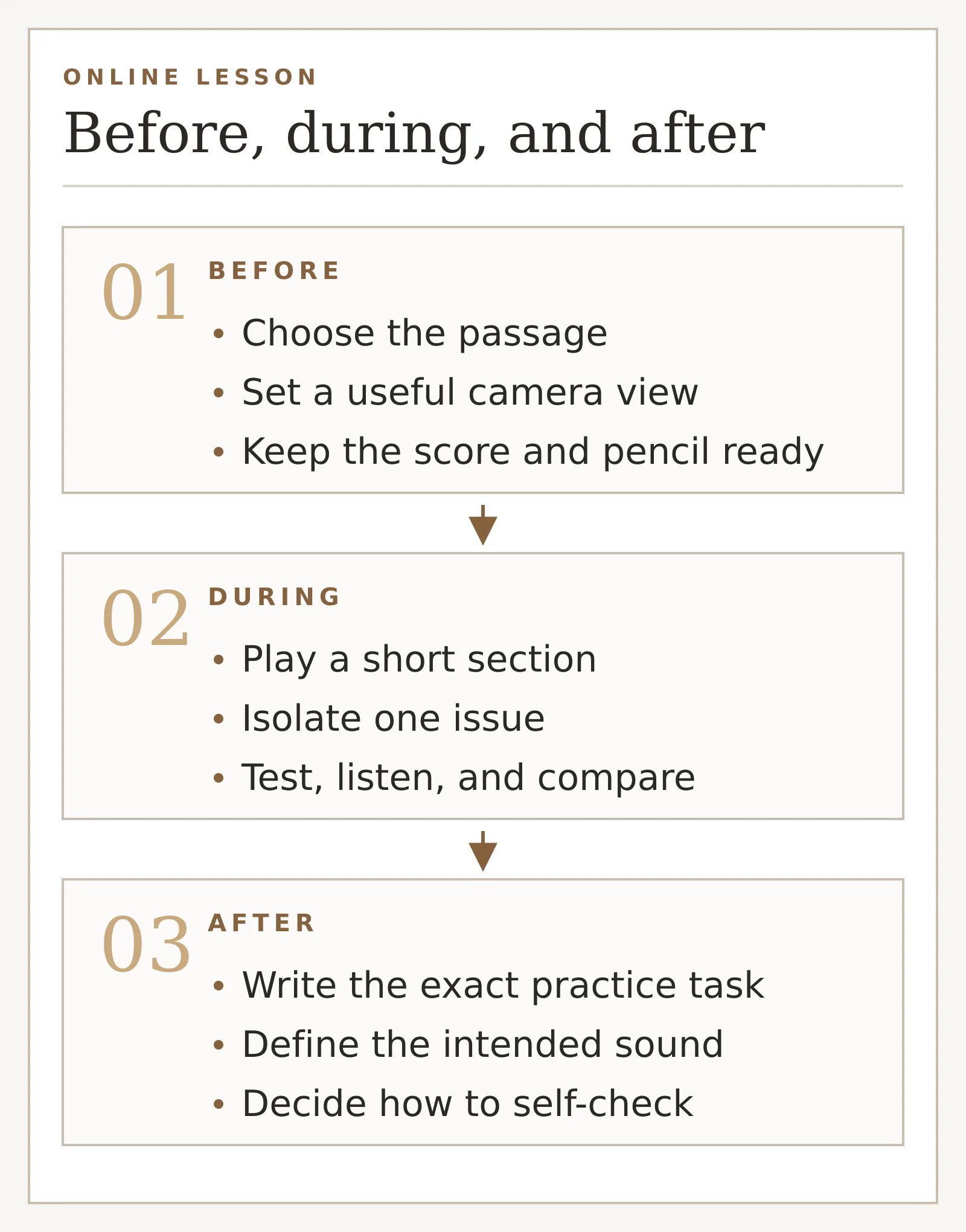
A useful online lesson has a clear before, during, and after.
We narrow the problem before trying to fix it
“This passage does not work” is a starting observation, not a diagnosis. The cause might be insecure fingering, an unclear rhythm, a movement that becomes tense at speed, a harmony the ear is not following, or a practice method that never isolates the difficult moment.
Suppose a repeated left-hand pattern becomes uneven as the tempo rises. Playing the whole page again may reproduce the result without revealing its cause. A teacher might instead ask for the bass alone, reduce the pattern to its rhythm, compare two fingerings, change the grouping, or listen to what happens immediately before the first uneven note.
The student then tests one change while the passage is still small enough to hear clearly. If it works, we return it to the surrounding phrase. If it does not, that result is useful too: it tells us that the first explanation was incomplete.
Observing, isolating, testing, and reconnecting the passage is more valuable than receiving a long list of corrections. It gives the student a way to continue working independently after the call ends.

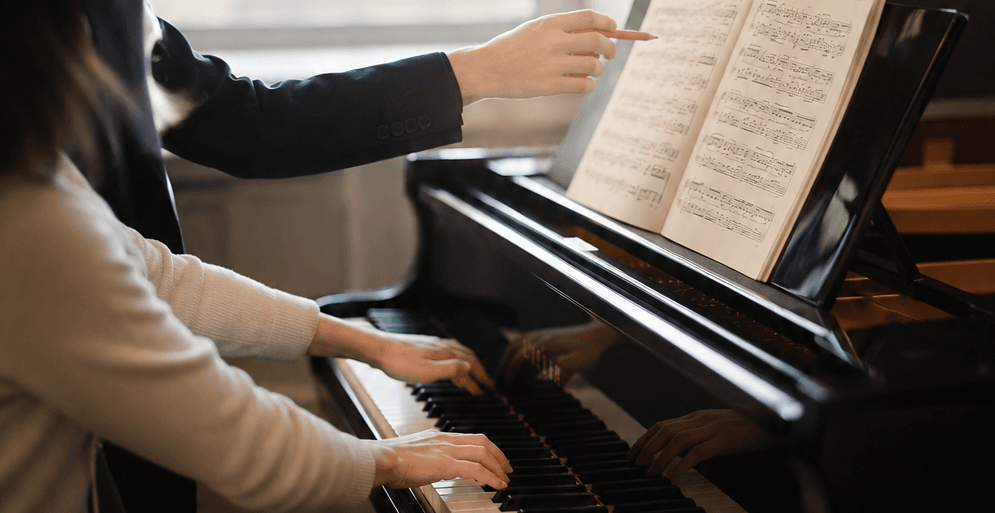
One-to-one classical piano
In person in Ikebukuro or Shinjuku, Tokyo. Online worldwide.
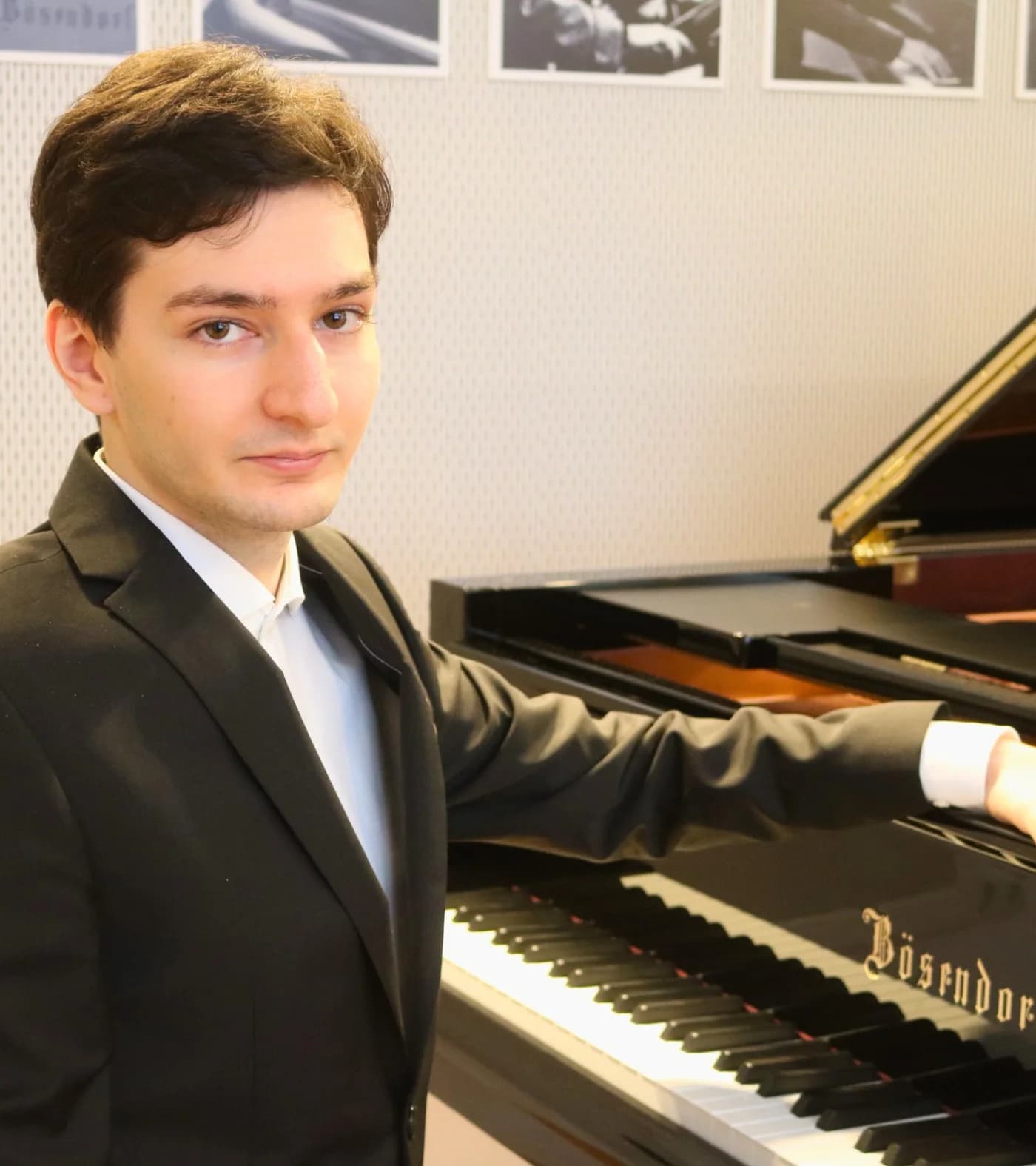
Enea
Concert pianist from Vienna
Pre-launch · Applications open
Demonstration and feedback happen in short exchanges
An ordinary online lesson works through short exchanges. The student plays; the teacher listens and responds; the teacher may demonstrate; the student tries the change and listens again.
That turn-taking is not just a matter of etiquette. A normal internet call introduces enough delay to make reliable simultaneous playing difficult. Research on audio delay in networked music performance shows how quickly timing between remote musicians becomes unstable as delay increases. Specialized low-latency modes now exist, but they depend on the setup at both ends and are not necessary for an ordinary one-to-one lesson.
Multiple camera angles help answer different questions. A keyboard view can make fingering and lateral movement easier to see. A wider view can show how the arm, torso, and distance from the instrument relate to the same passage. The useful angle depends on the problem; more cameras are not automatically better.
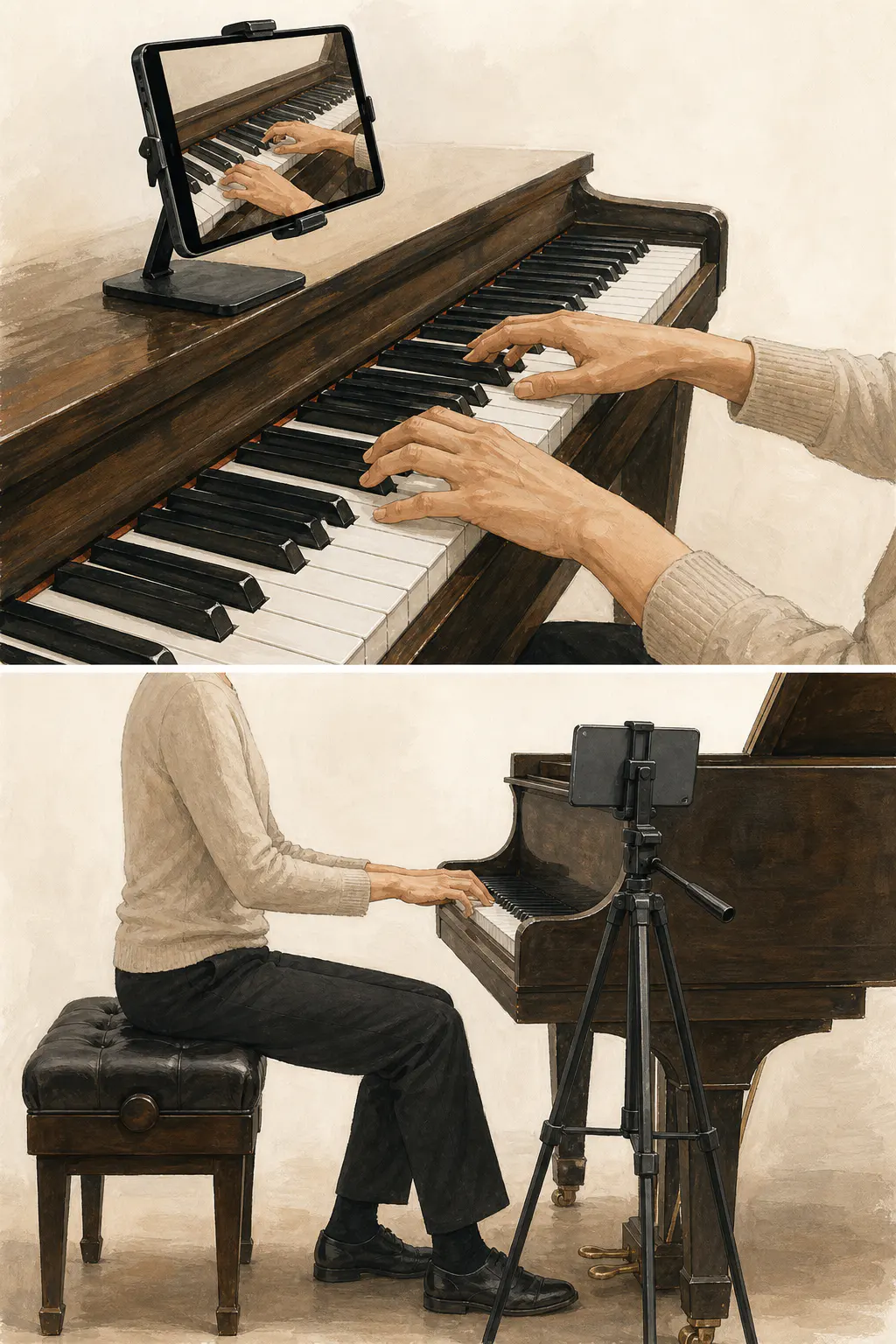
A closer keyboard angle shows fingering and lateral movement. A wider side angle shows the relationship between the body, bench, and instrument.
The screen can also make observation more focused. When everyone is looking at the same two measures, the teacher can ask for a short repetition, compare the result, and decide immediately whether the change helped. The technology is serving a precise musical question rather than trying to imitate every feature of the room.
Clear audio matters more than elaborate equipment
A laptop or tablet, a stable connection, and a sensible view of the piano are often enough for a first trial. Our online piano lesson setup guide explains how to test the camera, sound, lighting, and connection before buying a separate microphone, interface, camera, or stand.
Audio settings can make a larger difference than the price of the device. Because ordinary call settings prioritize speech, noise suppression and echo cancellation can interfere with the full range of a piano. Both Zoom and Microsoft Teams provide music-oriented audio options for this reason.
The exact setting depends on the platform and equipment. High-fidelity modes can require more bandwidth or additional audio hardware; they are not a prerequisite for a first lesson. Start simply, make sure speech and piano can both be heard, and improve only the part of the setup that is limiting the work.
It helps to have the following ready:
- the piano or keyboard you normally practice on;
- a charged device or power cable;
- the score, if you are using one;
- a pencil for fingering and practice notes; and
- one or two questions about the piece or your current goals.
There is no need to perform for the camera before the lesson has even begun.
What can a teacher assess online?
With a clear view and usable sound, an online lesson can address reading, rhythm, fingering, coordination, visible movement, practice method, structure, phrasing, articulation, balance, pedaling, memorization, and preparation for performance. It can work for a first piece, a return after many years, or detailed study of advanced repertoire.
There are also honest limits. A microphone does not reproduce the room exactly. The teacher cannot feel the resistance of the student's keyboard, and one camera angle can hide a movement that another would reveal. Very fine differences in color may need to be checked from a different position, on another instrument, or in person when that is possible.
These limits do not make the lesson vague. They change how evidence is gathered. A passage can be heard again without pedal, shown from another angle, reduced to one hand, played at a different dynamic, or compared before and after one specific adjustment.
The important question is not whether a video call reproduces the room perfectly. It is whether the teacher can hear and see enough to identify the next useful piece of work. The student must also be able to understand and apply it.
A lesson should end with a way to practice
Useful feedback does not end with “play this better.” Before the lesson finishes, the work needs to become something the student can repeat and evaluate alone.
A practical plan normally identifies:
- the exact passage or skill to work on;
- the exercise, fingering, listening task, or change to test;
- the musical result it is meant to produce; and
- a simple way to tell whether it is improving.
For example, “practice the left hand” is too broad. “Play these two beats without pedal, keep the bass quieter than the upper note, and record three attempts at a tempo where the wrist can release after each group” gives the student a task and a way to listen.
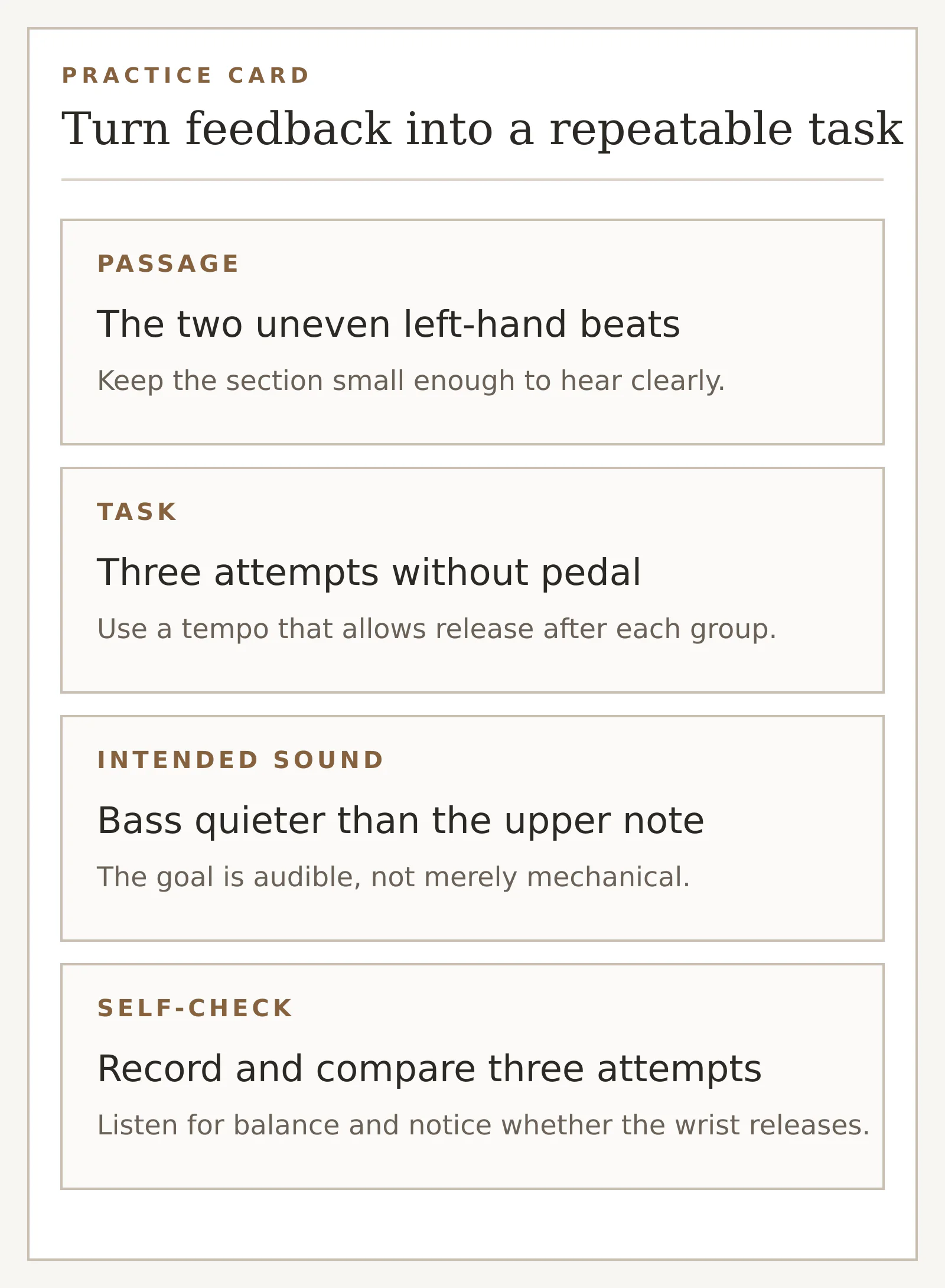
A useful practice instruction names the passage, action, intended sound, and self-check.
At the next lesson, the result becomes the new starting point. We review what changed, adjust what did not, and build from there. This continuity matters more than trying to cover as many topics as possible in one session.
What happens in the free trial lesson?
New students at Vienna Piano School normally begin with a free 55-minute trial lesson. We discuss your background and goals, listen if you have something ready to play, and suggest a sensible starting point. A complete beginner does not need to prepare a piece.
The trial is also a chance to check the practical side of online study: whether the connection, sound, view, explanations, and lesson pace feel workable. If lessons seem like a good fit, online lessons are booked individually at US$40 for 60 minutes or US$60 for 90 minutes. Current options and fees are listed on the admissions page.
Online lessons are available for teenagers and adults, from beginners and returning pianists to advanced players preparing demanding repertoire, auditions, or competitions. Lessons are available in English, Japanese, or German. You can read more about Enea's training and teaching approach before deciding.
If you would like focused help with your current playing, you can request a free 55-minute online trial lesson. A short description of your experience, current piece, and goal is enough to begin.
Sources and further reading
- Zoom Support: Setting up professional audio for Zoom Meetings, updated 26 August 2026.
- Microsoft Support: Use high-fidelity music mode to play music in Microsoft Teams, accessed 29 August 2026.
- Konstantinos Tsioutas et al., “Impact of Audio Delay and Quality in Network Music Performance”, Future Internet 17, no. 8 (2025).