
Keeping Piano Lessons Going During Work Travel
Piano lessons can remain connected during work travel if the musical task fits the instrument and time you will actually have. With access to a suitable piano, an online lesson can continue work on your current repertoire. Without one, a short period of score reading, listening and preparation can keep a familiar piece in view until you return. Agree that temporary focus with your teacher before leaving.
For a travel week, I would usually choose one unfinished musical question from the last lesson. Perhaps the melody disappears when the left hand becomes busy, or the return of the main theme keeps arriving too quickly. That question gives the trip a connection to your playing. A collection of unrelated exercises on your phone often creates more material to manage, without helping the piece waiting at home.
- Choose one passage and one question to take with you.
- Confirm the instrument and room you can use, including the permitted hours.
- Agree lesson dates and the relevant time zones before travelling.
- Keep a note of what you want to test at your own piano on return.
The piece you take with you
Choose music that is familiar enough to remember when you are away from the keyboard. A short section of your current piece is often more useful than starting a demanding new work in a hotel room. You already know its sound, where your hands tend to hesitate, and what your teacher asked you to listen for.
Make a brief recording before departure. Play the passage once at a workable tempo and keep that version as a reference. Alongside it, write the musical question: “Can I hear the right-hand melody through the left-hand broken chords?” is more useful than “Practise this page.” Include a bar number or a recognisable point in the music so you can find the same passage later.
Take the score you use in lessons, with its current fingering and markings. If you normally work from a digital edition, check that it opens without an internet connection and that the relevant pages are readable on the device you are carrying. A phone can be useful for listening, while a dense page of notation may need a larger screen or paper to read comfortably.
The choice also depends on the length of the absence. During a four-night trip, maintaining a clear idea of one phrase may be the most sensible aim. Several weeks away with regular piano access can support continuing repertoire work. Tell your teacher which kind of trip you are planning so that the next assignment reflects it.
Piano access at the destination
A photograph of a piano in a hotel lobby does not establish that you can practise there. Ask whether it is available to guests, at which times, and for what kind of use. Playing a short tune in a public room is different from spending half an hour repeating a difficult connection. For an online lesson, the room also needs to allow a call without disturbing other people.
If you book a practice room, include the journey and time to settle in when choosing the reservation. A room available only during a gap between meetings may suit a short practice visit better than a full lesson. Confirm the instrument, the seat, any headphone arrangement and the venue's rules for video calls before treating it as a teaching space.
A borrowed keyboard can serve some tasks well. You might check notes, compare fingerings within its range, or practise a rhythm with both hands. A small keyboard with unfamiliar key sizes or limited touch response changes what you can assess about balance and movement. Tell your teacher the model or show a photograph, then select work that the instrument can support.
For example, a passage using a wide bass register and pedal may not fit the keyboard in your accommodation. Its melody and rhythm may still be available to work on separately, while the complete texture waits for a full instrument. Keep the musical aim visible as you make that choice. The guide to regular piano access discusses borrowed instruments and practice rooms in more detail.

One-to-one classical piano
Online, worldwide. US$40 / 60 min · US$60 / 90 min.
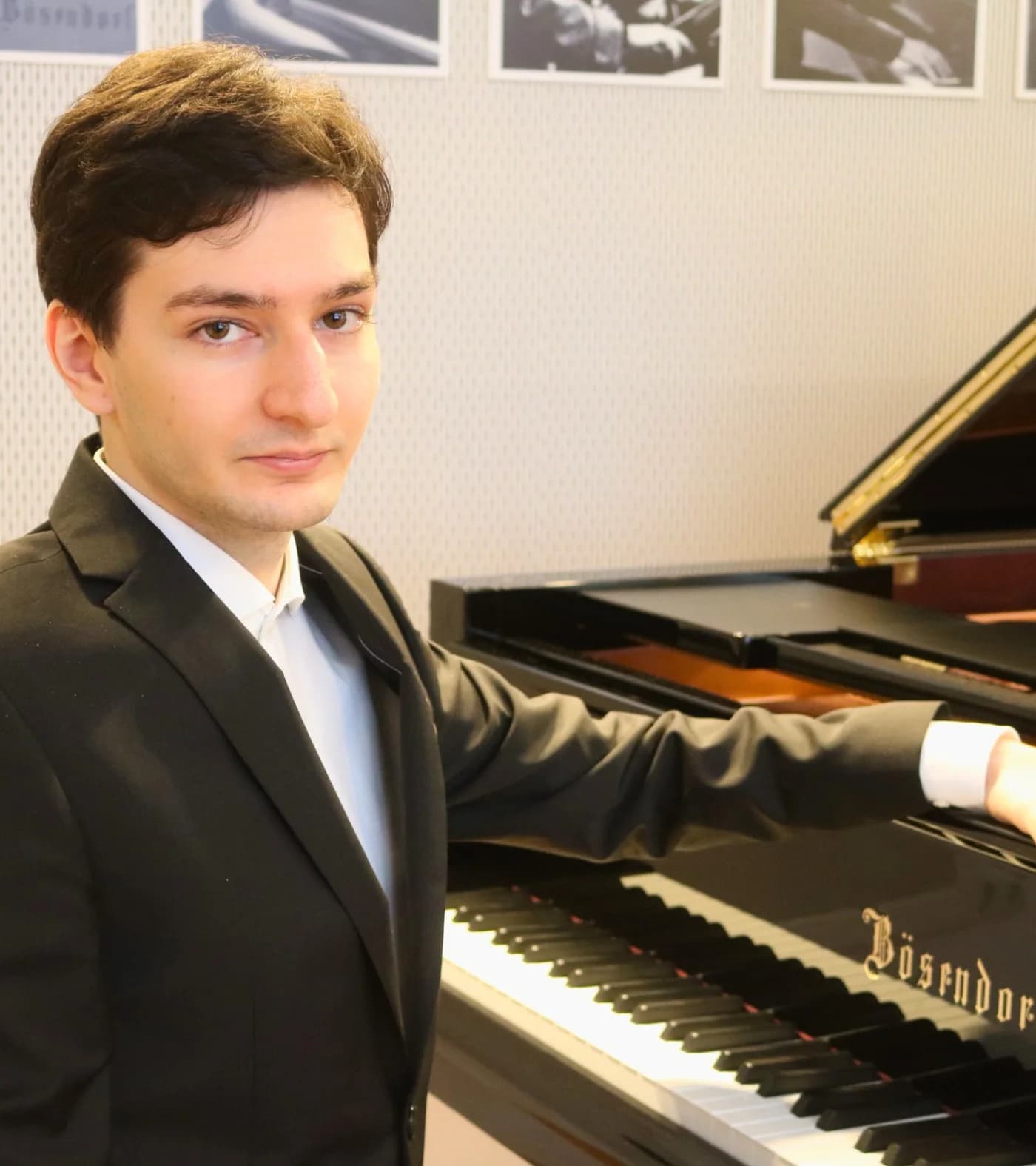
Enea
Concert pianist from Vienna
Free 55-minute trial, online or in person · Ikebukuro & Shinjuku studios from October 2026
An online lesson with a piano
An online lesson during travel can begin with the same passage you played before leaving. The teacher hears how it has changed and can distinguish a continuing musical problem from a response to the unfamiliar instrument. Play a short section, discuss it, and try the adjustment while the sound is still fresh in your ear.
Bring the camera close enough to show the keyboard and the relevant movement. If the left-hand leap is the question, that hand must be visible. If the problem is a buried melody, the teacher needs to hear both hands clearly. A practical view and audible piano sound matter more than reconstructing your usual room. The online piano setup guide covers the equipment details.
At the start, play both a quiet phrase and a fuller one so the teacher can hear whether the connection carries the piano's range. If notes disappear or the sound keeps cutting out, solve that before drawing conclusions about your tone. A connection that makes conversation possible may still give an incomplete picture of sustained piano sound.
The unfamiliar instrument can offer a useful listening question of its own. A bass that sounds powerful in your usual room may be less resonant here; the upper melody may need a different balance against it. Listen to the result of each attempt. Trying to reproduce a remembered amount of finger effort while ignoring the new sound misses the musical information the piano is giving you.
Work in turns with the teacher. Listen to an example, then play it back or try it in your passage. Across an ordinary internet call, transmission delay makes simultaneous duet-style playing unreliable. Alternating demonstrations and attempts lets the lesson remain about your timing and sound rather than the timing of the connection.
Days without a keyboard
Away from a piano, begin with something you have already heard and played. Listen to your departure recording while following the score. Choose one voice: the melody, the bass, or an inner line that was difficult to notice while playing. Stop at the place you wanted to understand and read what each part is doing there.
Suppose the right-hand melody rises towards a long note while the left hand continues a broken-chord accompaniment. Sing or hum the melody through that long note. Follow the bass changes underneath it in the score. Does the melody's destination coincide with a change of harmony, or does the same harmony continue? Mark the place you want to hear more clearly when both hands return to the keyboard.
Rhythm can also travel without an instrument. Speak the count through a rest or tap a troublesome pattern quietly where it is appropriate. Keep the duration of held notes in the pattern; otherwise you may practise only the attacks and skip the time between them. Return to the recording afterwards and hear whether the passage fits the rhythm you have just counted.
For a passage you know well, close the score briefly and imagine its opening, then look again. Check the bass note, the direction of the melody and the place where the next phrase begins. If your recollection becomes vague, open the music and locate the uncertainty. Guessing repeatedly at a note you cannot hear clearly is less useful than identifying it for your next session.
These activities prepare musical decisions. The feel of a key, the balance produced by two hands and the clearing of a pedal still need to be tested at an instrument. Mark those places to test when you sit down again.
If you want teacher feedback during a period without a piano, agree the purpose beforehand. Discussion of the score, a previous recording or your practice plan can be useful when it answers a real question. Choose that focus before booking the call.
One musical question across the trip
Imagine you are working on an eight-bar passage whose melody becomes hard to hear after the fourth bar. Before departure, play it for your teacher and establish where the balance changes. Perhaps the first bass note of each new bar becomes much louder, or the right-hand line loses direction after a long note. Those are different things to listen for during the trip.
Keep the musical question in view
Can the melody remain audible after bar four?
Before leaving
Record the eight-bar phrase. Mark where the melody disappears and where the bass changes.
Away, with a piano
Play the melody alone, then add the accompaniment. Listen through the whole phrase.
Away, without a piano
Follow the recording and score. Sing the melody across the troublesome bass change.
Back at your piano
Test whether the melody stays audible with both hands. Compare with the departure recording.
What to bring back to the next lesson
Keep the original recording and the marked place in the score. Add what you noticed: for example, “The melody holds its note while the bass changes underneath it.”
At the lesson, play that phrase with both hands. Listen for the change you wanted, then decide whether the remaining work is in the reading, the balance or the movement.
The important distinction is between knowing what you want to hear and being able to produce it. If you can sing the melody through the bass change but it still disappears when you play, another round of listening may add little. At the piano, I would hear the two parts separately, then listen to the exact moment they meet. An accompaniment can be quiet in isolation yet become heavy when the melody asks for more attention. That is the playing problem to take into the next lesson.
Meetings, time zones and bookings
Choose a lesson time that fits the trip as it is, including meetings, transfers and the hours when the instrument is available. A booking immediately after a flight leaves little room for delays. A quiet morning with a confirmed practice room may be a better teaching opportunity than an uncertain evening in shared accommodation.
For an international trip, agree the date and time in both the teacher's location and your destination. Check the calendar entry after arrival, particularly if the trip crosses a daylight-saving change or the International Date Line. The local date can matter as much as the hour. Include the time zone when writing about a change, rather than sending only “Tuesday at six.”
Arrange a temporary change of lesson format in advance. Availability at your normal in-person time does not automatically establish an online booking, and a trip does not automatically extend a booking into a later month. Vienna Piano School books lessons individually after the trial; a lesson is confirmed when its time and payment arrangements have been agreed.
Under the current lesson terms, a rescheduling request requires more than 48 hours' notice. A replacement lesson is subject to availability and must fall within the same calendar month; lessons cancelled 48 hours or less before the scheduled start cannot be rescheduled. Raise a travel conflict as soon as the dates are known, especially near the end of a month.
The first session back
Begin your first practice at home with a familiar, manageable part of the piece. Hear the instrument again before trying the hardest passage at performance tempo. Then return to the question you carried through the trip. The aim of this session is to find out what is present now: what you remember, what sounds different and what needs playing time.
Compare the new attempt with the departure recording at a similar tempo. A slower version may sound cleaner because it gives you more time, while a genuinely clearer melody should remain audible when the accompaniment returns. Make the comparison fair enough to answer your original question. Avoid judging the entire trip from the first cold attempt at a difficult leap.
Bring the score and the few notes you made to the next lesson. “I can follow the bass changes now, but I still lose the melody when both hands play” is a useful report. It shows what the work away from the piano addressed and what the teacher can help with next.
If travel becomes frequent, discuss a recurring approach. You might reserve some repertoire for weeks with regular piano access and keep another familiar piece available for shorter visits. Review the arrangement after a real trip: whether the room was usable, whether the booked time worked, and whether the assignment was worth carrying. Let that experience shape the next absence.
Planning lessons around your travel
Tell me the dates you will be away, the instrument you expect to use and the piece you are currently studying. We can discuss which work suits an online lesson during the trip and what to resume in person. If your instrument access is still uncertain, say so before we choose the lesson's focus.
Vienna Piano School offers online lessons for junior-high-school age learners and adults, and in-person lessons at piano studios in Ikebukuro and Shinjuku, Tokyo, from October 2026. Online lessons are US$40 for 60 minutes or US$60 for 90 minutes. In-person lessons are US$40 for 55 minutes, including studio use. The first trial is free and lasts 55 minutes.
Use the trial application to describe your usual location and any coming travel period. Existing students can discuss the trip when arranging their next lesson. For learners under 18, a parent or guardian should contact us.