
Accompanying a Singer at the Piano: Your First Lied Rehearsal
Accompanying a singer changes what you read in a piano score. The line above your two staves contains words, rests and a person’s next entrance. Those details shape the timing of the piano even when your own notes look straightforward.
In a Lied, a German art song, the piano may establish the atmosphere, carry a melody beneath the voice and continue the thought after the singer has finished. Preparing only the piano notes leaves much of that conversation undiscovered. Preparing the words and vocal line gives those notes a reason to move.
Before a first rehearsal, settle three things: the key and edition, the meaning and rhythm of the text, and the route from the piano introduction into the first sung phrase. Schubert’s An die Musik, D.547, offers a compact example of all three.
Agree the key and score
Songs circulate in different keys for different voices. Ask for the exact score the singer will use, then compare the key signature and first pitches with your copy. A familiar title on the cover does not establish that both versions will sound together.
Agree any repeat, verse or cut before learning the joins. In An die Musik, the two stanzas use the same main music, but editions may lay them out differently: a repeat sign in one copy can correspond to several written-out pages in another. A rehearsal reference such as “the bar before ‘Hast du mein Herz’” remains useful when page numbers disagree.
If the chosen key changes, prepare the new version before meeting. Transposing at sight is a separate skill; it should be an agreed part of the arrangement between the musicians. At a first rehearsal, a settled score lets both people concentrate on the song.
Keep the vocal staff visible while learning your part. Notice where a syllable lasts across several piano attacks, where a word begins between the main beats, and where the singer rests while the piano continues. These are places where a purely pianistic reading can miss the shape of the phrase.
Read the poem as a sentence
Franz von Schober’s poem addresses music directly. The opening, “Du holde Kunst”, can be rendered as “O gracious art”. The speaker recalls bleak hours and thanks music for kindling warmth and carrying them into a better world. That movement from difficulty to gratitude gives the song more direction than a general instruction to play beautifully.
I find a text most useful when it changes a musical decision. Who is being addressed? Which word completes the thought? Does the sentence continue beyond the place where the singer takes a breath? Those questions affect how I carry an accompaniment through a pause or prepare the next entrance.
Read the first stanza aloud, then speak its words in the rhythm of the vocal line. At “Kunst”, hear the word as an arrival; at the following “in”, hear the beginning of the next thought. The two syllables belong to different parts of the sentence even though both are sung within the same bar.
Make a brief sense translation in your score. A few words beside a phrase are easier to use while playing than a full prose paragraph at the top of the page. For an unfamiliar language, settle the meaning and pronunciation before practising a repeated approximation. The singer can then show you how the consonants and vowels sit within their musical phrase.
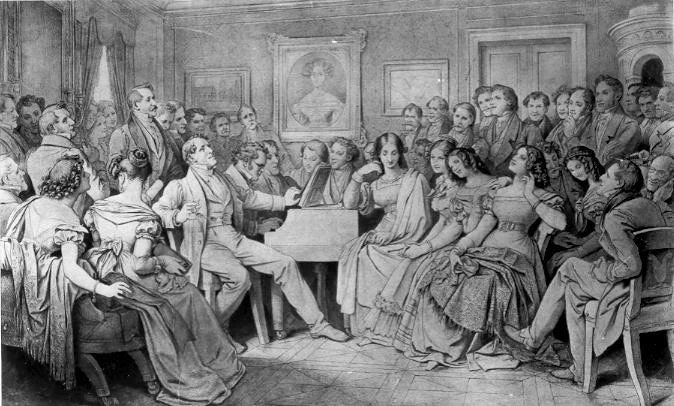
Schubert’s first entrance
In the score below, the piano has two introductory bars. At the start of bar 3, it continues while the voice has a quarter-note rest. The singer enters on “Du” after that rest, rather than on the bar’s first piano attack.
Bars 1–4: from the introduction to ‘Du’
Scroll sideways to read the score.
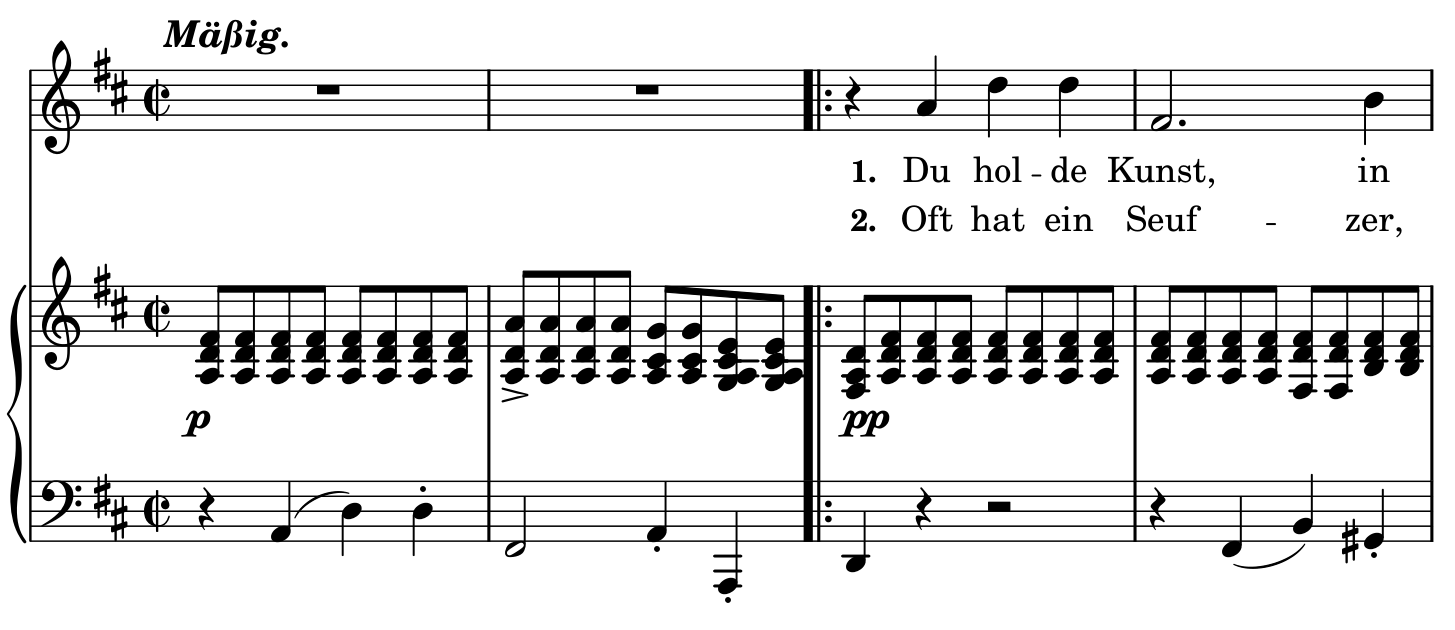
The metre is alla breve, 2/2: two half-note beats in the bar. For a slow reading, divide each into two quarter-note positions, “1-and, 2-and”. “Du” enters on the first “and”; “hol-de” occupies “2-and”; “Kunst” arrives at the beginning of the next bar. The following map makes that entrance visible without changing the metre.
Where ‘Du holde Kunst’ enters
In 2/2, divide each half-note beat into quarter notes: ‘1-and, 2-and’. The map follows the first stanza.
| 1 | and | 2 | and |
|---|---|---|---|
| Rest | DuA4 | hol-D5 | deD5 |
| 1 | and | 2 | and |
|---|---|---|---|
| KunstF♯4 | hold | hold | inB4 |
Du follows the quarter-note rest in bar 3. Kunst holds F-sharp for a dotted half note; in follows on the final quarter note of bar 4.
Practise the introduction while silently following the vocal line into that entrance. Then play it while speaking “Du holde Kunst” in place. The piano’s repeated chords should sustain a pulse the singer can enter, with enough direction to carry the words towards their arrival.
At rehearsal, agree how the song begins. The pianist needs to know that the singer is ready before the introduction; the singer needs a clear sense of the tempo and character once it starts. A glance and a shared preparation can establish that without adding a separate gesture to every beat.
Try the introduction through the end of the first sung phrase, rather than stopping immediately after “Du”. An entrance can be together yet lead into a tempo that gives the rest of the sentence no room. Hearing the whole phrase tells you whether the beginning was well chosen.
Breathing within the phrase
A breath is a musical event shared by the duo. Ask where the singer intends to breathe and what should happen to the piano there. Sometimes the accompaniment continues through the breath; elsewhere both parts make space. The score and the shape of the sentence help you decide together.
Mark the agreed place lightly. On the next run, listen to the end of the preceding word and the preparation for the next one. If the piano repeatedly arrives too early, begin the repair before the breath. Playing faster through the end of the previous phrase and then waiting abruptly can turn a natural renewal into a stop.
Equally, avoid lengthening every vocal rest. A written rest can give the piano its own line, and the next entrance may depend on that line keeping its direction. In An die Musik, bar 10 is a complete bar of vocal rest, while the left hand moves through a descending chromatic figure after its first low note.
Bars 9–12: the piano carries the vocal rest
Scroll sideways to read the score.
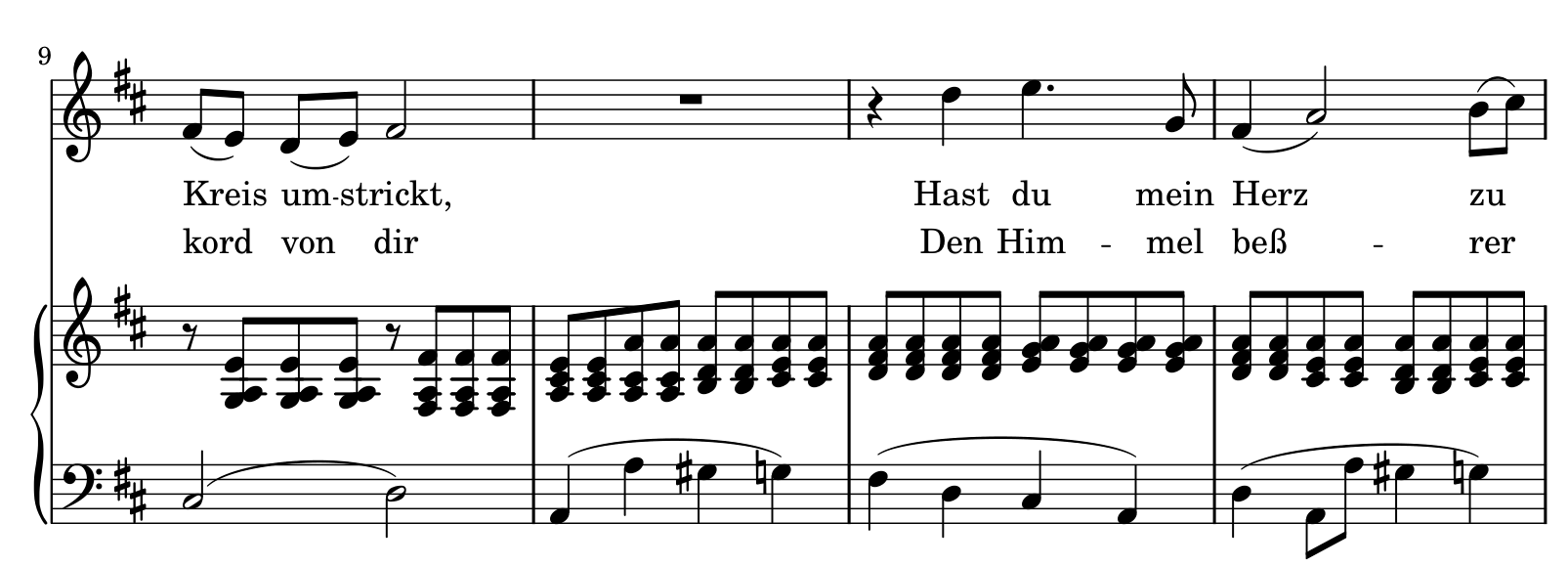
Play bars 9–12 while following the words “umstrickt” and “Hast du mein Herz”. The piano carries the connection during the vocal silence. At bar 11, the singer again has a quarter-note rest before entering. The collaboration includes both the singer’s preparation and the piano’s continuing musical thought.
Ask a practical question after trying it: “Shall I keep the bass moving here, or do we want more space before the next line?” Then repeat the join in context. This produces a musical choice you can both recognise, instead of a general promise that the pianist will somehow follow.
Hear the piano’s own voices
The accompaniment is not one undifferentiated background. In this Schubert song, the right hand repeats chords while the left hand supplies a moving line. If every chord receives the same prominent attack, that repeated layer can cover both the singer and the piano’s bass melody.
Learn the left-hand line as a phrase. Sing or hum its direction while playing it, then restore the right-hand chords at a level that lets the line remain audible. Finally add the imagined vocal part by following the words on the upper staff. You are learning where each layer belongs before balancing them with the actual voice.
The pianist Graham Johnson’s discussion of An die Musik draws attention to this relationship between voice, bass line and repeated chords. It is a useful reminder that playing with a singer does not mean making every part of the piano equally quiet. Listen for which line is speaking at each moment.
A sustained vocal note also needs attention. As it continues, several fresh piano attacks may sound beneath it. Keep hearing the singer’s line through those attacks rather than treating the long note as permission to foreground the accompaniment. When the piano takes over between phrases, let its own direction become clearer.
For a traditional performance reference, follow Dietrich Fischer-Dieskau and Gerald Moore in the Deutsche Grammophon recording. Listen first for the route from introduction to voice, then follow the left hand during a vocal rest. These are questions to bring to your own rehearsal, rather than a set of breaths or a tempo to copy unchanged.
Words, balance and pedal in the room
At the first meeting, play a short section together before trying to judge the whole balance. The singer’s sound, the piano and the room will give you information that solo preparation cannot supply. Ask whether the words remain clear where the piano texture is busiest.
Try reducing an accompanying chord layer before making the melody or bass less expressive. In a resonant room, also listen to what the pedal carries across a change of harmony. A blurred change can obscure the next word even when the immediate piano attack is quiet. Rehearse the passage with a clearer release and compare the result.
Consonants complicate the meaning of “together”. A word may begin with a consonant before its sustained vowel becomes clear; a final consonant may arrive as the piano is already continuing. Ask the singer to speak or sing the short phrase, then agree where your shared arrival is. Listening only for the beginning of every audible syllable can make the piano hesitate behind the line.
Keep the discussion tied to one phrase. “Can you hear the last word over these chords?” is easier to answer than “Am I too loud throughout?” The unfamiliar-piano soundcheck guide offers more ways to compare touch, pedal and audience-position balance.
Give the rehearsal a musical destination
Begin with a substantial phrase or a short complete song, so both musicians hear each other’s intentions. Afterwards, choose the join that most needs attention: the first entrance, a breath before a long sentence, an exposed consonant, or the handover into a piano passage.
When you restart, include enough music before that point to recreate it. Beginning on the difficult note alone removes the gesture that led there. Agree a word and a place in the bar, play through the join, and continue far enough to hear whether the change helped the sentence.
Keep the ending in the rehearsal too. The singer’s last word may leave a piano postlude with its own cadence and release. Follow that final musical thought together, even when only the pianist is still sounding notes. For the broader preparation shared with other chamber music, see your first ensemble rehearsal as a pianist.
Good Lied playing grows from knowing what both people are saying. The pianist can prepare the score, understand the words and offer a clear pulse; the singer brings the living pace of the text and breath. In rehearsal, those preparations become one phrase that neither part could make alone.