
Your First Chamber-Music Rehearsal as a Pianist
Playing your piano part correctly is only part of preparing for a first chamber-music rehearsal. The other player may begin a phrase before you enter, sustain a note while your harmony changes, or need a little space that your solo practice never included. The interesting work begins when you can hear those events while keeping your own part moving.
I would prepare for that first meeting with one aim: leave enough attention available to listen to the other musician. Choose a manageable piece, learn the whole piano part, and know what the other instrument is doing at your important entries. A rehearsal then becomes a place to discover the music together, with something dependable to bring to the conversation.
A playable part and a shared plan
Look through the complete piano part before agreeing on a work. A lyrical opening can lead to several pages of demanding figuration, and the word “accompaniment” tells you very little about the difficulty. Choose a movement or short piece in which you can maintain the pulse, hear the bass and recover your place without restarting every time a note goes wrong.
An accomplished violinist or cellist may suggest music that is comfortable for them but demanding for the pianist. Discuss the actual score and a working tempo together. For a first rehearsal, a shorter movement played with attention to both parts offers more musical experience than a large work in which the piano part consumes all your concentration.
Before meeting, agree on four things:
- The exact work, movement and version, with compatible scores and bar numbers.
- A working tempo that lets both players keep the music moving.
- Which passages each person already knows need attention.
- A rehearsal space with a usable piano, room to hear each other and a clear sightline.
Read through all of your part at that tempo. The opening should not receive an hour of polishing while the last page remains unread. If one passage needs a slower tempo, tell your partner which bars are involved; that is useful information for planning the rehearsal.
Reading the other part
In a duo score, the other instrument usually appears above the piano staves. Follow that line as you practise. Notice where it begins, where it rests, where a long note continues across your changing harmony, and where it takes over a figure you have just played. Those are the places where your attention needs to move beyond the keyboard.
Try singing the other part while playing a simplified version of your own. Keep the bass and the notes that establish the harmony, leaving out some inner detail for this exercise. You will quickly hear whether a piano chord supports the other line, answers it or interrupts it. Then restore the written piano part while retaining that awareness.
At a difficult entrance, mark a short cue from the other instrument rather than just “come in here”. It might be the last three notes of a melody or the rhythm immediately before your entry. Learn what that cue sounds like, including its place in the pulse. A cue becomes useful when it belongs to a phrase you can follow.
Joining a phrase: Beethoven Op.69
The opening of Beethoven’s Cello Sonata in A major, Op.69, shows this particularly well. The cello begins alone. The piano has five complete bars of rest, then enters near the end of bar 6 while the cello holds a low E. The pianist joins a musical world that is already in motion.
Use this opening as a listening and score-reading example; the complete sonata is a substantial undertaking. In the excerpt, the upper staff is the cello and the lower two staves are the piano. The first piano sound comes on the last quarter-note of bar 6: G-sharp in the right hand, with B and D as two eighth-notes in the left.
Scroll sideways to read the score.
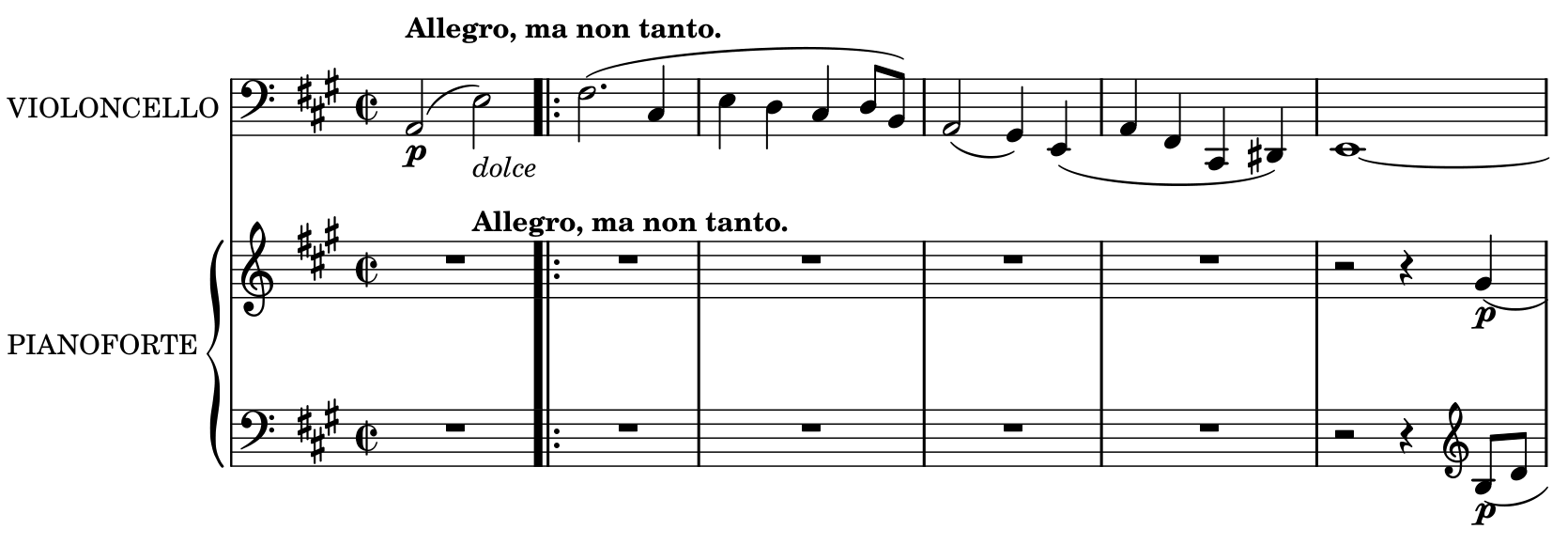
- Bars 1–5
- Follow the cello phrase during the piano’s rests.
- End of bar 6
- The piano enters on the last quarter-note, over the cello’s held E.
- Into bar 7
- Continue the shared phrase as the piano takes the moving line.
Count the rests, but also follow the cello’s phrase. Hear how its moving line reaches the sustained E and what character has already been established. A pianist who counts silently and then begins a completely independent phrase can enter at the correct moment yet still sound disconnected. The first piano note should belong to the sound that is already there.
Once the piano enters, it takes the moving melodic line while the cello sustains its bass note. That held E is still part of the conversation. Listen for it beneath the piano figuration, and keep the accompaniment light enough for its continued presence to matter.
Scroll sideways to read the score.
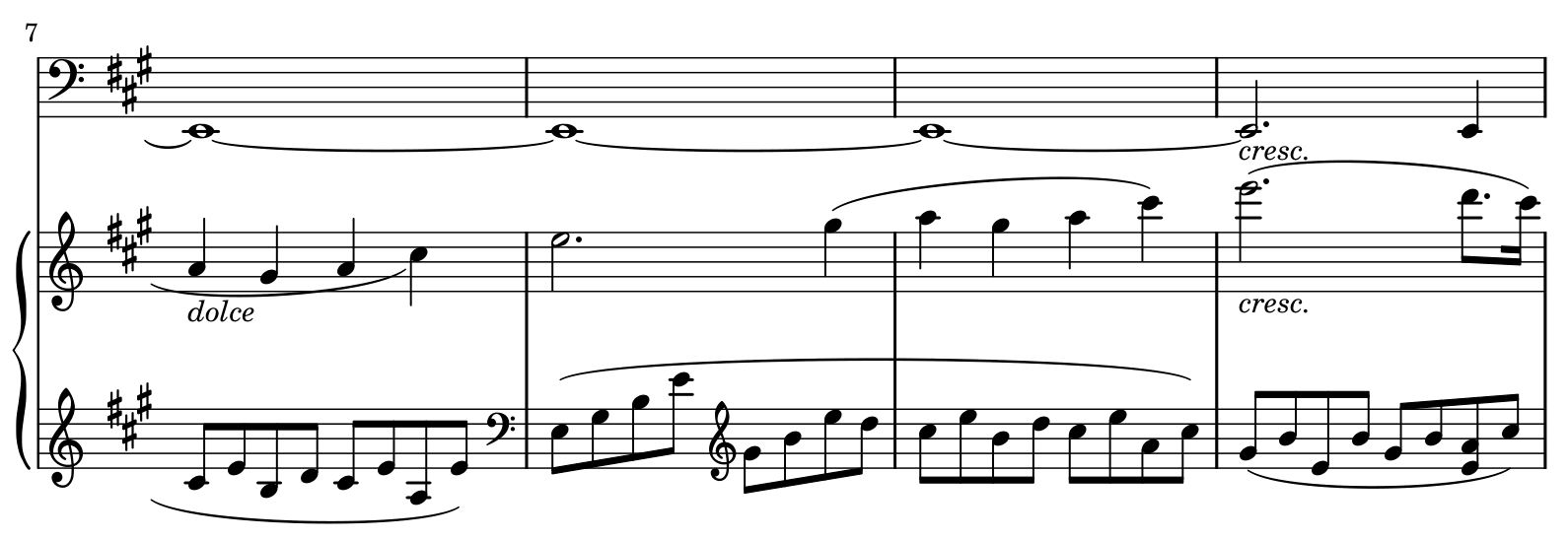
The cello’s E continues across the bar lines. Hear that sustained bass while following the piano’s melody and accompaniment.
In individual practice, play the cello’s opening on the piano first, then hear it internally while counting the rests before your entrance. A teacher can also play or sing the cello line while you try the piano part. The point is to practise hearing your entry as a continuation, rather than perfecting an isolated first chord.
Listening to Argerich and Maisky
Follow the opening in the recording by Martha Argerich and Mischa Maisky below. During the cello solo, look at the rests in the piano part. At the piano entrance, keep listening to the cello’s sustained note as well as the new line above it. The score shows a change of roles without a break in the phrase.
Martha Argerich and Mischa Maisky: Beethoven Op.69
Deutsche Grammophon / Universal Music Group. Listen on YouTube.
On another hearing, follow whichever instrument is providing the harmonic foundation. That may be a piano bass, a sustained cello note or a shared arrival. Listening this way develops a different familiarity from knowing only the tune. It also gives you something precise to discuss with your partner: which sound needs to remain audible at a particular point?
A cue that carries the pulse
When both players begin together, the preparatory gesture needs to communicate the pace and character of the music. A small breath or movement can do that. A sudden nod at the instant of the first note gives the other person very little time to respond. Hear the pulse before the gesture, and let the preparation lead naturally into the sound.
Practise the beginning a few times with your partner, changing who gives the cue. Then try starting at an agreed point later in the piece. The person beginning the important moving line will often have the clearest musical reason to lead, but that can change from phrase to phrase. A pianist with a full score is not automatically the conductor of the group.
At a held note or a pause, agree how the continuation will begin. Keep the discussion attached to the phrase: does the next note emerge gently, interrupt the silence or continue an existing impulse? The gesture should communicate that decision. Once the two players hear the same continuation, an elaborate system of signals is usually unnecessary.
Balance and the shape of a note
A piano note has a clear initial attack and then decays. A bowed string or wind player can sustain and shape the sound during the note. That difference affects balance: a piano chord may cover the beginning of the other instrument’s note even when the overall passage does not seem particularly loud.
Listen at the beginning of the sound, not only after it has settled. If the cello’s entry disappears under a piano chord, try changing the balance within the chord and the weight of the accompaniment. The harmonic bass may still need definition while the middle notes need less prominence. Making everything uniformly soft can remove the musical foundation along with the excess volume.
Pedal changes the texture shared by both instruments. Resonance that sounds attractive in solo practice may obscure a moving cello line or fill a rest that the ensemble needs to hear. Try the passage with less pedal, listening to the other part throughout, then restore only the resonance that helps the phrase. The guide to clear sustain pedal develops that listening question at the piano.
Balance also depends on the room and where the instruments sit. Ask what your partner hears, and listen from farther away if someone can play a short passage for you. A phone recording, made with everyone’s agreement, can reveal a buried line, though its microphone will also change the balance. Use it to ask a better question in the room, rather than treating it as a final judgement.
The first run and the first experiment
Begin with a section long enough to reveal the piece’s character and the way both players shape it. Keep going through an isolated wrong note when the ensemble can continue. Stopping at every slip prevents you from hearing the larger relationships, especially the approach to a cadence or the change from one character to another.
Afterwards, choose one musical problem. “The arrival felt late” is a starting observation. Find the bars before it and discover whether the two players hear the same pulse, lengthen the same note or aim at the same point. Play that approach in two ways and compare the result. The sound often settles a discussion more effectively than a long argument about terminology.
Make requests that describe an audible change. “Could we keep the pulse through this bar and give the next note more space?” offers an experiment. “Be more musical” leaves the other player guessing. The same applies to balance: identify the line you want to hear and the exact place where it disappears.
A passage that falls apart may contain a technical problem in one part. If so, lower the tempo together and identify the smallest useful passage to practise afterwards. The rehearsal can establish the shared timing and character; individual work then makes that decision dependable. The two kinds of work support each other without asking the partner to wait through repeated private note-learning.
Releases, rests and page turns
Shared endings deserve as much attention as shared beginnings. Decide how long a final note lasts, when the sound releases and whether the following silence belongs to the same phrase. On the piano, the pedal can keep a chord sounding after the hands have lifted. Listen to the complete release, including the other instrument, before assuming that both players finished together.
Look through page turns before the meeting. Mark a practical turning point, or arrange a page turner where the passage needs both hands continuously. Put bar numbers in a few useful places so that restarting a passage does not become a search through different page layouts. These small preparations protect the time you have for playing.
At the end of the rehearsal, note the few musical decisions that mattered: the working tempo, the balance at an entry, or the timing of a particular arrival. Keep them in the score beside the relevant bars. At the next individual practice session, hear the other part again as you work on your own.
Preparing in a piano lesson
Chamber preparation makes solo practice more attentive. A bass line has to support someone else’s breath; a melody has to continue an idea begun on another instrument; an accompaniment has to remain clear while another person shapes the foreground. These questions often reveal habits that are easy to miss when playing alone.