
Haydn's Sonata in C Major Hob. XVI:35: Articulation, Character and Practice
Haydn's Sonata in C major, Hob. XVI:35, can sound wonderfully direct: a few bright notes, a quick reply, a phrase that knows exactly where it is going. At the piano, that directness takes work. A clipped melody must stay buoyant above flowing accompaniment; an ornament must belong to a sentence; a rest must arrive with as much conviction as a note.
The whole sonata makes a rewarding project for an intermediate player with some experience of classical repertoire. Its three movements ask for different kinds of control. The first needs rhythmic energy and quick changes of character, the Adagio needs a singing line through elaborate decoration, and the finale needs a clear three-beat pulse through its surprises.
Three movements, three kinds of attention
I · Allegro con brio
C major · 4/4
Bright attacks, flowing triplets, sudden pauses
Keep the melody articulate while the accompaniment moves.
II · Adagio
F major · 4/4
Singing melody, ornaments, increasingly active bass
Hear the long line through its small notes.
III · Finale: Allegro
C major · 3/4
Quick replies, a C-minor episode, returning lightness
Let ties and rests keep their place in the three-beat pulse.
Difficulty and the complete sonata
The opening is a poor measure of the sonata's overall difficulty. Much of it lies comfortably under the hand, but the later triplet patterns, changing positions and ornaments need dependable coordination. The Adagio moves slowly while the fingers sometimes move very quickly. In the finale, a simple-looking melody shares the page with ties, rests, changes of register and a contrasting minor-key episode.
Henle places the sonata at level 5, within its medium category. For choosing a piece, I would look more closely at three things: whether you can keep an accompaniment light for several phrases, whether you can read changing subdivisions without changing the underlying beat, and whether your articulation remains clear when both hands play together. Those tell us more about the work ahead than a grade number alone.
Try the opening of each movement before committing to the whole sonata. Then look beyond those openings, especially at the slow movement's running left hand. If the notes are readable but the two hands always copy each other's touch, this piece offers an excellent musical reason to develop that independence.
Hob. XVI:35 is the useful identifier when looking for a score; numbering differs between sonata collections. It appeared in an Artaria collection published in Vienna in 1780. The excerpts below come from the 1918 Breitkopf edition. For detailed study, a modern critical edition's comments are also useful, particularly where slurs or ornaments differ between copies.
Allegro con brio: the opening conversation
Start with the upbeat and the first four full bars. The melody enters softly, rises into repeated detached notes, and reaches a marked accent near the end of the first full bar. The following bar answers it. By the fourth bar, two quarter rests create a space before the next upbeat.
C major, 4/4. A dotted upbeat, detached quarter notes and a late-bar accent lead into an answer and a pause.
Scroll sideways to follow the score.
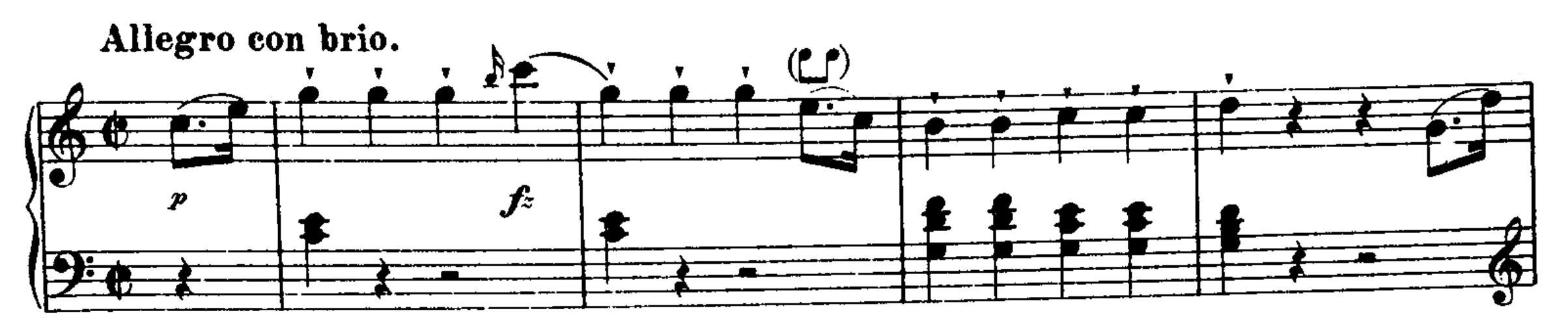
The upbeat is a dotted eighth followed by a sixteenth. Give the long note its time, then let the short note lead into the first full bar. If the short note arrives early and waits, the gesture loses its spring. Count the beat in four small parts while learning it; later, hear the two notes as one movement toward the downbeat.
The detached quarter notes still belong to a phrase. Play them with a clear release and listen to the space between them. A short sound can be warm, bright or pointed. Choosing the length alone does not settle the character. On a resonant grand piano, a relatively brief touch may leave plenty of sound in the room; on a dry digital instrument, the same release can feel abrupt.
I like to play these bars as a conversation before increasing the tempo. The repeated notes establish a confident voice, the accented high point gives it an inflection, and the answer settles it. That suggests different weights within the phrase. Four identical hammer blows erase the inflection, even when every staccato mark is observed.
Pay equal attention to the left hand. Its opening chords are followed by rests, so they punctuate the melody. Release them cleanly and keep listening through the silence. Holding the pedal across those rests turns a sharply drawn exchange into a continuous wash of harmony.
The different shapes of staccato marks in older scores can be distracting. Henle's critical comments explain that the original source uses dots and dashes without a clear distinction. Let the phrase, register and accompaniment guide the degree of separation instead of assigning a rigid mechanical length to each printed shape.
Triplets beneath a detached melody
The opening idea returns over a more active accompaniment. In bars 9–12, the right hand retains its speech-like gestures while the left hand plays three eighth notes to each quarter-note beat. The accompaniment changes the energy of material we have already heard.
Both staves use treble clef here. The left-hand groups are eighth-note triplets, three notes to each quarter-note beat.
Scroll sideways to follow the score.
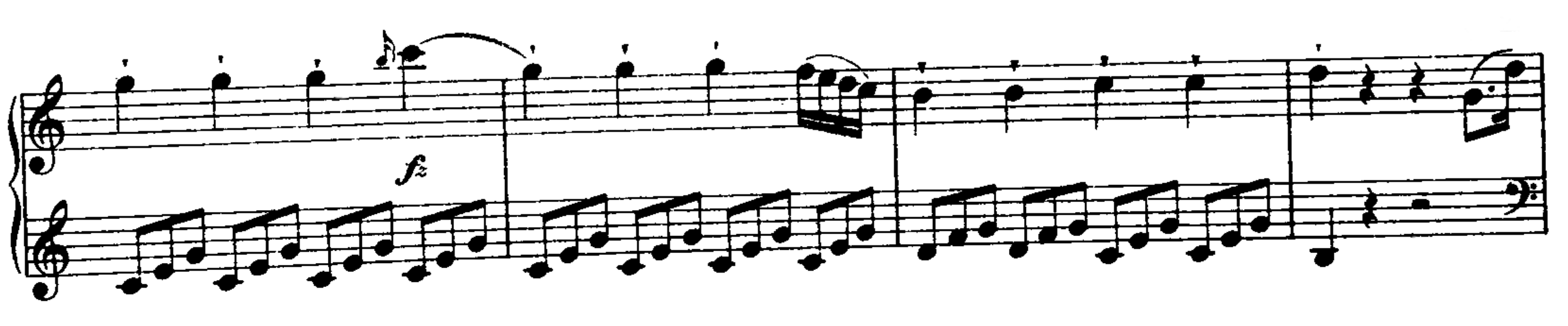
Begin with the left hand alone and hear four beats per bar. Each group of three notes should fit inside one beat. The lowest note of a group can help you feel where the beat begins, but a strong accent on every group soon makes the accompaniment lumber. Aim for a continuous current with an audible harmonic direction.
A useful reduction is to play the right hand with only the first left-hand note of each triplet. This reveals where the melody meets the accompaniment and where it releases. Restore the other two notes at the same tempo. The right hand should keep its detached character while the left hand fills the space underneath.
Listen especially at the right hand's rest in bar 12. The left hand also has a written interruption there. The preceding flow must lead naturally into that silence; rushing the last triplet or dragging the final chord makes the interruption sound accidental. Practice from the previous bar through the next upbeat so the rest has a place in the sentence.
As the accompaniment moves into new positions later in the movement, choose fingerings that let the hand travel with the pattern. A large stretch held in advance often makes the smaller notes heavy. Play one group and the first note of the next, notice the direction of travel, then extend the passage. The important join is the one between groups, where an otherwise fluent hand may hesitate.
Development, pauses and returning material
The first movement's middle section takes familiar gestures through new harmonies and registers. Its changes of colour become much clearer when you know the bass. Reduce a passage to the bass notes and the main notes of the melody, then restore the running figures. Listen for where a new harmony changes the meaning of an otherwise familiar rhythm.
There are also moments when Haydn interrupts the flow explicitly. The score includes fermatas and a brief Adagio indication before Tempo primo. These deserve a different kind of timing from an ordinary phrase ending. Allow the interruption to be heard, then establish the original movement again when the music resumes.
A common problem is to spend so much attention on the pause that the restart has no pulse. Before playing the whole passage, hear the first resumed beat internally. Then practice the last gesture before the pause and the first complete gesture after it. The silence can be spacious while the return remains decisive.
The opening material also returns in a lower register. That change has a colour of its own: the same articulation can sound fuller and more grounded. Avoid reproducing the exact physical force used higher on the keyboard. Listen to the new register and choose the touch that lets the familiar idea speak clearly there.
For the larger shape, identify the first section's repeat, the contrasting middle and the return of recognisable material. Each offers a place to start practice from memory. A performance feels more secure when you know which musical situation you are entering, rather than relying entirely on the previous bar to trigger the next one.
Adagio: melody through the ornaments
The F-major Adagio needs a different kind of attention. Its opening melody contains dotted rhythms, small grace notes, slurs and detached notes. Underneath, the left hand alternates chords, rests and sustained sound. A broad singing character grows from those details.
F major, 4/4. Short left-hand chords and rests give way to held sound; the right-hand line contains grace notes, slurs and ornaments.
Scroll sideways to follow the score.
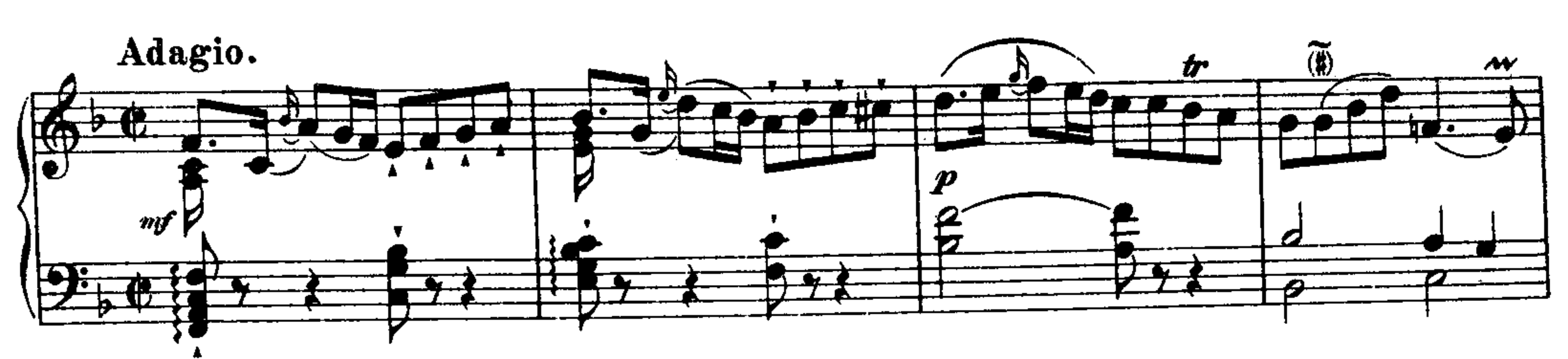
First play the melody at a tempo where the small notes remain intelligible. Hear the destination of each ornament. A grace note that leans toward a main note has a different expressive effect from a quick flourish passing through several pitches. The printed size of a note tells you how it is notated; the harmony and phrase help you decide how it should speak.
For a first reduction, leave out a decoration and play the main melodic notes with the bass. Sing that simpler line. Then put the decoration back and listen for the same direction. If the phrase now stops at every ornament, reduce the passage again and find the notes that carry it forward.
The left-hand rests are particularly revealing. The first two bars contain short chordal events separated by silence, while the third opens with a held sonority. Give those textures different treatment. A pedal that connects every chord indiscriminately removes the change from punctuation to sustained support.
Use pedal by ear, in short amounts where it enriches the sound without covering a release or carrying old harmony into new. Try the opening without it first. That exposes whether the melody itself has a convincing connection and whether the bass has the length written in the score.
A moving bass in the slow movement
From bar 9, the accompaniment becomes a stream of sixteenth notes. The right hand floats above it with longer notes, small turns and much finer divisions. This is one of the places to test before deciding that the sonata is comfortably within reach.
Both staves use treble clef, with one flat. Four left-hand sixteenths fill each quarter-note beat.
Scroll sideways to follow the score.
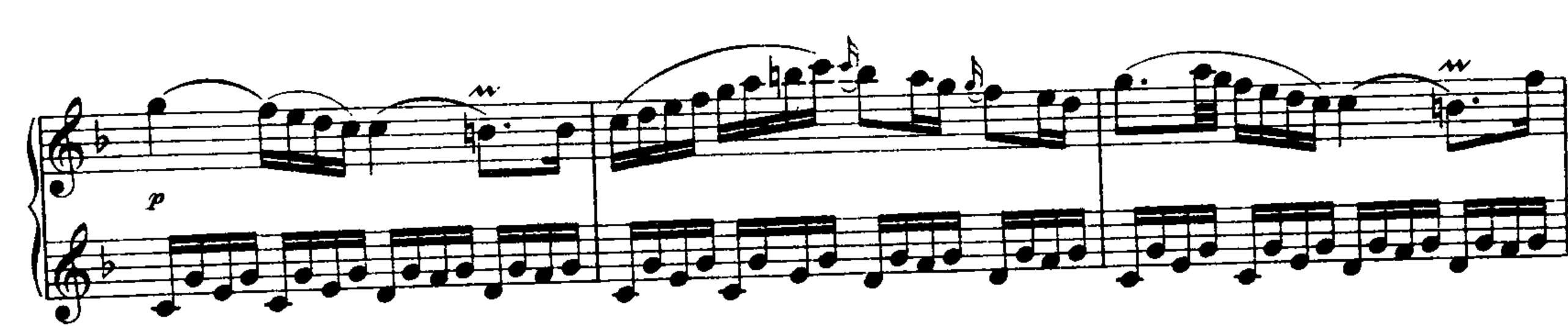
Keep the four quarter-note beats underneath both parts. In the first bar of the excerpt, the right hand's first beat is a quarter note; the next beat contains a quick group before another longer note. The left hand continues its regular sixteenths throughout. Count where each new right-hand gesture begins, rather than trying to make every note in the hands move together.
The longer melody notes need enough presence to survive while the accompaniment continues. If the left hand becomes louder halfway through a held note, the ear follows the pattern and loses the melody. Practice a single bar with a clear melodic beginning and a softer left hand that stays soft until the next melodic event.
Then listen across the bar line. The rise into a decorated high point and the descent afterwards form a larger gesture. A slightly broader arrival can be expressive, but slowing for every small group turns the music into a sequence of obstacles. I listen for whether I can still sing the phrase while hearing all the detail underneath it.
Bring the same care to the repeated sections. Repetition gives the listener another encounter with a phrase; it also gives the player a chance to hear its balance more closely. Preserve the articulation and shape through the repeat instead of treating it as permission to hurry toward the next section.
Finale: three beats and quick replies
The finale is marked Allegro in 3/4. Its opening has a tied note, dotted figures, pairs of slurred eighth notes and a clean cadence. The left hand begins with a rest and enters on the second beat. These are the ingredients of its light, conversational character.
C major, 3/4. The first melody note is tied across the start of beat two, when the left hand enters.
Scroll sideways to follow the score.
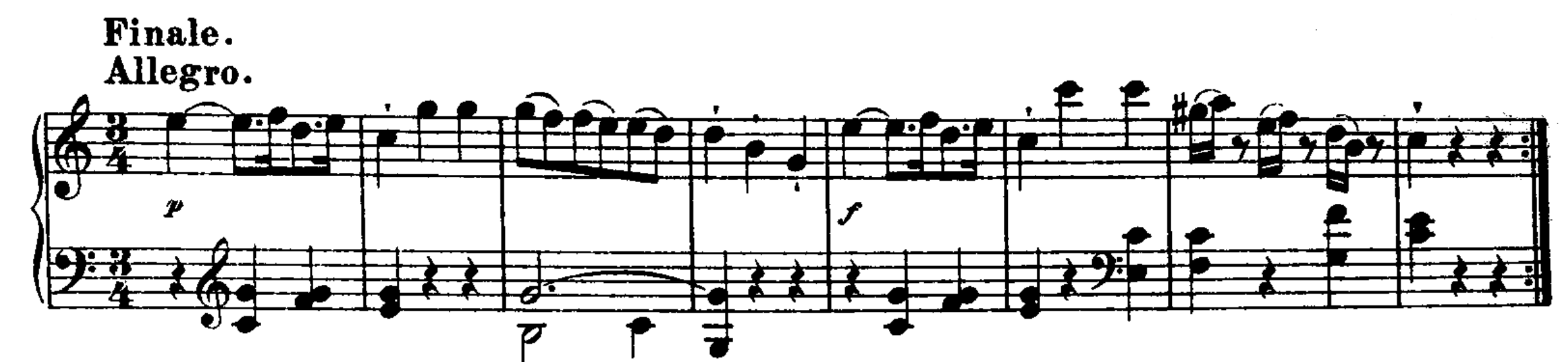
In the first bar, the initial quarter note is tied into the dotted eighth that follows. Sustain it through the start of beat two. A fresh attack there changes the rhythm and makes the opening more square. The left-hand entry on beat two is a new sound beneath a melody note already in progress.
The third bar brings three pairs of slurred eighth notes. Give each pair a small direction, with a lighter ending, while hearing the whole bar as one gesture. Three large wrist lifts and three equally emphatic beginnings make the phrase fussy. The next bar's descending quarter notes supply a broader answer.
The seventh bar has little paired figures separated by eighth rests. Release each figure in time for its rest, then continue to the cadence. In bar eight, the final quarter note is followed by two quarter rests. Keep the three-beat measure alive through both rests before repeating. Otherwise the repeat arrives early and the dance loses its footing.
This is a good passage for comparing two recordings of yourself: one focused on the three-beat pulse, another on the phrase's arrival at the cadence. Listen for whether the second keeps the rhythmic clarity of the first. Expression should make the sentence more persuasive, while the beat still carries the listener through it.
The finale's minor-key turn
Later, the key signature changes to three flats for a C-minor episode. The texture changes too. The left hand now moves in continuous eighth notes, and the right hand opens with a measured quarter-note line. The contrast is already in the writing; it needs room to register.
Treble clef in both staves; three flats, still 3/4. In the first bar, the melody moves C–B-natural–C above continuous eighth notes.
Scroll sideways to follow the score.
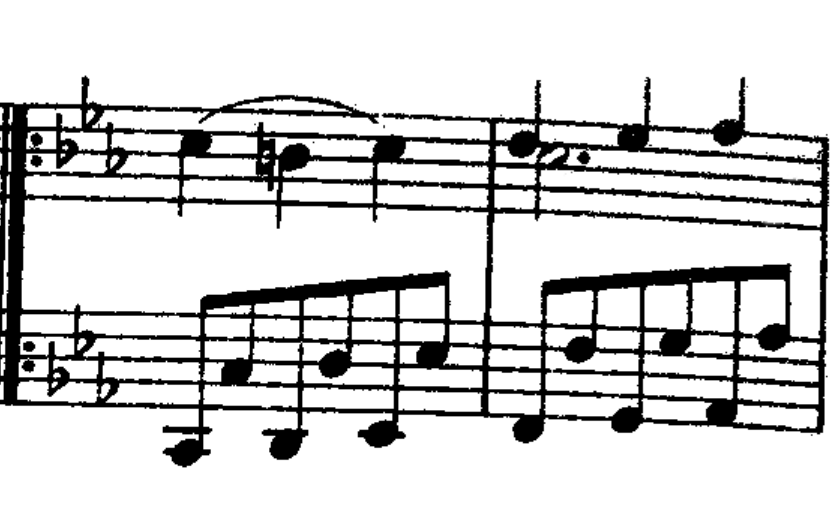
In the first bar of this episode, the melody moves C–B-natural–C. The B-natural has a distinct pull back toward C, even though the new key signature contains B-flat. Play that line with the bass and listen to the tension of the middle note. Merely darkening every note by the same amount misses the expressive movement inside the phrase.
Keep the three-beat pulse from the surrounding music. A different colour can come from a more connected line, the lower harmony and a changed balance. Making the episode drastically slower would weaken its relationship to the finale around it.
When the major-key material returns, let its lighter texture be heard again. The minor episode gives that return a history: the familiar tune now follows a different sound world. Practice the approach to the return as carefully as the tune itself, so the change is audible at the moment it happens.
Bringing the three movements together
Give each movement practice time from the beginning of the project. It is easy to polish the familiar Allegro for weeks and discover the Adagio's coordination demands much later. A short visit to all three reveals the work's range and helps you choose a sustainable tempo for each.
Keep a few musical starting points ready: the triplet-accompanied theme, the first movement's interrupted passage, the Adagio's moving bass and the finale's minor episode. Start directly at one of them, establish its character, then connect it to the music around it. That tests your understanding of the sonata as well as your memory.
For related work, the guide to classical phrase shaping explores how local gestures belong to a longer sentence. Mozart's Sonata K.545 offers another complete-sonata study, with different problems of scale playing, balance and dialogue.