
Hanns Eisler Berlin: Piano, Chamber Music or Lied at Master’s Level?

At master’s level, “I want to study piano in Berlin” leaves an important question open: what kind of musical work do you want to spend the next two years doing? A solo recital, a piano trio and a song recital all demand excellent playing. They also ask the pianist to listen, prepare and lead in different ways.
Hochschule für Musik Hanns Eisler Berlin offers several routes relevant to pianists. Its piano master’s includes a chosen emphasis in concerto playing, chamber music or Lied accompaniment. There are also separate master’s degrees in chamber music and Lied interpretation for pianists. Those similar names describe different study commitments and application requirements.
Four points deserve attention before choosing a course:
- Degree and emphasis: a chamber music emphasis within the piano master’s is different from the separate chamber music degree.
- Your current playing: the audition should reveal the artistic work you are ready to develop, including substantial solo playing on the collaborative routes.
- Musical partners: the chamber music and Lied auditions make different arrangements for fellow performers.
- Language and qualification: check the requirements for the exact master’s course, rather than borrowing the bachelor’s rules.
Three master’s routes
The piano master’s combines principal piano study with a selected Schwerpunkt, or emphasis. Its published 120-credit plan assigns 66 credits to principal study, 20 to the chosen emphasis, 14 to individual profile development and 20 to the final project. Within the profile area, four credits must come from academic or theoretical subjects.
The three emphasis options are Klavierkonzert, Kammermusik and Liedbegleitung: piano concerto, chamber music and Lied accompaniment. You choose one. The module catalogue says that an emphasis already begun cannot be changed, so this deserves discussion before enrolment. It shapes a sustained part of the course, alongside your main piano work.
The separate chamber music and Lied degrees place the collaborative discipline at the centre of their identity. All three routes have a standard duration of four semesters and advertise both winter and summer entry. The distinction is therefore about the content of those semesters, rather than the length of the course.
01
Piano master’s
Klavier
Principal piano study with one 20-credit emphasis.
Piano concerto · Chamber music · Lied accompaniment
02
Chamber music master’s
Kammermusik
Chamber music as the degree’s central discipline.
Individual piano applicants or eligible ensembles
03
Lied master’s for pianists
Liedgestaltung für Pianist*innen
Song interpretation and sustained work with singers.
A separate programme for pianists
Four semesters in each route. An emphasis within the piano degree and a separate specialist degree have their own curricula and admissions requirements.
The university has two principal locations in central Berlin: Charlottenstraße 55 and the Neuer Marstall at Schlossplatz 7, shown in the opening photograph. For course choice, though, I would begin with the curriculum and the playing. A compelling city and a distinguished name cannot answer the question of what you want to hear changing in your own performances.
Solo piano and concerto work
A pianist choosing the piano master’s might want to develop a broader recital repertoire, gain greater command of musical form, or become more convincing in a concerto. Those are substantial ambitions. “Better technique” becomes a useful study aim when you can identify what the present limitation costs the music: a melody loses its line over repeated chords, or a fast passage arrives without the harmonic tension that gives the arrival meaning.
Concerto preparation brings an additional kind of attention. Imagine the piano entering after an orchestral introduction in Mozart. Practising from the first solo note can produce a secure entry in isolation while leaving the tempo, character and breath of the preceding music vague. I would ask the pianist to sing or play the orchestral phrase before beginning, then notice whether the first piano gesture belongs to that same sentence.
Later in the movement, the orchestra may finish a thought that the piano has started. A pianist who knows only the solo part can mistake that moment for a pause in the work. Following the full score reveals the direction of the phrase, and changes how the pianist releases the preceding sound and prepares to return. Concerto study includes this knowledge of the surrounding music, as well as projection and virtuosity.
The degree also asks for an artistic final project with written documentation. The university’s 2026 examination amendment describes that documentation as a professional programme booklet. Choosing repertoire therefore involves an argument that you can express through playing and explain in words: why these works belong together, what you hear in them, and how your interpretation responds. That is a useful test of a proposed master’s direction even before an application.

One-to-one classical piano
Beginner to advanced. Online, worldwide.
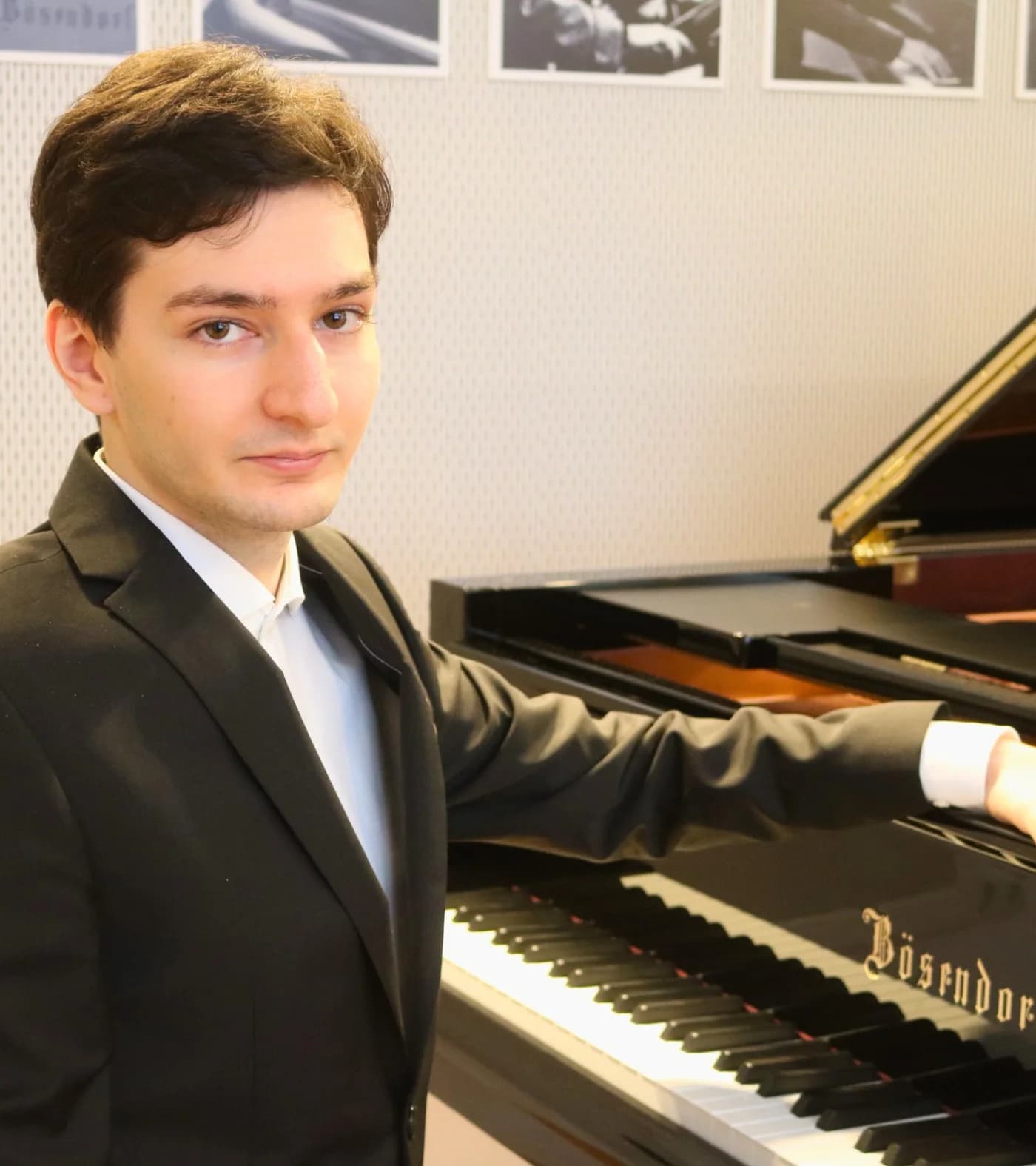
Enea
Concert pianist from Vienna
30 minutes · Ikebukuro & Shinjuku studios from October 2026
Chamber music and shared decisions
Chamber music requires strong individual ideas and an ear for how those ideas affect other players. In a piano trio, a melody may pass from violin to cello while the piano continues the same accompaniment pattern. The notation in the piano part scarcely changes, yet the balance, colour and timing may need to change considerably. The new voice has a different register, resonance and way of sustaining a note.
I find it revealing to ask a pianist where the melody is going during such a passage, then hear the same bars again. When the answer is audible, the accompaniment acquires direction. Simply playing more quietly may leave the phrase just as static as before.
Rehearsal is another part of the discipline. “Can we try that again?” is less informative than identifying the musical event: the cello’s arrival is being covered, the piano bass is changing the perceived pulse, or two players are placing a dissonance differently. A good suggestion leads to an experiment that everybody can hear. The result may change the pianist’s original idea as much as the partners’ playing.
Hanns Eisler’s separate chamber music master’s accepts individual piano applicants as well as ensemble applications. The ensemble route is described for Lied duos or groups of at least three instrumentalists; exceptions require a separate decision. A violin-and-piano duo should therefore ask about its eligibility before treating the ensemble route as an automatic fit.
For an individual pianist, the live audition includes a collaborative stage after the initial playing has been passed. A chamber work is assigned two weeks beforehand, and the university provides the other players. The open rehearsal asks the pianist to take an active musical lead among colleagues. That is a strong indication of the kind of readiness to cultivate: learn the other parts, form an interpretation, and be prepared to revise it in the room.
Lied and the singer’s text
Lied interpretation gives language a direct role in musical decisions. A pianist accompanies a person saying something, with consonants, vowels, stresses and breaths. Knowing the translation is a beginning. The next step is hearing which word carries the thought, and how the piano’s harmony and gesture respond to it.
Take a song with a repeated accompaniment figure. It is tempting to settle the pattern into a consistent motion and keep it there. But the singer may move from description to a question, or repeat a word with a changed meaning. The pianist has to decide whether the figure preserves its regularity against that change or participates in it. Both can be expressive; an unexamined habit is less persuasive.
Breathing raises similarly musical questions. A singer may need time before an important phrase, while the piano harmony is already drawing the listener forward. Stopping all movement can break the sentence. Pushing through can make the entry feel rushed. In rehearsal, I would listen for where the harmonic energy can continue through a breath, and where a genuine release belongs. The answer comes from the text, the phrase and the singer in front of you.
The separate Liedgestaltung für Pianist*innen master’s is for pianists developing this partnership. Its module catalogue centres on preparing concert programmes with singers and presenting them professionally. This is a useful distinction from adding some song repertoire to a mainly solo piano degree: the collaborative work is the principal artistic subject.
The audition reflects that focus. Alongside Bach and Classical solo repertoire, applicants prepare ten songs from different stylistic periods. Choosing the songs also means choosing a workable collaboration. You will need a singer for the recordings and must bring your own singing partner to the live audition. The university strongly recommends an introductory conversation with the subject adviser before applying.
Audition repertoire and recordings
The first stage for these courses uses recordings submitted through Muvac. The portfolio differs by route, so a set of files prepared for one application may leave an important part of another unanswered.
For the piano master’s preselection, the current requirements name a Baroque polyphonic work, one movement of a Classical sonata and a virtuoso étude. The pianist must be visible in full, including hands and feet; recordings must be no more than a year old, unedited in sound and image, and played from memory. Where a complete work is required, include all its movements.
The live piano programme broadens to at least four works from different stylistic areas: a polyphonic work, a Classical sonata, a representative Romantic or Classical-modern work, and a work composed after 1950. Sight-reading is also tested. The memory exception is the work after 1950. The sonata requirement at this stage is a sonata, with three or four movements recommended, rather than the single movement requested for preselection.
For an individual chamber music applicant, preselection requires at least 30 minutes with at least two complete, demanding solo works from different periods, including Bach or a Classical sonata. For an ensemble, the minimum is 60 minutes across three stylistic periods, including Baroque or Classical repertoire, with at least two complete works. The ensemble should be the one intending to study together. Both routes require recent recordings, with whole works unedited.
There is a discrepancy to resolve before finalising an individual chamber music live programme. The current course webpage asks for three complete works, including at least one representative solo work, while the linked admission order lists two solo works plus an étude. Ask the university’s study adviser which programme applies to your intended intake. The separately described rehearsal with university-provided partners follows the initial examination.
For Lied preselection, the two solo items must be on video; one movement is sufficient for the Classical item at this stage. Submit all ten songs with a singer, with at least three as video and the remainder permitted as audio. The recordings must be no more than 12 months old. At the live audition, the published programme again names Bach, a Classical work and ten songs from different periods; memory is preferred for the solo works.
- Individual chamber applicant
- The university supplies partners for the second-stage chamber rehearsal. The assigned work arrives two weeks before the audition.
- Lied applicant
- You arrange a singer for your recordings and bring your own singing partner to the live examination.
What this means for musical preparation
For the chamber rehearsal, know the full score and arrive with ideas you can explore with unfamiliar colleagues.
For Lied, prepare the poem, breathing and piano part together with your singer. The recorded performance already needs to reveal that partnership.
A recording should make the musical point of the chosen work audible. In a fugue, I would listen for the entries and the longer harmonic direction, including passages where the subject is absent. In an étude, listen beyond speed to the continuity of sound and the shape of the phrase. Our guide to listening to your own piano recording offers a way to separate those observations from the distraction of every small slip.
Qualifications and German
The piano master’s admission information specifies a Bachelor of Music with 240 ECTS, or an equivalent qualification in the intended principal subject. Equivalence is assessed by the university. A degree from another system should be presented with its transcript and course information; counting its local credits as though they were ECTS would not establish equivalence.
The separate chamber music and Lied admission orders have their own qualification wording. The individual piano and Lied routes ask for a relevant bachelor’s or equivalent in piano; the ensemble route requires the members’ qualifying degrees. Read the order for the degree you are applying to instead of transferring the piano master’s 240-credit wording to every course with a piano in it.
Language also needs a course-specific reading. The piano and Lied pages list German as the teaching language; chamber music lists German and English. At present, the university’s application FAQ says that a language certificate is not required for master’s or Konzertexamen applicants. Its B2.2 certificate rule concerns bachelor’s entry.
That leaves a practical question for a master’s applicant: can you take part in the work? A Lied pianist needs to discuss text and its musical implications. A chamber musician needs to understand a colleague’s suggestion and offer a precise response. Even when an individual conversation can happen in English, German opens more of the surrounding study and daily life.
Useful preparation might begin with a familiar passage: explain where you want the phrase to move, ask to start on the upbeat, or describe why the bass should remain lighter. These are small but demanding acts of musicianship in another language. They also reveal vocabulary worth learning far more clearly than memorising an unrelated list of examination words.
Dates and professor contact
The current application calendar gives 1 October to 8 November 2026 for summer-semester 2027 entry, with the university’s examination period on 18–22 January 2027. For winter-semester 2027/28, it lists 15 February to 8 April 2027, with examinations on 7–11 June 2027. These are university-wide periods; the invitation supplies the applicant’s actual examination arrangements.
Before contacting a professor, decide what you want to learn from the exchange. Perhaps you want to discuss the concerto emphasis within piano, or ask whether your current ensemble experience supports an individual chamber music application. A short account of your recent repertoire and one or two well-chosen recordings gives that conversation a musical basis.
An introductory lesson can be especially revealing when you bring a passage with a real interpretative question. Notice the teacher’s priorities and how you respond to them. Does a suggestion alter your hearing of the phrase? Can you carry it into the next passage independently? Those observations tell you something about the work a longer period of study might contain.
Keep formal eligibility and application questions with the university’s responsible office or subject adviser. A conversation with a teacher and an application through the official process serve different purposes. Our guide to emailing a piano professor in Germany or Austria covers the first contact in more detail.
Preparation from Tokyo or online
In lessons, I would begin with the music that makes you want this particular course. A pianist considering solo study might bring a sonata and a concerto passage; a chamber applicant might bring both solo repertoire and the full score of a recent collaboration. For Lied, the poem belongs beside the score from the beginning.
We can then work on the demands that are actually present: the sonata’s larger structure, the independence of voices, a reliable performance from memory, or the way a piano texture leaves space for another musician. Recordings of chamber or song performances add something that solo playing cannot show. They reveal how you respond to another person’s timing, colour and phrasing.
I also teach music-focused German and can help with professor correspondence and application communication. The language work can grow directly out of the repertoire, including rehearsal vocabulary and explanations of your musical choices. Preparation should leave you able to speak about and take responsibility for your own playing.
Vienna Piano School offers lessons for students from junior-high-school age through adults. Online lessons are available now, with in-person teaching at piano studios in Ikebukuro and Shinjuku, Tokyo, from October 2026. You can request a free 30-minute trial through the lesson application form. Include the degree you are considering and the repertoire currently on your desk.