
Für Elise Beyond the Opening: Learning the Complete Piece
The opening of Für Elise is often one of the first pieces an adult remembers from the piano. E, D sharp, E, D sharp: the sound comes back quickly. Learning the complete work brings a different challenge. Beyond that familiar theme are a brighter episode with quick right-hand figures, a tense repeated bass, and a rising passage that must find its way home.
To learn the whole piece, give those contrasting sections their own musical character and practise their connections to the theme. Speed is one part of the work. So are holding a chord while the other hand moves, hearing a melody through accompaniment, and returning to a familiar phrase without a sudden change of pace.
Look at the middle sections early in your work on Für Elise. They reveal what the complete piece will ask of the hands and ears, while there is still time to choose useful fingerings and a workable tempo.
The complete original
A score labelled Für Elise may contain the whole original, an excerpt of the main theme or an arrangement. Look through every page. The complete work includes the contrasting episodes discussed below; their demands can be substantially greater than those of a simplified opening.
Beethoven’s A minor bagatelle
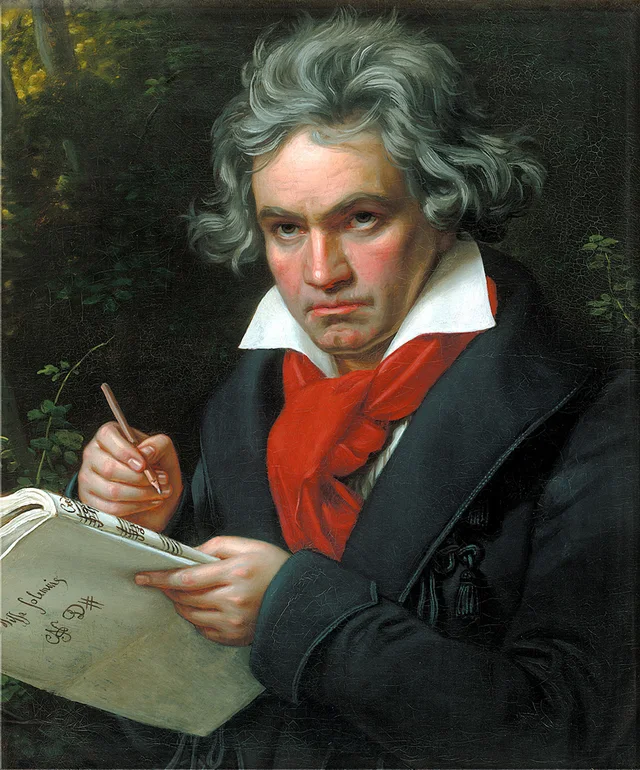
The piece dates from 1810 and was first published in 1867, after Beethoven’s death. Its familiar opening belongs to a complete work with contrasting episodes and returns. When choosing a score, look for Für Elise, WoO59 and check whether it is the original or an arrangement.
The examples here follow Stelios Samelis’s Mutopia engraving, based on the 1888 Breitkopf & Härtel edition. Its written bar numbers provide our reference points. Another edition may count the pickup and alternative endings differently, so match the notes and texture as well as the number.
Read the repeats in your own score before practising a continuous performance. A first ending and a second ending lead to different places. Knowing where the next phrase begins also helps you start from the middle during a lesson, instead of needing a run-up from the first E.
Hear the three textures
Listen through the complete piece before concentrating on a difficult bar. Follow these changes in the writing:
- The returning theme: a melody and broken chords passing between the hands.
- The brighter episode: a more continuous accompaniment, decorated melody and later bursts of fast notes.
- The repeated-bass episode: persistent low notes beneath changing right-hand harmonies, followed by the rising passage and return.
Wilhelm Kempff: Beethoven’s Für Elise
Decca. Listen on YouTube.
Use the performance to keep the whole work in your ear while practising smaller sections. The useful question is how each episode leads back to the theme. Learning its notes in isolation is only part of that journey.
The opening phrase
The familiar E–D-sharp figure should have somewhere to go. Sing the opening phrase through to its arrival on A, then listen to what happens when the left hand enters. If every E receives the same accent, the melody can become a repeated signal rather than a phrase.
The broken chords also pass the sound across the hands. A left-hand bass note, the notes above it and the right hand’s continuation belong to one flowing gesture. Practise the handover slowly enough to hear the last note from one hand lead into the first note from the other. A pause to search for the next position is audible even when all the pitches are correct.
Keep the accompaniment present but proportionate. A bass note can give the phrase warmth without becoming its loudest event. Play the melody alone, remember that sound, then add the left hand while keeping the melody in focus.
The printed metre is 3/8. When reading, three eighth-note subdivisions help you place the rests and smaller notes. As the playing becomes fluent, hear the larger movement of the bar too. The music should flow beyond a succession of three equally stressed counts.
The brighter episode
In the reference score, the first contrasting episode begins at bar 24. The accompaniment now moves in a more continuous stream of sixteenth notes, beneath a melody with decoration and dotted rhythm. That change of texture deserves attention before the later fast passage attracts all the practice time.
3/8. Upper staff: treble clef. Lower staff: bass clef.
Swipe across the score to follow the passage.
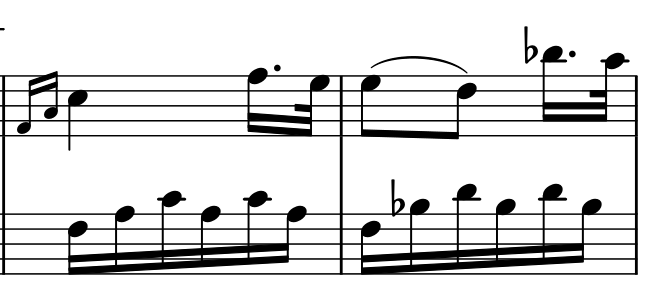
Find the main melody notes before adding the decoration. Keep their direction audible above the left hand.
Find the main melodic notes first, then fit the small ornamental notes into their approach. The melody needs a clear line through the decoration. If the ornament makes you rush the following note, play the phrase without it once, hear the timing of the main notes, then restore it within that phrase.
In bar 25, the first two right-hand notes are joined by a slur while the accompaniment continues underneath. Listen to that small melodic gesture and the space around it. Six left-hand notes in a bar can easily flatten the phrasing into a stream of equal events; the right hand gives the listener another layer to follow.
Practise the accompaniment at a comfortable pace and notice its changing notes. Then add only the main melody notes before returning the decoration. This reveals whether the coordination is interrupting the phrase or whether the phrase itself is still undecided.
The fast notes in bar 31
The right-hand thirty-second notes are a different rhythmic task from the accompaniment that preceded them. Each eighth-note subdivision contains four right-hand notes. The hand must travel through a changing pattern while the left hand places its own notes and rest accurately.
3/8. Both staves use treble clef at this point.
Swipe across the score to follow the passage.
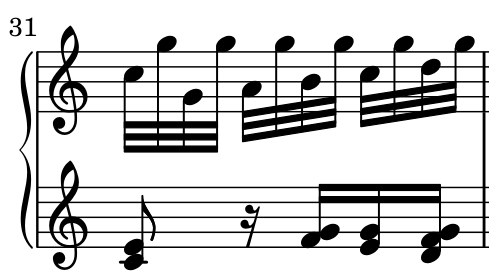
Locate the left-hand entries within the right-hand groups, including the space occupied by the rest.
Read one four-note group, then look at the move into the next group. A high G recurs in this bar, but the notes between those Gs change. Find those changing notes deliberately. Accenting every repeated G may make the pattern easier to track at first, but it gives the passage a shape you may not want in performance.
The left hand starts with an eighth note, then has a sixteenth rest before three sixteenth-note chords. After the rest, each chord coincides with a particular right-hand note. Mark those meeting points mentally or in a short practice note. Playing the right hand quickly on its own will not settle that relationship.
Begin at a pace where you can hear the groups and place the left hand reliably. Then work on one group and its next arrival at a quicker pace, before joining a longer span. When the pattern breaks, identify the exact transition: the end of one group, a left-hand entry or a change in fingering.
Continue beyond bar 31. The following bar travels through a wider range and has its own turn at the top. Practise through the end of that gesture, rather than treating the first successful burst as the finish line. The repeated appearance of a pattern is also an opportunity to hear whether the second attempt has the same clarity as the first.
Repeated bass notes and held chords
The second episode introduces a repeated low A at bar 60. The right hand then adds longer harmonies. The musical tension comes from the relationship between the persistent bass and the changing chords; it need not come from making every bass note forceful.
3/8. Upper staff: treble clef. Lower staff: bass clef.
Swipe across the score to follow the passage.
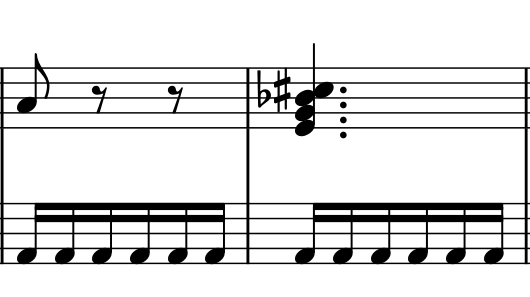
In bar 61, hear the held chord through all six left-hand attacks. Keep its full written duration.
In bar 61, the right-hand chord lasts the full bar while the left-hand A sounds six times. Play the right-hand harmonies alone and listen to where they move. Then add the repeated bass, keeping the chord’s duration intact. A common coordination problem is rearticulating the right hand whenever the left hand strikes; the score asks the hands to do different things.
For the repeated note, allow the key to return between attacks and look for a manageable, responsive movement. On an unfamiliar piano, begin slowly and listen for missed or uneven notes. The instrument’s response matters, so find a movement that works on the piano in front of you instead of forcing a remembered sensation.
Follow the whole episode’s harmonic changes. The bass eventually changes too, and the right-hand chords move through different colours. Learning only the first repeated A pattern can leave the later transitions unexpectedly insecure. Practise from more than one starting point, including the approach to the passage that follows.
Pedal should support the harmony while preserving its changes. Try a short span without it to hear the written durations, then add pedal and listen for unwanted overlap. The guide to clear sustain-pedal changes explains how to compare the old harmony with the new one at the keyboard.
Triplets and the rising passage
Bar 78 introduces a new subdivision: three sixteenth-note triplets within each eighth-note unit. Earlier, the thirty-second-note passage put four notes in that same amount of time. The difference needs to be clear in the ear before the hands attempt the run.
3/8. Upper staff: treble clef. Lower staff: bass clef.
Swipe across the score to follow the passage.
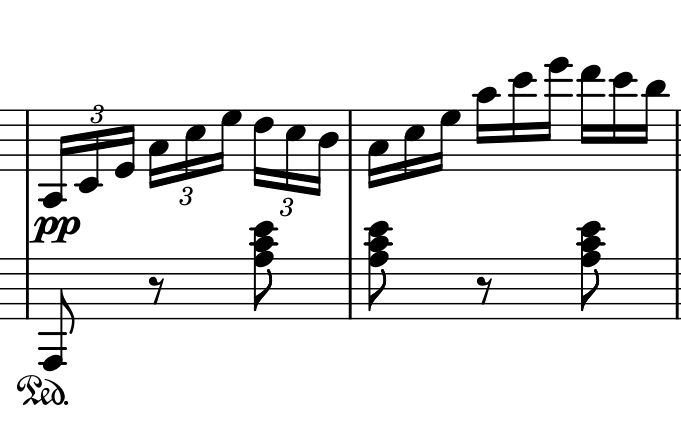
Keep the groups of three distinct from the four-note subdivision used in bar 31. Include the turn after the ascent.
Read the first bar in three groups of three. Hear the shape rise and then turn down. Choose fingering that allows the hand to move to the next position, and include the arrival after a change of position in your practice. Stopping just before the move leaves the difficult part untested.
The left hand adds a low bass note, a rest and a chord. Place those events against the right hand’s groups. The accompaniment can help you feel the span of the bar, provided you keep its sound in balance and avoid waiting for it at each entry.
The next bars rise higher. Follow the octave indication where it appears in your edition; the written position on the staff and the sounding register must both be clear. At the top, listen forward into the descent. A successful climb that ends in uncertainty still leaves the phrase unfinished.
If the hand tightens as the register rises, shorten the passage and slow it enough to organise the next position. Work out the movement with the score and keyboard in view. More repetitions at the same speed are useful only when you know what you are trying to change.
Returning to the theme
The descending passage brings the right hand back to the familiar E–D-sharp figure. In this edition that figure is recognisable again in bar 83, and the left-hand broken chord follows in bar 84. The connection is part of the phrase, not simply the end of a technical exercise.
The complete system keeps the returning accompaniment and pedal marks in view.
Swipe across the score to follow the passage.
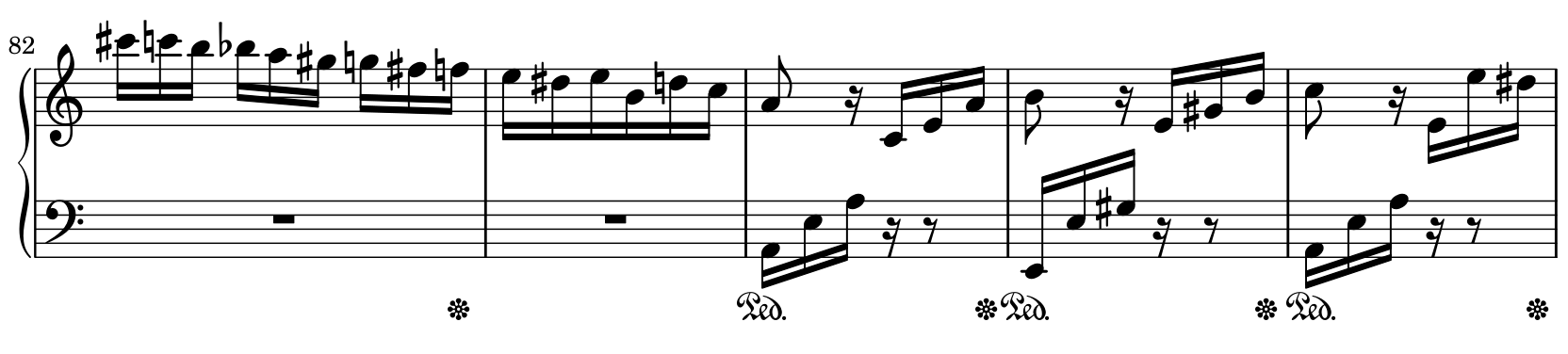
Practise from within the descent until the melody and accompaniment have settled, rather than stopping at the first familiar notes.
Start within the descent and continue through the theme’s arrival on A and the following accompaniment. Listen for two possible disruptions: a pause while the hand searches for the familiar notes, or a sudden rush because those notes feel easier. Keep enough of the preceding passage in the practice span to hear the transition honestly.
The earlier return from the brighter episode deserves the same attention. Find where its fast texture begins to thin and where the E–D-sharp gesture reappears. Practising the theme from the very beginning will never exercise that entrance. Begin before the return and finish after the melody has settled.
A returning phrase can carry a different feeling after what has preceded it. I would explore that through sound and direction: perhaps the opening now feels more inward, or its simplicity offers relief after the repeated bass. Try a musical choice and listen to the complete connection, rather than adding a pause merely to announce that the theme is back.
A tempo for the whole work
During practice, different passages will have different working speeds. When you play through, choose a pace that gives the episodes room to remain clear. An opening that races ahead of everything else makes the contrast sound accidental.
Let the finer subdivisions serve the phrase. Counting four notes or three notes is a reading tool; in performance, the listener should hear the line moving through them. If the pulse becomes uncertain when you stop counting aloud, return briefly to the smaller units and hear where the next beat belongs.
Keep a separate place for the ending. Begin from the last return of the theme and play to the final release, listening to the remaining resonance. The ending should belong to the same sound world as the rest of the piece. Reading its final note lengths and rests is as much part of learning the original as mastering the run.
What finishing sounds like
A complete run-through gives you information that a successful difficult bar cannot. Can you keep listening to the melody after the first episode? Do the repeated notes remain responsive later in the piece? Does the final return have a clear destination?
Choose one of those questions for a run-through, then return to the passage that needs attention. This keeps the whole piece present without spending every practice session repeating the opening. The practice guide to choosing a focused musical test develops that approach through another short work.
If the episodes are far beyond your present reading or coordination, pair Für Elise with shorter music that develops the missing skill. The repertoire-level guide can help you judge that balance. A favourite piece can stay in your plans while your playing gains the resources it needs.