
Applying for Piano in Freiburg: Documents, Repertoire and Audition

Applying for piano at Hochschule für Musik Freiburg involves an online application and a separate paper submission. For a Bachelor Musik applicant, the musical preparation centres on three contrasting styles and an étude, alongside the supporting entrance tests. The application form and the audition programme deserve attention at the same time: choosing the music comes too late if it begins after the documents have been sent.
This guide concerns classical piano as the main subject in the Bachelor Musik. The next application window is for summer semester 2027. Start with four points:
- Choose the piano degree and profile that match what you want to study.
- Complete both the portal application and the paper submission for the same intake.
- Prepare stylistic breadth across your programme, including the additional étude.
- Work on aural skills, theory and musical German while the repertoire develops.
The Freiburg piano degree
Freiburg offers piano study within an eight-semester Bachelor Musik, with artistic and artistic-pedagogical profiles. Look beyond the name of the principal teacher when comparing these routes. The curriculum describes the kinds of musician you will be asked to become, including work that takes place away from a solo lesson.
The artistic piano study plan, for example, includes chamber music and Lied, historical performance practice, contemporary playing techniques and notation, and substantial theory and aural work. Even this performance-focused route includes music pedagogy and teaching methodology. Its published total is 240 ECTS credits.
That breadth is worth considering before an audition. A pianist who enjoys shaping a vocal line with a singer, listening inside a string texture or discussing a score has interests that belong within this course. If your recent preparation has consisted almost entirely of solo competitions, try some collaborative playing too. Accompanying a song reveals whether you hear the singer's breath and words; the same sensitivity can change the way you phrase a solo melody.
When I discuss a possible course with a student, I want to hear what they hope to learn after admission. “I want to study piano in Germany” names a destination. “I want to develop my chamber playing while strengthening my Classical repertoire” gives us a musical purpose against which to read the course.
Online registration and paper submission
For summer semester 2027, Freiburg's dated application notice gives the following sequence. The portal opens on 1 October 2026. Online registration closes on 1 November at 23:59, and the paper application must be sent by 2 November, using the postmark date. The entrance-examination period is 25–30 January 2027.
01
Online application
- Date
- 1 October–1 November 2026
- What happens
- Register through Freiburg’s campus portal. The window closes at 23:59 on 1 November.
02
Paper documents
- Date
- Send by 2 November 2026
- What happens
- Mail the application and required papers. The current notice uses the postmark date.
03
Entrance examinations
- Date
- 25–30 January 2027
- What happens
- Read the invitation for your individual appointment and examination arrangements.
Postmark or arrival date?
The summer 2027 notice says “Datum des Poststempels”: the date stamped by the postal service. Send the package early and keep the posting record. The online deadline is a separate requirement.
Use the notice for your specific intake when checking dates. The paper requirement remains part of the application even after the portal stage is complete. Freiburg sends updates through the portal, so keep reading its messages after submission.
For an international applicant, the sensible practical deadline is earlier than the published final day. A translation that needs correcting or a certificate that needs certification can take longer than entering the online form. Work backwards from the document that depends on somebody else, then leave the final weeks free for playing. An evening spent chasing a missing school certificate is an evening that cannot be used to hear an entire movement properly.
The January examination period is a range for the institution. Your invitation provides the personal arrangements. Keep travel planning flexible until those details are available, particularly if other conservatoire auditions fall nearby.


One-to-one classical piano
Beginner to advanced. Online, worldwide.
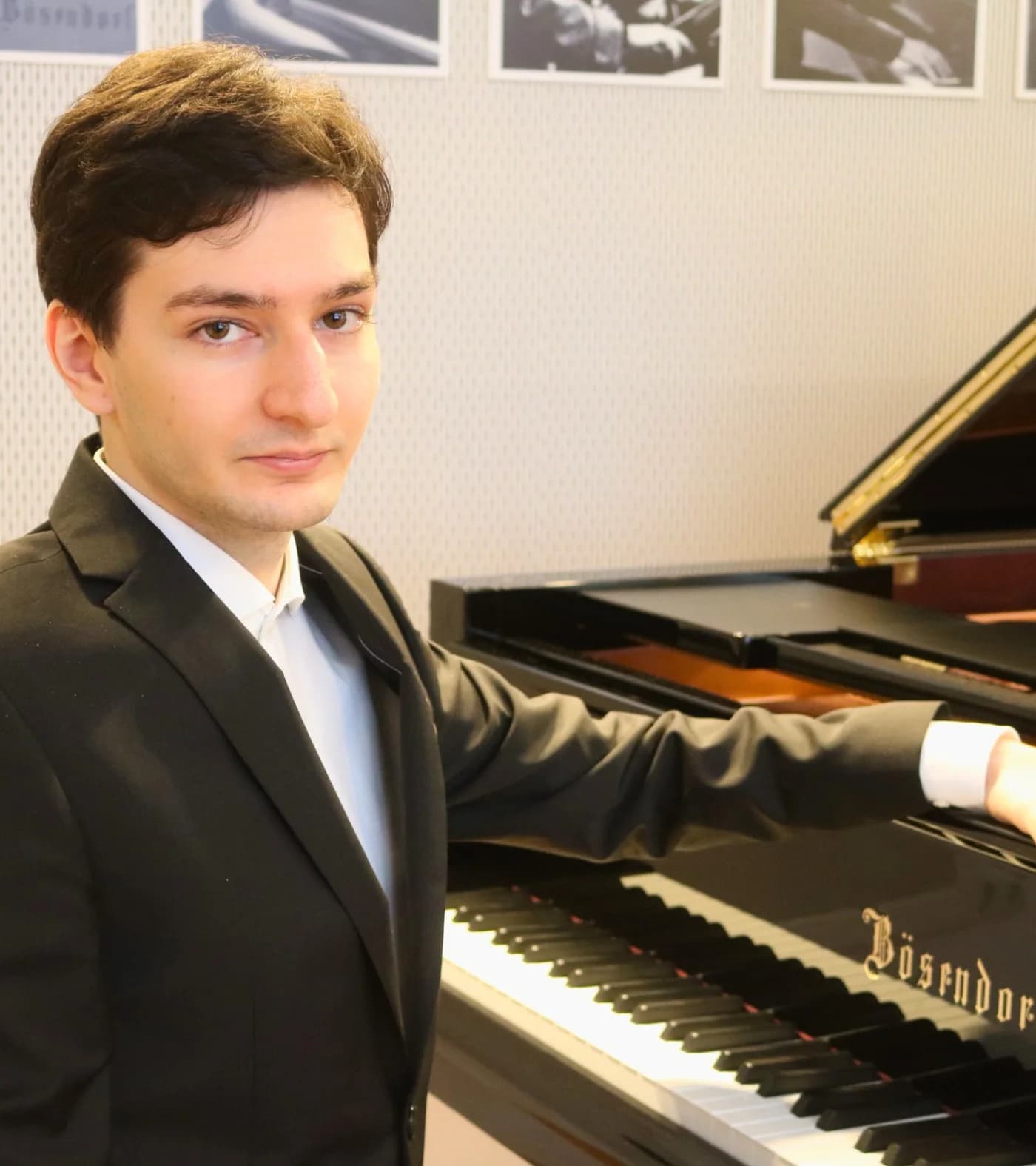
Enea
Concert pianist from Vienna
30 minutes · Ikebukuro & Shinjuku studios from October 2026
Certificates and the musical CV
The required papers include the completed application, an attached passport photograph, a current chronological CV, proof of the €50 application fee, academic records and the relevant language evidence. The school-leaving qualification requires a certified copy; foreign-language certificates need certified German or English translations. Existing university students also submit a current transcript. Use the official document list for the complete requirements and the university's assessment of your qualifications.
The CV has a different job from an audition programme. It gives the reader an intelligible account of your education and musical development. List institutions and study dates consistently, then the relevant teachers, courses and performance experience. A recital entry should identify your role: solo recital, chamber concert and accompaniment describe different experience.
For a student still at school, the most useful detail may be a sustained period of piano study and a small number of substantial performances. For somebody transferring from a university, the current course and completed study deserve prominence. Keep dates continuous and explain a significant change of direction in plain language. A period spent working before returning to serious music study belongs in that chronology.
Repertoire needs more precise naming. “Beethoven sonata” leaves the reader to guess which piece and how much of it you offer. Give the key, opus number and movement where applicable. Use the same title on your repertoire list and in correspondence. If your school certificate or degree title has no obvious German equivalent, retain its actual name and supply the requested translation; let Freiburg decide eligibility.
Three styles and an étude
The Bachelor piano requirement is three works, or individual movements, from three different styles, plus an étude. The wording allows movements; it does not require every sonata offered at this level to be complete. The étude is additional to the three stylistic selections.
This leaves room for a programme that reflects your strengths. One possible shape is a contrapuntal work, a Classical sonata movement and a Romantic character piece, followed by an étude. A twentieth-century selection could change that balance. The named combination is a planning example, not a prescribed Freiburg list: the actual works must demonstrate suitable musical and technical development.
Start by hearing the pieces together. Does each introduce a different musical world, or do all four rely on a similar fast, brilliant surface? A lyrical choice needs sustained tone and harmonic direction. A transparent Classical movement exposes timing and balance. A contrapuntal piece asks the listener to follow several lines at once. These contrasts give the programme its substance.
I would be cautious about replacing a convincing piece simply because another has a more imposing title. In an audition, the slow transition, the return of a theme and the final cadence all belong to the performance. A difficult opening followed by several pages of uncertainty presents a different picture from a work that you can shape throughout.
Freiburg's general Bachelor rules allow the panel to select from the submitted list and interrupt a performance for time. The usual main-subject duration is around 15 minutes; where a preliminary round is used, the rules describe approximately 10 minutes for each round. Follow the invitation for your actual format. Prepare every selection, including an independent start in each musical character.
Contrast in the sound
Stylistic contrast should be audible before somebody reads the programme. This is where preparation becomes more interesting than sorting composers into columns.
In a Bach fugue, take a passage where the subject enters in an inner voice while another line continues above it. Play the entering voice alone and hear its full shape. Then add the upper part, keeping its phrase alive without covering the new entry. The goal is a listener who can follow both events. Accenting every subject note may make the entry obvious while destroying its line.
Move from that texture to a Mozart or Beethoven sonata movement and listen again to the accompaniment. A repeated figure can support a phrase, suggest agitation or keep a quiet pulse moving. Giving each note equal weight often makes the passage sound busy. Try melody and bass alone, locate the harmonic arrival, then restore the middle notes with that destination still audible.

For a Romantic selection, notice how the melody behaves when the harmony changes underneath it. A long note may become more expressive because of a new bass, even though the melodic pitch stays the same. Practise that span slowly, listening to the bass change and releasing the old pedal before it obscures the new colour. Then restore the phrase's larger motion. Lingering at every harmonic event can prevent the line from reaching its destination.
The étude needs a musical identity too. In passagework, decide where the pattern is going: towards a bass arrival, a change of register, a new harmony or a climax. Test the difficult figure inside the preceding phrase. An isolated pattern can run fluently while its approach still causes the pulse to tighten. The audition performance includes that approach.
When reviewing a recording, compare the first half-minute of each selection. Listen for changes in articulation, proportion and tone. If they all sound like the same piece played at different speeds, return to the score's texture and phrase structure before making another complete recording.
Aural skills and theory
Freiburg's supporting Bachelor tests include aural work and theory, with written and oral tasks. The currently linked written aural sample is a 2023 paper. It illustrates the task types, including intervals, chords, a chord progression, and one- and two-voice dictation; it is useful practice material rather than a prediction of the next paper.
Try the sample before judging your preparation from general confidence at the piano. Playing complex repertoire and writing down an unfamiliar short phrase use overlapping musical knowledge, but the act of listening, retaining and notating needs its own practice.
For a two-voice example, first listen for the metre and the direction of the bass. Sing the upper line after a hearing. On the next attempt, follow the lower line and notice where the voices move together or apart. Write what you retain, then compare it with the score. If a rhythm was wrong, speak the corrected rhythm against a steady beat before adding pitch. If a pitch was wrong, sing the phrase through the point where its direction changed.
This kind of review produces a useful distinction. You might hear the melodic contour but lose the rhythm, or write a plausible bass that belongs to a different harmony. Repeating the entire exercise without examining the error leaves both problems hidden under the label “ear training.”
Theory preparation should include making music with the concepts. Freiburg's requirements include written harmonisation and practical work such as cadences. Take a simple melody, identify a possible cadence, and play a bass line towards it. Add the inner voices and listen for their movement. Then write the result away from the keyboard. Moving between hearing, playing and notation exposes gaps that one mode alone can conceal.
Our guide to theory and aural tests at a German conservatoire develops this preparation further. Keep it alongside the repertoire from the beginning, with short regular sessions that continue through the application month.
German for the course and audition
Freiburg's language rules place classical piano study within the B1 requirement for applicants from non-German-speaking countries. Other subjects have higher requirements. If your certificate is pending, ask the university how the rules apply to your application; a possible exception requires its decision. The broader guide to German requirements for piano study explains the relationship between formal evidence and everyday musical communication.
Alongside certificate preparation, rehearse the language you will use with your music. Name your works and movements aloud. Explain briefly what you have studied and what you are working on. Practise hearing a request to begin at a new place, because the vocabulary is most useful when it leads directly back to the keyboard.
For example, “Ab dem zweiten Thema, bitte” asks you to begin at the second theme. Find that point in your score and hear its tempo internally before playing. If the location is uncertain, “Meinen Sie Takt 35?” asks whether bar 35 is intended. The useful skill is the exchange: listen, locate, clarify and play.
In a musical discussion, a short observation can carry real meaning. “Hier möchte ich die linke Hand leichter spielen” means that you want to play the left hand more lightly here. Demonstrate the passage, hear whether the melody now has more space, and explain what changed. That is much closer to a lesson than reciting a long account of your achievements.
Preparation before January
For this intake, the months between the November application and the January examinations should deepen work already underway. Hear the whole programme before deciding how to distribute that time. One movement may need firmer structure, another a more responsive tone, and the étude a reliable transition into its hardest passage.
I like to hear the slow or transparent selection early in preparation. It often reveals the quality of listening more plainly than a brilliant passage: whether a held melody survives the accompaniment, whether a cadence settles too soon, or whether the bass gives the phrase direction. Those observations can influence the entire programme.
As the audition approaches, arrange a hearing in which somebody else chooses what comes next. Allow a pause, establish the new character and begin. Afterwards, choose a small number of musical priorities from the feedback. The article on mock piano auditions includes worked examples of turning those comments into practice.
At Vienna Piano School, I can work with you on repertoire, interpretation and music-focused German, and help with professor communication and the application process. Piano lessons are available online now and at piano studios in Ikebukuro and Shinjuku, Tokyo from October 2026, for learners of junior-high-school age and adults. In a free 30-minute trial, we can hear a selection from your programme and discuss the preparation your Freiburg application needs.