
Is Clair de lune Within Reach? What the Complete Piece Requires
The complete Clair de lune asks for much more than the quiet chords of its opening. Debussy moves from a spare melody into fuller chordal writing, flowing arpeggios and a more animated climax. When the opening idea returns, its accompaniment and register have changed. The final pages need as much care with balance and timing as the middle section.
I would consider it a substantial project for a pianist with established intermediate skills who is beginning to handle more advanced textures. In a lesson, I look at the flowing passage marked Un poco mosso as well as the opening. Those two places reveal different things: how a pianist travels across the keyboard, and how they hear a melody inside a quiet sonority.
The useful question is which parts of the piece you can already approach musically, and which would require foundations you are still building. The score examples below give that question something definite to rest on.
Hear the whole piece
- Bars1–14
The opening line
Quiet balance, sustained notes and the spacing of 9/8.
- Bars15–26
Tempo rubato
A melody inside fuller chords, leading towards the rolled sonorities.
- Bars27–50
Flowing movement
Arpeggios, the animated C-sharp-minor passage, then Calmato.
- Bars51–65
The returning melody
A higher, quieter return above a changed accompaniment.
- Bars66–72
The fading ending
Moving figures recede while their timing remains clear.
Original score and difficulty
This guide concerns the original solo piano piece, the third movement of Debussy's Suite bergamasque. It begins in D-flat major, in 9/8. Simplified arrangements can be worthwhile music to play, but their demands vary with the arranger. Check the edition or arrangement you have before comparing its difficulty with the examples here.
For the original, useful foundations include reading changing harmonies in a five-flat key signature, hearing the upper line of a chord, moving through broken chords without holding the hand in a fixed stretch, and changing pedal while preserving a phrase. The middle section adds a change to four sharps and considerable movement across registers.
A single grade or a number of years at the piano leaves much of this unspoken. A strong reader may find the notes quickly while needing time to control the sound. Someone with fluent arpeggios may still find the opening's spacing and ties unfamiliar. Assess both the reading and the musical control before deciding how large a project the piece would be.
Our guide to choosing a classical piano piece at the right level gives a broader way to make that decision. For Clair de lune, include a sample from the middle and a sample from the ending in that assessment.
Opening: the melody inside the sound
The first bar begins with an eighth rest, then a lower pair of notes, then the upper F and A-flat. That upper pair is tied across the next large beat. At the end of the bar, the melody moves to F, with D-flat beneath it. Even this first gesture has different layers and different moments of arrival.
Clair de lune, bars 1–4. D-flat major, 9/8.
Scroll sideways to read the score.
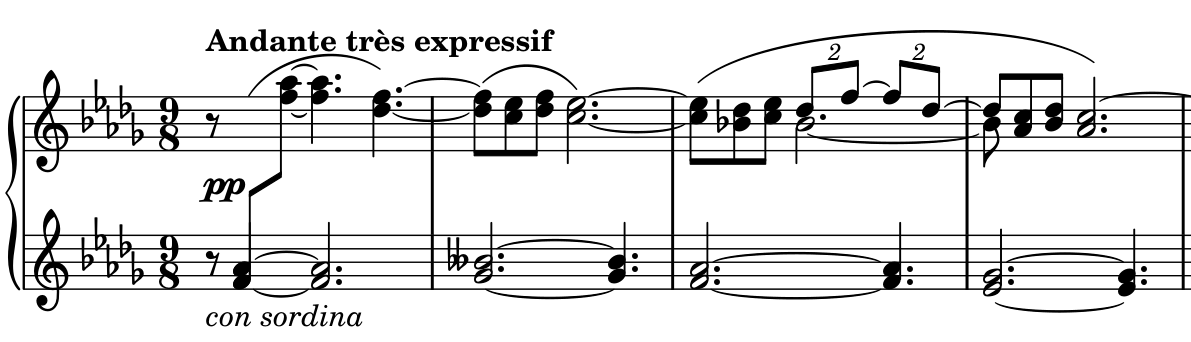
In the first large beat, hear three places: the rest, the lower pair, then the upper pair. The tied upper sound continues through the next beat.
Start by playing the upper melodic notes alone. Hear the A-flat moving towards F and then onwards into the next bar. Restore the lower notes of the pairs, keeping that same line in your ear. When every note has equal prominence, the opening can sound like a succession of chords with no voice leading through them.
The lower sustained notes also need space. Listen to what remains after an attack: the sound decays, while your attention continues towards the next melodic note. Adding more weight to each new chord can make the phrase grow unintentionally. Try a quieter supporting part before making the melody increasingly loud.
At a soft dynamic, simultaneous notes should still begin together unless an arpeggio is indicated. An accidental spread changes the timing and colour of a chord. Practise a single pair at a comfortable volume, then reduce the sound while keeping its arrival coordinated. The guide to melody within piano chords develops that balance in more detail.


One-to-one classical piano
In person in Ikebukuro or Shinjuku, Tokyo. Online worldwide.
Enea
Concert pianist from Vienna
Pre-launch · Applications open
9/8, ties and duplets
Feel the 9/8 bar as three dotted-quarter beats, each normally containing three eighth notes. In the first beat of the opening, those three places contain the rest, the lower pair and the upper pair. The upper pair then continues through the second beat. Counting only the melody's attacks can hide this underlying spacing.
In slow practice, count the small divisions while holding the tied notes for their full value. Then return to the three larger beats and hear the phrase across them. The aim is to know where the notes belong while allowing the line to breathe.
Bar 3 introduces groups marked with a small 2. These duplets place two equal eighth-note values in the time normally occupied by three. A tied note continues across a boundary here, so the printed groups do not all produce two new attacks. Trace the ties before tapping the rhythm or copying what you remember from a recording.
This is one reason a free-sounding performance needs a clear rhythmic foundation. If a held note is shortened because the pianist loses count, the next arrival may sound hurried. If the spacing is understood first, a small expressive adjustment has a musical purpose.
Tempo rubato: moving through chords
At bar 15, Tempo rubato accompanies a fuller chordal texture. The melody now has more notes beneath it, and the hands must move between shapes while the line continues. The slower surface does not remove the need to prepare those changes.
Play the upper melody alone, then add the bass notes. Listen to the movement between those two lines before restoring the middle notes. This reduction shows where the phrase is going and which chord changes deserve attention. It also prevents the internal notes from becoming equally strong simply because they are harder to place.
Choose a short succession of chords and find the next shape before playing it. Then remove the preparation pause and hear the succession in rhythm. An individual chord can feel comfortable while the route from the previous one remains awkward; practise that route as part of the phrase.
The written arpeggios in bars 25–26 bring a different kind of arrival. Listen to the rolled chord as one sonority, including the upper note's place in the phrase. Spreading every chord earlier in the section would make this change less distinct. For a span that does not suit your hand, consider the distribution between hands and the musical timing with a teacher.
Un poco mosso: bass, melody and arpeggios
Bar 27 changes the texture. The melody sits above groups of six sixteenths, each group filling one dotted-quarter beat. The bass moves through D-flat, F and A-flat in the first bar. Above those bass notes, the broken chords climb into the middle of the keyboard.
Clair de lune, bars 27–28. Un poco mosso.
Scroll sideways to read the score.
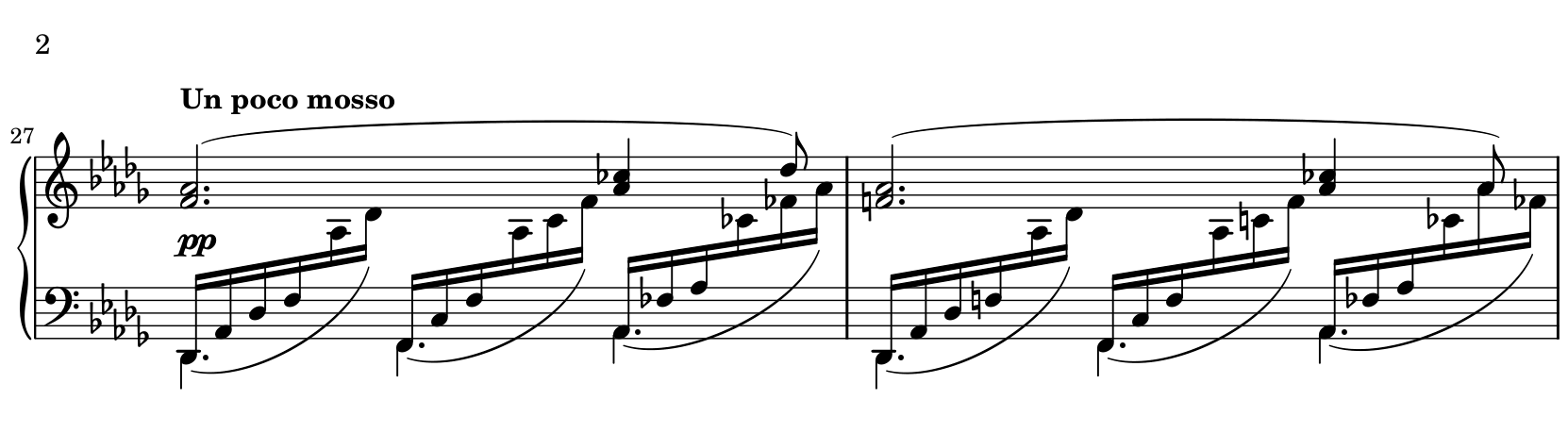
Hear the melody with D-flat, F and A-flat in the bass first. Then add the arpeggios, including the move back down to the next bass note.
First play the melody with the three bass arrivals, leaving out the moving notes. Hear how the harmony changes under the held melody. This gives you the outline of the bar before the arpeggios fill it. The bass should support the phrase without becoming three heavy accents.
Next practise the first rising group through to the bass note that begins the following group. The return down the keyboard is part of the movement. Stopping at the top of every arpeggio practises only the ascent and leaves the next bass arrival unprepared.
The notes span more than a fixed hand position. Allow the hand to travel through the group, and work out a consistent distribution where the parts share the middle register. Beams crossing between the staves show the line continuing through registers; the printed staff alone does not settle every practical choice of hand.
Now add the melody. Its first pair of notes lasts two large beats, while the lower part continues moving. Listen for that sustained sound above the first two arpeggio groups. If each new moving note takes over, reduce the accompaniment and hear the long melody again.
The final group in bar 27 introduces F-flat and C-flat. Read them as part of the harmony instead of treating every rising group as the same familiar chord. In the following bar, the accidentals and their cancellations need fresh attention. Similar-looking patterns are one of the places where memorising only a hand shape can become unreliable.
This passage is a useful readiness test because several tasks meet at once: reading the harmony, moving through space, returning to the bass and keeping the upper line audible. Work on a small portion and notice which of those tasks absorbs most of your attention.
Pedal: hearing the changes
The sustain pedal helps this music resonate across wide distances. Its use depends on the harmony, the register and the instrument's response. A fixed rule such as changing once per bar would overlook the changes within bar 27; changing at every moving note would fragment the sonority.
Play the bass and melody reduction with pedal, listening at each change of harmony. Then add the arpeggios and compare the result. The moving notes introduce more resonance, so a pedal choice that sounded clear in the reduction may need adjusting in the complete texture.
When the sound becomes cloudy, listen for what is being carried over. Is an earlier bass still dominating? Are inner notes obscuring the melody? A clearer change of pedal may solve the overlap, while a lighter accompaniment may solve the balance. These are different things to hear in the same passage.
Practising a little without pedal reveals the attacks and releases. Return to the pedalled sound while those details are still in your ear. Sustain pedal and clear harmony explains this listening process with a simpler score example.
The animated middle and the return to calm
At bar 37, En animant brings a change to C-sharp minor and a more animated character. D-flat and C-sharp share a piano key, but the new key signature changes how the whole passage is read. Check the melody and bass in this spelling before relying on a movement learned from the preceding bars.
The writing also moves into a higher register, with octave signs affecting the sounding pitches. Mark where each octave sign begins and ends in your working score. The shape on the staff can stay familiar while the hand belongs elsewhere on the keyboard.
As the passage grows, preserve the hierarchy of sound. A crescendo in the melody and bass can lose its effect if the moving inner notes grow even more. Try the main lines alone at the intended intensity, then restore the inner motion at a supporting level.
The Calmato at bar 43 returns to five flats and a quieter texture. Practise arriving there from the preceding music. An abrupt stop followed by a carefully placed quiet chord can make it feel like a restart. Hear how the previous phrase settles, then let the new sound continue from that point.
The theme returns differently
At bar 51, a Tempo 1º brings back the opening idea, marked ppp. Its return is higher, and rising accompaniment figures now precede and support it. Familiarity with the opening melody helps, but the timing between the layers has changed.
Clair de lune, bars 51–54. A tempo 1º, ppp.
Scroll sideways to read the score.
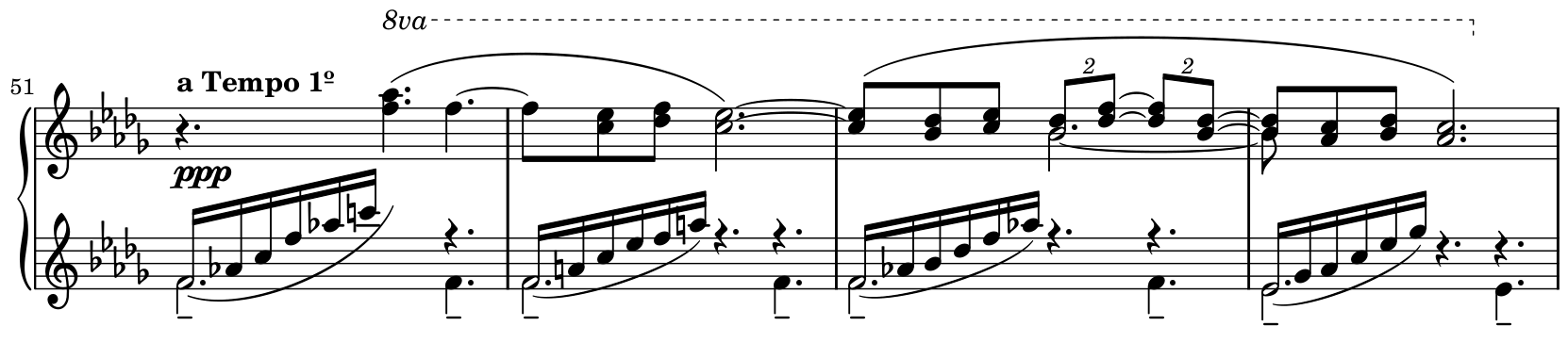
The accompaniment starts before the melody. Compare this dotted-quarter rest with the shorter rest at the very beginning of the piece.
Compare the first bar of the piece with bar 51. The opening begins with an eighth rest and the lower pair; bar 51 gives the melody a dotted-quarter rest while the accompaniment rises. The melody therefore has a different entrance to hear and prepare.
Play the returning melody alone, then add the first accompaniment figure and listen for the point where the melody enters. Keep the accompaniment's sound beneath that arrival. At ppp, an accompaniment note that would be harmless at a louder dynamic can become disproportionately prominent.
The return also asks for changes in the colour of repeated material. Hear it after the intensity of the middle section. The same melodic shape now belongs to a different part of the piece's overall arc. A softer sound can still have a clear direction towards the next note.
The final fading figures
At bar 66, Debussy writes morendo jusqu'à la fin: dying away to the end. Flowing figures continue underneath a sparse upper part. Their sound must recede while their timing and notes remain dependable.
Clair de lune, bars 66–68. Morendo jusqu’à la fin.
Scroll sideways to read the score.
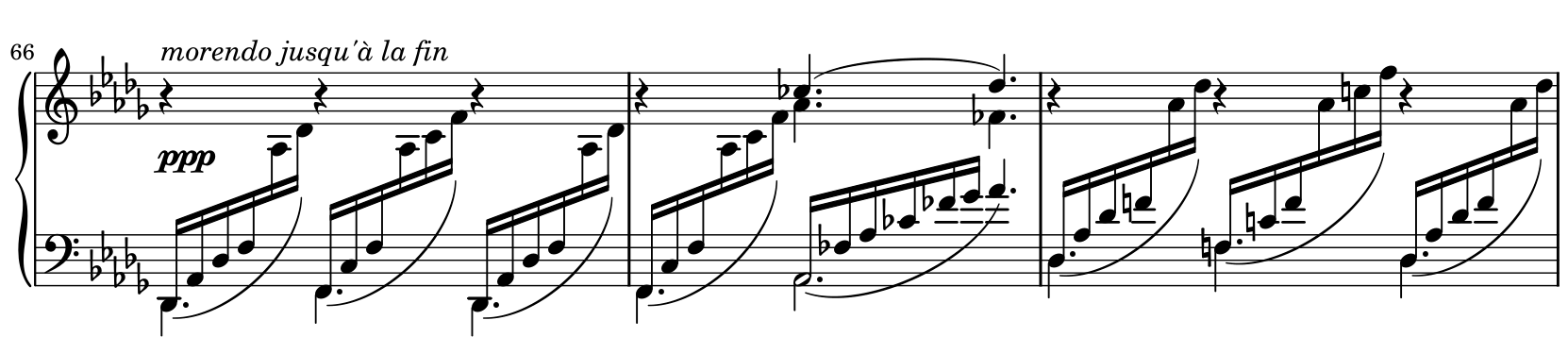
Keep every moving note present as the sound recedes. Listen through each ascent to the next bass arrival, then continue to the final harmony.
Practise one group of moving notes at an ordinary quiet level first. Then make it softer, listening for whether all the notes still speak. If a note disappears or arrives late, return to the level where the movement is reliable and reduce the sound more gradually. Quiet playing still needs a definite contact with the keys.
Hear the next bass note while the current group is rising. As the sound fades, a late bass arrival or an unexpectedly loud top note becomes particularly noticeable. The hand's journey remains active even though the sonority is withdrawing.
Finally, include the last harmony and its release in your practice. Listen after the last attack, and decide how the sound leaves the room. Stopping practice at the end of the moving notes leaves the conclusion of the piece unexplored.
A useful learning order
Begin by sampling the opening, bar 27 and the ending at a manageable speed. If the notes and rhythm are readable and a short passage becomes steadier with focused work, there is something to build on. If every layer requires a separate explanation before you can hear a phrase, a shorter piece that develops one of those skills may be a better current project.
When you do begin the complete work, give the arpeggio passage attention early. Work on the opening and its later return alongside one another so that their differences stay visible. Bring the chordal section into the plan before polishing the opening for weeks. Its movement between shapes and its approach to the flowing section deserve their own practice.
Join sections by playing across their boundaries. Enter Un poco mosso from the fading rolled chords, reach Calmato from the more animated music, and find the returning melody after the accompaniment has begun. Those connections are part of the musical learning, even when each individual passage already works.
There is no single practice time that predicts when the whole piece will be ready. Look for audible changes: a melody that survives the full accompaniment, a bass return that no longer disturbs the pulse, a quiet ending whose notes remain present. Those changes tell us what the next lesson should address.
Vienna Piano School is accepting applications for English-language lessons online worldwide and in person at piano studios in Ikebukuro and Shinjuku, Tokyo. The school is preparing to launch, with start dates and trial arrangements confirmed by email. You can apply for a free 55-minute trial lesson to explore a passage from Clair de lune or choose repertoire that prepares you for it.