
Brahms Intermezzo Op.118 No.2: Voicing, Phrasing and Readiness
Brahms’s Intermezzo in A major, Op.118 No.2, is demanding because several musical lines must remain alive inside a quiet, richly voiced texture. The opening asks for a sustained melody above moving inner notes. The middle section adds triplets, a second singing voice and close chordal writing. Later, the familiar theme returns with a changed continuation before the final rise and release.
If you are deciding whether to learn it, try passages from those different textures before committing to the whole piece. If you already play the notes, the next work is often in their balance, length and direction. A beautiful opening alone does not tell us how comfortably the rest will sit under the hands.
Three spans, several kinds of listening
- Bars 1–48Melody, inner voices and a long harmonic journey
- Follow the two-note upbeat into the held melody, then hear how the same small gestures grow across the first section.
- Bars 49–76A changing middle section
- Triplets and two singing voices at 49; quieter chords at 57; a returning dialogue at 65 and a pause before the theme.
- Bars 77–116The return and its changed ending
- Compare the familiar beginning with its new continuation, then hear the final rise and the release of the last chord.
The opening upbeat is outside bar 1. Bars 49–56 repeat; the repeated playing does not change the written bar numbers.
Readiness for the complete piece
I would look for a pianist who can follow more than one voice, hear when pedal clouds a change of harmony, and keep a phrase moving through a difficult hand position. Fluency in faster pieces is useful experience, but these are the skills that the Intermezzo tests most directly.
Three short passages reveal different parts of that readiness:
- Opening upbeat through bar 5: can the melody remain audible while the notes below it move, and can you continue through the rolled chord without losing the pulse?
- Bars 49–52: can you place two ordinary eighth notes against three triplet eighths, then hear the left hand’s upper line inside the triplets?
- Bars 57–60: can the quiet chords connect while their individual notes keep different lengths and the hand changes position?
Read them slowly enough to hear what is happening. The useful distinction is between a passage that needs learning and a texture whose separate layers are still difficult to understand. Finding an unfamiliar chord is ordinary score work. Being unable to keep any one voice steady when another enters suggests a foundation to develop first.
A teacher can also assess the actual spans and fingerings against your hand. A large printed chord may have a workable distribution between the hands; a seemingly small chord may be awkward because one finger must keep a note while the others move. The surrounding music determines the practical difficulty.
The opening melody
The two-note upbeat, C♯–B, leads to a held D in the first full bar. That arrival is the beginning of a longer thought. While the melody stays on D, notes underneath it continue moving. A performance can have all the correct pitches yet lose its line if those new attacks cover the sound of the held note.
Upbeat and bars 1–5. A major, 3/4. Treble clef above, bass clef below.
Scroll sideways to read the score.
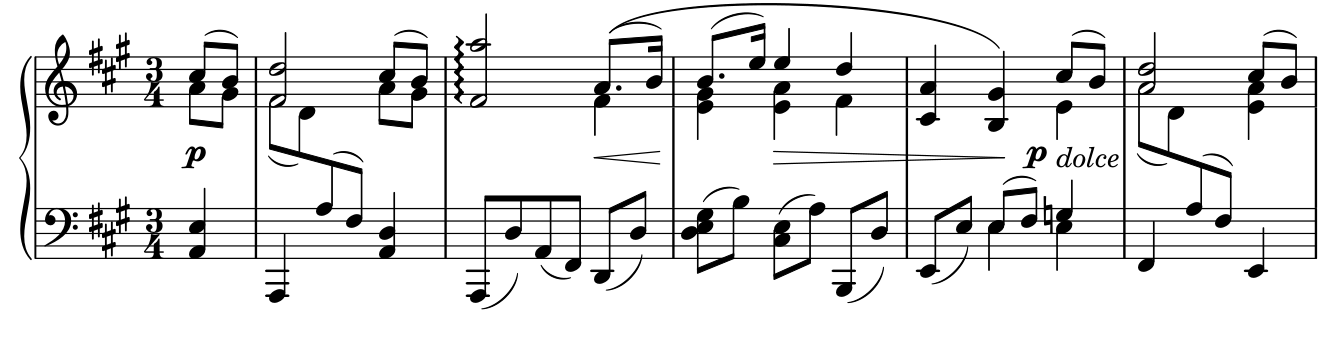
- Melody
- C♯–B leads to the held D. Listen through that long note towards its continuation.
- Inner voice
- The notes below it move across the staves. Trace their own line and releases.
- Bass
- Hear the lowest notes as the support and harmonic direction of the phrase.
Play the upper melody alone from the upbeat through bar 4, keeping its written lengths. Listen to the larger rise to the high A in bar 2 and the continuation after it. The first D and the higher A occupy different places in the phrase. Giving each long note the same swell-and-fade treatment would make those places sound interchangeable.
Now add the lowest bass notes, leaving out the middle texture for this comparison. Hear how the melody feels against the bass, and where the harmony seems to lean forward or settle. Once that relationship is in your ear, restore the inner notes at a level that preserves the line you just heard.
I often listen to what happens just after a beautiful melody note has sounded. On the piano, that note begins to decay. A forceful accompaniment attack a moment later can cover it, even though the melody was louder at the instant of its own attack. The balance has to last through time, not only at the first chord.
Keep the top note alive in your attention while the other fingers move. Pressing harder into a key that is already down will not make its sound grow. Shape the approach to the note, choose its initial sound, and leave space around its decay. For a more concentrated study of that control, see bringing out a melody inside piano chords.


One-to-one classical piano
In person in Ikebukuro or Shinjuku, Tokyo. Online worldwide.
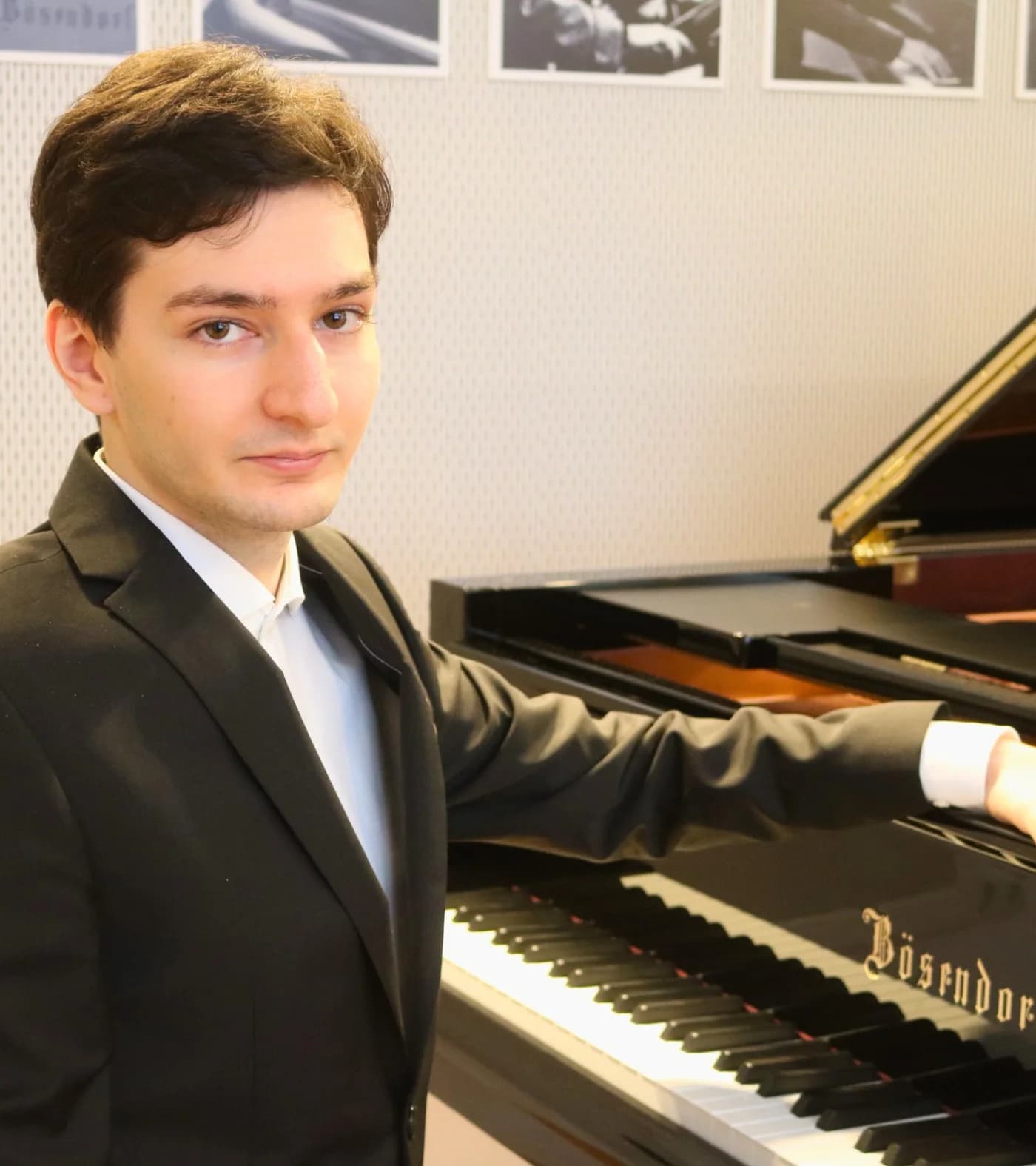
Enea
Concert pianist from Vienna
Pre-launch · Applications open
Inner voices and the hands
The moving notes below the opening melody cross between the staves. Read the stems and beams before deciding that every upper-staff note belongs to one musical role and every lower-staff note to another. Two hands can share the work of sustaining several lines.
Try the inner line alone through the first bar, then play it with the melody. Notice which notes continue and which are released. If every change below the melody causes its finger to lift as well, reduce the passage to just the held melody note and the first moving inner note. Restore the rest after those two actions are distinct.
That small comparison is especially revealing without pedal. You can hear whether a written held note actually continues and whether an old inner note is being carried too far. Then add pedal for the resonance of the complete texture. Finger duration and pedal support should agree about which sounds remain.
Fingering choices belong to the phrase. Test a proposed fingering through the next change of position, including any repeated melody notes. A fingering that reaches one chord easily but leaves the hand stretched and fixed for the next one is unfinished. Where a held note makes the movement awkward, consider a quiet finger substitution or a different division between the hands with a teacher.
Brahms’s arpeggio signs also deserve their own attention. In the rolled chord in bar 2, the upper note needs to arrive as part of the phrase. Compare a compact roll with a broader one at your chosen tempo. Listen to whether the melody continues naturally or seems to wait while a separate flourish happens below it.
Longer phrases in the first section
The opening gesture returns in several forms before the middle section. Its familiarity can encourage a habit of shaping every recurrence in exactly the same way. Instead, listen to the harmony and to how far the next continuation travels.
Bars 1–4 and 5–8 make a useful first comparison. The same two-note upbeat begins both spans, but the continuing melody and its support change. Play their endings before returning to the beginnings. Hearing the destinations gives the repeated gesture a reason to move differently.
Further on, the texture becomes more closely woven. Around bars 17–24, repeated melodic gestures are supported by changing inner notes and bass. Keep track of the moving line rather than treating the page as a succession of chord shapes. In bars 25–28, longer melody notes again need room above the inner movement, but the harmonic route has moved away from the sound of the opening.
The later descent and calando around bars 31–34 bring another colour. Let the sound recede with the phrase while preserving the notes that lead into what follows. If all the energy disappears before the next entrance, the listener hears a stop instead of a change in expression.
By bars 39–48, the recurring gestures are working towards the close of this large first span. Listen to the build and the gradual settling into the più lento ending. Practising the entire approach to bar 48 occasionally keeps this from becoming a collection of individually expressive four-bar fragments.
Pedal and harmonic colour
The bass can change beneath a long melody note, and an inner chromatic note can alter the harmony while the bass remains. Pedal decisions need both kinds of information. Changing at every bar line or every new bass note is a starting observation, not a complete reading of this texture.
Choose a short passage and play its melody and bass without pedal. Then restore the inner voices and listen for the particular notes that colour each harmony. Add pedal while keeping those changes audible. If one new harmony seems to contain the whole previous chord, the old resonance needs more clearing.
A clean change can still preserve a singing line. Hold the notes that should continue with the fingers, sound the new harmony, then lift and lower the pedal so that unwanted sound clears. On a resonant grand, a shallower pedal or more frequent partial clearing may suit a passage that sounds dry on an upright. Judge the result from what reaches your ear.
Some dissonances belong to the written voice leading. They create the desire for the next chord. Distinguish that expressive friction from an accidental mixture of notes that should already have ended. The guide to using sustain pedal without blurring the harmony gives simpler listening comparisons for that distinction.
The triplet middle section
At bar 49, the texture changes: the left hand has triplet eighth notes, while the right hand uses ordinary eighths and longer notes. The opening of the melody rises from C♯ to F♯, and another voice appears within the left hand’s moving notes.
The repeat begins at bar 49. The key signature retains three sharps; the new passage centres on F♯ minor. Treble and bass clefs, 3/4.
Scroll sideways to read the score.
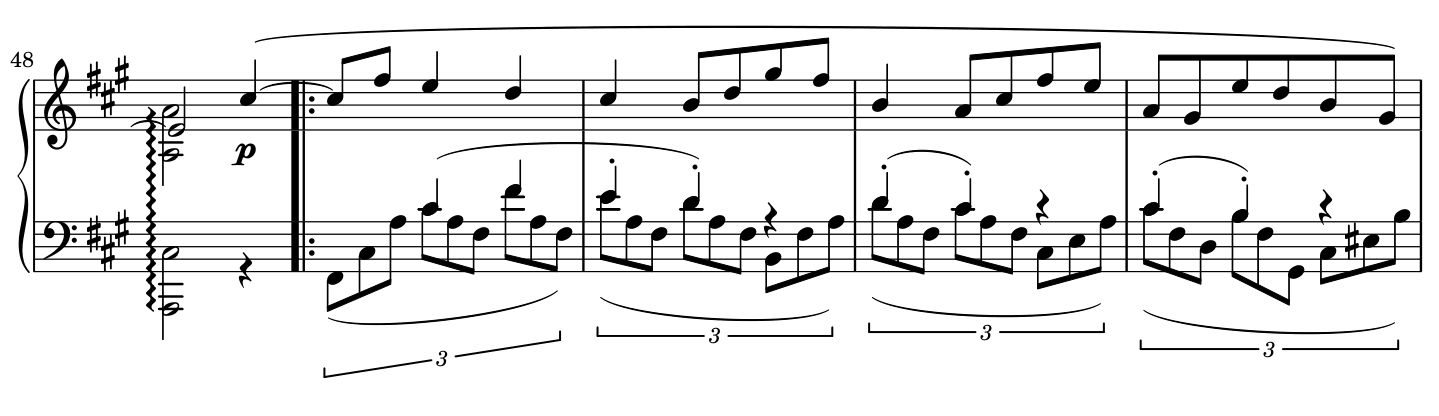
- Shared pulse
- Each quarter-note beat contains two ordinary eighth notes or three triplet eighths.
- Left-hand line
- Listen to C♯–F♯–E–D across bars 49–50 as a phrase inside the moving notes.
Start with the first quarter-note beat of bar 49. Divide that beat into six equal units. The triplet attacks fall on 1, 3 and 5; the two ordinary eighth-note positions are 1 and 4. In this bar the right-hand C♯ is tied from the preceding note, so you hold it through the start of the beat and sound F♯ on the second eighth-note position. That tie is part of the coordination.
Tap the two divisions, then play the written notes into the following beat. Once their positions are clear, hear one shared pulse with two different subdivisions. Continuing to count six tiny units throughout the passage can make both lines stiff; the counting has done its job when each voice can move within the larger beat.
Next, take out the left hand’s upper line. Across bars 49–50, listen to C♯–F♯–E–D. Its separate stems distinguish the voice from the surrounding triplets. Sing that line, play it alone, then return the accompanying notes around it. The left hand has a phrase to deliver as well as a pattern to maintain.
When the right hand returns, listen to the relation between the two voices. They need space to answer and overlap. Making every high note in the left hand loud would produce a new series of accents; letting those notes disappear would remove the dialogue. Their weight and length belong to the line.
Bars 49–56 repeat. Include the end of bar 56 and the return to 49 in your practice, then separately play into bar 57. The same approach has to lead convincingly to two different continuations: another statement of the triplet passage, and the quieter chordal section.
Quiet chords, bars 57–64
The più lento passage begins at bar 57. After the moving triplets, its closer chordal texture can seem easier to place. It is less forgiving of uneven chord balance. A middle note that sounds too prominently can briefly replace the intended melody.
From the più lento passage that starts at bar 57. Treble and bass clefs, 3/4; read the written accidentals as well as the three-sharp signature.
Scroll sideways to read the score.
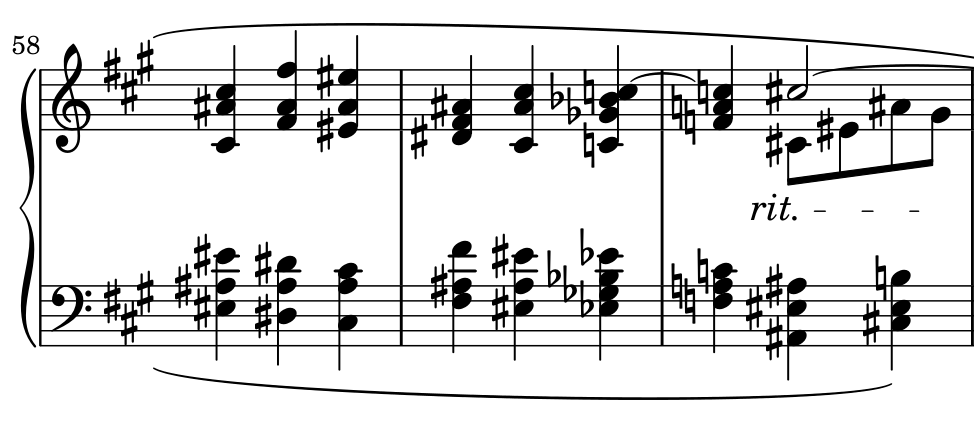
- Across the bar line
- A tied upper note continues while the notes underneath change.
- Within one hand
- In bar 60 the inner eighth notes move beneath the held C♯. Keep the sustained voice audible.
Play the top line through bars 57–60, then the lowest line. Add the other notes while keeping those two paths in your ear. Read the accidentals as changes in individual voices, rather than memorising a new hand shape for every chord. Several notes move by small distances even as the overall colour changes markedly.
At the end of bar 59, the upper C♮ is tied into the first quarter of bar 60. It then moves to C♯, which lasts a half note. Under that held C♯, an inner line continues in eighth notes. This is the opening problem in a different texture: the hand must keep one sound while allowing another to move.
Try that bar without pedal to establish the note lengths. With the pedal restored, listen for the inner movement inside the continuing upper sound. A large swell on every new inner note would interrupt the stillness; an indistinct wash would hide the movement altogether.
The phrase comes to a pause in bar 64, then Tempo I at bar 65 brings back a more flowing texture. The contrast needs a living pulse on both sides. Let the quieter passage breathe, and hear the next beat before starting the returning movement.
Dialogue and the thematic return
In bars 65–68, the right hand has rests while a line rises through the lower texture. Those rests make room for another entry; they are part of the conversation. Follow the line through the space rather than treating the right-hand gaps as empty time.
The music gathers intensity around bar 69, then the approach through bars 73–76 leads towards the return of the opening theme. Practise that whole connection at a moderate sound level first. The timing of the entries should explain the phrase before a large crescendo is added.
The familiar upbeat comes at the end of bar 76; bar 77 begins the returning theme. A major, 3/4. Treble and bass clefs.
Scroll sideways to read the score.
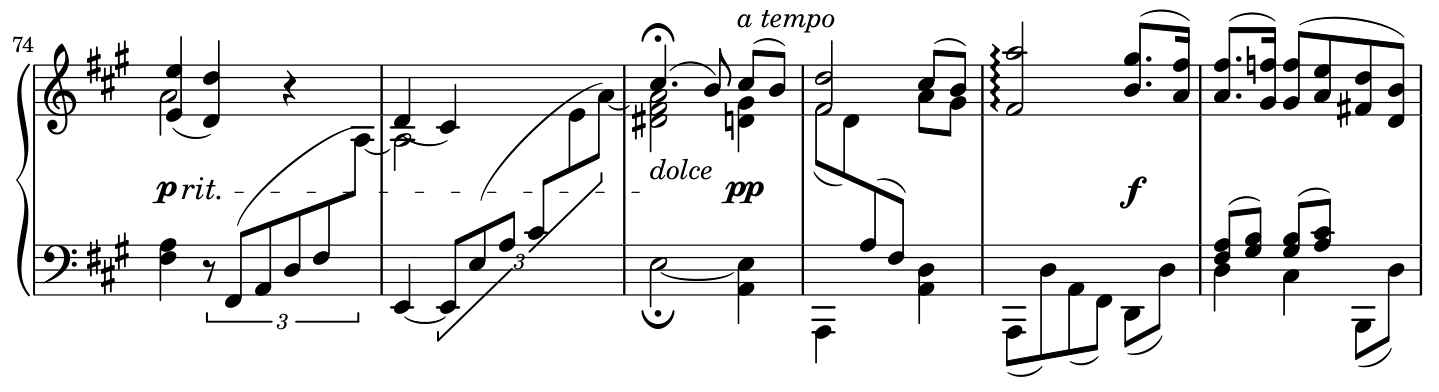
- After the pause
- Feel where the upbeat is going before playing its first note.
- Beyond recognition
- Compare bars 78–79 with bars 2–3: the continuation takes a new route.
After the fermata in bar 76, the familiar C♯–B upbeat leads into bar 77. Prepare the pulse silently before sounding it. If the first note begins without an idea of the bar ahead, the second can become an anxious correction of the tempo.
Compare bars 2–3 with bars 78–79. The rolled chord is familiar, but the following upper line takes another route and the stronger dynamic gives it a new intensity. Mark that continuation in your score if the hands repeatedly slip back to the earlier version. Memory needs the change of harmony and phrase, as well as the physical pattern.
Later in the return, passages that resemble the first section acquire different inner details. Reading those details keeps the return fresh and helps secure memory. At a restart point, name the melody entry, the bass and the harmony you are expecting before playing. A location in the music is more reliable than “the bit my hands know after this chord.”
The final rise and release
The closing phrase is worth learning early in the project. It asks for the same control of layers as the opening, but now the crescendo, rising bass and later slowing have to belong to one long motion.
A major, 3/4, with the closing partial bar. Treble clef above, bass clef below.
Scroll sideways to read the score.
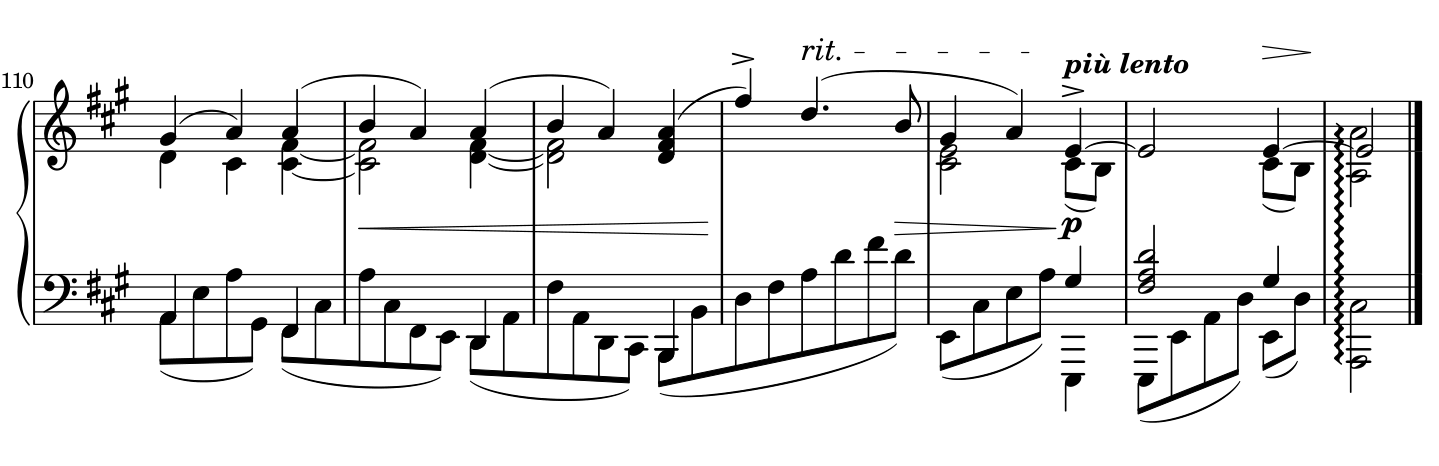
- The crest
- The bass rises into the melody's arrival; hear the whole approach.
- The end
- Follow the remaining inner movement and the rolled final chord before releasing the resonance.
In bars 111–113, the growing sound leads to the upper F♯ and the left hand’s rising arpeggio. Hear that destination from the beginning of the approach. Reaching the loudest sound too soon leaves little room for the arrival; saving all expression for the top note makes the approach feel neutral.
The following ritardando and più lento bring the sound down towards the end. Keep listening to the inner movement beneath the sustained upper E. The phrase continues after its main rise, and those remaining notes need an audible direction of their own.
For the final rolled chord, choose a pace for the roll that belongs to the slowing phrase. Hear the bass, the arrival of the upper sound and the resonance that follows. Release the pedal after listening to the completed harmony, rather than letting the end happen automatically when the fingers stop moving.
Preparation when a texture is difficult
If the opening melody disappears whenever other fingers move, spend some time on a simpler chordal phrase. Establish a clear upper line at a comfortable dynamic, then reduce the accompanying notes. Transfer that relationship back to one bar of the Brahms. More repetitions of the complete opening will not by themselves teach the hand which sound matters.
If the triplets repeatedly pull the right hand into their rhythm, work on the 3:2 relationship on single notes before restoring the passage. Then add its tied entry and the following beat. The aim is to keep the same coordination when musical context returns.
If reading the chordal middle section consumes all your attention, learn its top line and bass before filling in one inner voice at a time. Each addition should leave something you can still hear and follow. A shorter piece can support this work alongside the Intermezzo; choose one that develops the particular skill you are missing, using the criteria in choosing a classical piano piece at the right level.
Working on Brahms in lessons
For an interpretation lesson, bring the score and a passage whose sound troubles you. A useful starting point might be a melody that fades too soon, a pedal change that breaks the phrase, or an inner voice that becomes heavy when you try to hear it. We can compare the full texture with selected voices, test a fingering or balance change, and return immediately to the phrase.
Vienna Piano School is accepting applications for piano lessons in English, online worldwide and in person at piano studios in Ikebukuro and Shinjuku, Tokyo. You can apply for a free 55-minute trial lesson to work on the Intermezzo or discuss a suitable path towards it. The school is preparing to open; start dates and trial arrangements are confirmed by email.