
Piano Practice Away from the Keyboard: A Score Exercise
You can practise part of your piano piece without a keyboard: read a short passage, hear its rhythm and melody, follow the bass, and decide what to test when you next play. The useful result is a clearer idea of the music. Touch, balance and pedal still need the sound and resistance of an instrument.
I find this work most valuable when the question is small. “Study the score” is a vague instruction. “Does that note last as long as I have been playing it?” gives your eyes and ears something to investigate. A few attentive minutes can uncover a detail that has passed unnoticed during many repetitions at the piano.
Below, Mozart’s familiar theme from the Twelve Variations on “Ah, vous dirai-je maman”, K.265, provides a short example. You may know the tune as “Twinkle, Twinkle, Little Star”. That familiarity is useful, but it also creates a trap: the tune in your memory can replace the notes on the page.
Choose a passage you can already hear
Start with four or eight bars from a piece you have played or heard clearly. An entire unfamiliar movement asks you to solve too many things at once: pitch, rhythm, texture and structure. A familiar phrase lets you notice what you have been overlooking.
Keep the task connected to your current playing. Perhaps the end of a phrase always feels rushed, or you lose your place when the opening returns. Take that passage with you, together with a pencil or a way to add a brief note to your score. The aim is to return with one useful discovery, not a page covered in markings.
Three questions give the session a direction:
- What does the notation actually ask me to play?
- What can I hear beneath the melody?
- What will I check at the piano afterwards?
If a pitch or rhythm is uncertain, mark the exact place. Trying to imagine an entire phrase while guessing its notes tends to hide the point that needs attention. A question beside one bar is more useful than a confident but inaccurate mental performance.
The remembered tune and the printed tune
Look at the opening eight bars below before using the recording. The melody begins C–C, G–G, A–A. Now look at bar 4. Mozart writes two Gs, each a quarter-note, where a familiar sung version may leave you expecting one longer G.
The difference matters even away from the instrument. Two notes require a second beginning within the bar. Hear that repeated G as part of the phrase, keeping the pulse moving through it. Simply recognising the melody would not reveal whether you had read that detail.
Scroll sideways to read the score.
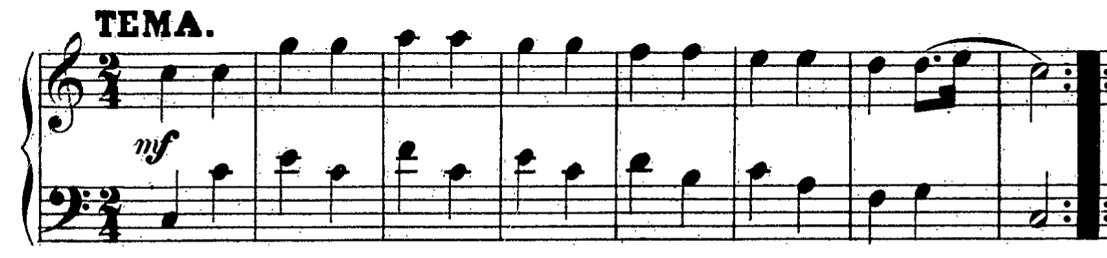
The end of the phrase deserves an even closer look. In bar 7, the right hand has a quarter-note D, then a dotted eighth-note D and a sixteenth-note E. Bar 8 arrives on a half-note C. There are still two quarter-note beats in each bar, but the second beat of bar 7 contains unequal subdivisions.
Say or tap that rhythm slowly while following the notes. Keep the first D for one beat; the next D takes most of the second beat, with E at its end. Then let C occupy the whole following bar. The little E is easy to omit when you are singing the childhood tune instead of reading Mozart’s version.
Check three details
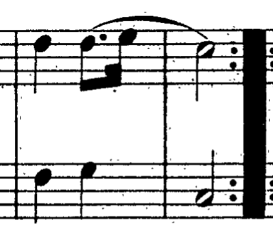
Are the two Ds in bar 7 the same length?
The first is a quarter-note: one beat. The second is a dotted eighth-note: three quarters of a beat. The final E is a sixteenth-note; those last two notes share beat 2.
How long does the C in bar 8 last?
It is a half-note, lasting two quarter-note beats: the whole bar.
Where is the second left-hand C in bar 1?
An octave above the first. The right hand repeats its C while the left hand moves.
This is the kind of reading I want to take back to the keyboard. You have identified a particular repeated note and a particular rhythmic detail. The next playing attempt can test them immediately. General concentration has become an audible choice.
Hearing a phrase without playing it
Choose a comfortable pulse and follow the melody with your eyes. Sing it quietly if the situation allows, or hear the contour internally: the opening repetition, the leap upwards, the higher pair of notes and the descent. Keep long notes moving through their full duration rather than mentally jumping to the next event.
The phrase should have a direction as well as correct pitches. Imagine where it gathers energy and where it settles. Try two versions of the approach to bar 8: one that hurries the final E and one that places it within the pulse. At the piano, you can decide which imagined version you actually produced.
Internal hearing varies with how well you know the music. When the sound becomes vague, shorten the passage or sing a few notes aloud later. Use an instrument or the recording to establish the uncertain sound, then try again without it. The melody-by-ear exercise offers a related way to connect a small musical idea with what you hear.
Avoid spending the whole session naming notes. Naming is useful when a symbol is uncertain, but a phrase also has duration, movement and character. Once you know the pitches, return to hearing how they belong together.
The left hand has a line too
Now follow only the bass staff. In the first bar, the left hand plays C and then the C an octave above. Both are quarter-notes. The hand moves while the melody repeats its opening note. Already, the two staves contain different kinds of motion.
Trace the next few bars without trying to imagine every sound at once. Notice the rise and fall of the left-hand notes and where their register changes. Sing the melody while tapping the left hand’s two beats on the table. Then follow the left hand while recalling the tune above it. This shifts your attention towards a part that can become automatic at the keyboard.
The score can tell you which notes coincide; it cannot tell you whether your accompaniment is covering the melody in the room. That becomes a playing question: can you hear the tune clearly while the left hand keeps its shape? Write that question beside the opening rather than deciding, in silence, that the balance is already right.
For another piece, the useful detail might be a held bass under changing chords, an inner voice or a rest. Choose the part your ear normally ignores. You will often learn more from four bars of that line than from silently replaying the familiar tune for a tenth time.
Finding the return
The complete theme below has 24 written bars, before taking the repeats. The opening melody returns at bar 17. Find the two Cs in the right hand and the octave movement in the left, then look backwards at the bar that leads into them. Hear the return emerging from that approach.
Scroll sideways to read the score.
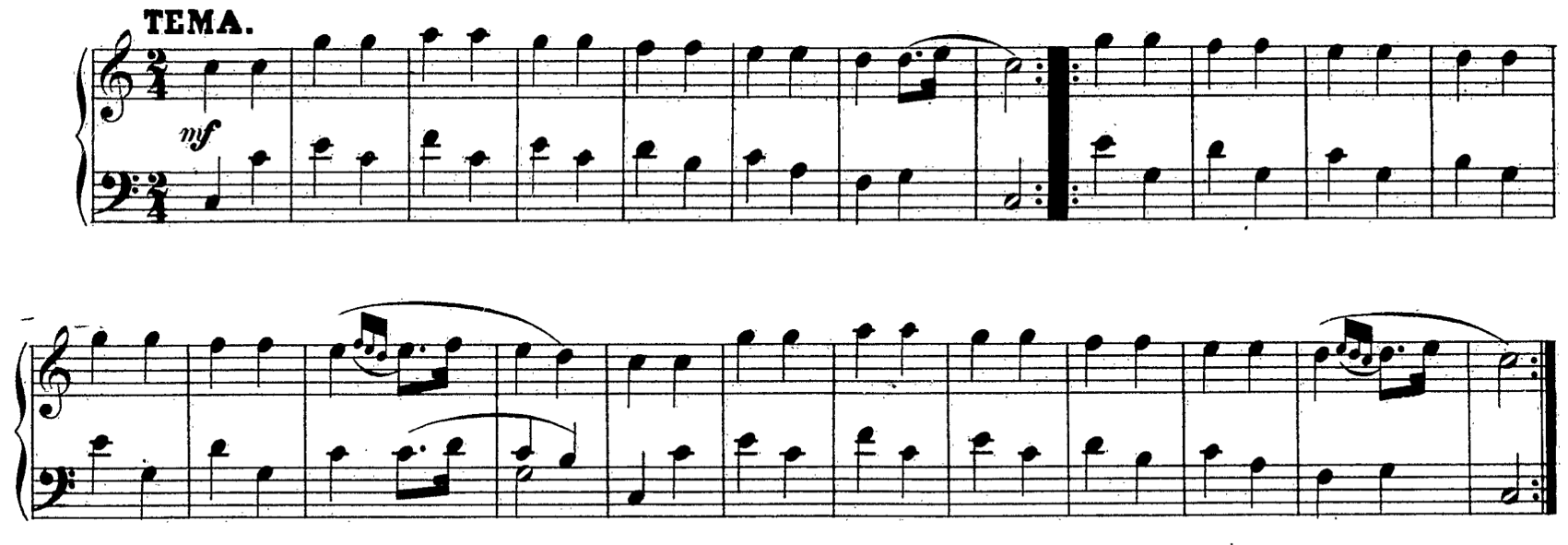
- Bars 1–8
- The opening section. Repeat from the beginning.
- Bars 9–16
- The next section begins on G–G.
- Bars 17–24
- C–C returns. The final repeat goes back to bar 9.
Notice the repeat signs too. The sign at the end of bar 8 takes you back to the beginning. The last repeat takes you back to bar 9. Trace those routes with your eyes once. Page layout and musical structure are different things: the second printed line begins at bar 13, partway through the section.
For your own piece, mark a few landmarks that have a musical identity. “Opening melody returns” tells you more than “second line”. Add the note or bass movement that announces the return. When you practise later, start a bar or two before the landmark so that the approach becomes familiar as well.
A map is useful when it changes how you hear or practise the passage. A beautifully coloured score that you cannot follow through the repeats has not yet solved the reading problem.
Listening with a question
Walter Gieseking’s recording below begins with the theme and continues into Variations I and II. Follow the theme with the score, listening for the repeated G in bar 4 and the small rhythmic turn towards C in bars 7–8. Let the recording establish the sound, then pause it and try to hear those bars again for yourself.
Gieseking: K.265, theme and Variations I–II
Warner Classics / Parlophone. Listen on YouTube.
On another hearing, give the bass your attention. Afterwards, describe one thing you noticed without replaying the track immediately. You might remember the octave in the opening bar or the movement into a phrase ending. That recollection gives you something to compare with the score.
Listening continuously while reading can be enjoyable, but the recording also carries the pulse and supplies every next note. Briefly turning it off reveals what you can follow independently. Keep the experiment short enough that you are hearing music rather than struggling to recall a long sequence.
Back at the piano
Begin the next playing session with the passage you studied. Before touching the keys, recall the sound you intended. Then play slowly enough to hear the detail under investigation. In the Mozart example, check the second G in bar 4 and the duration of each note in bar 7, continuing through the C in bar 8.
If the rhythm still changes under your fingers, isolate that bar with a little context on either side. Count or sing it, play it, and compare the two. You may understand the notation while an old playing habit persists. The instrument shows you where the remaining work lies.
Then check something that silent study could only prepare. Can the melody remain clear over the bass? Does your intended phrase ending sound settled, or does the last note receive an accidental accent? Does the fingering let you play the repeated notes with the character you imagined? Listen to the result before adding more markings.
One short recording of your own playing can help with that comparison. Ask a narrow question and listen back once. If you hear the intended change, continue into a larger passage. If not, keep the problem small enough to investigate. The 30-minute piano practice plan shows how this focused work can sit within a broader session.