
Choosing ABRSM Piano Exam Pieces: Lists, Musical Fit and Your Programme

Choosing ABRSM piano exam pieces begins with the route and syllabus: Practical Grades require one piece from each of Lists A, B and C; Performance Grades add a fourth, own-choice piece. Within that framework, choose music you want to explore and can bring to life across the whole programme.
I would rather hear a pianist make something vivid of a well-chosen piece than spend months surviving a selection that never becomes comfortable. The useful question is what each piece asks of your ears and hands, and whether those demands make a good combination. A slow melody can expose more than a page of quick notes.
Start with three things: the valid syllabus, the complete musical task, and the programme you will actually play. This guide uses the 2027 & 2028 requirements, with the transition from the preceding syllabus explained below. The Mozart example belongs to that new syllabus, valid from 1 January 2027.
Practical or Performance?
The repertoire shape of each route
Practical
- AOne piece from List A
- BOne piece from List B
- COne piece from List C
Also includes scales and arpeggios, sight-reading and aural tests.
Performance
- AOne piece from List A
- BOne piece from List B
- COne piece from List C
+ one own-choice piece, which may also come from a syllabus list
Four pieces in one continuous programme, with the whole performance also assessed.
The repertoire lists are shared, but the preparation has a different shape. In Practical, time spent on pieces sits alongside technical work, sight-reading and aural skills. In Performance, four pieces need to hold together as one recorded performance. The comparison of ABRSM piano exam routes explains the wider assessment differences.
List letters give a useful starting point for contrast. A generally favours agility and quicker movement; B invites lyrical playing; C brings a broad range of styles and characters. They are not a rigid division into historical periods. Read the actual entries and listen to the music rather than assuming that every Baroque piece must belong to A, or every modern piece to C.
Browse the full syllabus, too. The graded exam book contains a selection of the listed repertoire, not every option. Another publication may hold the piece that catches your imagination. Note the exact work, movement, list number and edition while comparing candidates; a familiar title can exist in several arrangements of very different difficulty.
The 2027 syllabus transition
The 2027 & 2028 piano syllabus starts on 1 January 2027. Pieces from the 2025 & 2026 syllabus remain available during the overlap, through 31 December 2027. Keep the three set selections within one syllabus. A programme assembled from favourite entries across both editions can fail this requirement even when every individual piece appears somewhere in an ABRSM list.
For a Performance Grade using the old set-piece lists, the recording must be uploaded by 31 December 2027. Recording it before that date is not enough. The fourth, own-choice piece is unaffected by the overlap arrangements, although its other requirements still apply.
If you already have three pieces in progress, compare the remaining musical work with the time available. A syllabus change alone is not a reason to discard music that is developing well within the valid period. For a new programme, beginning from the new list may give the preparation more room. Keep the syllabus years beside the repertoire in your notes so that the decision remains visible when the exam approaches.
Musical fit before an “easy pieces” list
Two pieces in the same grade can suit very different pianists. One may ask for quick changes of position; another for a melody inside chords; another for a pulse that stays alive through rests. Count these demands in the score and hear them at the keyboard before deciding which piece looks easiest.
I listen especially to what happens when a texture changes. A pianist may enjoy a flowing opening, then lose the line when the same idea returns in thicker chords. That change is a better selection test than playing the opening once more. The guide to choosing a classical piece at the right level develops this kind of passage comparison beyond exam repertoire.
Try an opening phrase, a later change of texture and a passage you expect to find difficult. Give each enough attention to understand the fingering and rhythm. A first sight-read often measures unfamiliar notation more than the eventual musical fit; several thoughtful attempts reveal what the work will involve.
Listen for the quality of improvement. Does a useful fingering free the phrase? Does hearing the bass make the harmony intelligible? Or does every repetition demand a new rescue? A demanding passage with a clear way forward can be an excellent learning choice. A programme in which every piece needs a major technical reconstruction is a different commitment.
Slow pieces deserve the same scrutiny. Long notes require a sense of direction, and quiet accompaniment can be difficult to balance. Where pedalling carries the harmony, try the actual changes. Hand span also matters: examine the intervals in context, including what comes before and after them, instead of judging reach from one isolated chord.
Mozart K.265: beyond the familiar tune
In the 2027 & 2028 Grade 5 syllabus, List A15 specifies the theme, Variation I and Variation V from Mozart’s K.265. They form one listed selection. The theme alone does not fulfil it, and the entry does not ask for all twelve variations.
The melody is familiar as “Twinkle, Twinkle, Little Star,” but the variations change the work. These excerpts come from an 1878 edition of the piano score. Looking at the three openings side by side reveals why the complete selection matters.
Theme: the first eight bars
Hear the simple melody and its bass together. The half-note ending closes the first phrase.
Scroll sideways to read the score.
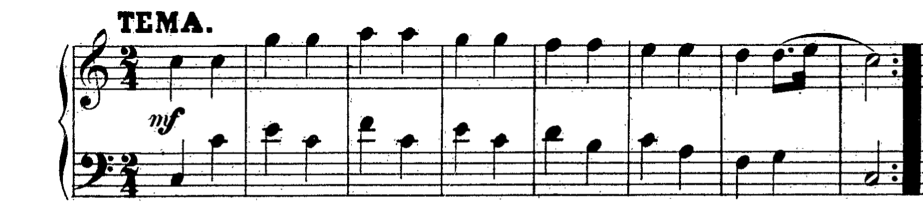
In the theme, let the melody travel through the repeated notes. Each pair belongs to a longer phrase; two identical pitches need not sound like two unrelated taps. Listen to the changing bass beneath them. The ending needs enough time to settle before the repeat or continuation.
Variation I: a moving right hand
The first five bars combine right-hand sixteenths with a quieter bass. Notice the left-hand rests and offbeat entries in bars 4–5.
Scroll sideways to read the score.

Variation I gives the right hand continuous sixteenth notes. Their direction and changing register matter as much as their evenness. Try the first few bars slowly enough to hear the theme’s outline within the figuration. Then bring in the left hand and notice how its rhythmic role changes in bars 4–5. Fluency includes those small interruptions and entries, not only the right-hand stream.
Variation V: the rests are part of the rhythm
The opening eight bars pass attacks between the hands. Keep the two-beat pulse while one hand leaves space for the other.
Scroll sideways to read the score.

Variation V offers a different test. The hands leave spaces for one another, and the texture can lose its buoyancy if the rests are shortened or the entries become heavy. Count the two-beat metre while tapping the attacks away from the keyboard. Return to the piano and preserve that relationship with a light sound.
For selection purposes, the question is whether you want to work on all three qualities: a shaped theme, mobile right-hand figuration and rhythmic exchanges between the hands. Enjoying the tune is a good beginning; the variations tell you what the coming practice will contain.
Hear K.265 with Walter Gieseking
Follow the melody’s outline as the theme gives way to Variation I. In Variation V, listen for the rhythm created by the two hands and their rests. This recording includes the complete set of variations.
Open the recording on YouTubeUse the recording to follow how the theme survives its changes of texture. A complete concert recording includes variations outside the exam selection, so keep your score and syllabus beside you. The aim is to hear the work’s possibilities, then find a tempo and sound in which your own playing stays articulate.
The fourth, own-choice piece
For Performance Grades, the fourth piece is an opportunity to bring a particular musical interest into the programme. It may come from the syllabus lists or from elsewhere. Its standard must be broadly comparable to the grade or higher, and it must have a legible, fully notated score that you follow in performance. ABRSM does not give prior approval for an own-choice selection.
Compare the whole piece with several set works. Look at its reading, coordination, rhythm, tone, phrasing and sustained demands. A popular-song arrangement can be substantial or elementary; the title alone tells you little. A short excerpt from a difficult work may also leave out the very features that make the complete piece demanding.
The own-choice work has a grade-specific minimum duration, and the whole programme has a maximum. For example, at Grade 5 these are one minute and twelve minutes respectively. The syllabus allows an exception to the own-choice minimum if the overall maximum would otherwise be exceeded. Time the programme from its first note to its last, including transitions, and check the figures for your own grade.
I would choose this piece after hearing what the other three already offer. If they all rely on a bright, detached touch, a sustained melodic work could bring a welcome change. If they already demand intensive work on balance and pedal, another piece with the same unresolved difficulty may concentrate the burden. The fourth piece should have a musical reason to be there.
Choosing all four from the lists gives no assessment advantage. Equally, an unfamiliar own-choice title is not a prize for originality. A personal favourite becomes a convincing choice when you can explain its appeal through the playing: the lilt of its rhythm, a particular harmony, or the shape of a melody you want to sing.
Programme balance and order
Contrast comes from the sound, not simply from four different names on a page. Try playing the endings and openings of neighbouring pieces. Does a quiet conclusion leave you ready for the next character? Do you carry the same touch into music that asks for something different? These short joins often reveal more than deciding the order on paper.
The syllabus permits the pieces in any order. For Performance, no more than two selections may be by one composer. A group of movements required together under one list number counts as one selection, as in the Mozart example. Keep those requirements distinct from the artistic question of which order you prefer.
An opener should help you establish the kind of playing you want to offer. The most impressive title may be a poor opening if its first gesture remains unreliable. A closing piece needs enough preparation to retain its character after the concentration spent on the earlier music. Try the proposed last piece after a partial or complete run, and compare it with a fresh attempt.
Watch for a shared demand across the programme. Three pieces with quiet inner parts may appear stylistically varied yet all depend on the same developing balance skill. That is worth recognising while there is still time to reconsider a selection. Conversely, one new technical challenge can sit productively beside music in which your existing strengths already sound convincing.
Editions, movements and repeats
Read every instruction attached to the list entry. “And” may require several movements; “or” offers an alternative. A movement title or number narrows what is being asked. Keep the exact selection in your notes even when the cover of the score uses a shorter title.
Where an entry specifies an arrangement or transcription, use the stated edition. For other works, the listed publication is guidance and another edition is allowed. That freedom is useful with older repertoire, but compare any unfamiliar notation or editorial choices with the musical task you are preparing.
Repeat rules differ by route. In Practical, follow da capo and dal segno instructions unless the syllabus says otherwise; ordinary repeats are generally omitted, apart from very short ones. In Performance, ordinary repeats are generally your choice; da capo and dal segno normally apply, and specific syllabus instructions and the programme time limit still govern. Check the full wording before settling your timings, especially when moving a programme from one route to the other.
For Mozart, this means writing down both the required variations and the repeat plan appropriate to the chosen exam. A recording’s repeats are an interpretation to hear, not a substitute for reading the examination requirements.
A programme worth practising
Put the programme on one page
Record the selection, list number, edition, passage to explore and playing time. Then consider the order, contrast and demands of the programme together.
Download the programme sheet (PDF, one page)Use the sheet to hold the musical reasons beside the formal requirements. “I like this piece” can become “I want to learn how its melody speaks above those chords.” “It looks difficult” can become a named passage and a skill to investigate. Those observations give the preparation a direction beyond finishing the notes.
Once the choices are taking shape, play small parts of all of them during the same practice session. Notice whether each piece draws a different response from you. Return to the proposed programme after a little work and adjust it while the choices are still flexible.
The best selection leaves you interested in the music when the examination is over. You have explored a new texture, learned to hear a line differently, or found a composer you want to keep playing. Those are strong reasons to choose a piece, and good reasons to prepare it carefully.